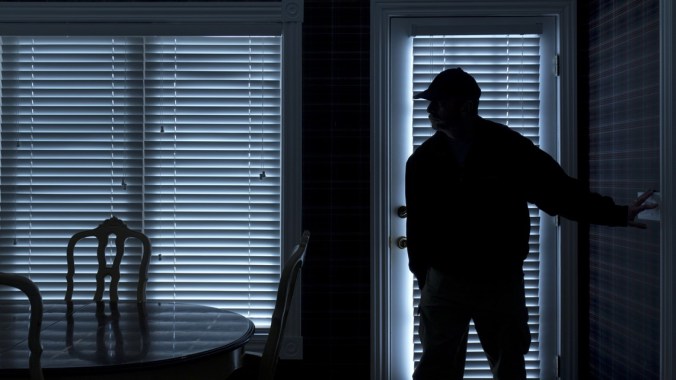
A week ago, early on a Sunday should have been like any other for a Santa Fe, New Mexico family, 34-year-old Teral Christesson, armed with an AR-15 rifle, broke a window and invaded their home. Once inside, he slept, had some beer and shrimp out of the fridge, and took a bath.
When the surprised and alarmed residents returned to their home later to find a stranger with a duffel bag and an AR-15 scoped rifle there, Christesson expressed great embarrassment and apologized profusely. He then gave them $200 to make it all better, or at least to pay for the window he broke. Then he said goodbye, and left.
What a nice young man!
He was arrested the next day when police found Christesson after responding to a report of a man attempting to hijack a car. He reportedly told investigators he still “felt bad” about breaking that window. Now he’s facing charges of aggravated burglary, larceny, and criminal damage to property.
Author Alex McElroy wrote an essay extolling grudges, which whatever he or she is endorses. By way of defining terms, the author writes,
Resentments are best suited for major mistreatment: the best friend who ran away with your wife, the parents who pressured you into a career you told them you hated, the ex who emptied your checking account. Grudges, however, work best in response to small and singular harms and annoyances: the neighbor who parked in front of your driveway, the cashier who charged you for a drink you never ordered. Did someone truly, existentially wrong you? Don’t waste your time growing a grudge — save it for something pettier.
Yes, in tone and intent, the essay is probably tongue-in-cheek to some extent. But the author has a grudge to declare that is unfunny and telling:
Two years ago I came out as nonbinary and started using they/them pronouns. I was initially a font of forgiveness for everyone who misgendered me: the roommate who remarked on my “masculine energy,” the cis friend who questioned whether I really was trans.
But when a year passed and it kept happening, I started to think of the immense effort it took for me to come out, and of how the misgenderers seemed to be acting as if it hadn’t even happened. I didn’t want to cut people out of my life for one-off comments; most often they were honest mistakes, born of ignorance or confusion. Glib jokes weren’t worth my bitterness. That’s how I discovered my capacity for holding grudges. By expecting people to treat me how I want to be treated, and remembering when they do not — a simple little grudge, nothing as serious as a resentment — I reaffirm my identity and protect my self-worth from those who misgender me.
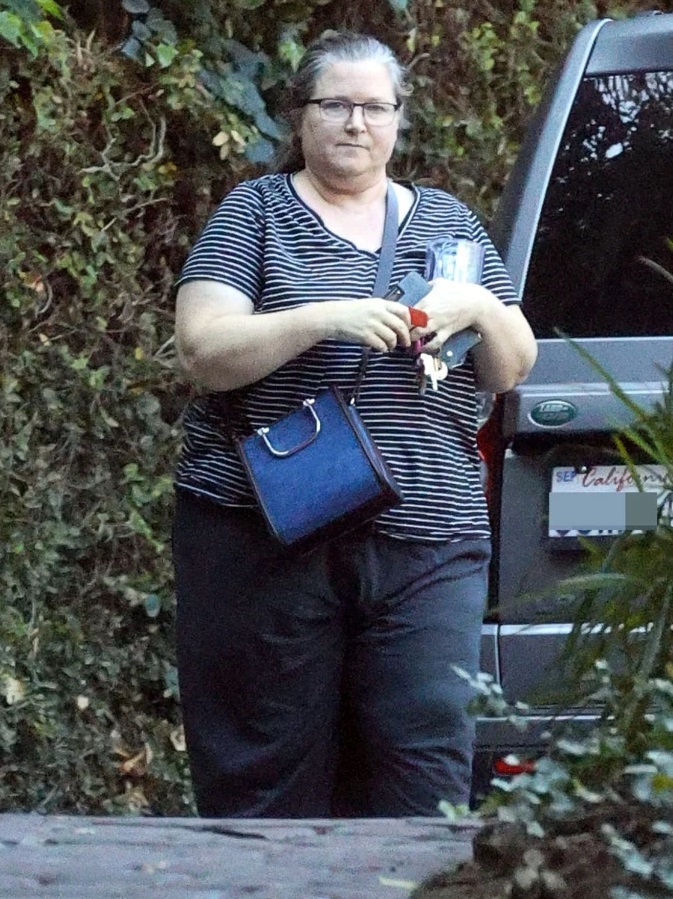
If the photo above was not already going viral, I wouldn’t print it here. Before the post continues, see if you can guess who that is above. No cheating now; this is an ethics blog… Continue reading →
This morning, Headline News devoted almost ten minutes to this earth-shattering event: in a basketball game a week ago between Laguna Hills High School and Portola High School, a single student in the stands shouted racial insults at Makai Brown, a black player for Portola, as he was shooting free throws. The HLN hostess announced the video of the section where the asshole student could be heard with a warning that I would expect for a decapitation video, or a geek eating live kittens.
“It is very disturbing,” she said. Yes, this spectator shouted “Who let him out of his cage? He’s a monkey!” and “Where is his slave owner? Chain him up! Who let him off the chains?” The student should have been forcibly shut up, or ejected. Would “High School Faculty Neglects To Eject Misbehaving Student from Gymnasium” normally rate national headlines?
After the now viral video above made the rounds, James Iannazzo, 48, was arrested and charged with a hate crime following the outburst at Robeks in Fairfield, Conn. over the weekend. The Fairfield Police Department said that Iannazzo returned to the store after a smoothie he purchased caused his son, who is allergic to peanuts, to be rushed to the hospital from his home. Iannazzo apparently ordered the smoothie without peanut butter, but did not explain to employees that his son had an allergy.
The New York Post says he called a staff member a “fucking immigrant.” The Times says he called her an “immigrant loser.”
After the Merrill Lynch office where Iannazzo works was swamped in furious emails, he was fired from his job as an analyst. A spokesman for Bank of America, the parent company of Merrill Lynch, told the New York Times in an email,
“Our company does not tolerate behavior of this kind. We immediately investigated and have taken action. This individual is no longer employed at our firm.”
“When faced with a dire situation for his son, Mr. Iannazzo’s parental instinct kicked in and he acted out of anger and fear,” the father’s lawyer said. “He is not a racist individual and deeply regrets his statements and actions during a moment of extreme emotional stress.”
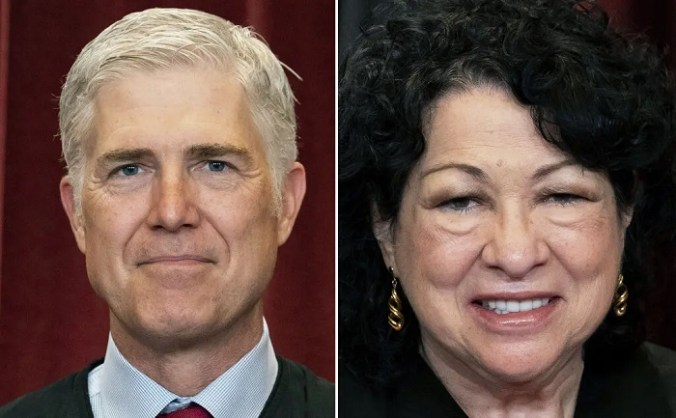
Compared to the above mass fake news about mass graves that have not, in fact, been verified, NPR’s bit of false reporting on Supreme Court intrigue seems trivial, and is. NPR’s longtime liberal-leaning Supreme Court reporter impugned Democratic Party boogie man Neil Gorsuch—He stole Merrick Garland’s seat!—by writing that Mean Neil was trying to kill Justice Sotomayor ( who “has diabetes, a condition that puts her at high risk for serious illness, or even death” from the Wuhan virus) or something, because he refused to wear a mask despite Justice Roberts “asking” him to. Sotomayor, therefore, has to participate in the Court’s work via Zoom. Gorsuch is, apparently, fully vaccinated, and doesn’t have the virus. Continue reading →
In 2018, Ethics Alarms questioned the wisdom and ethics of a state denying permission for drivers to have whatever vanity plates their little vain and often juvenile hearts desire. I happen to live in the state with the most vanity plates of all, Virginia, which not only seldom exercises government power over license plate speech, but also makes vanity plates extremely cheap…and, of course, being so close to Washington. D.C., the state has more than its fair share of narcissists.
What I wrote in 2018 still holds, unedited:
Utah, for examples, bans vanity plates with profanity, “derogatory language,” drug references, sex talk, references to bodily functions, “hate speech,” targeting a particular group, or advocating violence advocates, as well as alcohol references and the number combo “69.” Ethics verdict: None of their business. These are words and numbers, and the state is declaring content and intent impermissible. When I see a car with an obnoxious vanity plate, I’m grateful. This is useful information. Racist or vulgar plates translate into “I am an asshole, and want you to know it!”
Thank you, sir! I appreciate the heads up.
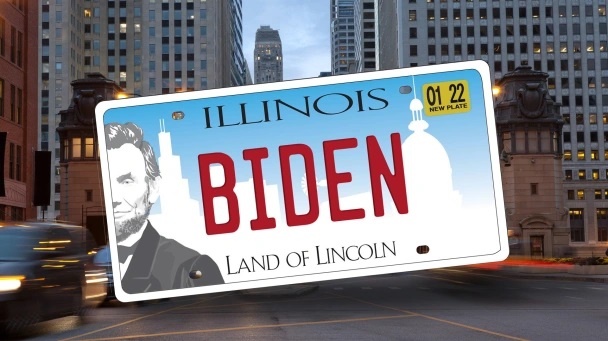
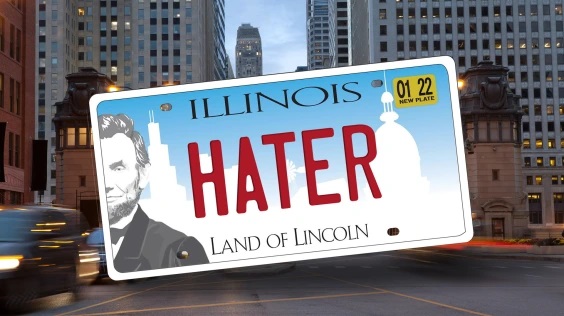
Last time, the post concentrated on the plate censorship by New Hampshire and Utah. Now we have access to the banned words and numbers in Illinois, which include, for some weird reason, “BIDEN.” It takes a lot of gall for the state that plasters “Land of Lincoln” everywhere to tell drivers they can’t have the name of Abe’s current successor on their cars. Also banned:
Ooooh...I’m so scared! And this one…
AAAAIIIIII! Now I’m REALLY scared! Take it away! TAKE IT AWAY!
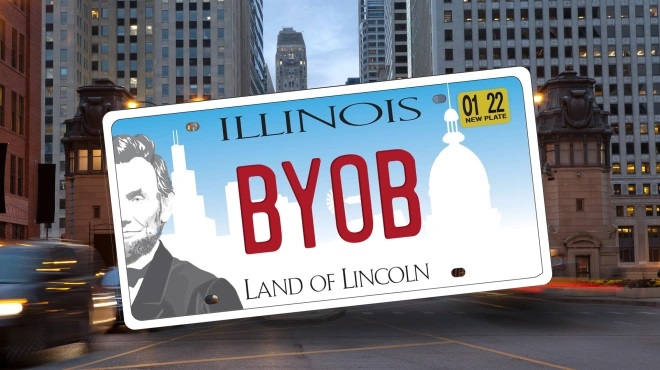
The Illinois Secretary of State is empowered by law to refuse misleading plates or those which create “a connotation that is offensive to good taste and decency.” The state currently has a “Inhibit List,” a compilation of more than 7,000 phrases that won’t be put on a vanity plate. Here are just the As and Bs. And what’s the matter with…
…I wonder? Mentioning beer is in bad taste? Does Illinois still have a Prohibition hangover?
And how did “Brandon” manage to avoid the list? The whole, silly, slippery slope thing is here.Continue reading →
Yesterday’s post about the “After School Satan Club,” as expected, quickly prompted a lot of intense commentary. One esteemed commenter, recently maligned stated “No one has ever been able to satisfactorily explain to me why hating one religion makes you a hater but hating all religions makes you an intellectual.” After receiving positive feedback on that statement, the commenter later suggested that Ethics Alarms “provide a little bit more analytical view of things, since [the host] belongs to no religion but is also not hostile to religion generally.”
Sure.
As a threshold matter, hate is not conducive to ethics. Hate is an emotion, a strong bias, and bias makes you stupid, as we all presumably know, since that is a theme here. Since hate makes you stupid, one cannot say that hating religion, or anything, makes one an “intellectual,” of all things. There are some kinds of human conduct that justify hate: genocide, murder, torture. I would add betrayal, child abuse, totalitarianism, corruption by public servants, bigotry…there are things (and people) that it can be justifiable to hate (though Clarence Darrow’ nostrum to “hate the sin, never the sinner” is an ethical standard worth considering. Whether Darrow believed that, or practiced it, is open to debate. He was also an outspoken atheist, or as he called himself, an agnostic in the sense that there was no way to “know” for certain whether God existed or not. He was pretty sure of “not,” though.)
Taking “hate” out of the argument, there are still good reasons to rationally determine that certain religions, sects of those religions, or the organizations that support them, are unethical, and do more harm than good in the balance. I can think of three right now, but I have neither the time, space or inclination to get into a religion by religion debate. One is a world religion, one is a denomination of a world religion, and one is a scam.
We have to keep baseball ethics alive even if baseball itself is in a state of suspension: the owner and players are, for the first time in decades, arguing about how to divide up their billions, everything from roster size to minimum salaries are on the table, and as of now, the two sides aren’t even talking with the season just a couple of months away. One of the issues to be settled is whether the National League will finally capitulate and adopt the designated hitter rule, which was accepted in the American League on this date in 1973, a day which many traditionalist fans then and now regard as an unforgivable scar on the integrity of the game. Baseball has always been celebrated for its equity and balance: as it was envisioned, every player on the field had to both hit and play defense. The DH, which is a batter who never uses a glove, also allowed the pitcher to be a defense-only specialist, never picking up a bat which, advocates of the new rule argued, was a result much to be wished, since the vast majority of hurlers are only slightly better at hitting the ball than your fat old uncle Curt who played semi-pro ball in his twenties. All these decades years later, the National League and its fans have stubbornly maintained that the DH was a vile, utilitarian gimmick spurred by non-ethical considerations, mainly greed. When the rule was adopted, American League attendance lagged behind the NL, which also was winning most of the All Star games, in part because that league had embraced black stars far more rapidly than “the junior league.” The DH, the theory went, would make games more exciting, with more offense, while eliminating all the .168 batters in the ninth spot in every line-up.
I had a letter published in Sports Illustrated in 1973 explaining why I opposed the DH as a Boston Red Sox fan. Since then, I have grudgingly come to accept the benefits of the rule: it gave the Sox David Ortiz, allowed Carl Yastrzemski to play a few more years, and let American League fans see such all-time greats as Hank Aaron at the plate after they could no longer play the field. It was a breach of the game’s integrity, but it worked.
1. At least that’s fixed. The Supreme Court issued a corrected transcript of the oral arguments in the Biden vaccine mandate case, and it now accurately records Justice Gorsuch as saying he believes the seasonal flu kills “hundreds…thousands of people every year.” The original version wrongly quoted him as saying hundreds of thousands, which allowed those desperately trying to defend the outrageously wrong assertions by Justice Sotomayor regarding the Wuhan virus to point to Gorsuch and claim, “See? Conservatives are just as bad!” Prime among these was the steadily deteriorating Elie Mystal at “The Nation,” who, typically for him, refused to accept the correction. Sotomayor is one of the all-time worst Supreme Court justices, though she will be valuable as a constant reminder of the perils of affirmative action. Her jurisprudence makes the much maligned Clarence Thomas look like Louis Brandeis by comparison. Continue reading →
Judge Michelle Odinet of the City Court of Lafayette, Louisiana, resigned last week after being heard on a video using the term “nigger” while watching security footage of a foiled car burglary outside her home. In her letter of resignation to the chief justice of the Louisiana Supreme Court, Odinet said she was stepping down “after much reflection and prayer, and in order to facilitate healing within the community.”
“My words did not foster the public’s confidence and integrity for the judiciary,” she wrote. Yeah, I would say that that’s accurate. Still, it’s a strange story. In the video, voices off camera inside the judge’s home are heard saying “nigger” repeatedly and laughing as they watch security-camera footage of someone trying to break into a car until the criminal was foiled. Also used: “mom,” which is the judge, who was clearly joining in the hilarity.
The video was originally sent by an unknown source to a local newspaper, and when she was first questioned, Odinet tried to huminhumina out of the mess. She initially said she had no recollection of the conversation shown, and claimed that her “mental state was fragile” because of the attempted burglary. She also used the excuse that she had been “given a sedative at the time of the video.” Then she played the Pazuzu card (“That’s not me talking!”) protesting that “Anyone who knows me and my husband, knows this is contrary to the way we live our lives.” Continue reading →

 Ethics Alarms