Yes, Some Things Are Worse Than Racism, Part 2: The Betrayal Of Daniel Miller

This seems like a propitious time to keep reminding people, especially those who are currently engaged in trying to tear up the culture and the nation into little pieces without a clue about what to do next,  that some things are worse than racism. Lots of things, actually. At some point, we will have to have this debate and that truth must be established.

In ethics, we judge conduct, not thoughts, beliefs, desires and even words, if they are not truly linked to unethical conduct. “Cancelling” people based on past racist or bigoted sentiments that do not seem to have been consistent with later conduct is unfair and  oppressive. The current movement to punish American citizens based on their failure to conform mandated thoughts and specific beliefs is at its core totalitarian, and is doomed to failure, or worse, success.

Playwright Arthur Miller committed one of the most nauseating acts of selfishness, cruelty and betrayal imaginable, but he wrote some of the most ethically resonant dramas in the American theatrical canon: “Death of Salesman,” “The Crucible,” ‘All My Sons,” “A View From the Bridge,” “The Price.” More than any other U.S. playwright, indeed writer in any genre, Miller earned a reputation as the culture’s herald of morality.  When he died in 2005, Miller was celebrated as perhaps our greatest playwright (he isn’t, but he’s certainly near the top.) He was also lionized as a lifetime ethics hero, in particularly because of his refusal to “name names” before the House Committee on Un-American Activities, and his vocal opposition to the Vietnam War. His battle with HUAC caused  Miller to be convicted of contempt of Congress in May 1957, when he was sentenced to prison sentence, fined, blacklisted, and forced to surrender his  passport.

Then, two years after the obituaries and tributes The Atlantic magazine revealed a horrible secret— not a skeleton in Miller’s closet, but a living, breathing, son.

Miller married the last of his wives, photographer Inge Morath (she came after Marilyn Monroe) in February, 1962.  The first of the couple’s  two children, Rebecca, was born on September 15, 1962. Their son, Daniel, was born  in November 1966.  Miller was excited about the birth until doctors diagnosed Daniel as having  Down syndrome. Against his wife’s wishes—she couldn’t have objected too strenuously— Daniel’s famous father sent the newborn to a home for infants in New York City within days of his birth, then four years later  to Southbury Training School, then one of two Connecticut institutions for the mentally challenged. There Daniel stayed until he was 17. Of that place, The Atlantic’s Suzanna Andrews wrote,

By the early 1970s, however, around the time Arthur Miller put his son there, Southbury was understaffed and overcrowded. It had nearly 2,300 residents, including children, living in rooms with 30 to 40 beds. Many of the children wore diapers, because there weren’t enough employees to toilet-train them. During the day, they sat in front of blaring TVs tuned to whatever show the staff wanted to watch. The most disabled children were left lying on mats on the floor, sometimes covered with nothing but a sheet. “In the wards you had people screaming, banging their heads against the wall, and taking their clothes off,” says David Shaw, a leading Connecticut disability lawyer. “It was awful.”

One observer reported that the institute reminded him of a Hieronymus Bosch painting. Continue reading

Naming Ethics: The Gaylord Affair

My short summary of this ethics controversy is: This mother is nuts.

A woman, 24, is due to have her first child in August, and, she says,  the first born son of everyone from her side of the family has been named Gaylord since the early 19th Century. She is determined to carry on the  tradition, though her husband is horrified, maintaining that to name any boy “Gaylord” is child abuse.

That’s probably overstating it, but just a bit. Gaylord is not a common name (it’s from the Old French gaillard meaning “joyful” or “high-spirited”), but Wikipedia lists 25 famous or accomplished Gaylords, only one of which I had ever heard of, the baseball player on the list (of course). That’s Hall of Fame pitcher Gaylord Perry, who won over 300 games during a 21 year career in which he was famous for throwing spitballs, an illegal pitch.  Perry is one of the three Gaylords on the list who is still alive, including a French long-distance runner named Gaylord Silly.

Now that’s child abuse..

But I digress. The mother says she offered her husband a compromise, agreeing that young Gaylord would go by “Gail” in school “so that he doesn’t have to deal with bullies.”

What? Continue reading

Sunday Ethics Warm-Up, 6/7/2020: Let’s Play “Name The Breached Ethics Values”!

Awash with shame for forgetting D-Day yesterday…

I don’t know about you, but for me the days merge into each other of late. I didn’t realize that I had snubbed D-Day until almost midnight. My Dad used to remind me that my existence may have been due to his unexpected inability to participate in the invasion: he had been assigned as an observer, which sounded scary to me, but “luckily” the idiot who blew himself and my dad’s foot up with a live hand grenade took him off the beaches.

1. I wonder...are the same PR hacks who wrote all of the “we’re all in this together? messages about the Wuhan lockdown the ones responsible for the smarmy “black lives matter” messages various companies are putting out?

Yesterday I was watching a movie on Vice, and the CEO kept interrupting the film to blather on about social justice. He is going to host a special, and among the guests—Trayvon Martin’s mother! That tells me all I need to know about the program. Outside of the false narrative constructed around it, the Zimmerman-Martin affair holds no enlightenment about systemic racism, police, or anything else useful, other than being a fine example of how the news media and politicians exploit race whenever they can.

The ethical values breached are honesty, responsibility, and citizenship.

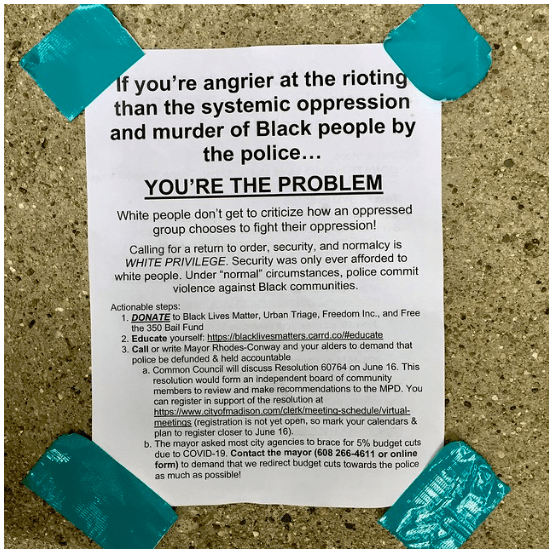
2. Ann Althouse posted this sign from her neighborhood (Madison, Wisconsin).

Yeah, that attitude will really assist the battle against “systemic racism.” Nothing builds racial trust like one race telling the other that there are some opinions it can’t express because of their race.

These are the people that the NFL, Uber, BestBuy and so many other businesses and institutions are supporting.

The ethical value being ignored are trust and integrity. Continue reading

It’s Time To Play The Exciting Game Show, “Pick Your Autopsy!”

From the New York Times today:

George Floyd died not just because of the knee lodged at his neck by a Minneapolis Police officer, but also because of the other officers who helped hold him down, a private autopsy found.

Dr. Allecia M. Wilson of the University of Michigan and Dr. Michael Baden, a former New York City medical examiner, were hired by Mr. Floyd’s family to help determine his cause of death. “Not only was the knee on George’s neck a cause of his death, but so was the weight of the other two police officers on his back, who not only prevented blood flow into his brain but also air flow into his lungs,” said Antonio Romanucci, a lawyer for the family.

Well I guess that settles it, then! And that Hennepin County medical examiner conclusion that the county autopsy “revealed no physical findings that support a diagnosis of traumatic asphyxia or strangulation,” and that ” that other factors were involved in Mr. Floyd’s death, including coronary artery disease and hypertensive heart disease”? Obviously rigged, wrong and based on racism. Or a cover-up. Or something.

Autopsies are not supposed to be advocacy proceedings. For the Floyd family to bring out their own, bought and paid-for autopsy to contradict the official one means that the case is being litigated in the news media and outside of the courtroom, and that is not the “justice” that Floyd’s protesters supposedly seek. Continue reading

“If Someone Like Myka Stauffer Can Be A Paid ‘Influencer,’ What Does It Take NOT To Be Influential?” And Other Mysteries Of The 21st Century

Quick: guess which kid they “rehomed”….

Here’s a another one: What the hell am I doing wrong?

Myka Stauffer is a so-called “online influencer,” meaning that she has such a huge following on social media that companies pay her to promote their products. Apparently being a social influencer has nothing to do with being smart, wise, ethical or a benefit to society. We know that because such wastes of DNA like the Kardashians are paid influencers—imagine making life decisions based on the recommendations of Kyie Jenner—but at least they have a TV show and have also demonstrated the ability to become rich with no discernible talent whatsoever.  That’s something, at least.

Stauffer is a much bigger mystery. I read a profile of her, and am still flummoxed. She has around 700,000 YouTube followers and 200,000 Instagram followers because…why? Her mother had her when she was 16. “I got to go to some really cool parties [and] I got to go to a bunch of concerts, which is a perk of having younger parents,” she says. Otherwise  her childhood was “basic, regular,”  and she loved everything about it until her mom told  her that her  dad was not her biological father.  “The next day I lost my virginity. I had planned to save myself for marriage. It wasn’t even a question in my mind,” says Stauffer. “When my identity was flipped upside down, everything went out the window.” Then she was grounded for an entire year as punishment, which gave her “lot of opportunity for self-growth.”  Then Stauffer found religion…oh, never mind, you can read the whole banal story here if your sock drawer is in order. Her second husband is a car detailer, and she’s a vegan. And an inexplicably large, gullible audience of infantilized women with empty lives and the brain pans of grackles look to her for guidance about what to wear and buy.

This is the quality of character they now know they can expect: After documenting on YouTube and Instagram her successful efforts to adopt an autistic little boy, she and her husband decided to “rehome” him,  using the term typically reserved for rotten pet owners who decide to get rid of a  dog or cat. It’s a euphemism, of course. What she is doing is giving away her son, because he’s just too much darn trouble if you’re going to get all those Instagram posts and videos out. Continue reading

Comments Of The Day: Ethics Dispatches From The Sick Ward, 5/26/2020: Arg! Yechh! [#1]

It took a while, but my complaint about the advertising world’s bizarre decision to make pirates the sole politically correct genre for innocent childsplay finally generated the intriguing commentary I hoped it would.

Here are two Comments of the Day on the topic, breached in Item #1 of the post, Ethics Dispatches From The Sick Ward, 5/26/2020: Arg! Yechh!”

First up, Isaac:

Permit me a midnight rant about pirates.

Kids did not play pirates at any time before this Gen-Xer was born. Kids played sailors or soldiers, and the PIRATES WERE THE BAD GUYS. That is because pirates were (and are) indeed very bad guys.

Treasure Island is a realistic story about stuffy British Christian men (and a boy) defeating a gang of vile, godless pirates. Once the story gets going there are exactly zero female characters. I can see why the destroyers of culture who lord it over modern schools would find this “problematic.” But it just might be my all-time favorite book. Pirates are interesting, fascinating, and make for good stories. BUT THEY AREN’T SUPPOSED TO BE THE HEROES.

Even the least-murderous of real-life pirates still tricked innocent merchant vessels and robbed them by force. They still were known for spending their free time raping, drinking themselves to death, and spreading venereal disease. Within just the last few years, pirates off the coast of Somalia have been murdering entire ships’ crews, so it’s not as if there’s no modern frame of reference for understanding why they generally shouldn’t be cast as heroes, as you mentioned.

There was a funny but sad incident not too long ago told by a mom who had been to Disneyland. She took her son into a boutique in the park that styles up girls into princesses. They offered to do their equivalent service for the young man by making him into a pirate. The small child, who had more common sense and moral awareness than the entire Disney corporation, pointed out that pirates are bad guys, and insisted that he wanted to be a prince instead. There were no prince costumes.

There are now SEVERAL kids’ cartoons in which kids “play pirate,” mostly thanks to the Disney movie. One of them is “Jake and the Neverland pirates” which doesn’t even make any sense in the context of Peter Pan. A character on this show said to his tiny audience, at one point, and I quote, verbatim, “A good pirate never takes anyone else’s property.” And they were serious.

The elephant is there in the room from that very first film. Jack Sparrow proves himself to be “a good man” and the moral (such as it is) is that even a pirate can be good. And so, at the end of the film, “good man” Jack gets his ship and crew back and sails off into the sunset too…do what, exactly? Sail the world looking for beached whales to rescue? Hunt for lost treasure to return it to its rightful owner? The next several movies twist themselves into knots to avoid having to give the obvious answer to this question: the only way to be a pirate is to, you know, commit piracy. It’s right there in the name.

I wonder if 50 years or so would be sufficient time for Disney to train kids to “play terrorist.” Just make a wacky movie about an eccentric jihadist who turns out to have a heart of gold.

Now here’s Pirate Comment of the Day #2, from Jeff: Continue reading

“The Nine Principles of Italian-Americanism” [CORRECTED]

Prolific commenter Steve-O-In-NJ brought this, his inspiration, to the attention of Ethics Alarms. I collect codes of conduct and creeds, and this is a revealing one. What is interesting about  his “The Nine Principles of Italian-Americanism” is that it substantially tracks with most such codes,  like the Six Pillars of Character, except that the groupings are different, and there are some values that many wouldn’t consider exactly ethical.

For example, the first principle, which usually means that it has the highest priority, is pride. Pride isn’t right or wrong necessarily, but it is usually marked as an impediment to ethics, a seed of bigotry, and nearly the opposite of humility, which is included in the Six Pillars.

The list turns up on the Facebook page of the Angelo Roncalli Lodge Order Sons Of Italy of America, a community organization (Pop Quiz: Who was Angelo Roncalli? He’s world famous, but not by that name.)  This was Steve’s introduction:

I thought this up. My thought is that if African-Americans can have the Seven Principles of Blackness, then we Italian-Americans can have our own code of principles too. I picked nine because it should be a number divisible by three for the three colors of the Italian Flag. Six was too few, twelve would be too many. Maybe it’s just a lot of self-important rhetoric, and if so, feel free to ignore it.

With that introduction, here are the “The Nine Principles of Italian-Americanism”: Continue reading

Observations On A Tender, Obnoxious, Unethical Screed

My original impulse was to post  this as an ethics quiz, with a heading like, “Is Bill Weir’s essay as bad as I think it is?”

Bill Weir is CNN’s climate correspondent. His wife just gave birth to a son, for which Ethics Alarms gives him a hardy congratulations and will wait for its metaphorical cigar. However, Weir chose to use this life event for an astoundingly long, self-indulgent, and in several ways unethical post on CNN’s site headlined, “To my son, born in the time of coronavirus and climate change.”

Read the thing, if you can stand it. Commenter Other Bill sent it to me with the query, “Is it ethical for this guy to have a child?” He was engaging in hyperbole, but the thrust of the question is valid. Here’s how the essay begins:

Against all odds you were conceived in a lighthouse, born during a pandemic and will taste just enough of Life as We Knew It to resent us when it’s gone. I’m sorry. I’m sorry we broke your sea and your sky and shortened the wings of the nightingale. I’m sorry that the Great Barrier Reef is no longer great, that we value Amazon more than the Amazon and that the waterfront neighborhood where you burble in my arms could be condemned by rising seas before you’re old enough for a mortgage.
The scent of your downy crown makes my heart explode. The curl in your Tic Tac toes fills me with enough love to power New York City.

Gack! I’m sorry, I have to take a break. Continue reading

End Of The Day Ethics, 4/24/2020: A Curse, A Whorehouse, And The Grim Reaper

Yay.

Another weekend…

1. Nah, there’s no news media narrative coordination! Twitchy has pointed out the remarkable conformity of language regarding the Joe Biden sexual assault accusation. Last week, CNN reported that Democrats are “grappling with questions” about Tara Reade’s allegations. This week:

Politico: “The movement is facing a new challenge: how to grapple with the allegations against Joe Biden without tearing itself apart.”

Jake Tapper on Twitter: “Democrats grapple with questions about Tara Reade’s sexual assault allegation against Joe Biden…”

Jeremy Scahill at the Intercept: “My aim in writing this piece was to put into words what many principled people are grappling with right now, not to tell anyone what to do. Recognizing and understanding the problem helps us all decide what we believe is right…”

Mother Jones: “Sexual Assault Advocates Are Grappling With the Allegations Against Joe Biden”

All independent, objective journalists, of course…talking points? What talking points?

2. This “sharing a life” concept seems to be beyond you…over at Social Q’s a woman who is living with her boyfriend to ride out the pandemic complains, “He eats significantly more than I do, including some foods I don’t touch. Still, we split the grocery bill, and I am paying significantly more for food than usual. How should I handle this?” Columnist Phillip Gallanes’ advice is impeccably ethical:

Try stepping back and looking at the bigger picture…Sure, he eats more than you, but are you twice as messy (while sharing cleaning duties equally)? Do you watch three times as much Netflix (but split the bill in half)? And I haven’t even touched on emotional labor yet. ..if you want your partnership to survive even after we’re set free again, consider all the contributions each of you makes.

Nice try, Phil, but I’m guessing that question is signature significance, and the relationship is doomed. Continue reading

Rationalizations From The Victim Of A Tragedy

A week ago, I briefly discussed the report on the 2017 death of major league pitcher Roy Halladay who crashed his plane into the Gulf of Mexico  on Nov. 7, 2017. The 13-page report said Halladay had 10 times the recommended level of amphetamine in his system, plus an antidepressant, a muscle relaxant, a sleep aid and morphine.  He was also attempting aerial acrobatics and stunt flying.

Now his widow, Brandy Halladay, has issued a statement through the now Hall of Fame pitcher’s last team, the Philadelphia Phillies. She wrote,

“Yesterday’s NTSB report on Roy’s accident was painful for our family, as it has caused us to relive the worst day of our lives. It has reinforced what I have previously stated, that no one is perfect. Most families struggle in some capacity and ours was no exception. We respectfully ask that you not make assumptions or pass judgment. Rather, we encourage you to hug your loved ones and appreciate having them in your lives.”

From one perspective, it seems unkind to be critical of the lament of a grieving family member in the wake of such a tragedy. From another—mine—I can’t let public endorsements of multiple rationalizations like that one pass. I just can’t, and I have an obligation as an ethicist not to. It’s a dirty job but someone has to do it: the reason so people make terrible decisions by defaulting to rationalizations rather than ethics is that the culture marinates them, day after day, in these excuses for bad conduct. After a lifetime of hearing the contrived arguments , most people accept such self-deceptions as true. In turn, they engage in conduct, or excuse conduct in others, that causes extensive harm. Continue reading