Power abusers only put evidence of their nature on public display when they are absolutely certain that no one can or will hold them accountable. That certainly is the case with New York State Attorney General Letitia James, but then this has been the pattern with all of the (inevitably) Democrats in her office since the days of Eliot Spitzer and before. Her latest example of unethical use of her office, however, is especially ominous.
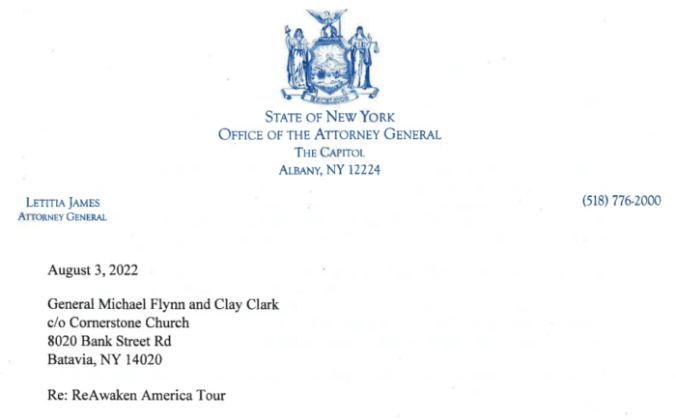
The pro-Trump Reawaken America Tour has been criss-crossing the U.S. for more than a year, and because speakers currently include former General Michael Flynn, a Trump ally, the Left has been trying to interfere with the event whenever possible. An online petition intimidated the owner of the Rochester’s Main Street Armory cancel its hosting of the event, so the Cornerstone Church in the tiny town of Batavia, NY. took over hosting duties. Borrowing heavily from the anti-speech petition (for talking about some topics are the equivalent of violence, you know), James sent a threatening letter to tour organizer Clay Clark and Flynn, along with the church itself.
Its objective: chill a legal gathering’s free speech rights by intimidation.
lf you are not familiar with Sam Harris, who has gained a fair amount of visibility (hear-ability?) as a result of his podcast, you might want to listen to the first 35 minute or so of the interview with him above, but the important part comes afterwards. As soon as your hear that, assuming you’re not Liz Cheney, Adam Schiff or George Conway, you will realize that you wasted your time, because the man is not worth taking seriously.
He is completely, thoroughly, through-and-through ruined by the hatred of Donald Trump, and so biased that his reasoning cannot be relied upon for anything. It doesn’t matter that he’s a neuroscientist, New York Times best-selling author, a genuine philosopher, and credentialed public intellectual. He’s useless. He’s a fraud. Trustworthy people simply don’t hold such opinions—not only hold them, but eagerly broadcast them. It’s a signature significance orgy!
The interview is outright scary, and should make people seek psychiatric attention when they sense they are nearing the point that Harris has, tragically, reached. Harris is honest and clear-eyed enough to recognize the (still running) 2016 Post Election Ethics Train Wreck for what it is [“Taking down the New York Post’s [laptop article]? That’s a Left-wing conspiracy to deny the presidency to Donald Trump. Absolutely it was. But I think it was warranted.”] but not ethical enough to realize that as an authority and scholar lesser mortals rely upon for enlightenment, he has an obligation not to sink into mob mentality just because he is surrounded by peers and friends who are consumed with unthinking fear, anger and hate.
After expressing his approval of Liz Cheney’s announced determination to use any means necessary to prevent Donald Trump from running for President, Harris is asked “You’re content with a conspiracy to prevent somebody being democratically elected President?” He responds with a flaming rationalization stew (and a terrible analogy) that belongs in the “Bias makes you stupid” Hall of Fame: “If there was an asteroid hurtling toward earth and we got in a room together with all of our friends and had a conversation of what we could do to deflect its course, is that a conspiracy?”
Ah! See, if Trump is the same as an extinction-threatening asteroid, so “Ethics is a luxury we can’t afford,” “It can’t make things any worse,” “It’s for a good cause,” “These are not ordinary times” and more rationalizations all apply. But Trump is just a politician and a human being, and even our politicized scientists cannot declare him an extinction event. Nor is planning a conspiracy: there are no laws declaring that blocking the path of an asteroid is wrongful. When someone as intelligent as Harris once was hears something that stupid leaping from his mouth, he must be able to recognize it, or something is seriously amiss.
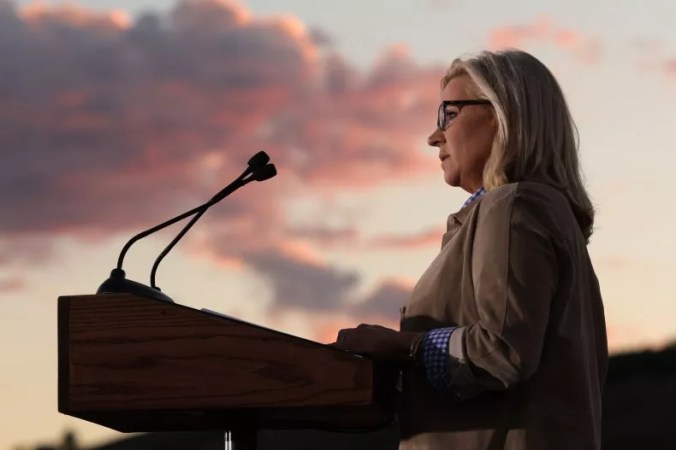
“I will do whatever it takes to make sure Donald Trump is never again anywhere near the Oval Office.”
—Rep. Liz Cheney (NeverTrump-MT) in her head-exploding, self-glorifying, beyond satire concessions speech after being crushed in the GOP state primary.
And there you have it: candor and saying the secret part out loud, though the anti-democratic motives of the “the resistance”/Democrats/ mainstream media cabal (the “Axis of Unethical Conduct”)is hardly a secret at this point, and was stated on Ethics Alarms, beginning, oh, nearly six years ago.
This is a woman (a Republican official who is aping Democratic Party talking points) who claims to be trying to save democracy by interfering with democratic processes and institutions. Does “anything it takes” set off an ethics alarm? If you’re Trump Deranged, it probably doesn’t. Cheney’s mad logic is that Donald Trump is an exception to the laws, rules and principles of democracy: he doesn’t get the benefit of them because he’s bad….mostly because he’s not in lock-step with the entrenched elite political class like the Bidens, Cheneys, Bushes and Clintons, and also a bit because he’s an unmannerly boor. Another crazed Trump hater, the Washington Post’s self-parodying Jennifer Rubin, writes in today’s Post that “Taking the Fifth should disqualify a politician from taking office.”Continue reading →
Apparently the Oscars are looking hard for virtue-signaling opportunities.
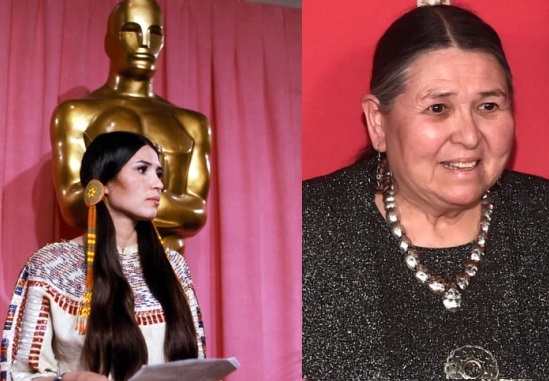
In this instance, they had to travel back in time 50 years and decide to make amends for one of the more ludicrous examples of celebrity grandstanding in pop culture lore. Marlon Brando, a cinch to win the Best Actor statuette for “The Godfather” in 1973, decided to snub the Academy of Motion Picture Sciences, his Hollywood colleagues and the Oscars’ TV audience by sending an obscure, Native American actress named Sacheen Littlefeather to go to the podium when Marlon’s name was read and make a statement about the abuse of Indians at Hollywood’s hands while announcing that Brando was rejecting his honor in protest. You know, because “The Godfather” was all about Native American mobs, or something.
It was a complete non sequitur, and many suspected that the whole stunt had little to do with Native American portrayals in film (about which Brando had previously said nothing) and more to do with the famously weird actor’s desire to stick his thumb in the eye of the industry that had made him rich and famous. He might have just as well had his statuette rejected by Bozo the Clown; maybe it came down to a coin flip: heads, Sasheen (it was an Indian Head nickel), tails, Bozo.
The young woman’s appearance did not go over well. “Mr. Brando very regretfully cannot accept this very generous award,” Littlefeather said. “And the reasons for this being are the treatment of American Indians today by the film industry and on television in movie reruns, and also with recent happenings at Wounded Knee.” That was a reference to a protest a month earlier,when the American Indian Movement had occupied the South Dakota town of Wounded Knee, site of the infamous massacre, to protest Hollywood’s killing and..no wait, it was the U.S. government’s treatment of Native Americans that protest was about. What did it have to do with movies, Brando, and the Oscars?
In May, Ethics Alarms began a review of the U.S. Presidents to separate the chaff from the wheat, keeping the chaff, and assembling the finalists for the Worst U.S. President Ever competition. The issue has gained more significance of late: President Biden’s polls are now the worst of any President at a similar stage in his first term, and his own party and its propaganda minions—you know, the mainstream media and its pundits—appear to be sharpening the metaphorical long knives. No potential finalists were found in the first ten Presidents, examined in Part 1. Among POTUSes 11-20, which EA covered in Part 2, there were three finalists, strong candidates all: depressed and drunken FranklinPierce, lonely and inert James Buchanan, and poor Andrew Johnson.
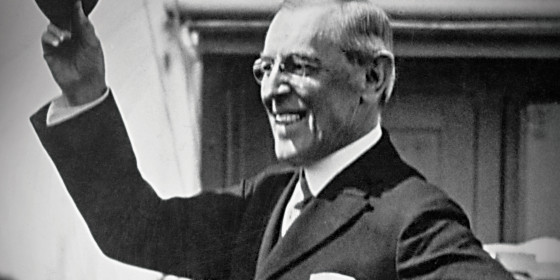
Let’s assess Presidents #21-28, technically eight, but really only seven, because one of them really needs a lot of exposition. The photo above is a clue…
President Chester A. Arthur, 1881-1885, who inherited the office after President Garfield’s doctors killed him, can’t be one of the worst Presidents, because he’s among the most over-achieving ones, as I’ve written about here and elsewhere. He rose to the challenge and surprised even himself. He also, unlike some Presidents I could name, refused to be a puppet of his party’s power-brokers, and did what he thought was in the best interests of the people. This ended with him being respected by the public and shunned by his party: he wasn’t allowed to run for a second term. If Biden is blocked from the nomination, it will be the first time since Arthur that a President who hadn’t removed himself from consideration after a single term was rejected by his party.
Arthur, however, was much more popular than Joe Biden.
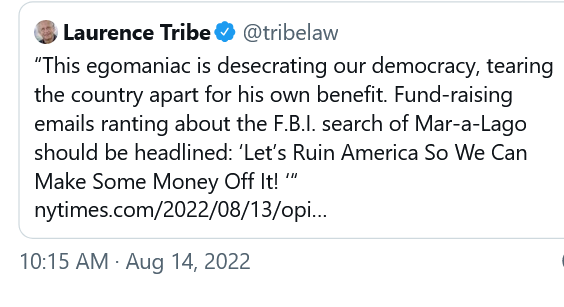
I can only find out about EA post-worthy tweets second-hand, as I killed my Twitter account after the platform censored the Hunter Biden laptop story. I actually followed Tribe’s tweets before that, because his public descent into demented hackery after such a distinguished legal and academic career had the tragic fascination of gruesome car wreck as well as conveying a useful lesson in mortality: I have asked my wife to bash in my head with a brick from behind should I ever jump the cognitive shark as obviously as Tribe has.
This time, Ann Althouse was my tweet source, though her post’s subject was another, slightly less whacked-out tweet re-tweeting Tribe by author Joyce Carol Oates. Tribe’s tweet, in turn, only quoted a typical piece of furious Trump-Deranged venom from Times columnist Maureen Dowd. Before his brain started to melt, the idea of Prof. Tribe appealing to the authority of the likes of Dowd would be like imagining Henry Kissinger quoting “Mark Trail.”
Is Roy Moore the most repulsive public figure to warrant an Ethics Alarms “Don’t Make Me Defend…” posts? Oooh, tough call. I checked: the all-time leader in such posts is Donald Trump, with Joe Biden a distant second. Then we have Jack Phillips (the anti-gay baker), Sean Spicer, MSNBC’s Lawrence O’Donnell, Kathy Griffin, Sarah Huckabee Sanders, Joy Behar, Alex Jones, Lenny Dykstra, Woody Allen, Stacey Abrams, Chris Cuomo (twice!), Nicki Minaj, Tucker Carlson, Nancy Pelosi and Pete Rose. That’s tough and nauseating competition. What do you think?
But I digress. The occasion for my rallying to Roy’s side is the $8.2 million verdict in his favor in his defamation suit against the Senate Majority PAC for a negative TV ad characterizing some of the sexual misconduct accusations against him that helped derail Moore’s failed 2017 U.S. Senate bid in Alabama.
Senate Majority PAC funded a group called Highway 31 that ran a $4 million advertising blitz against Moore, concentrating on the accounts of his pursuit of teenage girls early in his career when he was a 32-year-old assistant district attorney. It is beyond reasonable dispute that Moore was creepy with young girls, even Joe Biden-like. However, defamation is when one states as fact something for which there is no factual evidence and that harms another’s reputation.
Bari Weiss is one of the disgusted former journalists for progressive/ Democratic propaganda organizations who found the remaining sparks of integrity and belief in democracy within made continuing complicity impossible. A former opinion editor at the New York Times who resigned in July 2020 after she challenged the paper’s hypocrisy, Weiss (whose Ethics Alarms dossier is here) horrified Republican U.S. Senator Tim Scott (S.C.) during her recent podcast,”Honestly with Bari Weiss.”
I’m here to horrify you, too.
Weiss explained to the Senator what went on in the newsroom behind the scenes regarding Scott’s op-ed about a police reform bill he was working on, the Justice Act, in response to the death of George Floyd. Democratic support for the bill ultimately failed, and Scott authored a proposed op-ed piece for the Times explaining how the negotiations collapsed. Weiss told Scott,
The PDF of the unsealed search warrant and attachments is available here.
The central ethical conflict in this mess is between the danger of criminalizing politics, a warning sign of, as conservative talk show host Mark Levin says, creeping Stalinism, and appropriate revulsion at allowing anyone, including Presidents, ex-Presidents and would-be Presidents, to be “above the law.”
This inevitably leads to “whataboutism” arguments, and legitimate accusations of double standards. Hillary Clinton committed acts that other, lesser mortals have been prosecuted for, despite James Comey’s typically dishonest statements to the contrary. The Clinton Foundation, which operated–cleverly, creatively and mostly carefully—as a money laundering, pay-to-play and influence peddling operation for the benefit of Clinton family members in perpetual violation of basic non-profit practices and guidelines, mysteriously wound down to nothingness once Hillary had no influence left to peddle and no prospects for regaining any. An FBI raid of Clinton Foundation offices would have almost certainly turned up some fascinating documents, but the Trump Justice Department, which was, as we know, stuffed with Clinton loyalist holdovers, never went that far in its investigation, such as it was. There is a substantial distinction between crowds chanting “Lock her up!” and serious attempts to actually lock her up.
Daniel Goldman earns the Ethics Alarms clip with Sir Thomas More’s scalding indictment of the character of “A Man For All Seasons” villain Richard Rich, “Why Richard, it profit a man nothing to give his soul for the whole world. . . but for Wales?”
Donald Trump, fighting a coordinated (I believe) Democratic assault from all sides in a desperate effort to neutralize him (an effort than has continued unsuccessfully for a ludicrous six years!) invoked his Fifth Amendment rights against self-incrimination at a deposition for New York Attorney General Letitia James (D). While the ongoing January 6 kangaroo court in the House seeks to prove that Trump planned an “insurrection,” and the Justice Department raided his home ostensibly to find sufficient evidence to prosecute him for mishandling of classified documents, James is continuing her state’s long-running attempts to prove Trump engaged in illegal financial activity and/or corrupt business practices
After Trump’s non-response was reported, Goldman, who was an assistant U.S. attorney in the Southern District of New York for 10 years, tweeted,
“The Fifth Amendment ensures that people are not forced to incriminate themselves. But you don’t take the Fifth if you didn’t do anything wrong.”