
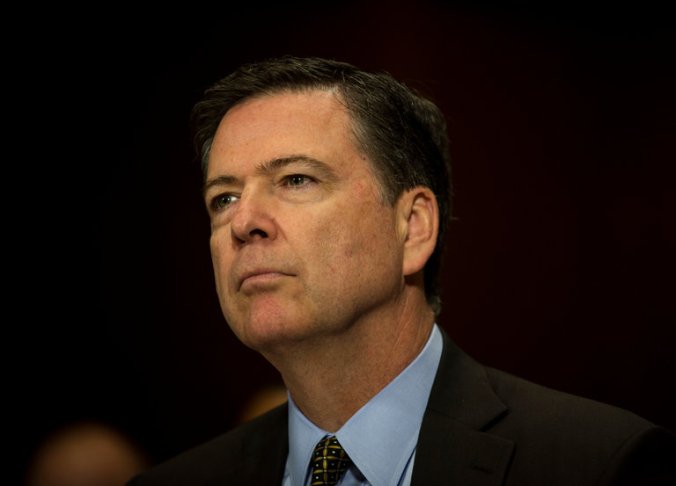
It’s all this guy’s fault…
I have read the initial comments on the original post-–which I interrupted my viewing of a Red Sox game to write, just so you know how dedicated I am—had some additional thoughts and processed some new data. Here are some more observations:
1. The New York Times biased reporting is even worse than I thought. Today’s print edition has a “Saturday Night Massacre” size headline screaming:
TRUMP FIRES COMEY AMID RUSSIA INQUIRY
This is deceit, and, as I noted before, yellow journalism. It is technically accurate, but misleading and false anyway. Trump also fired Comey in May, “amid” the North Korea crisis, and while the Orioles were playing the Nationals. There is absolutely no evidence whatsoever that Comey’s firing had anything to do with the Russia investigation except this: Comey thoroughly botched the last major investigation the FBI was engaged in.
The Times goes further, adding another above the fold story headlined, “The President Lands a Punch, and Many Hear Echoes of Watergate.” Ah, the old “many say/many hear/many think” ploy—an unethical journalism classic. Let’s seed the unfair suspicion without taking responsibility for it! Hey, we didn’t say we thought that, just that others do!
2. Many have noted that President Hillary would have fired Comey within seconds of taking office, or as close to that as possible. This is doubtlessly true. It is also true that Republicans would probably be attacking her with as much fury and blatant hypocrisy as Democrats are attacking the firing now.
But doing something unethical in an alternate universe is still not as damning is doing it in this one.
3. I have been working on a “100 Days” overview of the ethics score since President Trump took office. In general, it is both remarkable and disturbing how closely the President’s actual performance tracks with my expectations, as explained over the last two years. One aspect of this mostly negative assessment that is undeniably positive, however is that President Trump, unlike his predecessor, does not fear making decisions, and makes them despite the amount of criticism he knows will be coming, especially from the news media. (The previous President knew that he had nothing to fear from the news media, since it was invested in making him seem successful and wise even when he wasn’t.)
The firing of Comey is a perfect example, as was the decision to enforce, belatedly, Obama’s “red line” in Syria.
4. Nowhere near enough focus has landed on Rod Rosenstein (left) , the deputy attorney general who was only confirmed a couple of weeks ago ( April 25, 2017). Rosenstein is an impressive lawyer with a long, distinguished record in both Democratic and Republican administrations, and authored the “Memorandum to the Attorney General” on the subject of “Restoring Public Confidence in the FBI.” This articulates the best reasons for firing Comey, and any critic who argues that it made sense to keep him on is tasked with rebutting Rosenstein’s brief. Good luck with that.
Continue reading





By fortune’s smiles, I was able to finally meet Charlie last week face to face, as he kindly alerted me that he would be passing through my neighborhood. Finally having personal contact with an Ethics Alarms reader is always a revealing and enjoyable experience, and this time especially so. I think you would all enjoy Charlie; I certainly did. Maybe I need to hold an Ethics Alarms convention.
Here is his Comment of the Day on the post, Comment Of The Day: “No, Insurance Companies Treating People With Pre-Existing Conditions Differently From Other Customers Is Not ‘Discrimination’.”
…The claim that “a free market system” and “freedom of choice” is the solution to all that ails us is a mindless mantra that is only occasionally true, but not always.
It’s important to be clear about when free market solutions are good, and when they are not. It’s not all that hard to sort out. Basically:
Free market solutions ought to be the presumptive default. Unless there is good reason to the contrary, they ought to be the rule.
1. Exception Number 1: Natural monopolies. It makes no sense to have competition for municipal water supplies; airports; multiple-gauge railroads; fishing grounds; groundwater; or police departments. The basic reason is the putative economic benefit is either simply not there, or is absurdly overwhelmed by the social confusion engendered by multiple suppliers.
In these cases, a form of regulated monopoly is desirable. (By the way, the airline industry at a national level is precisely this kind of market; we do not have too little competition there, but too little regulation).
2. Exception Number 2a: Wallet-driven market power monopolies. It’s strategy 101 in business schools that the way to be successful is to be #1 or #2, and the best way to do that is to get more market share than your competition, so you can drive them out of business. The one guaranteed way to do that is to cut prices so low that no one else can compete. Think Walmart. Think Amazon. Think Japanese in the 60s and 70s in any industry.
The reason we have anti-monopoly laws is to reset the playing field when a competitor dominates the market too strongly.
3. Exception Number 2b: Product-driven market power monopolies. Where the product is so obscure, expensive, infinitely variable, and difficult to understand that the producers are de facto in control, because it is too confusing and too dangerous to challenge them.
Drug prescriptions are an interesting example. The ‘free market solution’ to high drug prices was (partly) to let drug companies advertise, and to loosen up the definition of what constituted a ‘new’ drug. What did we get? New diseases like RLS, new definitions of ‘new’ (moving ‘off label’ to ‘on label’) and even higher drug company profits. Because who’s still going to argue with your doc? Especially when he or she gets side benefits from giving in to the latest DTC ads on network news programs?
Continue reading →