More Fact-Check Ethics, And What It Tells Us About PolitiFact And How Fairly The News Media Will Treat Donald Trump

Just imagine how frustrating it must be to be a stopped clock and have people stiff claim you are wrong one of the few times you are right!

Just imagine how frustrating it must be to be a stopped clock and have people stillclaim you are wrong one of the few times you are right!

Constitutional law professor Eugene Volokh was intrigued when the infamously left-biased “non-partisan fact checking source” Politifact “fact-checked” Donald Trump’s recent assertion that “crime is rising.” The professor did his own fact-checking on the Tampa Bay Times’ verdict that…

“If you look at overall violent and property crimes — the only categories that would seem inclusive enough to qualify as “crime,” as Trump put it — he is flat wrong. In fact, crime rates have been falling almost without fail for roughly a quarter-century. We rate his claim Pants on Fire.”

Volokh’s conclusion? Trump’s statement can not be fairly called “Pants on Fire,” because in regard to violent crime, it’s true. Aggregate crime is not rising, but PolitFact’s statement—“If you look at overall violent and property crime”—is deceptive, and suggests that both violent crime and property crime are falling. (Uh-uh-uh! Bad Fact-Checker! Fact-Checker must not be misleading and deceptive!) Notes the professor: Continue reading →

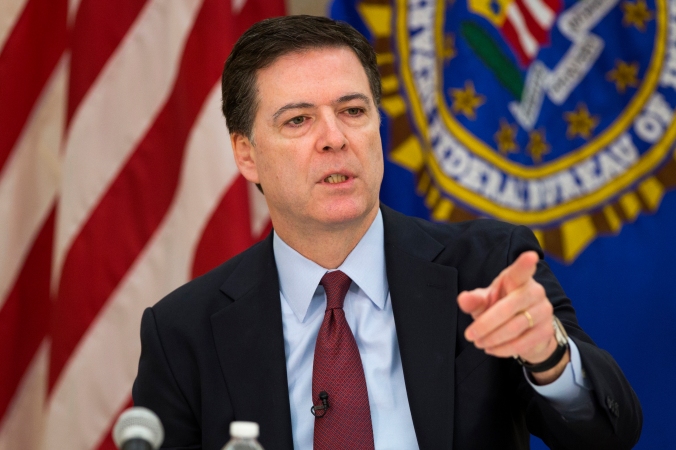
Ethics Observations On FBI Director Comey’s Statement Regarding The Clinton Investigation

James Comey

The transcript of FBI Director James Comey’s full remarks on the Clinton e-mail probe follow. I will highlight important sections in bold, and in some cases, bold and red. My  observations will follow.

Good morning. I’m here to give you an update on the FBI’s investigation of Secretary Clinton’s use of a personal e-mail system during her time as Secretary of State.

After a tremendous amount of work over the last year, the FBI is completing its investigation and referring the case to the Department of Justice for a prosecutive decision. What I would like to do today is tell you three things: what we did; what we found; and what we are recommending to the Department of Justice.

This will be an unusual statement in at least a couple ways. First, I am going to include more detail about our process than I ordinarily would, because I think the American people deserve those details in a case of intense public interest. Second, I have not coordinated or reviewed this statement in any way with the Department of Justice or any other part of the government. They do not know what I am about to say.

I want to start by thanking the FBI employees who did remarkable work in this case. Once you have a better sense of how much we have done, you will understand why I am so grateful and proud of their efforts.

So, first, what we have done:

The investigation began as a referral from the Intelligence Community Inspector General in connection with Secretary Clinton’s use of a personal e-mail server during her time as Secretary of State. The referral focused on whether classified information was transmitted on that personal system.

Our investigation looked at whether there is evidence classified information was improperly stored or transmitted on that personal system, in violation of a federal statute making it a felony to mishandle classified information either intentionally or in a grossly negligent way, or a second statute making it a misdemeanor to knowingly remove classified information from appropriate systems or storage facilities.

Consistent with our counterintelligence responsibilities, we have also investigated to determine whether there is evidence of computer intrusion in connection with the personal e-mail server by any foreign power, or other hostile actors.

I have so far used the singular term, “e-mail server,” in describing the referral that began our investigation. It turns out to have been more complicated than that. Secretary Clinton used several different servers and administrators of those servers during her four years at the State Department, and used numerous mobile devices to view and send e-mail on that personal domain. As new servers and equipment were employed, older servers were taken out of service, stored, and decommissioned in various ways. Piecing all of that back together — to gain as full an understanding as possible of the ways in which personal e-mail was used for government work — has been a painstaking undertaking, requiring thousands of hours of effort.

For example, when one of Secretary Clinton’s original personal servers was decommissioned in 2013, the e-mail software was removed. Doing that didn’t remove the e-mail content, but it was like removing the frame from a huge finished jigsaw puzzle and dumping the pieces on the floor. The effect was that millions of e-mail fragments end up unsorted in the server’s unused — or “slack”— space. We searched through all of it to see what was there, and what parts of the puzzle could be put back together.

FBI investigators have also read all of the approximately 30,000 e-mails provided by Secretary Clinton to the State Department in December 2014. Where an e-mail was assessed as possibly containing classified information, the FBI referred the e-mail to any U.S. government agency that was a likely “owner” of information in the e-mail, so that agency could make a determination as to whether the e-mail contained classified information at the time it was sent or received, or whether there was reason to classify the e-mail now, even if its content was not classified at the time it was sent (that is the process sometimes referred to as “up-classifying”).

From the group of 30,000 e-mails returned to the State Department, 110 e-mails in 52 e-mail chains have been determined by the owning agency to contain classified information at the time they were sent or received. Eight of those chains contained information that was Top Secret at the time they were sent; 36 chains contained Secret information at the time; and eight contained Confidential information, which is the lowest level of classification. Separate from those, about 2,000 additional e-mails were “up-classified” to make them Confidential; the information in those had not been classified at the time the e-mails were sent.

Continue reading →

More Fourth Of July Ethics: PBS Deceives Its Audience, And Calls It A “Patriotic Thing To Do”

a-capitol-fourth-concert-fireworks03

I hate writing posts like this. I hate the fact that the culture’s appreciation of the importance of integrity, honesty and transparency has declined so much during the Obama Administration that I have to write posts like this.

PBS’s annual coverage of the nation’s Capital’s Independence Day celebration from U.S. Capitol was handicapped by the overcast and drizzly weather in the area.  At the point in the show where the National Symphony Orchestra plays the 1812 Overture’s finale while a spectacular fireworks display explodes over the Capitol dome, someone in authority decided that the obscured fireworks  partially blocked by clouds weren’t good enough, so  a video compilation of previous years fireworks were interspersed with them without any disclosure.

To be clear, what happened was this: PBS intentionally deceived its audience, and presented old footage while representing what was on the screen as live.

Social media noticed immediately. “PBS Aired Old Fireworks Footage This Year. Did It Make A Difference?” asked various media commentators, in various forms. Gee, that’s a head-scratcher!  Huh. Tough one! Does it make a difference when a government-funded station deliberately sets out to deceive its viewers? Do lies matter? Is it okay for a broadcast of a live event to be secretly altered with film from a different time and event? Does it make a difference if the news media lies to the public?

Of course it makes a difference. It’s wrong. It’s a lie. It makes public trust impossible. What’s the difference between faking a moon landing and faking a fireworks display? Ethically, they are exactly the same, what we in the ethics field refer to as lies. Continue reading →

Loretta Lynch-Bill Clinton Meeting Aftermath: Hillary Drops An Unethical Hint, And My Head Explodes

pulling strings

According to the New York Times, “Democrats close to Mrs. Clinton say she may decide to retain Ms. Lynch, the nation’s first black woman to be attorney general.”

Wait, what?

WHAT????

WHAT???

kaboom

The woman’s department is currently involved in a criminal investigation of Clinton. Lynch has refused to recuse herself from the investigation despite the taint of the meeting with Bill Clinton, which was apparently engineered by one or both Clintons. Though she has said that she will accept the recommendation coming out of the FBI investigation, she is not obligated to do so. Thus she is still a participant in the process and a decision-maker who has significant power and influence, as of this moment, over Hillary Clinton’s political future.

And yet Clinton allows her camp to send the message to Lynch—through the New York Times— that there may be a job waiting for her in the Clinton Administration….as long as, well, you know. This goes beyond the mere appearance of impropriety that Bill’s trick created for Lynch.

The dangling of a potential high-profile job creates an actual conflict of interest. After all, Lynch can’t continue as Attorney General is Hillary isn’t elected, and Hillary’s election prospects are likely to be significantly diminished if she’s in the Big House.

What is this? A flat learning curve? Complete arrogance and open corruption? Stupidity? Are all of Clinton’s advisors and staff as ethically obtuse as she is, just as Trump’s advisors and staff appear to be as inept as he is? How could Clinton let this happen?

If Lynch wants to guarantee that the public does not assume that this is yet more proof that the Clinton’s are rigging the investigation, she needs to declare, right now, that under no circumstances will she consider or accept any post in a Clinton administration. Failing that. she needs to resign.

Writes Ann Althouse:

Sometimes the prosecutor offers the accused a deal and, on rare occasions, the accused offers the prosecutor a deal. But offering it right out in the open like that? It’s as ballsy as a former President strutting across a tarmac in 107° heat, fueled by a raging desire to talk about his grandchildren.

I don’t know if this was really “ballsy.” Having just written at length about Hanlon’s Razor, I’m more inclined to think that Clinton and her camp are just stupid and incompetent, which, if true, calls into question one of the few clear advantages she supposedly has over Donald Trump.


Fourth Of July Ethics: The Signers, Snopes, And Fact-Checking

stone.tif

I received  this inspiring bit of Americana from an old friend, a Marine and lawyer with a love of history. It’s a screed of unknown origin that has been circulating the internet since the 20th Century. Maybe you’ve seen it too:

The Price They Paid

Have you ever wondered what happened to the 56men who signed the Declaration of Independence?

Five signers were captured by the British as traitors, and tortured before they died.

Twelve had their homes ransacked and burned.

Two lost their sons serving in the Revolutionary Army; another had two sons captured.

Nine of the 56 fought and died from wounds or hardships of the Revolutionary War.

They signed and they pledged their lives, their fortunes, and their sacred honor.

What kind of men were they?

Twenty-four were lawyers and jurists.

Eleven were merchants, nine were farmers and large plantation owners; men of means, well-educated, but they signed the Declaration of Independence knowing full well that the penalty would be death if they were captured.

Carter Braxton of Virginia, a wealthy planter and trader, saw his ships swept from the seas by the British Navy. He sold his home and properties to pay his debts, and died in rags.

Thomas McKean was so hounded by British that he was forced to move his family almost constantly. He served in the Congress without pay, his family was kept in hiding. His possessions were taken from him – poverty was his reward.

Vandals or soldiers looted properties of Ellery, Hall, Clymer, Walton, Gwinnett, Heyward, Rutledge, and Middleton.

At Battle of Yorktown, Thomas Nelson,Jr., noted that the British General Cornwallis had taken over the Nelson home for his headquarters. He quietly urged General George Washington to open fire. The home was destroyed, and Nelson died bankrupt.

Francis Lewis had his home and properties destroyed. The enemy jailed his wife, and she died within a few months.

John Hart was driven from his wife’s bedside as she was dying. Their 13 children fled for their lives. His fields and his  gristmill were laid to waste. For more than a year he lived in forests and caves, returning home to find his wife dead and his children vanished.

So, take a few minutes while enjoying your 4th of July holiday and silently thank these patriots.  It’s not much to ask for the price they paid.

Remember: freedom is never free! We thank these early patriots, as well as those patriots now fighting to KEEP our freedom!

I hope you will show your support by sending this to as many people as you can, please. It’s time we get the word out that patriotism is NOT a sin, and the Fourth of July has more MEANING to it than beer, fireworks, HOT DOGS,  and picnics……

image002

The purpose and primary message of the post is irrefutably true. Those who signed the Declaration did so at great personal risk and sacrifice. Had the new nation failed in its revolution—and really, it is amazing that it didn’t—all of them would have been hanged as traitors. It was an act of principle and courage, and what happened later is entirely moral luck. The signers would have been no less honorable, remarkable and heroic if every single one of them, by various strokes of good fortune, had become wealthy, powerful, prospered in everything they did and died in advanced years, like Franklin, Adams and Jefferson. Unfortunately, most citizens lack the education, acumen and tools to figure this out, so we get stuff that equates random and uncontrollable misfortune with enhanced virtue. Continue reading →

The Latest Trump Embarrassment: You See, Donald, Hanlon’s Razor Provides No Protection To Presidential Candidates…

Star of David

Writing about the latest Donald Trump controversy, blogging professor Ann Althouse concluded…

This is either a revolting outrage or shocking incompetence.

Social media critics, Democrats, Jews here and in Israel and journalists who enjoy interpreting every Trump communication in the worst possible light were (and are) foaming with anger and indignation over the above re-tweet by The Donald, whose long-used press nickname is on the way to being officially changed to “The Lunkhead.” In case you are as insensitive and ignorant as he apparently is, that’s six-pointed star in the graphic, superimposed on a background of cash and referencing Hillary’s corruption. The six-pointed star, the Star of David, is associated with the Jewish people, culture and faith. When one links that symbol to money and corruption, you have the classic elements of anti-Jewish hate and bigotry. Here is a sampling of the online commentary on what some pleasantly refer to as Trump’s latest “unforced error”: The Verge, The American Spectator, The Atlantic, Hot Air, RedState, Raw Story, The Times of Israel, Gothamist, CBS New York, Mediaite, Little Green Footballs,  and ThinkProgress. Continue reading →

The Quest For A Positive Argument For A Donald Trump Presidency Continues: The Pathetic Professor Kesler

Searching

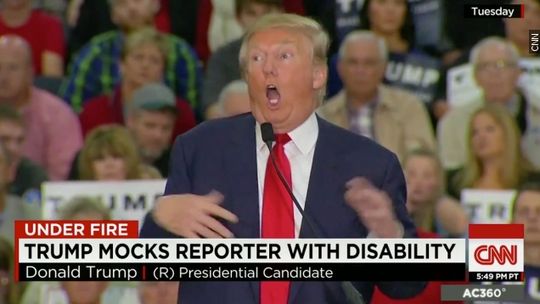
I am not a “Never Trump” advocate. I can conceive of a Presidential race that would force me to vote for Donald Trump, over, say, a Gorn, frightful Florida Congressman Alan Grayson, “Simple Jack” or Darth Vader. None of those, fortunately, are likely to be running in 2016, however, so the issue is moot. I have stated that there is no rational reason to vote for a candidate as undeniably unfit as Trump when the alternative is a candidate as undeniably as unfit as Hillary Clinton. Unlike Trump, Clinton does have positive features in her resume. As a Senator and former Secretary of State, she presumably has a passing comprehension of how the government works, and she comprehends the importance  of  public decorum and civility for a national leader, meaning that she knows that boasting about her penis or doing this…

Trump-Mocks-Disabled-Reporter-CNN-USA-Today

…is not remotely Presidential. Hillary’s positive features are, we all know, buried beneath the avalanche of her dishonesty, venality, incompetence and corruption,  but still, she has something. +1 beats – 1,606…even zero beats – 1,606.

Months ago, I challenged Trump supporters, Trump fans, Trump defenders and even Trump “oh come on, nobody is that bad”-ers to present a single, substantive, positive feature of Donald Trump that could justify voting for him as President. I have searched for and read alleged posts by professional pundits and others; I have listened to (until overcome with depression and nausea) Trump’s uniformly idiotic surrogates, and I have invited submissions. The results? Zilch. Nada. Bupkis.

“Hillary is evil!” is not a positive argument for Trump. Other submissions— “He’ll destroy the Republican Party, those collaborating traitors!”—“I’m mad as hell, and I’m not going to take it any more!,” “He says what he thinks!,” “I hate political correctness!,” “He’ll stick it to the elites!” and the ever-popular incoherent grunt—are similarly non-responsive. I don’t think it is too much to ask, and the lack of any entry remotely meeting the modest requirements (the best so far is, “At least the news media might do their job with someone like him as President”) makes me more certain by the day that 1) I am correct to reject him and 2) that Gorn may not be so bad.

Clearly I am not the only one engaging in this quest. The Washington Post obviously searched under every rock to come up with an academic who would put his name on an op-ed last week titled “Why ‘Never Trump’ conservatives are wrong about Trump.”

He is Charles R. Kesler, a professor of government at Claremont McKenna College, and the editor of the Claremont Review of Books. My heart soared like a hawk when I saw the column:  Claremont McKenna is an excellent institution, and finally someone who does not communicate in howls, hocks and memes had written down a substantive argument to vote for Donald Trump!

But no.

Here, alas,  are his “substantive” points: Continue reading →

Essay: On Loretta Lynch And Fighting Cynicism And Distrust Regarding The FBI Investigation Of Hillary Clinton

America_Falling_Apar

Warning:

This is long.

I think it’s important

In the wake of Attorney General Lynch’s acknowledgment of wrongdoing in meeting, however briefly and innocently, with Bill Clinton, some  reader comments here are redolent of the destructive distrust of government and leadership engendered by this administration and others, particularly Bill’s. Yet this attitude feeds on itself, and is to an extent a self-fulfilling prophecy. If leaders think that people expect corruption, they are less likely to shy away from it. Cynicism leads to acceptance. Of course, this is one explanation of why the tarmac meeting took place—pure arrogance and a belief that with the news media’s complicity, now virtually any degree of government dishonesty and corruption will be either effectively hidden from the public, or accepted by it.

This is untrue, still. Indeed, this episode is proof that it is untrue, though the news media did make (disgusting and ignorant) efforts to shrug off the clear appearance of impropriety represented by Lynch having a meeting with Clinton the Impeached under these circumstances. Why do I labor trying to write these essays explaining the legal and ethical context of such events if readers are so poisoned by bitterness and distrust that they can’t or won’t process them, and just default to “it doesn’t make any difference, all is shit, all is lost”?  If I believed that, I wouldn’t be spending time—work  time, uncompensated time—writing this stuff. I can earn peanuts directing professional theatrical productions: it makes people happy, gives actors work, and is a lot more fun, believe me.

Paranoia, suspicion, despair, and conspiratorial views of government, which are all these comments represent, are just forms of bias. Bias makes us stupid, and in this case, bias makes us dysfunctional as a people and fearful and miserable as individuals. Continue reading →

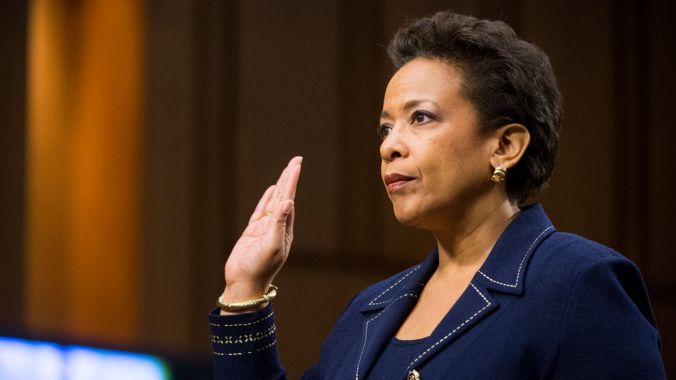
Now, Whatever Else, We Know That Attorney General Loretta Lynch Is More Ethical Than Hillary Clinton

Lynch2

Attorney General Loretta Lynch’s response to the immediate criticism of her private, suspicion-generating meeting with Bill Clinton was the correct one and the only ethical response open to her now. Today she admitted that that her airport meeting with former President Bill Clinton while possible charges against Hillary Clinton were being explored by the FBI had undermined public trust in the investigation, and she also took remedial action. She did more than recuse herself from the matter. She announced that she would  accept whatever recommendations that career prosecutors and the F.B.I. director make about whether to bring charges against the presumptive Democratic nominee.

“I will be accepting their recommendations,”  Lynch said in an appearance at the Aspen Ideas Festival. She said that “the case will be resolved by the same team that has been working on it from the beginning.”

This remarkable move will not remove the stain on the meeting, which already created the “appearance of impropriety” at the worst possible time in the worst possible matter. However, Lynch acted quickly, appropriately, honestly and decisively.  Incredibly, the episode may have actually resulted in a situation that will reduce public and political cynicism if Clinton is not indicted, except for those who will insist that the fix was in from the beginning, as indeed it might have been, given the general lack of accountability and propensity for cover-ups in the Obama administration.

As one delicious scenario, it is possible that Bill Clinton’s characteristic penchant for breaking the rules at will may have created a situation that leads to his wife having to face criminal charges. It is certainly true that the chances, still slim, that Hillary will have to face the music is greater now than it was two days ago. Continue reading →

Four Supreme Court Decisions: Abortion, Guns, Affirmative Action, Corruption…And Ethics. Part 2: McDonnell v. United States

Virginia Governor McDonnell shows off the luxury watch he got as a gift from a businessman he barely knew who expected expected nothing in return...

Virginia Governor McDonnell shows off the luxury watch he got as a gift from a businessman he barely knew who expected expected nothing in return…

Governor Bob McDonnell, Virginia’s Republican governor from 2010 to 2014, was charged with using his office to assist businessman Jonnie R. Williams Sr., who, often with Mrs. McDonnell as a conduit, gave his family wedding receptions, loans, vacations and jewelry worth more than $175,000. I wrote about this scandal here, here, and here. The gifts were legal, thanks to absurdly lenient Virginia ethics laws, just as they were obviously unethical, except perhaps to the clueless McDonnells.

Governor McDonnell arranged meetings for Williams and attended events with him. My favorite part of the criminal trial was when McDonnell claimed that he never dreamed that Williams expected anything in exchange for all of his gifts, and then Williams said that of course he expected some favors in return. The jury found that McDonnell’s actions amounted to corruption and a quid pro quo exchange amounting to bribery. A federal appeals court upheld the conviction.

The Supreme Court’s 8-0 decision this week to vacate the conviction upholds the principle that even if someone has done something obviously bad, there has to be a law against what was done before the act occurred in order to convict him. It’s a rather narrow decision. The Court points out that the law McDonnell was convicted of breaking requires “official acts” to be bought and sold for the law to be breached, but that all McDonnell did was hand out political favors to his “friend”: setting up meetings, communicating his favor, greasing the wheels, essentially. (Much is made of the fact that Williams didn’t benefit very much from any of this, which is just moral luck. It doesn’t make what the governor did any less sleazy.)

Wrote Chief Justice Roberts in his opinion for the unanimous Court: Continue reading →