American Disrespect for History, April 18 Edition

I waited until midnight, just to see if how many major news organizations would note the importance of April 18 before it was over. Oh, many mentioned the Boston Marathon, and almost every one of them prominently mentioned that it was tax day. The real importance of April 18, however, and the American heroes who made it significant, was ignored yesterday in all but a pitiful few newspapers and websites. It was yet another example of this country’s growing disrespect for its origins, its ignorance of the deeds of the men and women who created the United States, and the increasing disconnect between America’s present and its founding ideals.

On April 18, 1775, an accomplished silversmith named Paul Revere, eventually joined by fellow patriots  Charles Dawes and Dr. Samuel Prescott, rode from Charlestown, Mass. to Lexington, stopping at houses and farms along the way to warn the occupants that “The British are coming!” Continue reading →

Unethical U.S. Presidential Candidacies: Is Trump’s the All-Time Worst?

There have been many unethical candidacies for U.S. President in American history, and some of them have been successful.

I am not referring to unethical candidates for the job, for there have been too many of them to count. An unethical candidacy occurs when a candidate’s purpose for seeking the job, method of doing so, and/or the effect on the nation of his or her campaign is especially reckless, harmful, or irresponsible. Perhaps the first unethical candidacy was that of Aaron Burr, who attempted to exploit a flaw in the election process to steal the presidency from his position as a vice-presidential candidate. Rutherford B. Hayes allowed himself to be put in office by an undemocratic back-room deal when his opponent, Samuel Tilden should have won both the popular and electoral vote.

Teddy Roosevelt’s decision to oppose his old friend, President Taft, in 1912, splitting his party, breaking his word (he had earlier refused to run for what was in essence a third term, agreeing it was best to hold to George Washington’s tradition), and all-but-insuring Woodrow Wilson a victory, was an exercise in ego and hubris. Eight years later, Sen. Warren G. Harding, who privately expressed doubts about his ability to fill the highest post in the land, may have allowed himself to be manipulated and used by corrupt political operatives for their own purposes. Franklin Roosevelt recklessly ran for his fourth term knowing that he was seriously and perhaps terminally ill, and didn’t take care to ensure that he had a competent Vice-President. (He, and the U.S., were lucky in that regard.)

Gov. George Wallace’s third party presidential run in 1968 was explicitly racist. The beneficiary of that candidacy, President Richard Nixon infamously pursued re-election with a new low of unethical and even illegal tactics against the Democrats. There have been others.

Donald Trump’s revolting candidacy, as yet unannounced, cannot fairly be called the most unethical presidential candidacy, but it is early yet. It may well prove to be one of the most harmful. As the United States faces some of the most difficult challenges in its history, Trump has chosen to use the nation’s process of deciding on its leader for his own ego gratification and self-promotion, without  preparation for the job, deference to fair campaign rhetoric, or acknowledgment of his own fatal flaws as a candidate. Continue reading →

The Unethical Deficit Debate, a Cause for Despair

Our future, thanks to Washington, D.C.

If the bi-partisan dishonesty and unethical conduct surrounding the budget showdown last week didn’t cause you to despair, then you weren’t paying attention:

  • At a time when the federal deficit threatens the long-term (and not all that long, either) solvency of the U.S., risking quality of life, world leadership and security while placing us under the thumb of China, a Machiavellian adversary, both parties—and the President— opted for ideological point-scoring and demagoguery rather than serious explication of the issues.  Irresponsible cowards.
  • The government was brought to the brink of a shutdown over a pathetic, meaningless, 39 billion dollars of cuts that Democrats called “draconian” and Republicans and Obama trumpeted as the “largest budget cuts in U.S. history”. They were draconian only if you think like Senate Majority Leader Harry Reid, who argued that Republicans were heartless to put “cowboy poetry” on the cutting block, and if, as is increasingly looking to be the case,  the Democrats are willing to let the country stay on the road to bankruptcy as long as it also leads them to power. The cuts were the “largest” only in their inflated figures: the budget was cut close to 50% after World War II. Liars and frauds.
  • Even if it were truly”the largest,” the heralded 39 billion dollars cut represented an infinitesimal dent in the overall budget and will have no appreciable effect on the deficit at all. It took a near shutdown to accomplish that. Easy Quiz: what are the chances of our current leaders displaying the political courage to make the substantial, genuine, painful cuts that all serious analysts agree are imperative to stave off financial ruin? Liars and cowards.
  • After all of the drama, after all the condemnation and hype, after “draconian” and “largest ever,” and after the President joined the charade, the no-nonsense Congressional Budget Office announced that by its calculations, the so-called cut was mostly fiction. It boiled down to only $352 million, less than 1% of a 39 billion that was inadequate to begin with. Incompetents.
  • The Democrats chuckled into their sleeves; the Republicans cried that they had been deceived, as if legislators don’t have the resources to find out what the money in the budget they are charged with approving actually pays for. Liars, incompetents and fools.

For me, the low point was President Obama’s speech at George Washington University, announcing his engagement—finally!—in the deficit-cutting debate while resorting that old Democrat stand-by, class warfare; blaming the Bush tax cuts, irresponsible but only one of many contributors to the deficit crisis; and  pledging to cut expenses by ending waste, fraud and abuse while simultaneously stating that the deficit couldn’t be cut by addressing waste, fraud and abuse.  It wasn’t any of those cynical moments that caused me to lose hope, however. It was the President’s insistence that the deficit cutting measures must not interfere with his highest priorities…such as building “new roads.” Continue reading →

Global Warming Advocates Flunk Ethics, and Credibility…Again

Never mind!

The evidence for global warming is pretty overwhelming, though still possessing some holes, and the likelihood is that much of the change is man-made. That’s about as far as the scientific evidence goes, however, without getting into serious controversy. The dire climate chance projections continue to be questionable at best, which poses problems for environmentalists who want to use climate change as a wedge to shut down industry, and alarmists who are frightened out of their wits by science they really don’t understand. Rather than demonstrate that the science is unbiased and credible by acknowledging the uncertainty, the global warming community, including elected officials with agendas, radical anti-industrialists, various research, political and advocacy groups and a depressing number of scientists who know better—and Al Gore…can’t forget Al!—have resorted to outrageous scare tactics and apocalyptic “projections.” Continue reading →

Why We Cannot Trust The News Media, Reason #116: ABC’s Deceptive Video Editing

The ABC News version: "I'm going to make him an offer!"

In a fiery speech in budget wars epicenter Madison, Wisconsin yesterday, whatever-she-is Sarah Palin told cheering Tea Party followers,

“If you stand by your platform, if you stand by your pledges, we will stand with you, we will fight with you, GOP, we will have your back. What we need is for you to stand up, GOP, and fight. GOP leaders need to learn how to fight like a girl!”

“Fight like a girl” —that is, like Palin—immediately spread over the internet, one more example of Palin’s uncanny bumper-sticker catch phrase talent. Now here is how ABC’s “This Week with Christiane Amanpour” played the video today:

“What we need is for you to stand up, GOP, and fight. GOP leaders need to learn how to fight—!” Continue reading →

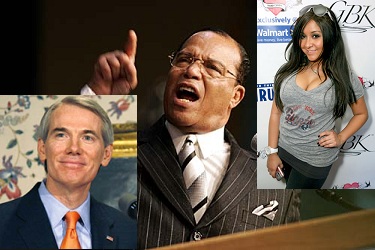
Ethics Quiz: Farrakhan, Snooki, Senator Portman, and University Speaker Ethics

Pick your poison!

Your Ethic Quiz question for the weekend: Which of these is the most unethical choice to speak at a University?

Your choices:

A. Nicole “Snooki” Polizzi, the over-the-top trashy break-out star of the bottom-of-the barrel cable reality show “Jersey Shore,” hired for $32,000 by Rutgers University to address students. Continue reading →

Would It Be Ethical To Prohibit Civicly Ignorant Citizens From Voting?

CNN columnist L.Z. Granderson made the argument in a recent website post that it would be reasonable to deny the right to vote to ignorant Americans who cannot name the three branches of government and who have nary a clue about the issues facing the country .

Granderson could have saved some time by simply writing the undoubted truth that American policies, progress and choices of leaders and are greatly handicapped by the fact that lazy, uninformed, blissfully ignorant boobs warp our democratic process….and have almost from the beginning. But so what? What can be done about it? There is one thing for certain: taking away the right to vote based on someone’s subjective formula for measuring “ignorance” isn’t among the realistic—or ethical—solutions. Continue reading →

Ethics Hero: Arizona Governor Jan Brewer

There is hope for Arizona yet...

Earlier, I wrote about a bill passed by the Arizona legislature that would broadly allow religious practices and beliefs to trump professional obligations, ethics codes and discipline. The bill, SB 1288, directed in part:

A. Government shall not deny, suspend or revoke a professional or occupational license, certificate or registration based on a person’s exercise of religion.

B. Government shall not deny, suspend or revoke a professional or occupational license, certificate or registration based on a person’s refusal to affirm a statement that is contrary to the person’s sincerely held moral or religious beliefs, regardless of whether those beliefs are specifically espoused by a recognized church or religious body…

C. A person’s exercise of religion is not unprofessional conduct.

It was widely assumed, including by me, that Republican governor Jan Brewer would sign this stunningly awful bill into a law which would allow any practice that could be called “religious” to be immune from community, cultural and professional norms of right and wrong unless they were explicitly illegal. She did not. She vetoed it, an act of responsible leadership and political courage.

You can read her veto letter here.

The “Baby Emma” Saga Revisited: The Core Issue

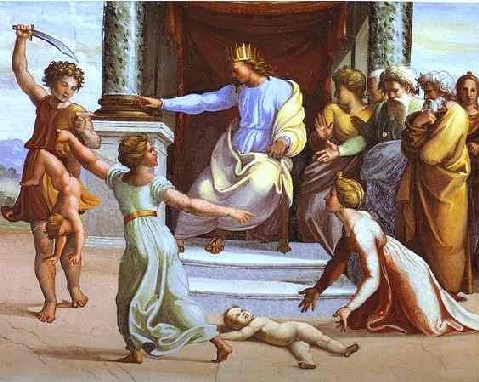
Didnt King Solomon have a case like this once?

When the mother of the child an unmarried father co-created with her decides that she doesn’t want to/ can’t raise the child and doesn’t trust the father to raise her, is it ethical to put said child up for adoption without notifying or consulting the father?

That is the ethical issue the “Baby Emma” incident, first discussed here in an earlier post, ultimately raises. It is a question that I did not discuss in that post, focusing instead on the father’s conduct and his current plight, as self-described on his “Baby Emma” website. I made three ethical assessments, each of which are self-evident:

1. The whole situation would have probably not occurred if John Wyatt and Baby Emma’s mother had been married before conceiving a child.

2. Both of them were irresponsible to plan on having a child together without formalizing a mutual commitment to form a family and raise the child together…that apparently archaic institution known as “marriage.”

3. The mother betrayed John’s trust, deceived him, and treated him unfairly.

I also suggested that, absent a marriage, it is fair and reasonable that the mother of a newborn be able to put the child up for adoption if she deems that course better for the child than being raised by the child’s father. I did not say that was the law, or even that I would vigorously oppose a law that directed otherwise, as Virginia’s law does. I only stated that my own belief is that incentives for irresponsible parenthood are unwise. I have been asked why I focused on the issue I did, rather than the other ethical issues raised by the controversy. It was because the issue was brought to me with the presumption that John Wyatt, the father, was a blameless and unequivocal victim in the matter. My ethics alarms sounded: he has significant ethical accountability for the mess, and I explained why.

As to the answer to question above, I can only say this: it depends. The conduct of Baby Emma’s mother is mysterious and extreme. Did she panic? Did she have a mental break? Why would a lifetime friend and partner of a man conceive a child, pretend to plan to raise her with him, and then secretly negotiate to have the baby adopted and taken out of state?

I see many scenarios that could be behind her decision, which fall into three distinct categories: ethical, unethical, and too close to call: Continue reading →

Just So You Know The Legal Profession Is Trying…

The Massachusetts bar has suspended a lawyer for six months for running an advertisement on Craigslist offering to write  papers and essays for students to turn in as their own. The state Board of Bar Overseers of the state Supreme Judicial Court issued a memorandum April 1 announcing that lawyer Damian R. Bonazzoli was suspended from practice.  He also lost his job lost his job with the state Appeals Court.

Good. Continue reading →