Gee, Who Could Have Ever Predicted That Marijuana Use Would Become a Problem? Me, For One…

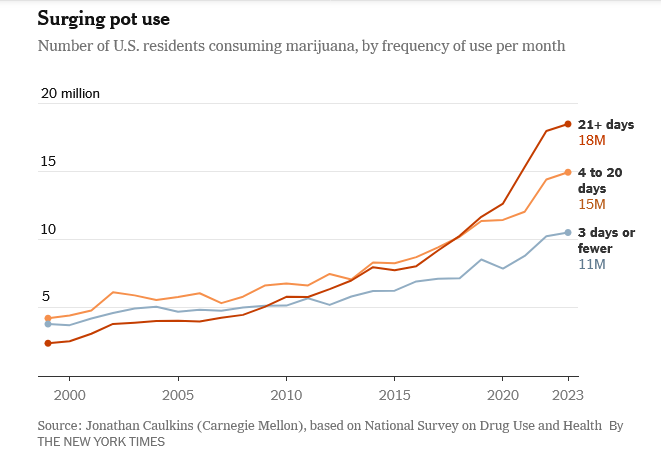
I really try not to get emotional over ethics stories, but the current Editorial Board declaration in the New York Times headlined, “It’s Time for America to Admit That It Has a Marijuana Problem” makes me want to run screaming naked into Route 395.

The U.S. had a marijuana problem a half century ago, when an earlier wave of The Great Stupid washed over the land and all manner of important lessons a healthy and functioning society needed to remember and institutionalize were deliberately tossed away because a lot of passionate, anti-establishment assholes were sure that they knew better than anyone “over 30.” I fought this destructive development from college, when I watched one of my room mates suffer short term memory loss from getting stoned morning and night; in law school, when the student running my lightboard for a production of “Iolanthe” erased all the light cues that we had taken six hours to set up because he was higher than the moons of Jupiter, all the way onto this blog. I put up with the mockery of classmates and dorm mates over the fact that I would not “try” pot (“It’s illegal” wasn’t a winning argument, so I settled on “It’s stupid and destructive.”). I drew a line in the sand with my addiction-prone wife, a former pot-head who was already an alcoholic. My fellow lawyers quickly learned not to get stoned around me because they knew I regarded buying and selling pot when it was illegal grounds for reporting them to bar authorities and respected my integrity enough to have reasonable doubts that I might not pretend that I didn’t know what I knew.

I carried the battle onto Ethics Alarms as the relentless pro-stoner propaganda was heading to victory, resulting in the legalization of the drug, the inevitable result of which the assholes who edit the New York Times have the gall now to tell us “Oopsie!” about after being a significant part of the mob mentality that inflicted it on the public, probably forever.

Back in 2011, I drafted a post that I never finished titled, “To My Friends the Pot-Heads: I Know. I’ve Heard It All Before.” It began:

“I take a deep breath every time I feel it necessary to wade into the morass of the Big Ethical Controversies, because I know it invites long and fruitless debates with entrenched culture warriors with agendas, ossified opinions, and contempt for anyone who disagrees with them. War, abortion, religion, prostitution, drugs, torture, gay marriage…there are a lot of them, and all are marked by a large mass of people who have decided that they are right about the issue, and anyone disagreeing with them is stupid, evil, biased, or all three. Contrary to what a goodly proportion of commenters here will write whichever position I take, I approach all of these issues and others exactly the same way. I look at the differing opinions on the matter from respectable sources, examine the research, if it is relevant, examine lessons of history and the signals from American culture, consider personal experience if any, and apply various ethical systems to an analysis. No ethical system works equally well on all problems, and while I generally dislike absolutist reasoning and prefer a utilitarian approach, sometimes this will vary according to a hierarchy of ethical priorities as I understand and align them. Am I always right? Of course not. In many of these issues, there is no right, or right is so unsatisfactory—due to the unpleasant encroachment of reality— that I understand and respect the refusal of some to accept it. There are some of these mega-issues where I am particularly confident of my position, usually because I have never heard a persuasive argument on the other side that wasn’t built on rationalizations or abstract principles divorced from real world considerations. My conviction that same-sex marriage should be a basic human right is in this category. So is my opposition, on ethical grounds, for legalizing recreational drugs.”

Instead of finishing and posting that essay, I posted this one, which used as a departure point a Sunday ABC News “Great Debate” on hot-point issues of the period featuring conservatives Rep. Paul Ryan and columnist George Will against Democratic and gay Congressman Barney Frank and Clinton’s former communist Labor Secretary Robert Reich. [Looking back, it is interesting how all four of these men went on to show their dearth of character and integrity. Ryan proved to be a spineless weenie, rising to Speaker of the House but never having the guts to fight for the conservative principles he supposedly championed. Frank never accepted responsibility for the 2008 crash his insistence on loosening mortgage lending practices helped seed, preferring to blame Bush because he knew the biased news media would back him up. Will disgraced himself by abandoning the principles he built his career on in order to register his disgust that a vulgarian like Donald Trump would dare to become President. Reich was already a far left demagogue, so at least his later conduct wasn’t a departure. I wrote in part,

The N.F.L. Is Helping Chuck Klosterman’s Prediction Come True [Corrected]

I was going to get this up before the Super Bowl, but it turns out that the issue was further crystalized by the game itself. As happens approximately 50% of the time with this annual spectacle, the game was a yawn, and much of the news coming out of the contest involved the NFL’s deliberate transformation of what was once considered a unifying family cultural event, like Fourth of July fireworks, into a partisan, progressive statement about how America sucks, with expensive TV ads extolling capitalism and patriotism at the same time. That’s message whiplash, and ethically irresponsible.

As the New York Times explained, without criticism, the NFL took a hard turn Left when it put Barack Obama pal Jay-Z, the rap star and impresario, in charge of the Super Bowl halftime show after the 2018 Super Bowl had triggered anger from fans over players “taking a knee” during the National Anthem. The Times, spinning as usual, says that the kneeling was intended to “draw attention to police brutality and social justice issues.”

As Ethics Alarms pointed out at the time, none of the kneelers, including its cynical originator, over-the-hill quarterback Colin Kaepernick, ever explained coherently what they were kneeling about. What “police brutality”? Oh, you know, Mike Brown, whom Black Lives Matters still says was “murdered” on its website. What social justice issues? Oh, you know: it’s time for white people to be discriminated against to make up for slavery. The left-turn was a greed-induced mass virtue signal to blacks, clueless young fans, and Democrats. (It helped that President Trump vociferously attacked Kaepernick and Co., so the kneeling appealed to the Trump Deranged too. (See Dissonance Scale, Cognitive)

The Times:

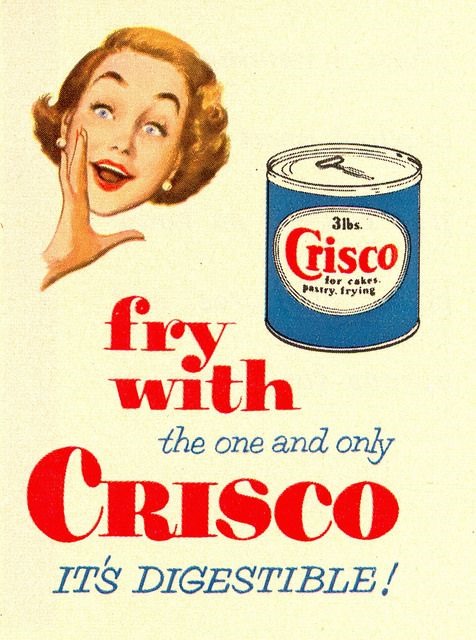
From The “I Did Not Know That!” Files: The History of Crisco

A British personal trainer and fitness coach named Sama Hoole posted this on “X”:

1866: Cotton seeds are agricultural waste. After extracting cotton fiber, farmers are left with millions of tons of seeds containing oil that’s toxic to humans. Gossypol, a natural pesticide in cotton, makes the oil inedible. The seeds are fed to cattle in small amounts or simply discarded.

1900: Procter & Gamble is making candles and soap. They need cheap fats. Animal fats work but they’re expensive. Cotton seed oil is abundant and nearly worthless. If they could somehow make it edible, they’d have unlimited cheap raw material. The process they develop is brutal. Extract the oil using chemical solvents. Heat to extreme temperatures to neutralise gossypol. Hydrogenate with pressurised hydrogen gas to make it solid at room temperature. Deodorise chemically to remove the rancid smell. Bleach to remove the grey color. The result: Crisco. Crystallised cottonseed oil.

Industrial textile waste transformed through chemical processing into something white and solid that looks like lard. They patent it in 1907, launch commercially in 1911. Now they have a problem. Nobody wants to eat industrial waste that’s been chemically treated. Your grandmother cooks with lard and butter like humans have for thousands of years. Crisco needs to convince her that her traditional fats are deadly and this hydrogenated cotton-seed paste is better. The marketing campaign is genius. They distribute free cookbooks with recipes specifically designed for Crisco. They sponsor cooking demonstrations. They target Jewish communities advertising Crisco as kosher: neither meat nor dairy. They run magazine adverts suggesting that modern, scientific families use Crisco while backwards rural people use lard.

But the real coup happens in 1948. The American Heart Association has $1,700 in their budget. They’re a tiny organisation. Procter & Gamble donates $1.7 million. Suddenly the AHA has funding, influence, and a major corporate sponsor who manufactures vegetable oil.

1961: The AHA issues their first dietary guidelines. Avoid saturated fat from animals. Replace it with vegetable oils. Recommended oils: Crisco, Wesson, and other seed oils. The conflict is blatant. The organization issuing health advice is funded by the company that profits when people follow that advice. Nobody seems troubled by this. Newspapers report the guidelines as objective science. Doctors repeat them to patients. Government agencies adopt them into policy. Industrial cotton-seed oil, chemically extracted and hydrogenated, becomes “heart-healthy” while butter becomes “artery-clogging poison.”

1980s: Researchers discover that trans fats, created by hydrogenation, directly cause heart disease. They raise LDL, lower HDL, promote inflammation, and increase heart attack risk more than any other dietary fat. Crisco, as originally formulated, is catastrophically unhealthy. This takes 70 years to officially acknowledge. Procter & Gamble’s response: Quietly reformulate without admission of error. Remove hydrogenation, keep selling seed oils, never acknowledge that their “heart-healthy” product spent seven decades actively causing the disease it claimed to prevent. Modern seed oils remain. Soybean, canola, corn, safflower oils everywhere. Same chemical extraction process. Same high-temperature refining. Same oxidation problems. Just without hydrogenation so trans fats stay below regulatory thresholds. These oils oxidise rapidly when heated. They integrate into cell membranes where they create inflammatory signalling for months or years. They’re rich in omega-6 fatty acids that promote inflammation. They’ve never existed in human diets at current consumption levels. But they’re cheap. Profitable. And the food industry has spent a century convincing everyone they’re healthy. The alternative, admitting that industrial textile waste shouldn’t have been turned into food, would require acknowledging the last 110 years of dietary advice was fundamentally corrupted from the start. Your great-grandmother cooked with lard because that’s what humans used for millennia. Then Procter & Gamble needed to sell soap alternatives and accidentally created the largest dietary change in human history.

We traded animal fats that built civilisations for factory waste that causes disease. The soap company won. Your health lost.

I have no idea if this is all true, partially true, a matter of dispute, or complete fantasy. But I bet RFK Jr. likes it. The story, which certainly has the ring of truth, also raises the issue of trusting science and experts, especially when business interests and money are involved.

My personal favorite use of Crisco was when people would mix it with food coloring and sugar and call it “frosting.”

On The Limitations Of Expertise

Guest Column by Sarah B.

[From your Host: This excellent essay arrived on an Open Forum, and as I sometimes do, has been elevated from Comment of the Day status to a Guest Column. I’ll even forgive Sarah for making me look bad in comparison to such thoughtful, eloquent and perceptive work.]

***

“The embarrassment is that chemistry was treated as a mere technicality rather than the foundation of the entire conclusion. The embarrassment is that skepticism—real skepticism, the disciplined refusal to accept claims without robust evidence—was framed as denial rather than diligence.”

This is, in my opinion, the money quote from The Brain, Microplastics, and the Collapse of Scientific Restraint. 

This particular article discusses the extraordinary claim that our brains contain a huge amount of microplastics.  The problem with this claim is that the study has a fatal methodological flaw.  The study relies on spectroscopy and detecting signatures of chemicals to determine a sample’s composition.  However, the fats in the brain break down into similar compounds as polyethylene, which means without further differentiation methods, there is no way to tell if the “microplastics” the study detected were actually just normal lipids found in the brain.  The whole article is worth reading, as it does an excellent job of explaining the issue. 

I recently saw a post on Facebook that decried the idea that experts could be challenged by some novice watching a few YouTube Videos and reading a few scientific papers.  This led to a long discussion in the comments, which was unfortunately extremely one-sided.  Most everyone agreed that trying to correct an expert in their field was utter hubris.

“Take something you are good at, like maybe changing transmissions.  Imagine someone who has watched a few YouTube videos comes up and tells you that you are doing it all wrong.  How would you respond?”

The main problem with this is that, in terms of changing a transmission, we can obviously see who is right and who is wrong.  The car will run, or the car will not.  Indeed, if you truly are an expert in changing transmissions, you can step up and, in simple terms, explain why your process is the correct one, what is wrong with the YouTube watcher’s process, and even perhaps teach your skeptic how to do it correctly. 

With any field of expertise, we have to remember that experts are people too, and all humans have flaws.  Experts can be tempted by money, power, prestige, and politics.  There are also limitations that even experts struggle to overcome.  For example, in many branches of research, there are serious problems (often ethical in nature) in creating a good control group. 

Kanye West Issues a Level #1 Apology…Or Maybe Not

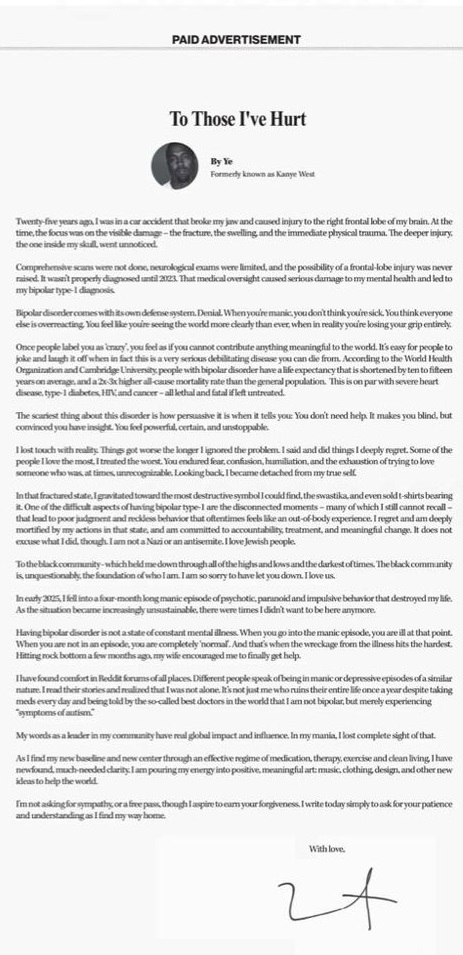
That’s the full page ad that “Ye,” aka. Kanye West, paid to have placed in, of all papers, the Wall Street Journal. I wonder what percentage of WSJ readers even know who the hell he is? Never mind; he did it. Here’s what the ad says (I hesitate to put down “he wrote’):

“Twenty-five years ago, I was in a car accident that broke my jaw and caused injury to the frontal lobe of my brain. At the time, the focus was on the visible damage – the fracture, the swelling, and the immediate physical trauma. The deeper injury, the one inside my skull, went unnoticed….”

It wasn’t properly diagnosed until 2023. That medical oversight caused serious damage to my mental health and led to my bipolar type-1 diagnosis. Bipolar disorder comes with its own defense system. Denial. When you’re manic, you don’t think you’re sick. You think everyone else is overreacting. You feel like you’re seeing the world more clearly than ever, when in reality you’re losing your grip entirely.

Once people label you as crazy, you feel as if you cannot contribute anything meaningful to the world. It’s easy for people to joke and laugh it off when in fact this is a very serious debilitating disease you live from….

The scariest thing about this disorder is how persuasive it is when it tells you: You don’t need help. It makes you blind, but convinced you have insight. You feel powerful, certain, and unstoppable. 

I lost touch with reality. Things got worse the longer I ignored the problem. I said and did things I deeply regret. Some of the people I love the most, I treated the worst. You endured fear, confusion, humiliation, and the exhaustion of trying to love someone who was, at times, unrecognizable. Looking back, I became detached from my true self. 

In that fractured state, I gravitated toward the most destructive symbol I could find: the swastika, and even sold t-shirts bearing it. One of the difficult aspects of having bipolar type 1 are the disconnected moments – many of which I still cannot recall that lead to poor judgment and reckless behavior that oftentimes feels like an out-of-body experience. I regret and am deeply mortified by my actions in that state, and am committed to accountability, treatment, and meaningful change. It does not excuse what I did, though. I am not a Nazi or an antisemite. I love Jewish people. 

To the black community – which held me down through all of the highs and lows and some of my darkest times. The black community is, unquestionably, the foundation of who I am. I am so sorry to have let you down. I love us. 

In early 2025, I fell into a four-month long manic episode of psychotic, paranoid and impulsive behavior that destroyed my life. As the situation became increasingly unsustainable, there were times I didn’t want to be here anymore. 

Having bipolar disorder is not a state of constant mental illness. When you go into the manic episode, you are ill at that point. When you are not in an episode, you are completely “normal.” And that’s when the wreckage from the illness hits the hardest. Hitting rock bottom a few months ago, my wife encouraged me to finally get help. 

I have found comfort in Reddit forums of all places. Different people speak of being in manic or depressive episodes of a similar nature. I read their stories and realized that I was not alone. It’s not just me who run [sic] their entire life once a year despite taking meds every day and being told by the so-called best doctors in the world that I am not bipolar, but merely experiencing “symptoms of autism.” 

My words as a leader in my community have real global impact and influence. In my mania, I lost complete sight of that. 

As I find my new baseline and new center through an effective regime of medication, therapy, exercise and clean living, I have newfound, much-needed clarity. I am pouring my energy into positive, meaningful art: music, clothing, design, and other new ideas to help the world. 

I’m not asking for sympathy, or a free pass, though I aspire to earn your forgiveness. I write today simply to ask for your patience and understanding as I find my way home.”

It’s time to check the old, Ethics Alarms Apology Scale to see where this whatever it is fits.

According to the scale, this is the hierarchy of apologies, their function and their motivation, from most admirable to the least credible:

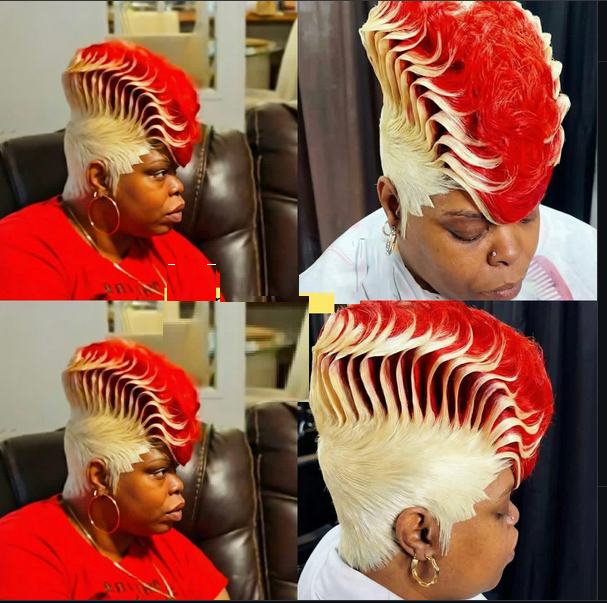
Ethics Quiz: the Narcissist Nurse

The woman above, a nurse at a Georgia hospital, was told to go home and not to come back to work until she got rid of her flamboyant (I’m being nice) hair style. The woman—I don’t care what her name is—claims that the ‘do is culturally significant, whatever that’s supposed to mean. She also claims that it doesn’t interfere with her job, which I would dispute, and that the hospital is discriminating against her race by telling her that is isn’t professional to dress up like an exotic bird …

…to care for sick people.

I think the lawsuit is a loser: I’m sure the administrators will say convincingly that no one, male or female, black, white or puce, would be allowed to work with that on their head. The woman is an exhibitionist. Personally, I would be wary of trusting any hospital that allowed someone with such dubious judgment and misaligned values to be charged with patient care.

Also, as someone whose week long stay in a hospital last summer featured being awakened out of a deep sleep to have some nurse’s head four inches from my face, the sight of that hat hair could spark a cardiac episode.

But hey! I can be convinced otherwise. So that’s why…

Today’s Ethics Alarms Ethics Quiz is…

Is a nurse who wears her hair like that meeting minimal professional standards?

From Maryland, A “When Ethics Fails, The Law Steps In” Verdict

I recently re-watched “Runaway Jury,” the ethically and legally repugnant film adaptation of a John Grisham legal thriller. It’s one of the most unethical movies extant, and before the last couple of years I would have said such egregious lawyer conduct as depicted in the film was unlikely to the point of impossible (as in most of Grisham’s books). The novel and movie involved a high-profile civil suit: the widow of a man murdered when a fired employee “goes postal” seeks to hold the manufacturer of the gun used by the killer liable for millions in damages. A pair of anti-gun zealots conspire to both rig the jury verdict and ruin the evil jury consultant (Gene Hackman) who helped defeat their home town in a similar case years before. In the end the “good guys” win (that is, Hollywood’s idea of “good”); I have mentioned the film before in the context irresponsible films and TV shows that actively misinform the public about a lawyer’s ethical responsibilities. Now comes a jury verdict from Maryland where a jury delivered a multi-million dollar verdict against Walmart for allowing an employee to buy a shotgun before he used it to blow his head off.

Continue reading

Ethics Quiz: The Turncoat Fat Comic

I decided to skip this issue a month ago when comic Amy Schumer was being called a hypocrite for suddenly showing off her newly svelte, Ozempic-drowned body all over social media after spending years defending being”plus size.” Then she posted bikini photos yesterday and social media was freaking out again.

“I think there’s nothing wrong with being plus size,” Schumer argued in a tiff with Glamour Magazine a decade ago. “Beautiful healthy women.” Amy got progressively more plus-size as the years went by and was more militantly anti-fatshaming as a “body-positivity” advocate while the pounds piled on.

Continue reading

Ethics Observations On The Dionne Quintuplets’ Resentment

The last of the famous Dionne Quintuplets died last week. Annette Dionne, who seems to have been the strongest of the five identical sisters from the very beginning, was 91. The New York Times has an obituary that is also an excellent feature on their unusual lives (Gift link!)—this is the kind of thing the Times still does well. There isn’t a single slap at President Trump anywhere, at least that I noticed.

The article begins by noting that Annette, like all of her sisters, “resented being exploited as part of a global sensation.” I get it: the five girls were celebrities from the second they were born, and their fame was such that they never really escaped it: thus the last surviving quint being deemed worthy of a Times obituary more than 60 years after her birth. But resenting something that any objective analysis would find unavoidable is not just pointless, it’s unfair. In this case, the resentment was unfair to the quints’ parents and the public.

In 1934, the birth of surviving quintuplets in Ontario, Canada was considered, justifiably, a medical miracle. All five of them together weighed only 13 pounds, 6 ounces. Yes, in a way they were freaks and treated as such, extraordinarily cute little freaks. Medical miracles give people hope; they suggest that the world is getting smarter, safer, more beneficent. This miracle happened in the pit of the Great Depression, when celebrities like Babe Ruth and Shirley Temple became icons because they made Americans forget their troubles.

To the girls’ parents, Oliva and Elzire Dionne, the arrival of five babies to a family living in poverty was a looming catastrophe. The parents and five children already lived in a run-down farmhouse lit by kerosene and serviced by an outhouse. The new babies were nursed on water and corn syrup until the family started receiving breast milk donations. The fact that the public was so interested in the quintuplets was a blessing that saved the family from disaster.

They were indeed exploited. The parents for a time surrendered custody of the girls and they were cared for by a government-appointed guardian, the doctor who had delivered them. The were housed and cared for by the doctor and a staff at “Quintland,” where they were displayed several times a day on a balcony as 6,000 spectators watched them through one-way glass.

Continue reading

Flashback: Depressing How Little Has Changed In 16 Long Years…

I was looking for an appropriate “Night Before Christmas” post and found this instead, a parody I wrote on Christmas Eve in 2009, the very first year of Ethics Alarms, in reaction to the ethically-tainted passage of the “Affordable Care Act,” which didn’t make health care affordable. I knew the bill was smoke and mirrors and that it would not accomplish what it was supposed to do.  I knew that we would be in one mess or another as a result of the ugly thing, supposedly the signature legislation of the Obama Administration…and sad thing is that it probably was. What does that tell you?

I was struck, as you will be, how much of my mordant satire seems relevant today, and how little has changed.

So let’s travel back to that halcyon year, and the day before Christmas…

Continue reading