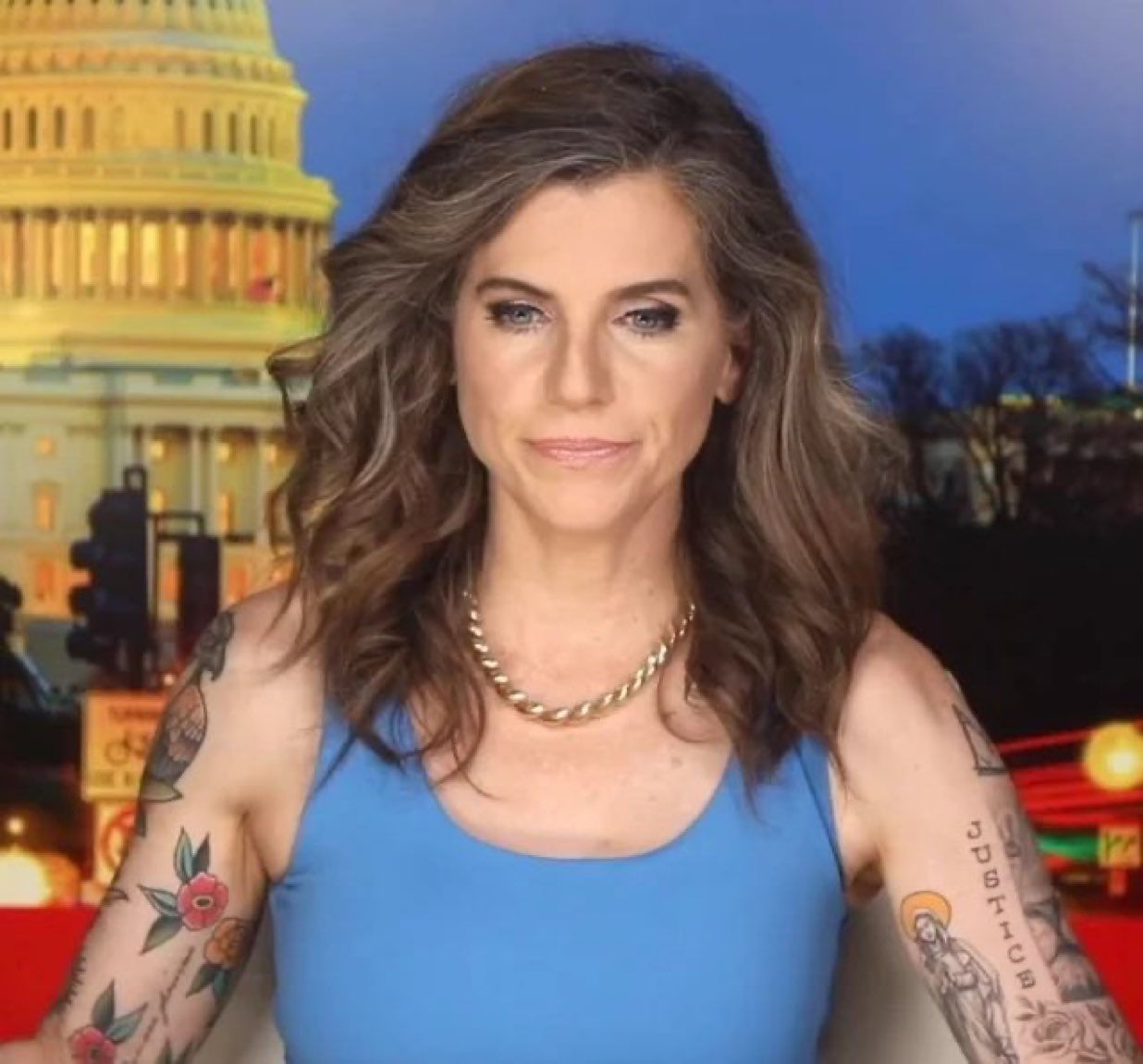
More Ethics Observations On Nancy Mace’s “Sleeves”…

This is a rare case of EA using the same graphic two days running, but there is a good reason.

In yesterday’s morning post, I wrote, concerning Rep. Nancy Mace’s extensive tattoo “sleeves” which she revealed in public for the first time this week, that voters and parties needed to stop letting people with serious emotional or mental issues from getting at the levers of power. I also mentioned that an associate of mine, also fully sleeved, a veteran and a Camp Lejeune victim who suffers from Complex PTSD, once told me that excessive, visible tattoos like Mace’s (and his) are often, even usually, a form of self-harm to cope with serious emotional damage.

I need to pay more attention to his observations in the future. I had missed a story in the New York Post earlier this year in which Mace explained her reasons for getting the tattoos:

Rep. Nancy Mace (R-SC) has gotten nine tattoos as a member of Congress because getting inked provides “the pain that I need to feel,” the congresswoman said in a revealing profile released on Friday. The 48-year-old congresswoman got the tattoos in “rapid succession” between a period in late 2023 and early 2024, marked by the breakup with her fiancé and an exodus of staffers from her office, some of whom viewed working for Mace as “toxic,” according to Politico.

Aside from a need to feel “pain,” Mace described getting tattoos as a way to “reclaim” her body and identity. One of her nine tattoos is the opening line of Virginia Woolf’s famous novel, “Mrs. Dalloway.” Woolf, as Politico pointed out, committed suicide in 1941 over fears “she was going mad.”

“So my story is I am totally broken,” the congresswoman and South Carolina Republican gubernatorial candidate is quoted as saying in the profile. Mace details the strained relationship she has with her father, her struggles in becoming the first female graduate at The Citadel and alleged instances of sexual molestation and rape that she’s been the victim of throughout the piece.

“I have PTSD over what I’ve been through,” she said.

On The California-Texas Foiled Baby Murder Case, Part II: Ethics Verdicts

Again, I don’t know how any thoughtful, ethical person could question the outcome in this case. Apparently the “intended parents” refused to agree that they would seek appropriate medical care for the child after he was born with a serious but medically correctable heart problem. Having been unsuccessful in their efforts to have the child aborted late term, these ghouls were going to get custody of the child and perhaps have a hospital administer “palliative care”…that is, let the baby die. Pleasantly, of course,

A legal battle, at least regarding the life of the child, was averted when the child was born ahead of the September 3 due date.

As with some of the other cases discussed in Part 1, how could a typical pro-abortion advocate who uses the standard pro-abortion rhetoric about women’s “bodily autonomy” argue that the parents could force the surrogate to undergo an abortion? Yet abortion activists are apparently immune to integrity, logic, and decency. The main thing is to get the unborn child disposed of.

The surrogate’s contract contained a clause obligating her to submit to an abortion if the “intended parents” demanded it. The lawyers who drafted that contract should be sued for legal malpractice, and there are arguable ethical violations as well. I am wondering how common such contracts are, and how often they are enforced. For human beings cannot sell themselves into slavery or otherwise contract away their “unalienable rights.” That contract provision is unenforceable as against public policy, and should be made illegal by statute.

Republicans should pass the bill in the House and make Democrats show their lack decency when they vote it down.

Ethics points:

On The California-Texas Foiled Baby Murder Case, Part I: Prelude

Yesterday, an ugly abortion controversy was resolved by the birth of “Baby Gabriel.” Here the legal/ethical gray areas involving hired surrogate mothers and the legal/ethical not-quite-so-gray areas regarding legal abortion mated to create a monster.

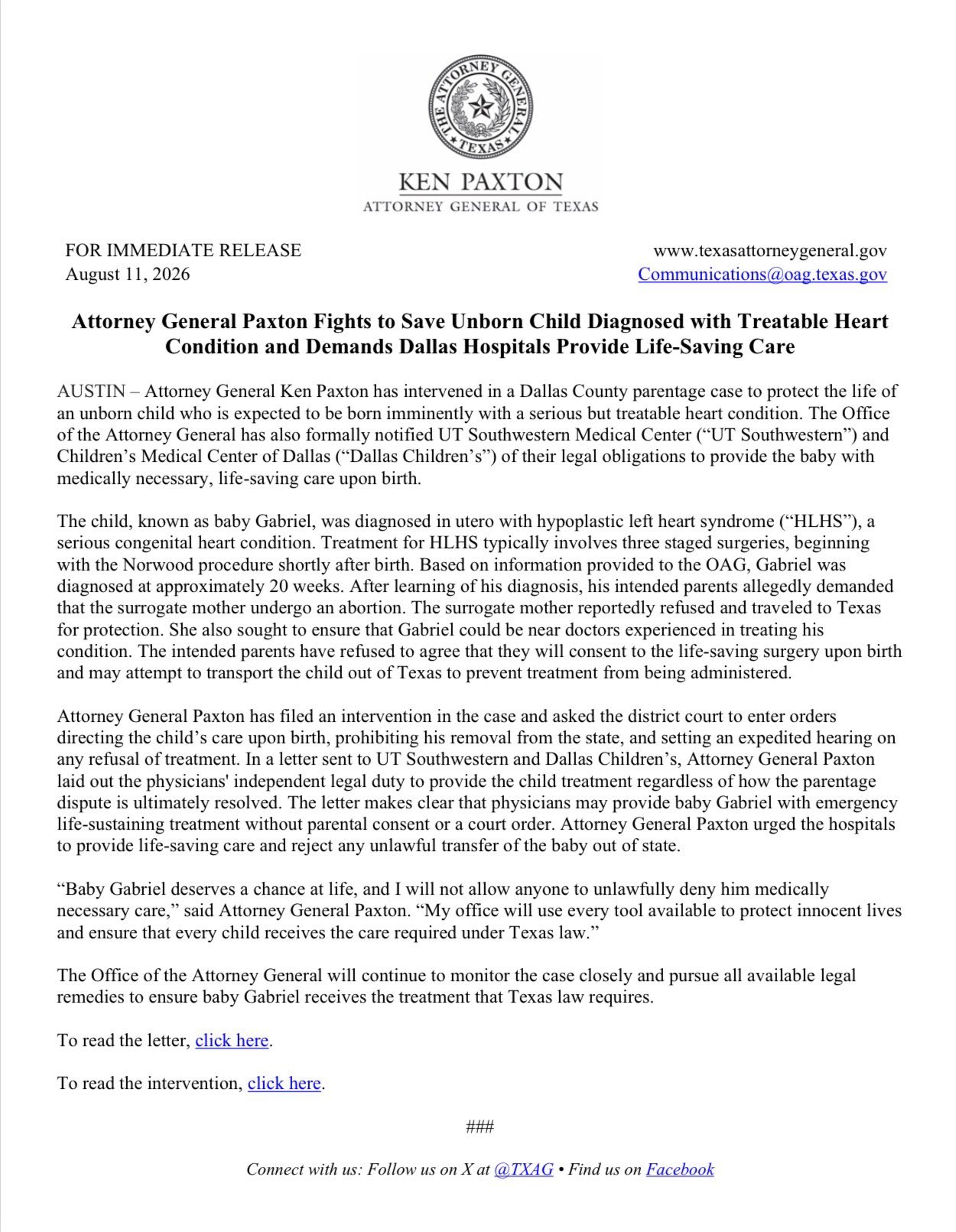
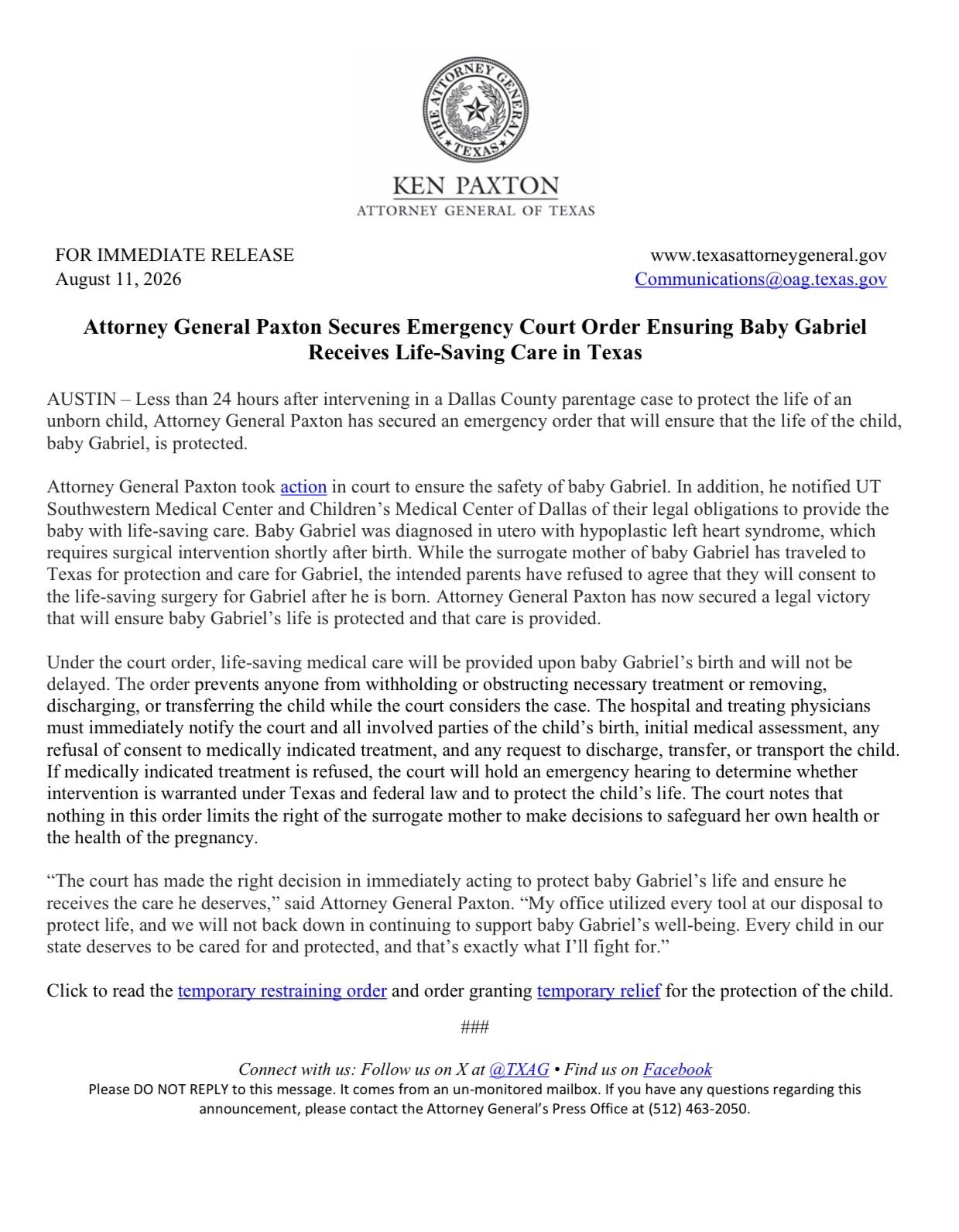
Upon learning that the baby gestating in their surrogate’s womb was not perfect (the unborn boy had a congenital heart defect), a California couple decided to exercise a provision in the surrogacy contract and force the mother-by-proxy to undergo an abortion. Instead, the surrogate fled to Texas, where abortion is illegal. Thanks in part to the intervention of Texas AG Ken Paxton (who is running for governor), the baby in question was born. Now there is a dispute over who gets custody. The birth mother has decided she wants the child anti-abortion activists have named “Gabriel.” The couple that wanted to have him killed wants him too.

Guess which I would choose, were I the infant.

I’ll examine that mess in Part II, but ahead, from the EA archives, is the last post Ethics Alarms had regarding the generally messy ethics issue of surrogate motherhood, from 2016, Pre-Unethical Conditions: Surrogate Mother Contracts And Making Babies With Jerks…

AAAAAAH!!! Scary…

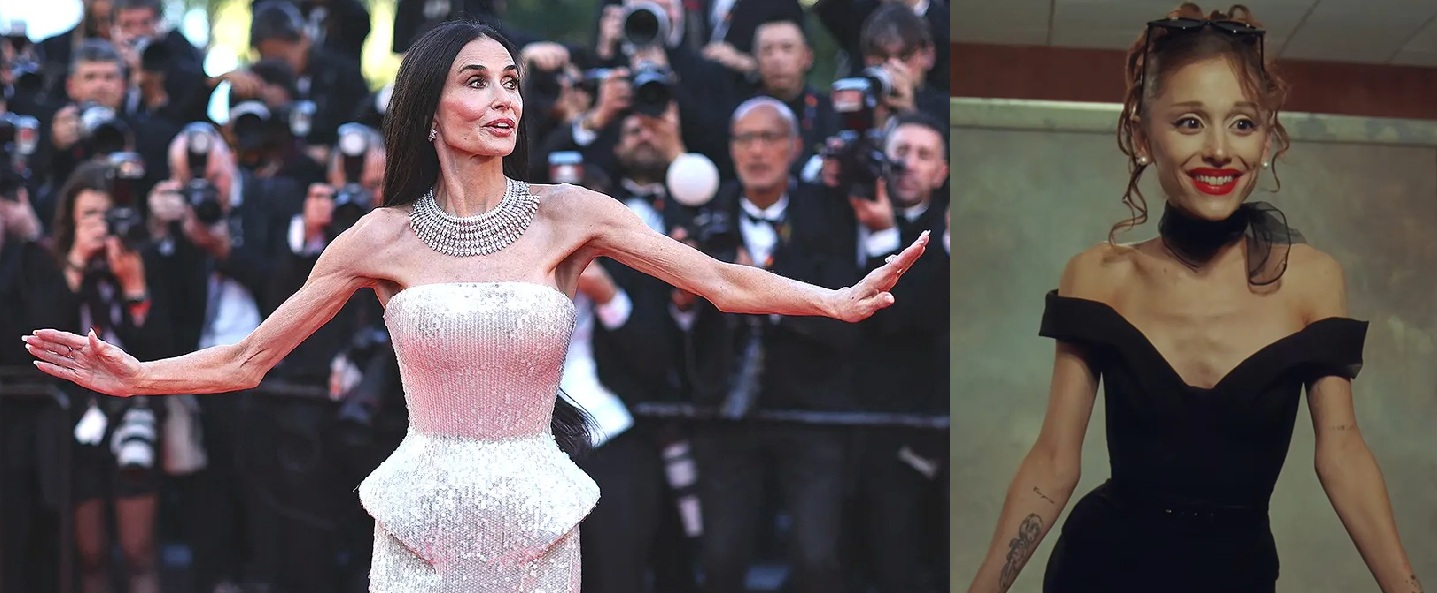
By pure luck, I stumbled across the photo above of Demi Moore from earlier in the year right after watching a disturbing PBS documentary about the late Karen Carpenter, who died in her early thirties as a result of a long battle with anorexia. The frightening figure to the right is pop singer and actress Ariana Grande. Both performers chose to highlight their appearance; several publications that used the photo of Moore referred positively to her “toned arms.”

In a related development, women (and some men) as young as 18 are getting botox injections because the flat, unexpressive forehead look is unavoidable if one watches much TV. Icons such as Jane Fonda and Goldie Hawn send the message that natural aging is shameful—Jane’s appearance in her 80s is so disturbing I refuse to look at her. In the meantime, Nicole Kidman has found some elixir or spell that has kept her appearance at 59 creepily similar to how she looked at 30, with none of the tell-tale signs of touch-ups that make other actresses her age grotesque.

My late wife suffered from anorexia in college and was so traumatized by natural aging that by the time she died Grace had become a virtual recluse. The damaging behavior of youth-obsessed celebrities is hardly a recent development; still, after being reminded of how one of the most gifted female vocalists was taken from us by the body dysmorphia their narcissistic habits inspire, I felt it necessary to flag the issue—again—today.

Public figures become role models whether they like it or not, and they influence the behavior and attitudes of others, especially the insecure, the emotionally vulnerable, and those without healthy and responsible role models in their own lives. It is impossible to measure the damage they do, the Demis to the aging, the Arianas to the young.

But it is a lot.

Abortion On Demand Up To Birth

I have two simple questions for pro-abortion (or perhaps “pro mothers and doctors being able to kill viable infants at will” is a more accurate label…a bit long, I admit) advocates.

How can you honestly and sincerely defend the new Massachusetts abortion law? If you can, how do you look yourself in the mirror or sleep at night?

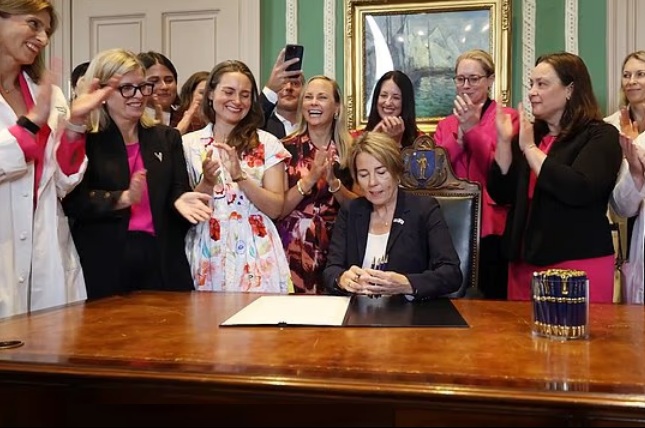
Abortion will now be allowed at any time before birth in Massachusetts after Governor Maura Healey (D, or course: what other party would do this?) eliminated the state’s abortion limits yesterday. Previously, the Bay State had allowed abortion only up until 24 weeks. Now a fully developed unborn infant can be killed any time during the 40-week gestation cycle, even second before birth. That means that the child could be delivered via C-section and instantly be protected by law as a living human being, but an unborn infant at the exact same state of development and fully viable can be murdered in the womb after the mother’s water has broken and contractions have begun.

To be fair, now, the home of my birth and happy childhood isn’t the only barbaric state with such an immoral law. Alaska, Colorado, Maryland, Michigan, Minnesota, New Jersey, New Mexico, Oregon, Vermont, and the District of Columbia of course, also believe that being able to kill living and viable infants in the womb is a human “right.” Peter Singer, the Princeton ethics professor, once caused an uproar when he said that as long as we were allowing abortions up to birth, why not let the mother see her baby first after it is born and then have the option to kill it? He was right: morally and ethically, either homicide is exactly the same. The distinction between born and unborn at that point is arbitrary and a legal fiction, created to let mothers feel better about a monstrous act.

Wrong! Athletes Should Shut Up About Political and Social Issues and Do What They Are Paid To Do.

I remember sports columnist Steve Buckley, now with the Athletic (the Times’ captive sports publication) from my halcyon days in Boston. Now he’s issuing badly-reasoned, ethically blind sports commentary from a national platform. Yecchh.

As a special annoyance, his poorly-reasoned observations on sports figures weighing in on national controversies are under a misleading headline: “Aaron Rodgers, Sophie Cunningham speak out. Caitlin Clark doesn’t. Either way, they lose.” I assumed from those words that Steve was going to echo my long-time position regarding narrow-range celebrities in general: “Shut up and sing/dance/act/ dribble/run/kick/pitch.”

But no.

“…Sports people (and this includes sports media people) who weigh in on political and social issues can count on being inundated with anonymous directives that they should “stick to sports.” It’s a mystery who these people are who feel empowered to tell others to stick to sports. The mere utterance suggests somebody with a doctorate in government affairs, or who perhaps has served in Congress or the diplomatic corps. The hypocrisy is at once comical and frightening. We like it when our athletes offer their opinions on this or that issue, except when we disagree with those opinions. (Stick to sports!) And athletes who choose not to play this silly parlor game are dismissed as cowards. At the risk of boring you with seventh-grade civics, but to use a kitschy sports term to make the point, this would be a good time to have a Turn Back the Clock event that teaches and celebrates the protections of the First Amendment. And if you happen to be a member of a championship team who’s been invited to the White House, go ahead and go. Or don’t go. Do that First Amendment thing and tell everyone else to screw off. For sports people who want to take a stand on this or that issue and who are prepared to deal with the avalanche of positive and negative commentary that ensues, go right ahead. For athletes who choose to say nothing, allow them that right. Why does everything have to be so complicated?”

Because things are complicated, Steve—now I remember why I skipped your work at the Boston Herald—and because they are complicated, most sports celebrities have nothing of value to contribute in understanding them. Celebrities do, however, have outsized metaphorical megaphones that give their usually simple-minded opinions far more influence on the public than is healthy for democracy and the quality of civic discourse. I know why Buckley has his own simple-minded view of this issue: sportswriters are, with few exceptions (not him, obviously), also unqualified by intellect, education, experience and skill, to comment publicly on political and social policy matters. Like all journalists, they think they are smarter than they are. This column is a useful piece of evidence to the contrary.

The inspiration for Buckley’s piece was Pittsburgh Steelers quarterback Aaron Rodgers criticizing Dr. Anthony Fauci after the Ethics Villain repeatedly invoked the Fifth Amendment during a Senate hearing last week, plus Sophie Cunningham‘s public statements regarding trans-females competing in women’s sports, along with fellow WNBA star and team mate Caitlin Clark’s refusal to get drawn into the controversy. Right off the bat (that’s a sports metaphor), Steve trips on his sneaker laces by mixing apples and oranges (a fruit analogy).

Ben Franklin’s Curse

The House this week passed a measure, the Sunshine Protection Act, that would set America’s clocks to daylight saving time permanently once it clears the Senate and is signed into law by the President. The bill itself raises no ethics issues at all: it is the reactions to it and the reasons, real and alleged, for those reactions that ping ethics alarms.

The headline is tongue-in-cheek, incidentally. Most of my life I heard that Daylight Savings Time was Ben Franklin’s idea. Ben was an amazingly prolific innovator and out-of-the-box thinker, but he was not the originator of the practice, so we can neither blame him nor praise him. Another myth is that DST was implemented for the benefit of farmers. Actually, farmers have been one of the strongest opponents of DST because the factors that influence farming schedules, like dairy cattle’s readiness to be milked, are dictated by the sun, so clocks going back and forth just complicates things. In general, Retailers, sports, and tourism interests like daylight saving, while agricultural and evening-entertainment interests do not.

Personally, I just want one time in place all year, because the changeover is traumatic for me whenever it happens. I have a long list of screw-ups, missed deadlines and meetings on my record. I bet no year has ever passed without one.

Like so many policies, the Daylight Savings Time tradition has had and continues to have all manner of unintended consequences, and those are controversial too. There is some data that shows that crime and accidents are reduced by DST, but precise causation issues make such data inherently dubious. A 2017 analysis of 44 studies concluded that DST leads to electricity savings of 0.3%, but we now know, or should, we can’t trust studies because we can’t trust the reseachers who perform them. Ditto for a 2017 study in the American Economic Journal: Applied Economics that estimated that “the transition into DST caused over 30 deaths at a social cost of $275 million annually,” primarily by increasing sleep deprivation. Another study claimed that hospitals see a 24% increase in heart attacks and a 6% increase in fatal crashes each year when the time changes.

President Trump has advocated permanent Daylight Savings Time, so that’s enough for the Axis of Unethical Conduct to oppose it. Predictably, the Washington Post rushed to publish “Why standard time is better for your health than daylight saving time: A proposed bill would make daylight saving time permanent. But standard time is actually better for your body, according to science.”

According to science! Even the Post’s readers tended to agree that this take was hooey. A typical reaction:

While We’re On The Topic Of Dumb Sports…THIS

Yes, it’s true, I regard professional soccer and professional women’s basketball as less than diverting, but this sport, Australia’s Run Nation Championship (RNC), not only requires morons to watch and play it, the sport is likely to turn competitors into morons if they aren’t already.

Part Sumo wrestling, part Easter egg cracking, part “Jackass” and part bumper-cars, the “sport” involves muscular contestants running into each other at full speed to see who falls down. This idiotic competition was spawned by ‘run it straight,’ a social media trend that had random people running into each other for online views. The videos of stupid teens colliding and often suffering injuries have gotten millions of views online. The Run Nation Championship is trying to make the sport mainstream.

RNC has different weight classes. Most participants, called runners, have a background in combat sports, rugby, or American football. Run Nation co-founder and CEO Tremaine Fernandez says he’s trying to make the new sport as safe as possible…you know, like the electric chainsaw juggling contests do. Fernandez admits that the collisions still risk concussions and serious injuries, but his organization has doctors on the sidelines, so it’s all good.

Sports neurologist Rowena Mobbs, among others, has been calling for the sport to be banned.“Certainly every time they run up and clash in that way, there’s likely to be at least a microscopic brain injury,” Dr. Mobbs said. “They are high-risk and harmful activities, and almost having these protocols and practitioners there whilst good overall, I would ask, is it sort of giving an air of reassurance, an illusion or an impression that these activities are safe?”

You mean that children and teens and drunks and cretins will think, “Hey, this looks like fun!” and people will get maimed and killed? Of course they will! I guarantee this new pastime, which essentially takes the complex strategy, scoring and rules elements out of football and hockey to focus on what its fans really like—the violence—will become a sensation in the U.S., fueled by social media, on-line gambling, and low IQs.

Ban it? Hey, this is America. We have a right to the pursuit of happiness, and if running full tilt into consenting people makes some dim bulbs happy, then let them do it. A few thoughts:

1. The female runners should make just as much as the male runners. It’s only fair…

2. The biggest societal benefit of the sport will be its Darwinian selection features.

3. As with NFL football, anyone who watches this sport is complicit in the injuries it will cause.

Alcoholic Lawyer Ethics: An Inconvenient Truth

[That’s Paul Newman above, playing the alcoholic trial lawyer in “The Verdict.”]

I recently caused consternation (again) on the listserv of the Association of Professional Responsibility Lawyers (APRL), the organization that brings together most of the lawyers who concentrate on the contentious field of legal ethics as ethics partners, professors, state bar disciplinary counsel, CLE trainers, consultants, and just interested lawyers. I had been considering dropping this metaphorical bomb on the group for some time. My thesis: lawyers who are alcoholics, “recovering” or not, are ethically obligated to inform their clients of that ongoing and incurable malady. I see no way out of this ethical obligation, but the legal profession has been scrupulously avoiding confronting reality for centuries.

Alcoholism was once the secret meaning of “moral turpitude” in state bar associations’ requirements for admission: if you were guilty of moral turpitude, you couldn’t get a law license because of a presumed character deficit. When alcoholism was finally recognized as the illness it is, being an alcoholic was no longer a basis for bar exclusion or discipline. Bar associations all established “Lawyer Assistance Programs” as the alternative to punishment for lawyers with alcohol or substance abuse problems. That’s nice. However, none of the measures currently employed deal with the inconvenient facts of alcoholism.

Based on my knowledge and extensive experience with friends, family and associates, all alcoholics are untrustworthy by definition. They have a strong tendency to lie, for example (and they will admit that, if pressed) to conceal their addiction as well as the often disastrous results of it. No one, including the alcoholic himself or herself, can know when a relapse will occur or what will trigger it. A binge alcoholic can seem healthy and dependable for months or years, and suddenly go on a bender that incapacitates him. My late wife, a brilliant and capable woman who struggled courageously with the illness her whole life and ran our business and finances (or, should I say, said she was and made a good show of it) would have sudden unpredictable relapses that she covered up with consummate skill. She was what is called a maintenance-level alcoholic. She had a degree of intoxication she needed to maintain to function well and appear sober; below that level of alcohol consumption she suffered from withdrawal symptoms. One drink over that set-point, however, and she was physically and mentally incapacitated. Many maintenance level alcoholics successfully hide their addictions while actually being drunk every day in highly challenging jobs…until they can’t. Alcoholism is a progressive disease. Over time, alcoholics’ ability to control their addiction deteriorates along with their over-all health and mental state.

Confronting My Biases #30: Fake Puffy Lips

More than 10 years ago I wrote about Kristina Rei, 22, of St. Petersburg, Russia. She wanted to look like Jessica Rabbit, the cartoon character, so she got herself a pair of huge—lips.She has undergone over 100 silicon-injection procedures, and considers it just the initial step in her quest to look like Roger Rabbit’s Toon wife from “Who Framed Roger Rabbit?”. ” At the time, I asked whether it ethical for a plastic surgeon to give her the ridiculous lips she coveted, since plastic surgeons are subject to the Hippocratic Oath like other doctors. My own position then and now, was that it is unethical, though I tried to give both sides of the issue.

“If Kristin can eat, drink and breathe with her mega-lips,” I wrote, “and there is no risk that they might explode, killing everyone near her, the decision to do what she wants is probably ethical, at least by medical ethics standards. The fact that her Chap-Stick costs will be astronomical is not the doctor’s concern, however.” Nevertheless, I concluded that “a plastic surgeon who assists a patient, especially one so young, in disfiguring herself to this extent is unethical. Autonomy is to be respected always, and beauty is in the eye of the beholder.  Kristin’s lips are so far beyond reason that a plastic surgeon debases his profession by assisting in what can fairly be called self-mutilation.”

My bias regarding fake puffy lips does not involve such extreme disfigurement; indeed most would agree that young women getting their lips puffed up isn’t disfiguring at all. However, it is increasingly becoming apparent to me that this particular form of supposedly aesthetic enhancement is becoming a norm, and a harmful one.

Continue reading →