Comment Of The Day: “Open Forum” (Catholic Church Thread)

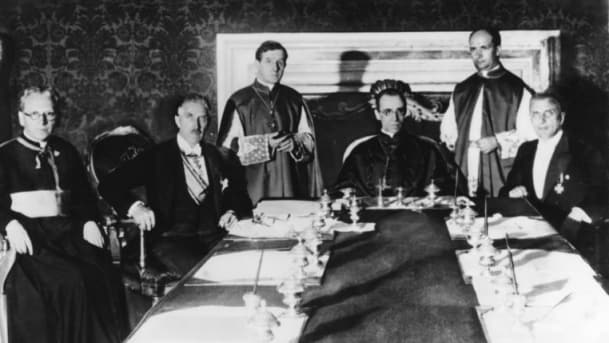
This seems like a nice, fraught time to post A. M. Golden’s comment in the last Open Forum, especially since he broaches the controversy over the Roman Catholic Church’s relationship with Nazi Germany and its efforts (or lack of them?) in support of Jews during the Holocaust.

Here is A.M.s Comment of the Day:

The Catholic Church signed a Concordant with the German government agreeing not to get involved in politics (something I’m sure every progressive in the U.S. has wanted for years and would heartily endorse) in return for the Germans agreeing not to interfere with the Catholic instruction of youth. This was an agreement that the Nazis grudgingly complied with for a limited time before finally interfering whenever they wanted.

Yet…the Catholics objected to converted Jews being discriminated against because the Nazi racial theories still considered them biologically Jews regardless of their religious persuasion. Many German Protestants had the same concern. There were also many who risked their lives to save Jews due to their religious convictions – spurred by their minister or priest’s teaching.

There were ministers and priests that preached against the T4 Aktion – the Nazi euthanasia program – that killed mentally and physically disabled children and adults. Continue reading →

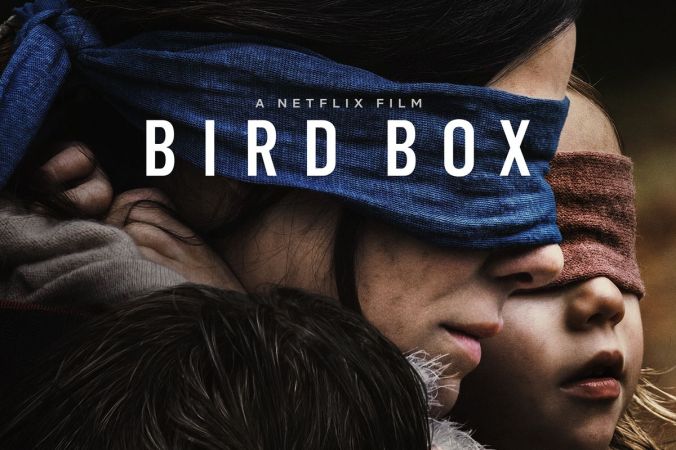
Demanding Blindfolds

From the New York Times:

“Netflix said on Thursday that it would not edit its movie “Bird Box” to remove footage of a disaster that killed 47 people in a Canadian town, rebuffing calls from town leaders who called the use of the video insensitive.”

Good.

This has got to stop somewhere, and “Bird Box,” the sensationally popular sci-fi horror film about Sandra Bullock and her children wandering around a forest blidfolded so they won’t see whatever it is that is driving everyone crazy and making them kill themselves, is a good a place to make a stand as anywhere.

In the movie, some things, or demons, or vibes cause insanity if they are seen: people really aren’t safe if they see them. Images that raise unpleasent thoughst and memories in real life are different, but somehow the idea was pawned that people have the right to expect to be “safe” from thoughts, memories, sights, symbols and ideas that might bother them. Thus “woke” college instructors felt compelled to give students “trigger warnings.” This principle, a really bad one that mistakes censorship for sensitivity, quickly metastasized into historical and artistic airbrushing. The National Park Service banned Confederate flags and their images from battlefield  gift shops—might remind some people of the Dylan Roof church shooting. Or slavery. Or racism.  Then the statues started coming down, because, as Carol Folt, blessedly outgoing chancellor of the University of North Carolina at Chapel Hill explained about why the terrifying pedestal of now toppled “Silent Sam,” a campus statue of a fictional Confederate soldier, must be destroyed:

“The presence of the remaining parts of the monument on campus poses a continuing threat both to the personal safety and well-being of our community and to our ability to provide a stable, productive educational environment. No one learns at their best when they feel unsafe.”

Unsafe! Continue reading →

Ethics Observations On Speaker Pelosi’s “Suggestion” The The President Skip The State Of The Union Message

Nancy Pelosi delivered an unprecedented and thinly-veiled insult to President Trump by urging him in a public letter to either reschedule the January 29 State of the Union Message or deliver it in writing to Congress because of “security concerns.”

Observations: Continue reading →

Morning Ethics Warm-Up, 1/15/2019: I Am Cleopatra!

Good morning, Ethics Lovers!

1. Coming attractions. Rep. Steve King is now officially a human ethics train wreck, but boy, it would be nice if we could trust the news media. I will be writing a full post on this matter soon, but in the meantime, if someone can find me the full text of the alleged “interview” with the Times that generated King’s infamous “White nationalist, white supremacist, Western civilization — how did that language become offensive?” statement, I would be very happy. The link used by all sources reporting on the interview and its aftermath, including the link used by the Times, goes to “Before Trump, Steve King Set the Agenda for the Wall and Anti-Immigrant Politics.”

But that’s not an interview! It’s an anti-King hit piece. I wanted to see the context of King’s remark, like, say, the question that evoked it. Is that too much to ask? All we get, however, is this:

Mr. King, in the interview, said he was not a racist. He pointed to his Twitter timeline showing him greeting Iowans of all races and religions in his Washington office. (The same office once displayed a Confederate flag on his desk.)

At the same time, he said, he supports immigrants who enter the country legally and fully assimilate because what matters more than race is “the culture of America” based on values brought to the United States by whites from Europe.

“White nationalist, white supremacist, Western civilization — how did that language become offensive?” Mr. King said. “Why did I sit in classes teaching me about the merits of our history and our civilization?”

That’s telling us about the interview, not the interview itself, and doing so while poisoning the well. More later. However, the fact that the Times won’t provide the unredacted interview itself is troubling.

2. Trump Tweets. Finally I can compliment a good one. This morning the President said, in the climax of a tweet, “They got caught spying on my campaign and then called it an investigation.” I’m critical of Trump’s communications skills, but you can’t do better than that. I also strongly suspect that he is correct. Continue reading →

Morning Ethics Warm-Up, 1/11/2019: Triplets, Tongues, Feet, And Screeches

Good Morning!

1.It’s time to play… Champerty! I’m beginning my morning by explaining to an outside litigation funding entity that they really don’t have to worry about champerty laws as long as their loans are handled properly. Champerty is an ancient common law crime that made it illegal for a third party to buy into litigation and to profit from the transaction if the litigation succeeded. Some states still have anti-champerty laws, but they are 1) pretty much dead letters and 2) don’t apply to legitimate litigation financing, where a loan is repaid whether the litigation succeeds or not, and the amounts repaid do not change if it does. In legal ethics, champerty becomes an issue when a lawyer or law firm “sells” a share of the legal fee to a third party. That’s fee-splitting with a non-lawyer, and strictly forbidden.

Champerty is often mentioned as a set with two other common law crimes, Maintenance and Barratry. Maintenance, Champerty and Barratry are among my favorite potential triplets names, along with Shadrach, Meshach, and Abednego; Caspar, Melchior, and Balthazar; Clotho, Lachesis, and Atroposand (The Fates);  Nina, Pinta and Santa Maria, and, of course, Moe, Larry, and Curly.

2. The Good Illegal Immigrant, again. In the wake of the wall dispute and the shutdown, the New York Times is ramping up its frequency of heartstrings-tugging tales of  illegal immigrants so lovable, industrious and virtuous that only a monster would oppose their permanent enjoyment of the fruits of illegally obtained citizenship. One such article this week began,

“Tomas Guevara fell in love with Ruth Ayala years before they met. Her brothers — like Mr. Guevara, Salvadoran immigrants living outside Washington — talked about her at church. She was hardworking and kind, they said, devoted to her family and her faith. Then Mr. Guevara saw Ms. Ayala’s photo; her big brown eyes, her warm smile. He decided to give her a call.”

Awww!

Later in the article, we have this sentence: “In 2001, he swam across the Rio Grande.”

The article raises many questions for me. Why was someone like Tomas eligible for “temporary protected status”? If the claim was that El Salvador was so dangerous that he could not be sent back there, why did he keep visiting that country, meet his wife there, and have his child there? Naturally, there was a program, the Central American Minors program begun in 2014, that allows the children of parents with temporary protected status to apply for permanent residency as refugees. Tomas’s wife was somehow eligible too.

This is what “chain migration” means, in case you wondered. Continue reading →
Morning Ethics Warm-Up, 12/27/18: It’s Video Thursday!

Happy inevitably confusing and disorienting period between Christmas and New Years!

1.. Is this a racially problematic TV ad, or an encouraging one that signals progress?

For me, the commercial raises the question: Have we reached a point when depicting an entire black family acting as moronic as white people are routinely depicted on TV is permissible and white people are allowed to laugh at it?

It made me uncomfortable. Am I alone?

2. Charley Parkhurst. The New York Times project to catch up on all the significant and remarkable women who never received the recognition of an obituary in its pages has been fascinating, and there has been no more interesting entry than this month’s remembrance of Charley Parkhurst, 1812-1879. Parkhurst was a famous driver of six-horse stagecoaches during California’s Gold Rush, a challenging job requiring strength, skill, and unusual honesty. Parkhurst was described as “short and stocky,” a hard-living whiskey drinker, cigar smoker and tobacco chewer, who wore  a patch  over the empty eye-socket where a horse had kicked out the eyeball. Charley was also universally regarded as male until a doctor discovered, post mortem, that she wasn’t. At a time when a women’s options  were severely limited, Parkhurst decided at a young age to live as a man, and was mighty good at it. She even registered to vote in 1868, and some give her the distinction as the first woman to vote in a Presidential election, though there is scant proof of it.

Looking at and thinking about a women “identifying a male” in a different cultural context is fascinating. Was Charley a woman, a male, trans, gay, a fraud, a hero (a heroine?), or just an opportunist and a gutsy realist who did what she wanted to do the only way it was possible for her to do it?

And does it matter? Should it matter?

We are told that Charley also was a lumberjack for a time. I wonder what she would have thought of the Monty Python song?

3. An Althouse quote: Continue reading →

The Story Of “Do You Hear What I Hear?” [Updated And Corrected]

Bing Crosby memorably introduced this last of the popular Christmas songs to have a religious theme to most Americans in 1963, on this live broadcast of “The Hollywood Palace.”  It  was written in October of 1962 during the Cuban Missile Crisis, by a married songwriting team that  wondered at the time if it would be the last thing they ever did.

Noel Regney, who wrote the lyrics, was born in France and had studied music at the Strasbourg Conservatory and at the Conservatoire National de Paris. When France was overwhelmed by Hitler’s troops in 1940, he was conscripted into the German army. As a Nazi soldier, he secretly joined the French underground and served as a spy, passing information along to the resistance. Once he led German soldiers into a trap where they were massacred by French fighters who cut them down in a crossfire. He was shot too, but survived.

After that traumatic encounter, Regney deserted and worked with the French underground until the end of the war. Continue reading →

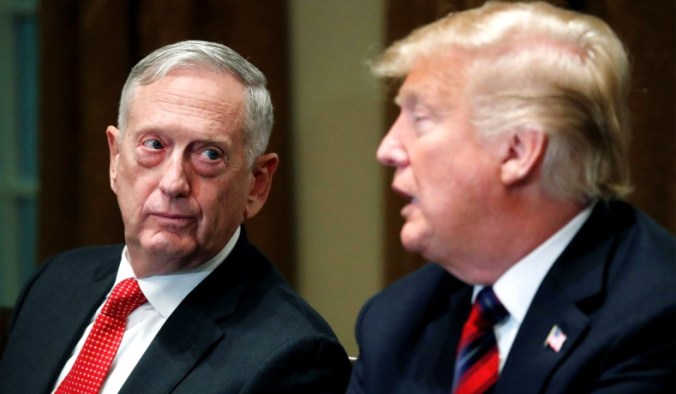
Ethics Observations On The Mattis Resignation

President Trump announced that he was ending the U.S. mission in Syria, and drawing down the troop level in Afghanistan. His Secretary of Defense,General Mattis, resigned in protest, and copied his letter of resignation to the world.

The news media, social media, and full time anti-Trump hysterics, among others, went bonkers.

  • What’s going on here? A President who has long held that U.S. domestic priorities are more important than “being the world’s policeman” followed through on his promise. As is his wont, he sprung the actual news without laying a foundation to cushion the blow. Nobody knows whether the decisions will work out or not, but the assumption is that because this President is the one making the decisions, they must be stupid, evil, or both. This, despite the fact that Barack Obama essentially did the same thing regarding Iraq, except that Iraq gave much more promise of stabilizing with continued U.S. presence. Syria is still in chaos, and nobody can confidently say when and if it will not be. As for Afghanistan, the U.S. has been expending lives and treasure there for a mind-blowing 17 years. What is the mission? Funny—I thought the original mission was to punish the country for sponsoring the 9/11 attacks. We could have declared the point made long, long ago. Is the President wrong to say “Enough is enough”?

I have no idea—and neither do you.

  • Having no idea, not having seen the data, not having been advised, and not being President of the United  States, I have little basis to challenge or deride the decision. But what’s really going on here is what has been going on since January, 2017. Any decision or action by this President is immediately assumed to be wrong. The analysis attached to it afterwards is superfluous. The position is that President Trump did it, it’s wrong because he’s a Nazi/idiot/ grifter /fool, and that’s all we need to know.

This, of course, makes it impossible, literally impossible, to get honest, trustworthy analysis about anything.

  • Anyone who criticizes Trump in public, even certifiable slime like Steve Bannon, James Comey, and Omarosa, suddenly is embraced by “the resistance ” and the news media using the formula that the enemy of my enemy is my friend. This rewards unethical conduct, and “Mad Dog” appears to have fallen into the trap, to his eventual shame. As a lawyer, I know it is unethical to drop a client, my employer, and make any pubic statements whatsoever impugning his or her judgment or conduct. It is also unethical to do this in any professional relationship. Professionals know this: I presume at one time Mattis knew this. But having paid attention to how routine betrayals of this President have been cheered and praised, he apparently couldn’t resist temptation.

Now, as a lawyer, my duties are codified. That doesn’t mean that professionals who don’t have the same duties codified aren’t obligated to follow them. Continue reading →

Morning Ethics Warm-Up, 12/21/2018: Getting The Tree Lights On In One Day Victory Lap Edition, Featuring Sports, Movies, Jerks And “Bambi”

Happy Holidays!

Seven hours, one serious needle wound, and 1300 lights later, victory! I’ll finish the decorations when I get back home, IF I get back home…

1. Itinerary…I’m heading to New Jersey via train to hook up with the brilliant Mike Messer, what we call “the talent,” in an encore rendition of the musical legal ethics seminar, “Ethics Rock Extreme,” lyrics by yours truly, musical stylings by Mike, on the guitar. Then it’s back to D.C. by air on Saturday, if I’m lucky. If I’m not lucky, I’ll be taking the New Jersey bar exam in the Spring…

I have no idea how or whether I’ll be able to keep Ethics Alarms on track once I board the train this afternoon. I’m not going to launch a second Open Forum in leas than a week, so please keep working on the current one here, now at 130 entries and counting. I will be reviewing those on the road, and I’m sure there will be some Comments of the Day to post, eventually.

2. In case I am trapped in New Jersey…Let me alert everyone that Peter Jackson’s apparently terrific (based on the reviews) WWI documentary “They Shall Not Grow Old” will be playing in theaters on December 27, and after that, who knows? The American public’s ignorance about that war, perhaps the greatest human catastrophe in modern history, is a failure of education, perspective and culture. If you have kids, take them. Here is the trailer:

3. Speaking of cultural literacy and movies, TCM is offering a limited engagement in theaters for “The Wizard of Oz,” on January 27, 29, and 30.

Is there another film that so many people purport to know and love so well without actually having seen it as it was intended to be seen? When I finally saw the movie in a theater—no breaks or commercials, big screen—I was shocked at how different and, obviously, better, the experience was. It’s an artistic masterpiece and sui generis: we will never see its like again, nor talents like Judy, Ray and Burt, among others. Continue reading →

“Miracle On 34th Street”…An Ethics Companion, Chapter One: “Meet Kris Kringle!”

The Introduction is here.

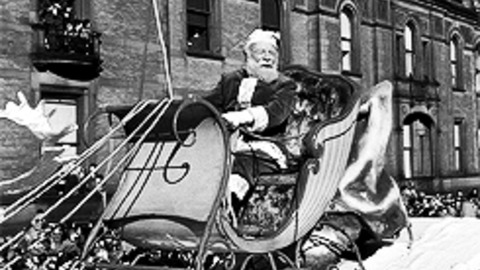
The movie tells us right at the start that 1) the charming old man in the white beard can’t possibly be Santa Claus, and 2) that he’s nuts. That is, he tells adults who are paying attention this as soon as he starts complaining to a New York City storekeeper that his window display has the reindeer mixed up: “You’ve got Cupid where Blitzen should be. And Dasher should be on my right-hand side. And another thing…Donner’s antlers have got four points instead of three!”

Let’s see:

  • No Christmas display has ever distinguished between Santa’s reindeer (except for Rudolph), because the individual reindeer have never had any identifying characteristics in reality or myth. Are we to assume that there are name-tags on the models? If so, why wouldn’t Kris be complaining about the features of all of them, not just “Donner’s” antlers?
  • The names of the reindeer, even if there are flying reindeer, were 100% the invention of the poem “A Visit from St. Nicholas,” or “The Night Before Christmas,” originally published in 1823.  No one has ever claimed that the author had some kind of special info on the actual names of the reindeer when he wrote,

    More rapid than eagles his coursers they came,
    And he whistled, and shouted, and called them by name;

    “Now, DASHER! now, DANCER! now, PRANCER and VIXEN!
    On, COMET! on CUPID! on, DUNDER and BLIXEN!

    …and anyway, if he did, those were their names 120 years before the movie takes place. Nobody has ever claimed the reindeer were immortal, either. I suppose Santa Claus, in a nod to the poem’s popularity (it has been called the most famous poem of all time), could have adopted the practice of always having the reindeer named after the poem’s versions, and when one Vixen dropped of old age, the young reindeer that took her place became the new Vixen.

I suppose. Continue reading →