Morning Ethics Warm-Up, 4/16/2018: The Integrity Edition

Good Morning!

1. James Comey, Cognitive Dissonance Dunce. The anti-Trump obsessed won’t be able to see it, but rogue ex-FBI director James Comey is doing an immense favor for President Trump and Republicans by single-handedly framing his campaign against the man who, it is increasingly obvious, correctly fired him (as Hillary Clinton would have done even faster) as that of a classic vengeful disgruntled employee and nothing more, or better. Even Time op-ed writer Charles Blow, whose every column since the election has been some paraphrasing of “I hate Donald Trump,” was forced to observe that Comey is an especially dislikable foe (as is Blow himself). The sheer number of loathsome Trump-bashers has a natural Cognitive Dissonance Scale effect that the President’s critics can’t seem to fathom.

Normal, fair-minded people whose natural instinct is to run from the likes of Nancy Pelosi, Ted Lieu, Hillary Clinton, David Hogg, Joy Reid, Bill Maher, James Comey, Robert DeNiro, Alec Baldwin, Stormy Daniels and the rest will find themselves, almost unconsciously, siding with the President rather than this basket of deplorables, because, you see, he is the President, and who wants to be identified with that crew?

In his ABC interview, which successfully marked Comey as Just Another Trump-Deranged Resistance Warrior, he actually said that Trump was “morally unfit” to be President. First of all, it is the electorate, not James Comey, that decides who is morally fit to be President.  Comey’s assessment is no more or less valid than that of anyone else. Second, the statement is ridiculous on its face. If Comey had an interviewer with any knowledge of Presidential character and the history of the office, plus the wit and integrity to expose  an ignorant opinion when one is broadcast coast to coast, he would have been asked..,

Was Thomas Jefferson morally fit to be President? Has Donald Trump kept his wife’s sister as a concubine and slave? Was Andrew Jackson morally fit to be President? Has Donald Trump killed anyone in an illegal duel? Was Grover Cleveland morally fit to be President? Did Donald Trump ever have a woman committed to an institution to silence her about their sexual relationship? Was Woodrow Wilson morally fit to be President? Has Donald Trump endorsed the Klu Klux Klan? Was Franklin Roosevelt morally fit to be President? Has President Trump ordered U.S. citizens into prison camps? Was Richard Nixon morally fit to be President? LBJ? Bill Clinton?

The Presidency is self-defined by its past occupants, and “moral fitness” is not a characteristic that comes to mind when considering what qualities are identified with successful, popular or effective Presidents.

2. Whither the ACLU? Alan Dershowitz has authored a searing attack on the ACLU’s lack of integrity demonstrated by its failing to condemn the Justice Department’s raid on lawyer Michael Cohen’s home and office. He writes in part, Continue reading

A Musical Ethics Quiz: “The Wanderer”

Here is Dion’s signature hit, 1961’s “The Wanderer”…

The song is ranked #243 on the Rolling Stone magazine’s list of The 500 Greatest Songs of All Time.The lyrics (the song was written by Ernie Maresca) , for those of you who are lyrically challenged, are as follows… Continue reading

Morning Ethics Warm-Up, 4/15/2018: Remember The Titanic And The Bay Of Pigs Edition.

Good Morning.

This, the annual March-April Ethics Alarms traffic dip, is when writing the blog becomes a job, not a joy. I really have to learn to stop caring about click, follower and share stats. It’s pure ego—well, that and the fact that my wife keeps telling me that I should be spending the time on billable matters, or getting books out to publishers.

1. Ethics Observations on the Syria bombing:

  • I teach in my seminars that often decisions made early in ethical dilemmas cause future ethical decisions to become impossible, because only less-unethical ones remain. U.S. and international   policies regarding Syria  are as good an example of this phenomenon as there is. The United Nations, if it wasn’t worthless, would  have intervened to stop the humanitarian catastrophe early in the Syrian civil war. This isn’t hindsight: plenty of experts were saying so at the time. When it became clear, years ago, that this was a bloodbath tidal wave that was destabilizing the whole region (as well as killing untold numbers of civilians and children), U.S. led pressure should have been brought to bear on Assad. Now there are literally no good choices, nor ethical ones.

The United Nations is worthless, as well as toothless, gutless and principle free. If there was any justification for such an organization, it should be to prevent carnage like we have seen in Syria.

  • The U.S., British and French response to Assad’s use of banned chemical weapons was unavoidable, especially after President Obama had been thoroughly embarrassed and discredited by ignoring his own “red line” statement, and after President Trump had made his own veiled threats that amounted to “red line” pledges of his own.

Democrats were going to mock Trump if he did not have a military response to the latest chemical weapons war crime, and they are now criticizing Trump for following through. In doing so, they only make their own fecklessness, hypocrisy and expediency more obvious, if that were possible.

  • Was Assad emboldened by the President’s comments about how he was preparing to pull the military out of Syria? Who knows? Announcing troop movements in a combat zone before they occur is irresponsible and incompetent.

Obama did it repeatedly. Criticism of Trump’s equivalent conduct is valid.

  • Trolling the news media, the President used the phrase “Mission Accomplished!” after the attacks. Good. There is nothing wrong with the phrase, and the mission was accomplished. The mockery of President Bush for a banner he did not have anything to do with was a dastardly media hit job. Ann Althouse’s theory:

Trump is completely aware of how Bush was punched around for using that phrase in a celebration of a specific mission that in fact was accomplished, and he would like the naysayers to come after him the way they came after Bush, and when they do, he’ll show us all how to handle that kind of anti-military negativity.

  • Conservatives are angry about the bombing, even the ones who mocked Obama for being a weenie when Assad called his “red line” bluff. Alex Jones was actually weeping about the raid on his show . These people really are old-style Fortress America isolationists, and want the United States to abandon its traditional mission of being the world’s champion of the abused and helpless while modelling the ideals of democracy.

The non-interventionists are wrong. The ethical optics of the United States and Great Britain and France punishing a brutal dictator who flouts international law are perfect.

  • From the other side of the aisle, some Democrats are whining about the attack being unconstitutional, so some unscrupulous left-biased journalists are spreading the word. Now, the War Powers Act may be unconstitutional, but as long as it’s in force—and Democrats share responsibility for its continued existence—this is just more double-standard hypocrisy aimed at President Trump. The War Powers Act allows the President to take some military actions based on exigencies, as long as they do not extend into a protracted engagement.

This is why “Mission Accomplished” is an especially appropriate message. Continue reading

Saturday Evening Ethics Update, 4/14/2018: Important Women Die Too, Fundraising Insanity, And Campus Segregation Is “In” Again

Good evening, everyone!

(This morning was completely unmanageable…)

1. This day in history..April 14 belongs with December 7, November 22 and September 11 as the four evil dates in American history, for Abraham Lincoln was assassinated on this day in 1865, yanking the course of events into a new riverbed. Who knows where we might be today if Booth had been foiled?

2. Oh, yeah, themThe New York Times is suddenly including more obituaries of women in its pages, the result of a ridiculously late realization last month that the paper’s  stories of death warranting special note had been overwhelmingly male from the paper’s birth. In March, the paper confessed,

Since 1851, The New York Times has published thousands of obituaries: of heads of state, opera singers, the inventor of Stove Top stuffing and the namer of the Slinky. The vast majority chronicled the lives of men, mostly white ones.

Charlotte Brontë wrote “Jane Eyre”; Emily Warren Roebling oversaw construction of the Brooklyn Bridge when her husband fell ill; Madhubala transfixed Bollywood; Ida B. Wells campaigned against lynching. Yet all of their deaths went unremarked in our pages, until now.

It is a welcome reform. The Times is also looking back over history to remedy the past bias and injustice, launching a special project to publish, a bit late, many of those obituaries that it had failed to write when remarkable women died. You can find the latest additions here.

3. What’s going on here? Wall Street billionaire Stephen A. Schwarzman agreed to give $25 million to the Abington, Pennsylvania high school he attended  in the 1960s. The money would finance  a massive upgrade in the facility. The school, in return, agreed to name the school in his honor, hang a portrait of him in the building, honor his twin brothers elsewhere in the school, and give him the right to review the project’s contractors and approve a new school logo.

Then the deal was announced. Local residents appeared at a standing-room-only, five-hour school board meeting last week to protest.  There was an online petition (naturally), and calls for school officials to resign.  And what was it about the quid pro quo that the people objected to? The quote from Robert Durham, who works at the local Chevrolet dealership and sent two sons through Abington Senior High School is explanatory as any:

“I just think there’s too much influence about big money, Wall Street money, in our society,” he told reporters.

Oh. Continue reading

Mission Accomplished: Political False Narrative Established

From a footnote in Robert Weintraub”s “The Victory Season: The End of World War II and the Birth of Baseball’s Golden Age” (2013, paperback edition 2014):

“Sanford, Florida would return to the civil rights foreground in early 2012, when an unarmed black teenager named Trayvon Martin was shot to death by a neighborhood watchman, mainly because he felt the hooded sweatshirt Martin was wearing looked suspicious.”

Weintraub is an author and baseball historian. I got the book, which is excellent, from my son for Christmas. The original hardback edition was published before George Zimmerman’s July 2013 trial, but the paperback edition could easily have been corrected. People have no reason to doubt Weintraub, or assume that he has a political agenda. Maybe he doesn’t.

When he wrote the above, the “Trayvon Martin was shot by a racist because he was wearing a hoodie and was racially profiled” had been the racially inflammatory narrative pounded into the American public for months by the news media, Democrats, black activists and, of course, the President of the United States. A member of the Congressional Black Caucus even wore a hoodie on the floor of the House. In fact, there was never a shred of evidence that race had anything to do with Zimmerman’s actions or Martin’s death, or that it was a civil rights story at all. George Zimmerman, the “neighborhood watchman”—at least Weintraub didn’t say he was a “white Hispanic”—“mainly” shot Martin because… Continue reading

President McKinley’s Statue And Revisiting The Newlands Fountain Principles

The statue-toppling mania as a part of the Left’s cultural revolution and determination to remake history in its own image—a form of thought-control–hasn’t abated; it’s just been eclipsed in the news cycle. For the record, 28 cities have removed close to a hundred statues of Confederate figures alone. Meanwhile, the statue topplers, flushed with victory, are raiding their sights to include Founders like Washington, Jefferson and Madison, politically-incorrect Presidents like Andrew Jackson, Woodrow Wilson and Teddy Roosevelt, and others. You can read, if you have lots of time, most of the Ethics Alarms posts on this topic here and here.

It isn’t just statues, of course. It is honors of every kind: university dining halls and dorms, Democratic party annual dinners, and much more. The Boston Red Sox have petitioned the city to retract the honor of a having a street by Fenway Park named after the man who made the team the regional institution is is today, and who was primarily responsible for the team remaining in Boston.

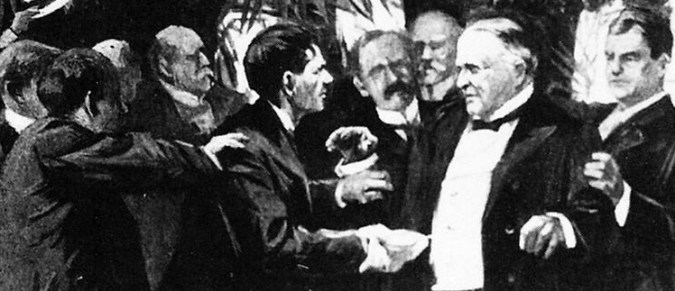
The latest mutation of the culturally-rotting virus has Native Americans demanding that memorials and honors to any figure whose legacy offends them must be eliminated. Five years after President William McKinley was assassinated,  George Zehnder presented the Northern California city of Arcata with an 8.5-foot-tall statue honoring him.  Arcata home to Humboldt State University, placed it in the city’s main square.

McKinley was no Confederate: he was a Union war hero at the Battle of Antietam. He was also a popular and effective President. He was elected in 1896 while the nation was in a serious depression, and was successful enough in getting the economy back on its feet that he was re-elected in 1900, the first Republican to get a second term since Grant.  He, not Teddy Roosevelt, led the U.S. into international significance, winning the Spanish-American War, and acquiring Puerto Rico, Guam and the Philippines. He also gave his life for national service, as have all our Presidents who died in office. Ah, but President McKinley also oversaw federal policies that continued the decline of Native American tribes in the U.S., and reservation lands were reduced by as much as 90 million acres. during his administration. Now the Tribal Council of the Wiyot Tribe in Northern California senses a chance at revenge.  It is demanding that the statue of McKinley be removed.

Almost four years ago, before the din of falling statues became a faint hum, like locusts, across the land, I wrote about a controversy in Chevy Chase, Maryland, where a fountain at the center of Chevy Chase Circle honored Francis Griffith Newlands,  a U.S. Senator who also founded the Chevy Chase Land Co., which in turn created neighborhoods on the Washington and Maryland sides of the circle. Senator Newlands also was a racist, and a proactive one. He was a white supremacist who even attempted to have  the 15th Amendment, which granted voting rights to African American men, repealed.

To assist in the analysis of when and whether any honor to a historical figure should be withdrawn, I offered a series of seven guiding principles: Continue reading

Morning Ethics Warm-Up, April 11, 2018: Caesar’s Wife At The EPA, Idiots On The Air, And Dreamers Demanding Discounts [UPDATED]

Good Morning!

1. Forgetting to heed the “Caesar’s wife” Principle. Whatever one may think about EPA head Scott Pruitt’s controversial policy directions as head of the environmental agency, all ought to be able to agree on this: he’s an idiot.

Here is a cultural literacy test: How many Americans under the age of—what, 45? 60? 104?—know what the term “like Caesar’s wife” means? When you have a target painted on your back because you are taking positions that are guaranteed to be anathema to powerful critics, like the news media, you are “like Caesar’s wife.” This should communicate something to you. In 63 BC, Julius Caesar, a man on the rise, was elected to the position of the Pontifex Maximus, the chief priest of the Roman state religion. The next year, his wife Pompeia hosted the festival of the Bona Dea (“Good Goddess”) in which no man was allowed to participate, at Caesar’s official residence. Publius Clodius Pulcher, a  rash young patrician, snuck into the celebration disguised as a woman, allegedly to seduce Pompeia. He was caught, prosecuted ( not for trying to shag Caesar’s wife but for the crime of sacrilege), and ultimately  acquitted. Nevertheless, Caesar divorced Pompeia, saying, “My wife ought not even to be under suspicion.”  Thus was born the saying, once well-known to educated individuals, that “Caesar’s wife must be above suspicion.”

Either Pruitt doesn’t know the reference, or doesn’t understand it. He has made himself vulnerable and a political liability to the Trump administration by the kind of grubby ethics violations so many of the administration’s recruits from the corporate world have engaged in. (And what does this tell us about that culture?)

David J. Apol, acting director of the Office of Government Ethics, sent  a letter this week to Kevin Minoli, the EPA’s  top ethics official,  asking the agency to take “appropriate actions to address any violations.”

Among the issues raised were Pruitt’s $50-a-night rental  of a Capitol Hill condominium from the wife of an energy lobbyist (This may not have been market value, the letter speculates, raising the question of whether it was a gift, aka “bribe.” Ya think? You can’t rent a decent garden tool shed for 50 bucks a night…), Pruitt taking an excessive number government-funded flights home to Oklahoma and back (He’s about the 78th Trump official to be caught doing this kind of thing—do these guys read the newspapers?), and worst of all, reports that agency staff members who raised concerns about these and other actions creating “the appearance of impropriety”  found themselves transferred or demoted.

“The success of our government depends on maintaining the trust of the people we serve,”wrote Apol. “The American public needs to have confidence that ethics violations, as well as the appearance of ethics violations, are investigated and appropriately addressed.”

Why yes! And anyone who holds high government office is supposed to know that. Anyone holding high government office in this administration, which is in the position of the thug sprung from police lock-up on a technicality to which an angry detective says before he strolls out the door, “If you so much as spit on the sidewalk, I’ll be there to pick you up,” should know that especially. When they are gunning for you, you have to be like Caesar’s wife.

The President should fire Pruitt for these flagrant abuses. He won’t, because he literally doesn’t think ethics matter. I wonder if he thinks stupidity and unrestrained arrogance matter… Continue reading

Comment Of The Day: “Ethics Quiz: Harvard And Evangelicals”

Here is another Comment of the Day emerging from the discussion of Harvard’s suspension of a student religious organization.

The topic is a bit tangential, but interesting nonetheless. One of EA’s readers from across the Atlantic—you can tell he’s British because he spell “theater” wrong— clarifies some history regarding England’s unpleasantness with the Colonies, and as you all know, correcting historical misconceptions is always welcome here.

This is P.M. Lawrence’s Comment of the Day on the post, “Ethics Quiz: Harvard And Evangelicals”:

“When we look at the Second Amendment, it was written at time when a rag-tag group of colonies resisted the greatest empire the world had seen to date.”

Though I mostly just lurk these days, I have seen that misconception so much that I want to rebut it here, as this is one of the few places where the search for truth might let it be taken seriously. Feel free to check what follows for yourselves.

Britain had only just acquired Canada and Bengal, along with hegemony over some (not all) of the rest of India. At that point, all of its gains were yet to be consolidated, and represented drains rather than sources of strength; the same applies to Gibraltar and Minorca too, of which more below. In military, geographical, and economic terms, Britain was weaker than the Chinese, Russian and Ottoman Empires – though all those fell back in one or more of those respects very soon afterwards, when Britain was surging ahead, which may give people the wrong idea from looking anachronistically at what came later. More to the point, Britain was then behind both France and Spain too in most of those respects, and those countries were allied with the revolting colonists.

Britain had just two advantages over France and Spain: it had a more resilient financial system than France and Spain (though not than Holland, a minor rebel ally), and it had denied France more territory even though it had not yet consolidated that for itself.

Britain was – at the time – equal in naval power to France, though not yet to France and Spain combined, which it only became after the Battle of Trafalgar in 1805. That was why Britain lost the.Battle of Chesapeake Bay, which in turn made Yorktown into a Dien Bien Phu rather than at worst a Corunna or a Dunkirk, or at best even a Torres Vedras. Continue reading

Comment Of The Day: “Ethics Quiz: Harvard And Evangelicals”


 The theological discussions that periodically break out on Ethics Alarms are always interesting. Naturally the question of whether seeking out a same-sex relationship justified expelling an officer in an evangelical Christian student group at Harvard sparked one. Here is Rich in Ct’s Comment of the Day on the post, “Ethics Quiz: Harvard And Evangelicals”:

“Given that someone other than Jesus Christ created the ideology then I cannot automatically believe that proscriptions against said choices are in fact Christ’s teachings. Much of those ideas are old testament ones. Christ’s teachings obliterated many of those old testament ideas.”

It is a fallacy to make these two unrelated but true statements (that Christ did not address homosexuality, and that Christ negated much of the Old Testament), and imply that the current ideology that homosexuals must abstain is inconsistent with Christ’s teachings. It is also a bit weaselly to say that you cannot “automatically believe” one way or the other, but not examine readily available arguments.

Stipulated: I am only arguing what Christianity historically teaches, not whether Christianity is correct or should be accommodated by Harvard or society at large; my goal is only to point out inconsistent theology and history. In the broader context here, understanding what Christ taught and teachings are inferred is important to understand the particular motivation for the student group.

At a minimum, the bible was not written in a vacuum, but within a living culture. The gospels and epistles were written for specific audiences, to address the particular concerns of those groups, not rotely restate what was already collectively understood. Luke, for instance, was addressed to Theophilos (his most excellency). That Jesus Christ was not recorded as addressing a particular topic just means that the gospel authors did not think it needed to be clarified. There is even a catch-all at the end of John stating as much:

“Now there are also many other things that Jesus did. Were every one of them to be written, I suppose that the world itself could not contain the books that would be written”.

This is not an esoteric concept. We live in our own collective culture. In constitutional law, for instance, justices routinely review contemporary sources to infer the framer’s intent. When we look at the Second Amendment, it was written at time when a rag-tag group of colonies resisted the greatest empire the world had seen to date. When interpreting “the right of the people to keep and bear arms shall not be infringed“, it very clearly echos the Declaration of Independence:

“That to secure these rights, Governments are instituted among Men, deriving their just powers from the consent of the governed, — That whenever any Form of Government becomes destructive of these ends, it is the Right of the People to alter or to abolish it,…”

The right of the people to resist their government as a last resort cannot reasonably be preserved if weapons are only guaranteed to a “militia” not elsewhere defined in the constitution. The Second Amendment can only be interpreted to mean something else if one ignores the culture and contemporary events that motivated it.

When we look at theology, we must interpret the topics discussed by Christ and the biblical authors in light of earlier theological works. To infer his teachings regarding homosexuality, we must look at his words regarding similar topics, and their relationship with Old Testaments view of homosexuality. Specifically, if we look at Christ’s teachings regarding sex, marriage, and lust, Christ act actually clamps down, rather than liberates. He abolishes Mosaic Divorce, binding married couples for life “what god has joined let no man put asunder”.

This must be interpreted within the Jewish culture; if men and woman are now bound for life, but if as stated in the Old Testament “If a man lies with a male as with a woman, both of them have committed an abomination;” it stands to reason that if the man laying with a woman portion of the law were tightened by Christ, then the man lying with a man part were not likely loosened.

However the second part of that line, “they shall surely be put to death; their blood is upon them….” must be equally reinterpreted in light of Christ’s mercy towards the adulterous, the violator of the vary portion of the law he tightened:

“(Let He Who is without Sin cast the First Stone) Woman, where are your accusers? Has no one condemned you?” – “No one, Lord,” she answered. – “Then neither do I condemn you,” Jesus declared. “Now go and sin no more.”

The theologically sound conclusion might be that Christ did not approve of homosexual behavior, but demanded that mercy be shown to them. Continue reading

Morning Ethics Warm-Up, 4/7/2018: “Ruggles Of Red Gap” And “Williamson No Longer Of The Atlantic'”


Good Morning…

(Do you remember when Saturday morning was fun? Stupid, but fun…)

1. Your cultural literacy note of the day. The Charles Laughton classic “Ruggles of Red Gap” was on Turner Movie Classics last night. The movie itself is wonderful—I recommended it in an Independence Day post here—but it is also a cultural literacy triumph.  In 1935, when the film was released, Lincoln’s Gettysburg address was in the process of falling out of the public’s consciousness. The film’s most famous scene, however, revived it. In a saloon, reference is made to “what Lincoln said at Gettysburg,” and all the cowboys in Red Gap ask each other, “What did Lincoln say at Gettysburg?” Then, quietly, unexpectedly, Ruggles the English butler (Laughton) and the only foreign-born man in the room, recites the speech. TCM host Ben Mankiewicz, in his post showing observations, revealed that when the film was first shown, audiences frequently stood and applauded Laughton’s rendition, and the Address itself became more widely known and quoted.

This is how popular culture works when it is in sync with national values, and not attempting to undermine them.

Here is the scene…for some reason YouTube doesn’t have it, but does have the entire film. The saloon scene begins at about the 56:09 mark:


2. The Atlantic-Kevin Williamson controversy. Unless you routinely plumb the depths of pundit wars and cultural bloodletting, you might well be completely unaware of this skirmish, but it is ultimately an ethics story. Continue reading