How Unethical Is Spike Lee’s Oscar Boycott?

SpikeLee

Short answer: Incredibly unethical.

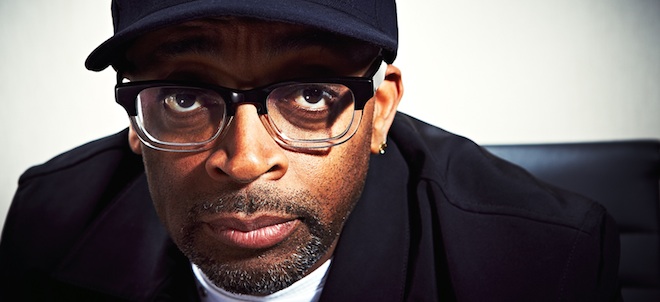
Spike Lee, ground-breaking black director, social commentator, Knicks fan and hot-head, announced that he’s boycotting the Oscars because its 2016 nominations list did not meet diversity mandates, and posted this rant/manifesto on Instagram:

“Again. I Would Like To Thank President Cheryl Boone Isaacs And The Board Of Governors Of The Academy Of Motion Pictures Arts And Sciences For Awarding Me an Honorary Oscar This Past November. I Am Most Appreciative. However My Wife, Mrs. Tonya Lewis Lee And I Will Not Be Attending The Oscar Ceremony This Coming February. We Cannot Support It And Mean No Disrespect To My Friends, Host Chris Rock and Producer Reggie Hudlin, President Isaacs And The Academy. But, How Is It Possible For The 2nd Consecutive Year All 20 Contenders Under The Actor Category Are White? And Let’s Not Even Get Into The Other Branches. 40 White Actors In 2 Years And No Flava At All. We Can’t Act?! WTF!! It’s No Coincidence I’m Writing This As We Celebrate The 30th Anniversary Of Dr. Martin Luther King Jr’s Birthday. Dr. King Said “There Comes A Time When One Must Take A Position That Is Neither Safe, Nor Politic, Nor Popular But He Must Take It Because Conscience Tells Him It’s Right”. For Too Many Years When The Oscars Nominations Are Revealed, My Office Phone Rings Off The Hook With The Media Asking Me My Opinion About The Lack Of African-Americans And This Year Was No Different. For Once, (Maybe) I Would Like The Media To Ask All The White Nominees And Studio Heads How They Feel About Another All White Ballot. If Someone Has Addressed This And I Missed It Then I Stand Mistaken. As I See It, The Academy Awards Is Not Where The “Real” Battle Is. It’s In The Executive Office Of The Hollywood Studios And TV And Cable Networks. This Is Where The Gate Keepers Decide What Gets Made And What Gets Jettisoned To “Turnaround” Or Scrap Heap. This Is What’s Important. The Gate Keepers. Those With “The Green Light” Vote….”

Now let me list as many of the ways Lee’s boycott is unethical (I may stray into why it is stupid as well),  as I can before my fingers get tired and nausea overwhelms me: Continue reading

There’s Nothing To Do About This, But “13 Hours” Is Unethical

13-hours-poster-image-2015

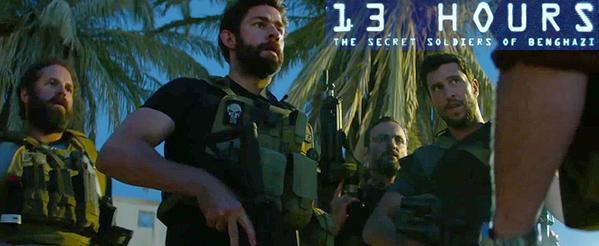
“13 Hours,” directed by Michael Bay,dramatizes the Sept. 11, 2012 attack on the Benghazi consulate in Libya, a tragedy, and also the center of an ongoing controversy over Clinton’s tenure as Secretary of State and her truthfulness. The movie hits theaters today,  two weeks ahead of the Iowa caucuses.

“The release of ’13 Hours’ will re-start the conversation over Benghazi and introduce a whole new audience to the events of that night,” says Brian O. Walsh, president of Future45, a conservative, Clinton-hating super PAC.  “Coming just weeks before the first votes are cast and in the form of a major motion picture from Hollywood, the timing couldn’t be worse for Secretary Clinton.”

He’s right. I haven’t seen the film, but the subject matter is bad enough. It is brutally unfair and an abuse of its influence and power over public opinion for Hollywood to release a feature film distorting a relevant historical event during the run-up to a national election. Doing so turns entertainment into propaganda, and confuses an already bewildered, ignorant and intellectually lazy public. It is irresponsible. Continue reading

Eleven Ethics Observations On The Fox GOP Presidential Debate In South Carolina

The moderators...

The moderators…

1. Last night’s Fox News debate was the most ethical,  and generally the best of them all so far, in either party.

2. Rand Paul’s boycott of the so-called “undercard” debate reveals his arrogant nature. Chris Christie was demoted for one round, didn’t complain, participated, did well, and came back to the main event. Rand thinks he’s more qualified to be President  than Carly Fiorina, Mike Huckabee and Rick Santorum. Well, then, show us. Paul, in one complaint, proudly pointed to the fact that he’s the only GOP candidate who wants to legalize drugs and return the U.S. to isolationism as the world burns.  Yes, and this is why you’re not on the main stage, Senator. This is called “answering your own question.”

3. A group of Paul supporters started chanting his name at one point, causing Neil Cavuto to pause and look bemused. Oddly, Donald Trump did not command that their coats be confiscated.

4. Early on, both Bush and Marco Rubio pointed out—since the news media is still trying to soft-peddle it—that Hillary Clinton’s legal problems are serious, and that her lies about her e-mail and Benghazi should disqualify her for national leadership. Good. Continue reading

In Search Of A Tipping Point: Trump, The Microphone, And Thomas Dewey’s Ghost

Tom Dewey

The question is what will be the tipping point with Donald Trump, the incident, large or small, that suddenly causes the scales to fall from the eyes of his so far endlessly tolerant supporters, and cause them to suddenly realize what they are doing, exclaim, “My God! This man is a jerk!” and end this sick romance. The human being behind the ugly mask is uglier still, after all. Sooner or later, a tipping point will be reached.

In 1948, Republican Tom Dewey, who already had given FDR his best battle in an election, was poised to defeat the unpopular President Harry Truman and become President of the United States. It was less than a month from election day when, in Beaucoup, Illinois,  Dewey was speaking on the rear platform of a train as a tactic to counter Truman’s 30,000-mile whistle-stop campaign. The engineer accidentally backed the train up a short distance and stopped with a jolt, frightening both the candidate and the crowd. Dewey, flustered, snapped, “This is the first lunatic I’ve had as an engineer. He probably ought to be shot at sunrise, but I guess we can let him off because nobody was hurt!”

Nobody laughed. This was a petulant, privileged, arrogant side of Dewey that the public had never seen before, and was played up by papers as emblematic of a contempt  for working Americans. It didn’t help that he wore a fussy, anachronistic  mustache mocked by Alice Roosevelt Longworth as making her visualize Dewey as “the bridegroom on the wedding cake,” but whatever his other flaws, the train incident and his unguarded moment of impatience may have cost Thomas Dewey the election.

Yesterday, during an overflowing rally in Pensacola, Florida, the Republican poll-leader for the party’s Presidential nomination became annoyed by a balky microphone and attacked an anonymous sound engineer.

Continue reading

Ethics Perspective: All Leaders Do Awful Things, And Many Are Awful People: All We Can Do Is Identify Leaders Who We Can Trust To Try Be Ethical, While Having The Ability To Lead

Roosevelts

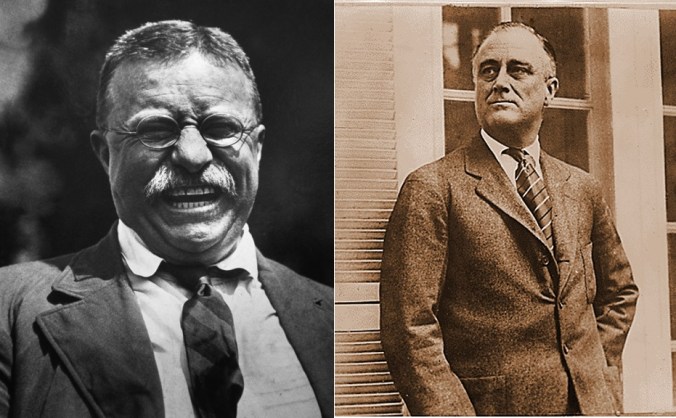
Case Study I: Theodore Roosevelt.

Teddy’s easily my favorite President, both as a personality, a leader, and a human being. Almost all of his flaws, and he had plenty—the excessive animal-killing, the imperialism, the love of war, his sexism and intrinsic belief in white supremacy—are directly attributable to his times and class. He learned, because he was brilliant and intellectually curious. Like George Washington, TR was capable of evolving. He wanted to do good, and like all of us, was on a lifetime journey to find out what good was. Like most leaders who are capable of leading, he thought he had a pretty good idea of what was right, and one that was better than those of almost everyone else.

In at least one instance, however, Roosevelt personality and leadership style led to a terrible injustice.

On August 13, 1906, there was a race-related fight in Brownsville,Texas. It got out of control, turned into a full-scale riot, and one white police officer was wounded while another man, a bartender, was killed. The town blamed the black soldiers of the 25th Infantry stationed at nearby Fort Brown; tensions between the soldiers and the all-white town had been growing since the blacks arrived.  The town produced spent shells from army rifles as evidence of the soldiers’ guilt, and investigators accepted them as incriminating, though they probably were planted.

All the soldiers protested that they were innocent. Their white officers backed up their claims that the soldiers had been in their barracks at the time of the melee.  No military trial was ever held, but a Texas court cleared the black soldiers of wrongdoing. Nevertheless, President Roosevelt discharged  the entire regiment without honor anyway: 167 men, but only the blacks; the white officers were not disciplined.  The alleged cause for the harsh punishment was that the blacks had engaged in a “conspiracy of silence” to protect the guilty member of their regiment. Some of the men dismissed had over twenty years of  honorable service; one had fought alongside Roosevelt during the Spanish American War. Many were only a short time away from retirement and vested  pensions. The 168 lost their careers, reputations, and retirement income. Continue reading

The Seventh Annual Ethics Alarms Awards: The Best of Ethics 2015, Part I

Sweet Briar montage

Welcome to the Seventh Annual Ethics Alarms Awards, our blog’s retrospective of the best and worst in ethics over the past year, 2015.

It was a rotten year in ethics again, it’s fair to say, and Ethics Alarms, which by its nature and mission must concentrate on episodes that have lessons to convey and cautionary tales to consider probably made it seem even more rotten that it was. Even with that admission, I didn’t come close to covering the field. My scouts, who I will honor anon, sent me many more wonderfully disturbing news stories than I could post on, and there were many more beyond them. I did not write about the drug company CEO, for example, who suddenly raised the price of an anti-AIDS drug to obscene levels, in part, it seems, to keep an investment fraud scheme afloat. (He’ll get his prize anyway.)

What was really best about 2o15 on Ethics Alarms was the commentary. I always envisioned the site as a cyber-symposium where interested, articulate and analytical readers could discuss current events and issues in an ethics context. Every year since the blog was launched has brought us closer to that goal. Commenters come and go, unfortunately (I take it personally when they go, which is silly), but the quality of commentary continues to be outstanding. It is also gratifying to check posts from 2010 and see such stalwarts who check in still, like Tim Levier, Neil Dorr, Julian Hung, Michael R, and King Kool.  There are a few blogs that have as consistently substantive, passionate and informative commenters as Ethics Alarms, but not many. Very frequently the comments materially enhance and expand on the original post. That was my hope and objective. Thank you.

The Best of Ethics 2015 is going to be a bit more self-congratulatory this year, beginning with the very first category. Among other virtues, this approach has the advantage of closing the gap in volume between the Best and the Worst, which last year was depressing. I’m also going to post the awards in more installments, to help me get them out faster. With that said….

Here are the 2015 Ethics Alarms Awards

For the Best in Ethics:

Most Encouraging Sign That Enough People Pay Attention For Ethics Alarms To Occasionally Have Some Impact…

The Sweet Briar College Rescue. In March, I read the shocking story of how Sweet Briar College, a remarkable and storied all-women’s college in Virginia, had been closed by a craven and duplicitous board that never informed alums or students that such action was imminent. I responded with a tough post titled “The Sweet Briar Betrayal,” and some passionate alumnae determined to fight for the school’s survival used it to inform others about the issues involved and to build support. Through the ensuing months before the school’s ultimate reversal of the closing and the triumph of its supporters, I was honored to exchange many e-mails with Sweet Briar grads, and gratified by their insistence that Ethics Alarms played a significant role in turning the tide. You can follow the saga in my posts, here.

Ethics Heroes Of The Year

Dog Train

Eugene and Corky Bostick, Dog Train Proprietors. OK, maybe this is just my favorite Ethics Hero story of the year, about two retired seniors who decided to adopt old  dogs abandoned on their property to die, and came up with the wacky idea of giving them regular rides on a ‘dog train” of their own design.

Ethical Mayor Of The Year

Thomas F. Williams. When the Ferguson-driven attacks on police as racist killers was at its peak (though it’s not far from that peak now) the mayor of Norwood, Ohio, Thomas F. Williams, did exactly the opposite of New York Mayor Bill de Blasio in response to activist attacks on the integrity of his police department. He released a letter supporting his police department without qualification. At the time, I criticized him for his simultaneously attacking activists as “race-baiters.” In the perspective of the year past, I hereby withdraw that criticism.

Most Ethical Celebrity

Actor Tom Selleck. In a terrible year for this category, Selleck wins for bravely pushing his TV show “Blue Bloods” into politically incorrect territory, examining issues like racial profiling and police shootings with surprising even-handedness. The show also has maintained its openly Catholic, pro-religion perspective. Yes, this is a redundant award, as “Blue Bloods” is also a winner, but the alternative in this horrific year when an unethical celebrity is threatening to be a major party’s nominee for the presidency is not to give the award at all.

Most Ethical Talk Show Host

Stephen Colbert, who, while maintaining most of his progressive bias from his previous Comedy Central show as the successor to David Letterman, set a high standard of fairness and civility, notably when he admonished his knee-jerk liberal audience for booing  Senator Ted Cruz

Sportsman of the Year

CC Sabathia

New York Yankee pitcher C.C. Sabathia, who courageously checked himself into rehab for alcohol abuse just as baseball’s play-offs were beginning, saying in part,

“Being an adult means being accountable. Being a baseball player means that others look up to you. I want my kids — and others who may have become fans of mine over the years — to know that I am not too big of a man to ask for help. I want to hold my head up high, have a full heart and be the type of person again that I can be proud of. And that’s exactly what I am going to do.”

Runner-up: MLB Commissioner Rob Manfred, who dismissed the ethically-addled arguments of Pete Rose fans to reject his appeal to be have his lifetime ban for gambling lifted.  For those who wonder why football never seems to figure in this category: You’ve got to be kidding.

Ethics Movie of the Year

SpotlightTIFF2015

“Spotlight”

Runner-up: “Concussion”

Most Ethical Corporation

Tesla Motors, the anti-GM, which recalled all of its models with a particular seatbelt because one belt had failed and they couldn’t determine why. Continue reading

The Late Senator Dale Bumpers Was An Ethics Corrupter Of Historic Significance: That’s His Legacy

Impeachment ticket

Former U.S. Senator Dale Bumpers (D-Ark) has died at 90, and his obituaries respectfully note his successful political career that led him to the Arkansas State House as well as Washington, D.C. His death is nicely timed with the re-emergence, thanks to Donald Trump and Bill Cosby, of scrutiny of Bill Clinton’s proclivities as a sexual predator. Bumpers played a key role in not only allowing Clinton to escape accountability for that reprehensible conduct and other conduct required for him to continue it, but also in corrupting the Presidency, the public and the nation.

Good job, Senator. Sorry you’re dead, but now, while you are briefly back in the public eye, is the time to be clear about your legacy.

On January 21, 1999, late in the Clinton impeachment proceedings on the Senate floor, recently retired Senator Dale Bumpers took center stage to defend his fellow Arkansas Democrat as he fought for his political life. The fact that Bumpers was allowed to make such a speech proved that the proceedings were rigged, and were nothing but partisan theater. I don’t think Chief Justice Rehnquist, who supposedly presided over the impeachment “trial,” should have allowed Bumpers to speak; maybe the Chief Justice had to: I am unclear on whether he could have acted like a judge if he wanted to. Bumpers was not then a member of the body, and he introduced no evidence. Indeed, his entire function was to mischaracterize the issues, confuse the public, and remind his Democratic colleagues that their first duty was to the party rather than the nation.

That being the case, he did his job well.

Reading the transcript of his speech again for the first time in over a decade, I was struck at how terrible—cynical, misleading, dishonest—it was. The speech essentially distilled all of the rationalizations and excuses, repeated ad nauseum by Lanny Davis and others on cable TV since the Monica Lewinsky scandal had broken, into a credible imitation of a sincere, non-partisan appeal by an elder statesman. Masterful it was; it was also rotten to the core. Continue reading

The Washington Post Drops Its Resident Op-Ed Socialist. Good.

Workers Unite

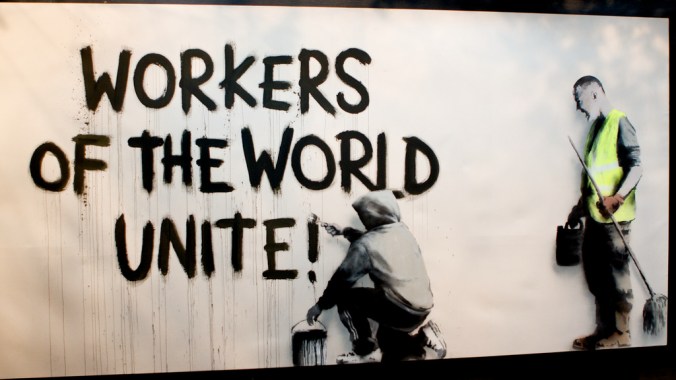
The Washington Post has jettisoned Harold Meyerson, who has been the leftest of the leftists on the Washington Post op-ed pages for about 13 years…not surprising, as he also serves as editor at large for The American Prospect. Mayerson, according to his last column, was told that he was a goner because he was losing readers and because his columns were repetitious, which they certainly were. How many times, after all, can one read “Workers Unite!”?  From Occupy Wall Street to BlackLivesMatter, there was no revolt of the oppressed and downtrodden that Meyerson didn’t support, nor any standard issue socialist/progressive position that he did not wholeheartedly embrace.

The Post has other kneejerk leftists among their pundits, a disproportionate number in fact (this was also part of the Post’s motivation to let Meyerson go), but I found Meyerson more infuriating than the others because he seemed so much more intelligent than his positions and statements would suggest. He was the epitome of an opinion journalist whose opinions seemed to be calibrated to achieve a grander agenda, rather than honest expressions of truth or even what he really believed. He is a columnist in the Saul Alinsky tradition of liberalism, willing to bend truth for the greater good, to win converts for the Great Worker Rebellion, or whatever it would be.

No newspaper should employ a journalist who is willing to deceive its readers, even on the pretense of saving the world.

Continue reading

Ethical Quote of the Month: Hollywood Chamber of Commerce President Leron Gubler

cosby-star

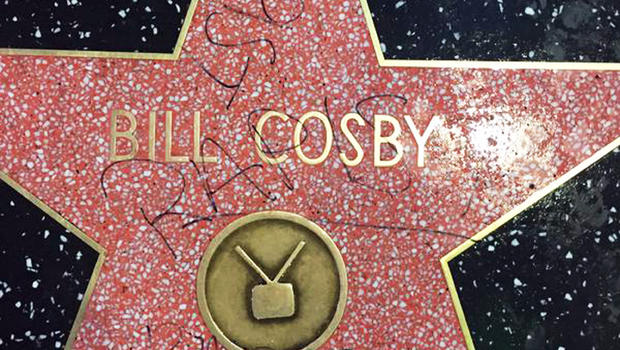
“The answer is no. Once a star has been added to the Walk, it is considered a part of the historic fabric of the Hollywood Walk of Fame. Because of this, we have never removed a star from the Walk.”

Leron Gubler, Hollywood Chamber of Commerce president and CEO, answering a question about whether Bill Cosby’s star would be removed from the Hollywood Walk of Fame. Cosby was formally charged with sexual assault today in Pennsylvania, the first time allegations of any of his nearly 50 accusers have resulted in a court appearance. The Cos is out on a million dollar bond.

Exactly.

Variety also quotes the late Johnny Grant, a former chairman of the Hollywood Walk of Fame Committee, who once addressed the status of another fallen star’s place on the walk, saying:

“Stars are awarded for professional achievement to the world of entertainment and contributions to the community. A celebrity’s politics, philosophy, irrational behavior, outrageous remarks or anything like that have never been cause to remove a Walk of Fame star.”

On this matter of ethics, at least, Hollywood gets it, unlike Disney World, Harvard Law School, Princeton, the University of Kentucky, the World Fantasy Award, Connecticut Democrats, the National Park Service, Saltzburg University…and many others.