Guess Who Invited Donald Trump to the White House Correspondents Association Dinner?

OK, who's the wiseguy that brought the skunk to the picnic?

I missed it, but the Washington Post of April 28 revealed who it was that invited Donald Trump, fresh from a month of trying to make the President’s citizenship a campaign issue while denigrating Obama’s integrity, legitimacy, and honesty, to the annual light-hearted White House Correspondents Association dinner, where the President is always a featured “performer.” It was buried in the gossipy Style section, but there was the culprit. Who invited him?

The Washington Post invited him, that who.

Inviting Trump to that event is in approximately the same good taste as inviting blogger Pamela Geller to a Park51 (a.k.a. “the Ground Zero Mosque”) controversy, or allowing a group of “Truthers” to crash a testimonial to Dick Cheney.

What could the Post have been thinking? “He’s a fascinating figure to Washington right now!” the Post’s representative breathlessly explained on the 28th. We are to assume, then, that if the dinner was being held this week and Osama bin Laden hadn’t been dispatched (most respectfully, of course) to Davy Jones’ Locker, the Post might have invited Osama’s bullet-riddled corpse to slump at its table.

The Post was stirring the pot, is what it was doing, and that is not the media’s proper of ethical role. If the intention was to set up Trump, who had been called everything from a joke to a fool to a thug to a racist by various Post writers only days before, to be insulted to his face by host Seth Myers and the President, that is taking sides in the news rather than reporting it. If it the intent was to position volatile elements together in the hopes of sparking a story, that is unethical  journalism too.

The paper got both results that it presumably desired: Trump was a sitting duck at the dinner, and then he embarrassed himself by later complaining about the skewering he so richly deserved. It also, not for the first time, showed how rusty those old ethics alarms are at the offices of Washington, D.C.’s most prestigious newspaper.

[Thanks to sharp-eyed Post reader Robert Sher.]
Ethics Hero: Washington Post Columnist Carolyn Hax

I’m breaking some precedent here: I don’t usually pick Ethics Heroes based upon writing alone, and I don’t usually reprint long sections from someone else’s column. But relationship advice columnist Carolyn Hax has long displayed a brilliant feel for ethical analysis, and expresses it sharply and entertainingly to the great benefit of her readers. Good general readership ethical analysis is all too rare, and she deserves accolades.

Today she provided as clear and as deft a lesson in how responsibility, honesty, fairness, bias and accountability work as I can imagine, while chiding a man who wants to rescue a younger woman from the relationship he didn’t have the guts to pursue herself. It shows her at her best, and is impeccable ethics as well. Brava!

Here is the inquiry and Hax’s response: Continue reading

Comment of the Day: “Death Photo Ethics”

Tim LeVier elaborates on the ethical awkwardness of President Obama’s stated rationale for not releasing Osama’s death photos, the topic of the post, Death Photo Ethics: Continue reading

Death Photo Ethics

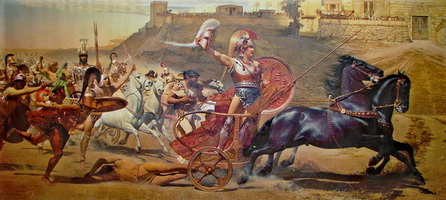
Even before Achilles dragged the corpse of Hector behind his chariot through the dust around the walled city of Troy, the tradition of demoralizing the enemy by degrading and displaying the bodies of its dead heroes was well-established. The United States was horrified when this was done to our fallen servicemen in Somalia, and it is one of the most barbaric and unnecessary practices of war.  While the Geneva Convention doesn’t mention the displaying of enemy corpses, a 2005 publication by the Red Cross called Customary International Humanitarian Law does. It was written to address issues that international treaties omitted, and its Rule 113 reads:

“Each party to the conflict must take all possible measures to prevent the dead from being despoiled. Mutilation of dead bodies is prohibited. Continue reading

In Search of Accountability, Fairness, Justice and a Champion: the Unending Persecution of Anthony Graves

Job would pity Anthony Graves

Governments and other bureaucracies are capable of unimaginable callousness, stupidity, and wrongful conduct, allowing individual fools to multiply their power to harm exponentially, and then to see an inhuman computer-driven monstrosity run amuck as everyone denies responsibility. You could not devise a better example of this process than what Texas is doing to Anthony Graves.

He is an innocent man convicted of murder in 1994 who was released last October after spending 18 years in prison, condemned to death. He had been convicted with fabricated evidence and coached testimony employed against him by former Burleson County District Attorney Charles Siberia, and a state investigation got a Texas judge to set Graves free. But the maw of Texas bureaucracy wasn’t through ruining his life. Continue reading

From First Amendment Outrage to Ethics Hypothetical: The Westboro Baptist Church vs. Brandon, Miss. Hoax

"Never mind!"

Bulletin: The story about how citizens and law enforcement personnel in Brandon, Miss. foiled the efforts of Fred Phelps’ homophobic Westboro Baptist Church to disrupt the funeral of a serviceman killed in Afghanistan never happened. The source of the hoax is unclear, but an enterprising Stars and Stripes blogger investigated and has determined that it never happened. The Church was never even in Brandon.

I detest fake web stories and the people who create them, as you probably know. The public is  confused enough by reality without having falsehoods, fabrications and hoaxes added to its database. Luckily, this is not a news site, but an ethics site, and my commentary about those who applauded this tale of a community conspiring to rob a group of their U.S. Supreme Court confirmed constitutional rights is as valid as when it was widely assumed that the story was real.

The foiling of Fred Phelps’ gang by “Mississippi Burning” tactics is not only an ethics hypothetical that most people flunked, but also an effective trap to lure the self-righteous into agreeing  that ends justify unethical means as long as the victims of those ends are sufficiently despicable.   This group includes one of the most quoted commentators on the story, who approved of the fictional response by the town and wrote,

“This is a template for how to handle the Westboro people. If lawsuits don’t work, other means will. Whatever it takes to keep them from harassing bereaved military families on the day their fallen loved ones are laid to rest.”

He was wrong then, and he’s wrong now.

Comment of the Day: “The Ethicists, Backing Judge Walker and Gay Marriage, At An Unacceptable Price”

The motion to vacate Judge Walker’s ruling on Proposition 8 has been filed, you can read it here. Since the original post, I have detected some cracks in the formerly near-united front of legal ethicists and journalists deriding Walker’s critics. Some of them are finally, grudgingly, admitting that the Judge might not have handled his potential conflict so well after all, and that the motion is not a frivolous, anti-gay outrage as they originally labelled it.  The most rickety of the rationalizations put forth on Walker’s behalf, advanced by some his most respected defenders, is that he had no obligation to reveal his own sexual orientation by disclosing his domestic arrangement because of its intimate and private nature. Yet the judge voluntarily disclosed it after his decision was in the books, raising a rebuttable presumption that his original silence was to avoid suggestions of conflict, not out of a desire for privacy.

First time commenter Jada adds her Comment of the Day to the discussion: Continue reading

Unethical Quote of the Week: Adam Dachis

“All posts that belong to the Dark Side are going to feature some ideas that might be a little evil or at least require some flexible ethics. Some things will be downright horrible, and you should not do them, but are either for your information or simply for the point of interest (and will be noted as such). Your judgment and actions are your own, so think before you do anything you read here and only use your dark side for good.”

Adam Dachis, ethics corrupter, in the “Dark Side Disclaimer” that accompanies his column on the website Lifehacker, called “Secrets from the Dark Side.”

His current “Secrets from the Dark Side” column is entitled “How to Lie, Cheat, and Steal Your Way to a Perfect Flight,” which is an accurate description of its contents. Some of Dachis’s “tips” (scams? cheats?) are interesting, some are humorous, and all (well, maybe with one exception) are unethical. Dachis, for his part, doesn’t have the guts to advocate outright the conduct that he is explicitly promoting, nor does he condemn it. As his ethically incoherent ( “Only use your dark side for good”) disclaimer demonstrates, he thinks ethics is a game of some sort, and that being a “little evil” is cute, or trivial, or something.

A true ethics corrupter, Dachis wants to avoid personal accountability for the unethical acts of his readers spurred entirely by his post, while at the same time getting credit for his cleverness. This is the Richard Nixon approach to ethical corruption, planting seeds and disclaiming responsibility for the crop, telling followers, “We could do that, but it would be wrong.” Wink, wink.

Yechhh.

Ethics Heroes: World Journalists

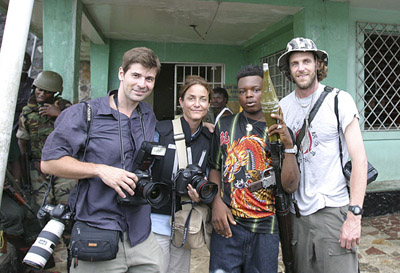
Chris Hondros (left) and colleagues

I know Ethics Alarms is critical of the media and journalists for breaches of objectivity and fair reporting. Nevertheless, there are few professions more inherently heroic than journalism, especially when it requires on-the-scene reportage under dangerous conditions. This was demonstrated, once again, by the recent death of Chris Hondros, a distinguished photo-journalist who was killed last week in Libya.

May 3 is World Journalist Day, and an excellent time to honor the tough and dedicated professionals who bring us important and hard-to acquire news, often risking their lives in the process. To that end, there is no better on-line destination than the website of New York-based non-profit Committee to Protect Journalists, dedicated to making it possible for journalists to do their jobs without fear of reprisals.  There you can learn about the perils faced by media personnel all over the globe, and read about the journalists killed since January 2010 while trying to let us know what is going on in the world.

Fake Quote Ethics

"Osama? The SOB had it coming."---Gandhi

Among the wise commentators who tut-tutted the unseemly rejoicing among Americans upon learning of the death of Osama bin Laden was the Rev. Martin Luther King, who sagely remarked, “I mourn the loss of thousands of precious lives, but I will not rejoice in the death of one, not even an enemy.” Rev. King’s words were immediately picked up and quoted yesterday in hundreds of blogs and news commentary, grateful for the silver-tongued orator and civil rights warrior’s ability to find just the right way to sum up what was troubling—to some— about the post-bin Laden festivities.

Wait...how could he do that? Rev. King is as dead as Osama! Well, he could do that because somebody decided to give his or her own sentiments the added influence, credibility and moral authority of an American hero, put their words in Rev. King’s mouth, and tweeted them to the world. [UPDATE: Now we know that’s not  exactly what happened—this time. An American teacher in Japan introduced a genuine King quote with her own sentiments, and her careless Facebook friends lost the quotation marks. Thanks to Barry Deutsch for the sleuthing.] Continue reading