I am finally typing at my desktop, and therein lies a tale.
As I briefly documented here, I spent much of the day failing to get my computer to work, though it was fine late last night, and it is less than six months old. The initial problem was that I had no WiFi connection and “no networks available.”
I spent almost three hours with three different Verizon techs who made me check connections and wires, reboot the modem, restart the computer at least 15 times, uninstall and reinstall programs and updates, and some other things I didn’t understand.
We changed settings and the date, to no avail. Then the last Verizon tech put my desktop in safe mode, whereupon my password suddenly wouldn’t work. She couldn’t explain why. I could connect turn my WiFi on, which represented progress, but I was locked out of my computer and stuck in safe mode. I also couldn’t reset my password. At one point she had me working off of two Microsoft websites on my laptop to find a way to reset it, while also using my cellphone. Continue reading →
A. Let this be a reminder that the social media giants will try to place their fists on the scale this election cycle.
The political spot above, a creation of the Republican group America Rising, was flagged by Twitter, which warned users that “The following media includes potentially sensitive content.”
What’s the sensitive content? The video is overwhelmingly constructed of news clips and recorded quotes from political figures, including the President, that were broadcast nationwide. It appears that Twitter considers pro-Trump, Republican, conservative advocacy, even of a res ipsa loquitur variety, inherently offensive to its audience. That may well be true, but the Russian attempts to manipulate what voters see and here in the 2016 campaign will be dwarfed by the domestic efforts by the social media platforms and search engines—all for the greater good, of course.
B.Nah, there’s no mainstream media bias! Go ahead, enablers and deniers, rationalize this one. Continue reading →
I need a little blood-stirring today, and my father’s favorite hymn always does the trick…
You know, character is my business, and my record is visible, public extensive and undeniable regarding the position that leaders, and especially U.S. Presidents, should have exemplary character—not just average character, but outstanding. It is exceedingly dangerous to our culture in the short and long term to have a leader whose ethical values are obviously lacking. I say obviously, because leadership is substantially symbolic as well as substantive: a President who has a seriously flawed character does minimal harm if he 1) knows how the govern and lead and 2) is skilled at playing a leader of exemplary character, despite sociopathic tendencies, or worse.
However, as importunate as character is, the evident lack of it is not justification for impeachment or removing a President between elections. The false, opposite claim is essentially the basis of the entire three year coup attempt by the Axis of Unethical Conduct (Democrats, the “resistance” and the news media). That is why so much of the “case for impeachment” are really ad hominem attacks on the President’s presumed motives, personality and alleged beliefs, none of which are remotely relevant to impeachment. It is the duty of educated experts not driven by bias, as well as the news media (which is now incapable of doing it’s job, which is informing rather than confusing the public) to explain that impeaching a President for having an objectionable character (according to his critics) is an incompetent, illegal and destructive act. Yet this—he’s a liar, he’s a racist, he’s an idiot, he’s a sexist, he’s corrupt, etc., etc, and so on-–is the guarantee default retort when anyone correctly points out to the Trump-Deranged that the Democrats and the resistance have no evidence of impeachable offenses at all. This is also why the polling shows so many people want the impeachment to succeed; not because they have a clue about the limitations on the the act of impeachment, but because they interpret the question as, “Don’t you wish we had a President who wasn’t such an asshole?”
Maureen Dowd, the Times whatsit columnists who is half political commentator and half-Joan Rivers, thoroughly disgraced herself yesterday by writing,
“You don’t realize how important character is in the highest office in the land until you don’t have it,” Schiff said. But the more impressive the Democrats’ case is, the more depressing the reality becomes. They want to convince themselves that character matters. But many Americans knew they were voting for a thug. They wanted a thug who would bust up Washington, and they got one.
The Democrats are relying on facts, but the Republicans are relying on Fox.
No, Maureen (are you a dolt or a brazen liar?), the Democrats are relying on facts that have nothing to do with impeachment. Character matters (although during the entire two terms of Bill Clinton the Democrats argued it didn’t), but it doesn’t matter in an impeachment trial. Acts matter in an impeachment trial. The Constitution matters. Precedent matters. Our institutions matter.
It is the mark of how incompetent and irresponsible the President’s critics are than the impeachment debate is being argued at this base level of civic and ethics ignorance.
In presenting this unethical project, the Times took unethical advantage of its readers’ confirmation bias. When the “Lie” list was printed, the Times made certain that it would require super-human dedication and extraordinary eyesight to read it, through the devices of listing every item and the Times commentary in horizontal sequence and in half the usual size type-face. (See above) This ensured that almost no readers would make the Herculean effort to read the whole thing , especially since the well-trained Times reader already “knows” that Donald Trump is a liar. In addition, the explosion of tiny words created the visceral response of “Wow! Look at all those lies!” which is exactly the effect the Times editors wanted.
But that isn’t reporting, and it isn’t journalism. The “list” was a page-size, visual, ad hominem attack. The Times wasn’t seeking close scrutiny of its list, nor was it interested in making any rebuttal easy or likely.
We have learned that the Times list was largely assembled from various fact-checker columns. That is a red flag, and explains many of the most embarrassing inclusions on the list. None of the fact-checkers are trustworthy. All of them are biased, Snopes and PolitiFact worst of all, and they consistently register opinions that the writer disagrees with as “false.” Many, many of the items on the Times list are in this category.
The entire exercise was an extension of #16 on the Fake News list, “Dishonest Factchecks. Here was a typical “lie” according to the Times, and its “proof”:
Jan. 21 “A reporter for Time magazine — and I have been on their cover 14 or 15 times. I think we have the all-time record in the history of Time magazine.”
Says the Times,“Trump was on the cover 11 times and Nixon appeared 55 times.”
Trump was making the general point that he had been on TIME’s cover a lot. He guessed that the number was 14 or 15; it was 11. That is what is known as a non-material misrepresentation: it’s meaningless and harmless, and certainly not an intentional deception. (“Heh, heh…I’ll make those poor, gullible fools think I was on TIME”s cover 14 times when it was ONLY ELEVEN!! BWAHAHAHAHAHA!!!) Then he said he “thinks” that’s a record. When someone says “I think” it means the speaker is acknowledging that he may be wrong. But Trump is not accorded the usual leeway given to everyone else, including other elected officials.
When a list includes something this clearly contrived, that list has no credibility. I found going through the Times list annoying, then shocking, and finally infuriating. So when the Washington Post pulled the same stunt, I kept putting off giving it the same treatment that I did the Times’ exercise in lies about lying.
On Ethics Alarms, the term “Authentic Frontier Gibberish” is used to describe “intentionally (or sometimes just incompetently) incoherent double-talk used by politicians, advocates, lawyers, doctors, celebrities, scientists, academics ,con artists and wrong-doers to deceive, obfuscate, confuse, bore, or otherwise avoid transparency, admitting fault, accepting accountability or admitting uncomfortable truths. The term comes from “Blazing Saddles,” in this memorable scene.
It sometimes arises from incompetent communication skills, which are unethical for anyone in the public eye to employ. Sometimes it is more sinister than that, and occurs when someone chooses to create a vague word cloud that obscures the speaker’s or writer’s real purpose…and sometimes the fact that they are frauds. Sometimes AFG is designed to convey a feeling while avoiding sufficient substance to really explain what he or she means.
Sometimes, it feels like gaslighting.
A New York Times article was ostensibly about “Dealing with Bias in Artificial Intelligence.” This was, obviously, click-bait for me, as the topic is a developing field of ethics. The introduction stated in part, “[S]ocial bias can be reflected and amplified by artificial intelligence in dangerous ways, whether it be in deciding who gets a bank loan or who gets surveilled. The New York Times spoke with three prominent women in A.I. to hear how they approach bias in this powerful technology.” The statements of the first two women—I see no reason why only female experts on the topic were deemed qualified to comment—were useful and provocative.
Last, however, was Timnit Gebru “a research scientist at Google on the ethical A.I. team and a co-founder of Black in AI, which promotes people of color in the field, [who] talked about the foundational origins of bias and the larger challenge of changing the scientific culture.”
Here’s what she said (Imagine, the Times said this was “edited and condensed”! ). The bolding is mine.. Continue reading →
1. The Canadian Broadcast Companyedited Donald Trump’s cameo out of “Home Alone II” when the Christmas-themed family film was aired this week. That sets some kind of record for pettiness, don’t you think? The CBC lamely denies that they meant anything by it, responding to an inquiry, “As is often the case with features adapted for television, Home Alone 2 was edited to allow for commercial time within the format.” Sure. I believe that! Don’t you believe that? Continue reading →
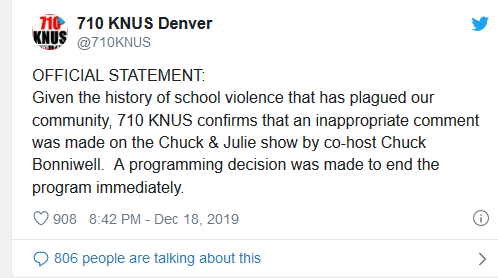
Chuck Bonniwell and Julie Hayden, a husband and wife team, co-hosted the “Chuck and Julie “show on KNUS AM TalkRadio in Denver. Riffing about the impeachment this week, Bonniwell said, “All right, here, a little after 1:30, talking about the never-ending impeachment of Donald Trump. Then he added, chuckling, ” You know, you wish for a nice school shooting to interrupt the impeachment news….” Julie quickly jumped in, saying, “No! No! Don’t even — don’t even say tha!. No, don’t even say that! Don’t call us. Chuck didn’t say that!”Still laughing, Bonniwell tried a save, finishing his handing sentence with “in which no one would be hurt.”
Jason Salzman of the Colorado Times Recorder, who said that after hearing Hayden’s plea for listeners not to call their complaints about her husband’s joke, he “called anyway.” Sandy Phillips, who lost her daughter in the Aurora theater shooting, posted on Twitter: “This guy should be fired. Total ignorance. Shootings hurt us all … just ask witnesses and first responders. You don’t have to be shot to be wounded.”
Bonniwell isued an apology the next evening after 24 hours of criticism on the “Chuck & Julie” Twitter feed, saying, “I made an inappropriate comment meant as a joke. I’m sorry it was not received that way.” Too late. KNUS fired Chuck and Julie later that evening:
Was this a fair decision?
I’m not sure it was. As I have held here on other occasions, those who take extemporaneously for a living, especially when they are expected to be amusing, are constantly walking a high wire. Occasional gaffes, including moments when certain metaphorical landmines are tread-upon or lines are crossed, are inevitable, and the more creative and bold the talent, the more likely such events are. A no-tolerance policy is unreasonable, and it is virtually always the ethical approach to treat the first such error with a warning or punishment short of dismissal. Virtually, because there may always be single gaffes that are so terrible and potentially destructive to the talent’s employer that firing is the only response.
Thus the question here is whether Chuck Bonniwell’s comment falls in the latter category. My view si that it does not:Continue reading →
For some reason, just like the Hallmark cable channels, the satellite radio monopoly Sirius-XM has gone nuts this pre-Christmas season. I count six channels devoted to Christmas music, and I’m sure there are some other buried in there. There are two traditional Christmas music stations that appear to be playing the same songs and recordings; a Country Christmas channel, which means really bad compositions like “Santa Looked A Lot Like Daddy,” a poor rip-off of the slightly less revolting, “I Saw Mommy Kissing Santa Claus” and better songs and carols sung with a twang; a Gospel Christmas channel, and “Nativity,” which includes only carols and songs referencing Jesus, and “Holly,” which avoid religious references completely and is required listening if you want to know how few modern Christmas ballads deserve annual airing. I could two: “Last Christmas,” and Mariah Carey’s “All I Want for Christmas is You,” neither of which can be sung around a piano anywhere but backstage at the Grammys.
I been forcing myself to listen to all of it for days, and have reached some rueful conclusions:
In their rush to avoid referring to Jesus, the programmers over-play the established Winter Solstice canon to the point of madness. We’re talking “Snowfall,” “Winter Wonderland,” “I’ve Got Your Love To Keep Me Warm,” “Sleighride,” “It’s a Marshmallow World,” “Let It Snow,” “Frosty the Snowman,’ and of course, “Baby It’s Cold Outside” by every possible artist, over and over. None of these songs are about Christmas, but if you’re a Druid, I suppose they are appropriate and festive.
At least some versions have lyric changes made to refer to Christmas. Sometimes Frosty says, instead of “I’ll be back again some day!” that he’ll be back on Christmas day. (Is Frosty some kind of a weird Christ figure?). In Winter Wonderland, Farmer Brown’s birthday party is sometimes turned into a Christmas party.
Boy, the ex-Beatles’ attempts at Christmas songs are awful, especially John Lennon’s, with its depressive message, and the lame and gloomy couplet,
And so Merry Christmas, and a happy new year
Let’s make it a good one, without any fear.
There hasn’t been a decent Christmas standard entering the canon since 1963’s “Do You Hear What I Hear?”, which I wrote about last year.
It is also the last popular Christmas song to be written with a religious theme. Think about that, and what it says about the status of religion in U.S. culture.
I know this is a personal preference, but when Bing Crosby’s recordings come on, his warm, smooth, impeccably-crafted delivery just blows everyone else out of the metaphorical water. Yes, even Old Blue Eyes.
Christmas keeps Bing’s legacy alive, though in an unfairly narrow context. We will never hear a voice like that again, I fear.
Having been forced to listen to “Rudolph the Red-Nosed Reindeer” until it kept me awake at night, I have concluded that the suddenly au courant criticism of the song—bullying, you know—is baloney. It teaches the valuable lesson that being a target and a victim need not be permanent, and that if one has character and develops skills, there will be opportunities to prove one’s critics wrong.
I think of Rudolph as a reindeer version of Desmond Doss.
At the risk of being repetitive (I’ve know I mentioned many of these before), here are some Christmas song lyrics that could be, and in some cases, should be, fixed.
What’s a drummer doing by the manger, with a baby sleeping? This has bothered me since the first time I heard “The Little Drummer Boy.”
Speaking of “Do You Hear What I Hear?”: I get the wind talking to the lamb, and I’ll even accept the lamb talking to the shepherd boy, but I’ve never understood how the boy had a chance to meet the mighty king, much less tell him to bring the child “silver and gold.”
Listen to Bobby Helms sing his 1957 hit “Jingle Bell Rock,” and then tell me he doesn’t keep singing “feet” when the lyrics obviously are “beat.” Amazingly, some covers of this song also seem to be singing “feet.”
Dumbest Christmas lyric of all time: The Beach Boys’ repeated (In “Little Saint Nick”) “Christmas comes this time each year.”
I’m tempted to nominate “see the kids bunch” from “Silver Bells” for the second worst. That requires assuming that “then we got upsot” in Jingle Bells is an intentional howler.
The lovely and wistful World War II Christmas ballad “I’ll Be Home For Christmas” refers to “presents on the tree.” Who hangs presents on a Christmas tree? How would you do that? Many recent versions substitute “”round” for on. Good.
The late Andy Williams’ Christmas standard, “It’s The Most Wonderful Time of the Year,” he lists ‘scary ghost stories” as a feature of Christmas. I know the song is referring to “A Christmas Carol,” but that’s a single ghost story. Andy makes Christmas sound like Halloween…
Finally, here’s an example of how attention to tone and craft improved a Christmas song and allowed it to become, deservedly, a classic.
“Have Yourself A Merry Little Christmas” is certainly somber, but having been through some sad Christmases, it’s an essential part of the canon, and a wonderful song. It almost was too sad, however. Hugh Martin and Ralph Blaine, who wrote the song ” for Judy Garland’s 1944 movie, “Meet Me in St. Louis”, originally had the lyrics…
Have yourself a merry little Christmas It may be your last… Next year we may all be living in the past…
Yikes! Judy Garland and others insisted on a revision, and the songwriters ultimately settled on …
Have yourself a merry little Christmas Let your heart be light… Next year all our troubles will be out of sight..
Another gloomy lyric that was vetoed:
No good times like the olden days Happy golden days of yore Faithful friends who were dear to us Will be near to us no more..
Nice. That one became,
Once again as in olden days Happy golden days of yore Faithful friends who are dear to us Will be near to us once more.
“O Come All Ye Faithful” is so stirring that it almost makes up for all other Christmas music botches.
This isn’t so much an ethics analysis as an expression of frustration. For a cultural holiday that relies so much on music, Christmas is wounded today by accumulated incompetence on that front, as well as a lack of diligence. Just a little more attention and industry could make the traditional repertoire so much better. You know those AT&T wireless commercials about how “good enough” isn’t good enough? That’s the issue in a nutshell. We have to hear these songs year after year. Can’t they be cleaned up?
Let’s begin with the traditional songs and carols that weren’t written to avoid the origins of Christmas. These are the strongest and most evocative of all the season’s songs, in contrast to the”popular” Christmas music that came down to us from Tin Pan Alley. I have to ask, though: What the hell is “I Saw Three Ships” about?
I saw three ships come sailing in, On Christmas day, on Christmas day, I saw three ships come sailing in, On Christmas day in the morning.
And what was in those ships all three? On Christmas day, on Christmas day, And what was in those ships all three? On Christmas day in the morning.
The Virgin Mary and Christ were there On Christmas day, on Christmas day, The Virgin Mary and Christ were there On Christmas day in the morning.
Pray whither sailed those ships all three? On Christmas day, on Christmas day, Pray whither sailed those ships all three? On Christmas day in the morning.
Oh, they sailed into Bethlehem, On Christmas day, on Christmas day, Oh, they sailed into Bethlehem, On Christmas day in the morning.
I assumed that there was an acknowledged and well-researched metaphor buried here, but no, there really isn’t. The nearest body of water to Bethlehem is the Dead Sea, and it’s 20 miles away: Bethlehem is land-locked. Where were those ships coming from? How did Jesus and Mary end up on a ship, and why were three necessary? This is the fake news of Christmas Carols. The song makes no sense, so scholars and critics have been positing justifications for this nonsense, without any evidence at all other than, “It must mean something!” One batty theory is that the the three ships are references to the Nina, the Pinta, and the Santa Maria. Wikipedia concludes that the reference to three ships “is thought to originate in the three ships that bore the purported relics of the Biblical magi to Cologne Cathedral in the 12th century.” Then the song has nothing to do with Christmas at all? The entry continues, “Another possible reference is to Wenceslaus II, King of Bohemia, who bore a coat of arms “Azure three galleys argent”. Ah! It’s a song about a coat of arms! Sure! THAT makes sense. Then it goes on to a theory that I considered years ago along with everyone else, that the ships represent the camels used by the Magi, as camels are frequently referred to as “ships of the desert.” Continue reading →
And juuuuust a bit uncivil, I’d say. I may be wrong…
In a motion to dismiss an insurance law suit, Allstate’s lawyers revealed this remarkable conduct on the part of plaintiff’s attorney Christopher Hook in his communications during the case. According to the declaration of those attorneys in their motion, Hook said or wrote…
“Fuck you crooks. Eat a bowl of dicks.” (Declaration of Peter H. Klee, Ex. 1, p. 5)
“I’m going to let the long dick of the law fuck Allstate for all of us.” (Id., p. 7)
“Hey Klee you Cumstain the demand is now 302 million. Pay up fuckface.” (Id., p. 8)
“Peter when you are done felating your copy boy tell Allstate the demand is now 305 million.” (Id., p. 9)
“[Other Sheppard Mullin attorneys] may not be too smart but at least they have some fucking dignity and honor unlike you two limp dick mother fuckers.” (Id., p. 10)
“What is Wright going to do when he finds out Allstate is using people who are borderline retarded to adjust complex claims. That’s what I’m going to do. Demand increases tomorrow.” (Klee Decl., Ex. 1, p. 11)





 Ethics Alarms