Comment Of The Day: “Ethics Dunce: Old Town Sport And Health in Alexandria, VA. Why? Because White Nationalists Have A Right To Work Out Too”

My initial response to this comment by Spartan on the post about Richard Spencer being harassed while trying to use his gym membership and the gym’s response of kicking him out rather than his harasser was in part:

“A very clear and well-stated exposition of an unethical point of view that many misguided people agree with…thus imperiling our pluralistic society.”

It troubles me greatly that so many intelligent Americans are thinking this way in 2017.

Here is Spartan’s Comment of the Day on the post, “Ethics Dunce: Old Town Sport And Health in Alexandria, VA. Why? Because White Nationalists Have A Right To Work Out Too”:

This guy is a public figure and he will be recognized. He chose to be in the limelight. Gym members are allowed to quit their memberships because they don’t want to work out with an asshole. Now imagine (in liberal Old Town) that 75% of the members decide to quit their memberships at this gym because they don’t want to be around him. The business will now suffer.

I used to go to this gym, and I can tell you that I would not want to be around this man. So, although I would not circulate a petition or demand that the gym expel him, I would quit my membership. And, I probably would tell all of my friends why, so I imagine many of them would quit as well. Also, keep in mind that this gym is super tiny — you are pretty much forced to interact with other members.

In this scenario, the gym might end up closing because of lack of membership. So, this is trickier than you make it out in your hypothetical. I am not obligated, as a private citizen, to be polite or even silent around odious human beings. While I do not support a gym’s decision to terminate membership based on political (although I’m being generous here) beliefs, the fact is that people can vote with their feet.

Continue reading →

Unethical Quote Of The Day: A Lovely, Smart, Trump-Deranged, Left-Biased Facebook Friend

“How do we know the Trump administration is racist? well, they’re all white – and if this had been a white student murdered by a black student or immigrant student in what appears to be a racially-motivated hate crime, they’d have plenty say about it.”

—-A Facebook friend who works at Bowie State, exploiting the tragic death of a black student there at the hands of a white student from the University of Maryland, to attack President Trump in a post on his page.

How hysterical, unfair and unethical is this statement? Let’s see:

1.The administration is not all-white. Even if it was, that would not prove it was racist, except in the warped logic of progressives and social justice warriors. People like my friend know Trump is racist because that’s the narrative, and they just decided that he was, mostly by designating as  racist comments that were not, and using race-baiting as substitute for substantive arguments to support their irresponsible love of illegal immigration.

2. The assertion that simply by being white, one must be racist is itself a racist statement. (My friend is white, but this is virtue -signalling on the Left. Denigrate men, whites and conservatives, and that means you are good.)

Addendum: a commenter on the post who had the bad manners to point out that “we know they are racist because they are all white” was a questionable assertion saw his comment immediately deleted.

2. “We know you are racist because we are sure what you would do, though you have never done it.” This kind of reasoning from a faculty member is what Bowie students pay tuition for.

3. In fact, earlier this month a black student attacked and stabbed FOUR white students in Austin, Texas.

The President had no comments, though it was unquestionably a “racially-motivated” crime.  Never mind though, you know he wanted to say plenty.

4. Presidents should have nothing to say about such incidents. They are local, they are single events, they don’t prove anything, and their comments can undermine the justice system and inflame public opinion. President Obama never learned that, repeatedly making inappropriate comments about events that were none of his business, often exacerbating racial tensions, as in his uninformed, slanted statement about the Trayvon Martin-George Zimmerman tragedy. Obama also did exactly what my Facebook friend suggest is racist. He never commented on incidents where whites were the victims, as when Francisco Sanchez, a repeatedly deported Illegal immigrant,  shot and killed 32-year-old Kathryn Steinle in 2015. Does that prove Obama was a racist? Of course not! When you are in the grip of irrational Trump paranoia and hate, these standards only apply to this President, not the previous one. Continue reading →

The Good, Bad Lucky, Unlucky, Legal Illegal Immigrant: Colorado Governor Pardons A Convicted Armed Robber

It is  misleading to describe this story as a Democratic governor letting an convicted armed robber escape punishment so he can stay in the US, though that is how it is being reported.

The world has gone mad, but the pardon issued to convicted bank robber Rene Lima-Marinby by Governor John Hickenlooper isn’t necessarily proof of that, though Lima-Marinby’s weird story is.

He came to the U.S. as a toddler in the 1980 Mariel boat lift from Cuba, and had obtained  legal residency. His 2000 criminal conviction for armed robbery when he was 19 caused that status to be revoked. Lima-Marin was sentenced to 98 years in prison for the robbery.

Let me pause. He was 19, and they sentenced him to 98 years in prison.

Then he was mistakenly paroled from Colorado state prison in 2008, 90 years early. I’ve written about these cases before. I hate them. Releasing a prisoner then coming back years later and saying, “Oopsie! Sorry! Our bad! Back you go!” turns a gaffe into cruel and unusual punishment. Unless a prisoner is a serial killer or a terrorist or breaks the law after he is released, the authorities should bear the burden of such incompetence, and any early release should stand.

Lima-Marin is a good example of why this should be the practice. he married, had a child and got a steady job installing glass. It took six years for the state authorities to discover their mistake, and in 2014 they sent him back to state prison for the remainder of his 98-year  sentence.

Yechh. Continue reading →

Comment Of The Day: “The Most Unethical Sentencing Fallacy Of All: Lavinia Woodward Gets “The King’s Pass”

I am almost caught up on my backlog of Comments of the Day!

This one, by multiple COTDs author Humble Talent, is really two; I’m taking the liberty of combining his later explication with the original comment, as they follow as the night follows day. The topic is bias and double standards in the criminal justice system, and hold on to your hat.

Here is Humble Talent’s 2-for 1 Comment of the Day on the post, “The Most Unethical Sentencing Fallacy Of All: Lavinia Woodward Gets “The King’s Pass”:

You know, every now and again when I’m feeling adventurous, I go to a place I think will have a whole lot of people that don’t think like me and poke at their sacred cows. You meet all kinds of people, and recently, I was given probably one of the better answers to a gender/race issue from the other side yet.

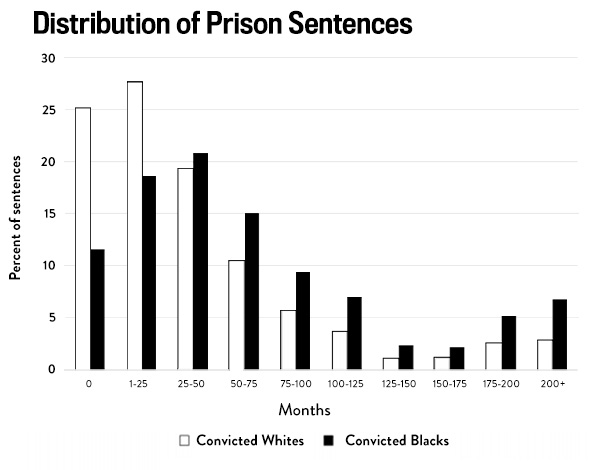
The original fact pattern is that racial activists will cite disparate impact as a problem at every stage of an interaction with the legal system. Black people are more likely to be pulled over, more likely to be arrested, more likely to be charged, more likely to be convicted, and more likely to receive harsher sentences… All for the same stimulus. All of this, by the way, is true. It doesn’t account for the five-fold disparity between the black and white prison population on a per capita basis, but it is a thumb on the scale.

The juxtaposition is that the disparity between men and women in the justice system is about six times that of the racial disparity I just described. Men are more likely to be pulled over, more likely to be arrested, more likely to be charged, more likely to be convicted, and more likely to receive harsher sentences… All for the same stimulus. Sonja Starr wrote extensively on this, and despite some of her methodology being questioned, there’s general consensus that she was on to something.

So the question is that if someone is deeply concerned about inequality, that they are genuinely interested in justice for everyone, why wouldn’t you be just as, if not more concerned with the gender disparity, than the racial one? Continue reading →

Comment Of The Day: “Reluctant Additional Ethics Notes On A Manufactured Crisis: The Comey Firing Freakout”

With so much loose talk about impeachment going around (and by “loose” I mean “inexcusably ignorant”), texagg04’s review of the Constitutional standard for the removal of a President is a gift to readers of Ethics Alarms, and one of the most interesting and informative comments ever to appear here.

He was reacting to a New York Times op-ed, cited by another commenter,  by political scientist Greg Weiner (no relation) titled, “Impeachment’s Political Heart,” in which the author concluded,

“The question is by what standards they should conduct this work, and that question provides an opportunity to correct the mistaken assumption according to which presidents can forfeit the public trust only by committing what the law recognizes as a crime. That is a poor bar for a mature republic to set. It is not the one a newborn republic established. And that is why the idea that the conversation about impeachment is simply a political persecution of a man who is technically innocent of a literal crime not only jumps the investigatory gun. It misses the constitutional point.”

Having studied the issue myself, I immediately rejected Weiner’s analysis (which still is worth reading in its entirety) on the ground that a constantly evolving standard of what is a “high crime and misdemeanor” simply means that Presidents can be impeached for behaving, or governing, in ways that enough members of Congress, the news media and the public don’t like. That is what is being advocated now, and that approach would undermine our democracy, the power of elections, and the office of the President.

My gut response, however, is wan and insubstantial compared to tex’s masterful historical review and astute analysis, which (whew!) reaches a similar conclusion.

Here is texagg04’s fascinating Comment of the Day on the post, “Reluctant Additional Ethics Notes On A Manufactured “Crisis”: The Comey Firing Freakout”…I’ll have one brief comment afterwards:

[Weiner] is making an argument from the same source material I mentioned, chiefly the Federalist papers. I still haven’t found Madison’s own specific arguments regarding it, but I think the source is irrelevant as the body of work published by the Founders (“Federalist” and “Antifederalist” alike) should be read as a single work documenting an internal dialogue, to be used as clarification when and where the final adopted documents possibly contain ambiguity. This could very well be one of those cases. That being said, the body of work by the Founders which may aid in revealing their intent or at least how they believed their philosophy of our political system out to be enshrined in the constitution, isn’t the only body of work used to interpret their intent. There is precedence and tradition, which the author of this article disregards when he says “Our tendency to read the impeachment power in an overly legalistic way, which is ratified by 230 years of excessive timidity about its use, obscures the political rather than juridical nature of the device.”

He’s right in nothing but that many of the earliest drafts and proposed language of the impeachment standards were very vague, such as (not an exhaustive list):

Continue reading →

Ethics Quiz: A Police Hypothetical From, Of All Places, “Diagnosis Murder”

Hallmark has launched an all-mystery channel, moving into the territory NBC’s Cloo cable channel abandoned when it went belly-up in February. (The name should have doomed it anyway.) The mainstays of the new channel are a fleet of “Murder She Wrote” rip-offs starring a string of female C-list stars TV and has-beens: Allison Sweeney, Candace Cameron Bure, Kelly Martin and Courtney Thorne-Smith so far. The flagship show is the real McCoy, Jessica Fletcher herself. Take it from me: there is no current scripted drama as trite, predictable or badly acted or written than “Murder, She Wrote”—the closest in years would be Debra Messing’s  idiotic “The Mysteries of Laura,” but that was officially a “comedy.”

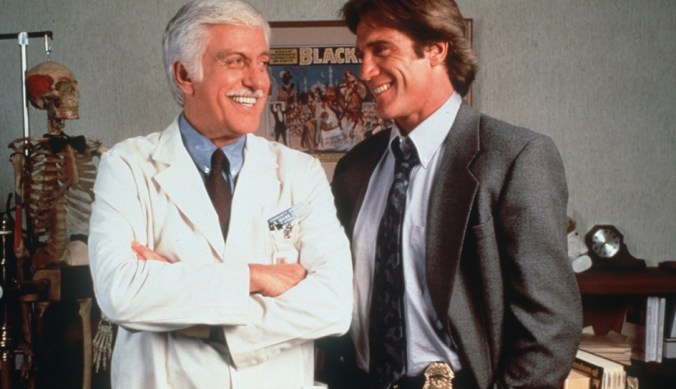
Another mainstay on the channel is “Diagnosis, Murder,” which is marginally less terrible than watching in Angela Lansbury collect a check for doing the same thing over and over, in part because I am entertained by Dick Van Dyke doing anything.  ( “Diagnosis, Murder” was a drama, yet still about ten times funnier than “The Mysteries of Laura.” ) Still, I don’t expect thought-provoking episodes on the Mystery channel.

Two nights ago, I was surprised. The episode showed Dr. Dick’s police detective son (played by Van Dyke’s real son Barry, who sounds just like Dad) chasing a perp he had stopped while the man was roughing up a woman in  the park. Barry was chasing him on foot, gun drawn, and in the shadows (it was evening), the suspect quickly turned, stopped and pulled something metallic from his pocket. The officer fired, killing him. Barry’s troubled partner shows up (he had been backing up Barry) and checks the scene as police sirens are heard. He finds a flashlight, not a gun, right by the unarmed deceased man, and Barry says, mournfully, “I though the had a gun” His partner (played by Joe Penny) pulls a revolver out of his  own pocket, wipes it, and places it in the dead man’s hand as he pockets the flashlight. “Don’t worry,” he tells distraught Barry, contemplating his career going down the drain, “It’s clean,” meaning “It can’t be traced.”

The police arrive, and Joe quickly tells them that it was a good shooting, that the victim was armed. Barry knows that his partner has strikes against him already for substance abuse, and to rat him out about the flashlight would end his career for certain, and maybe Barry’s as well. He doesn’t say anything, thus becoming complicit in the cover-up.

Tough one! Continue reading →

When Ethics Alarms Don’t Ring: The Bad Date Lawsuit

No story is too stupid for Ethics Alarms!

I’m so proud.

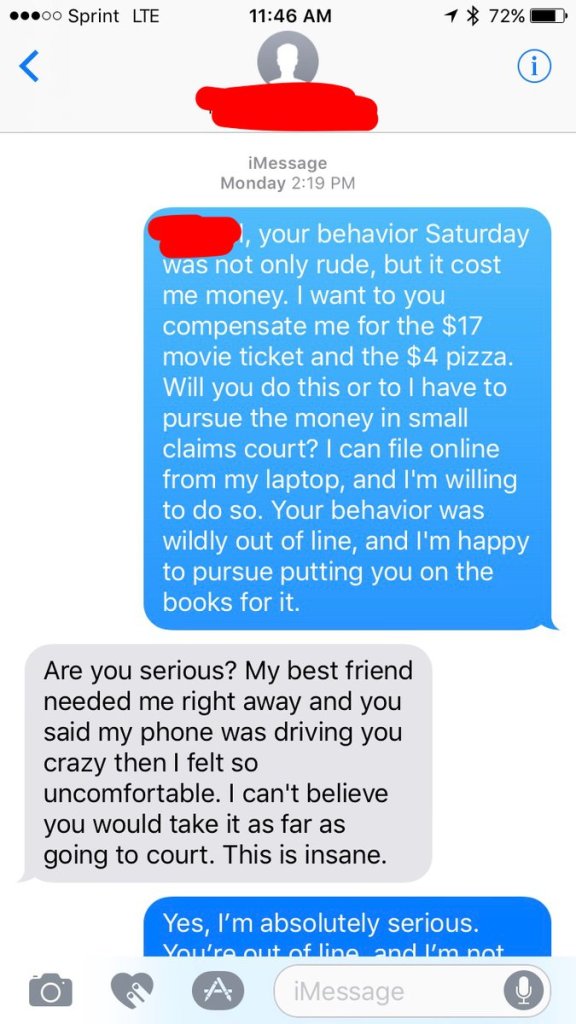
In Round Rock, Texas, Brandon Vezmar took a woman out for a pizza and to see “Guardians of the Galaxy, Vol. 2” , but she texted throughout the film and then left him sitting alone. He texted her, demanding that she  refund the cost of the pizza and the ticket, but she says she refused because “he took me out on a date.”. Now Brandon has filed a claim for $17.31 in small claims court.

Ethics Observations:

1. Brandon’s law suit can be translated as: “Look at me! I’m a big jerk!” I cannot imagine that he will be more successful finding dates in the future. And no wonder she abandoned him.

2. The lawsuit is an abuse of process. He will be lucky if he doesn’t get a dressing down from the judge.

3. Of course he should have let the incident go. This is custom, not contract. The date stunk. That’s a risk you take.

4. The woman, who remains un-named, is a rude jerk as well. She could and should have apologized quickly enough that Big Jerk didn’t have time to complain.

5. There is so much wrong with any two people who can’t locate the social skills and common sense to resolve a matter like this without resorting to the legal system, that it is a near certainty that they will engage in far worse conduct, doing real harm, in the future.

______________________

Pointer: Tim Levier


The Most Unethical Sentencing Fallacy Of All: Lavinia Woodward Gets “The King’s Pass”

Oxford University student Lavinia Woodward, 24,  punched and stabbed her boyfriend in a drunken rage, then hurled a jam jar, a glass and a laptop at him. This, in the U.S., would be called a criminal assault, and maybe even attempted murder.  Ah, but British Judge Ian Pringle knows better. He agrees these acts would normally mean a prison term, but Lavinia is a star student, and wants to be a surgeon. He hinted that he would spare her prison time so that her “extraordinary” talent would not be wasted. As poor Lavinia’s barrister, James Sturman, argued, his client’s dreams of becoming a surgeon would be “almost impossible” if she had to serve time.

Well, we certainly mustn’t jeopardize a violent felon’s dreams.

This kind of reasoning is infused with The King’s Pass, also known as The Star Syndrome, the rationalization making the perverse unethical argument that the more talented, prominent, useful and important to society a miscreant is, the less he or she should be accountable for misconduct that nets lesser lights serious and devastating consequences:

11. The King’s Pass, The Star Syndrome, or “What Will We Do Without Him?”

One will often hear unethical behavior excused because the person involved is so important, so accomplished, and has done such great things for so many people that we should look the other way, just this once. This is a terribly dangerous mindset, because celebrities and powerful public figures come to depend on it. Their achievements, in their own minds and those of their supporters and fans, have earned them a more lenient ethical standard. This pass for bad behavior is as insidious as it is pervasive, and should be recognized and rejected whenever it raises its slimy head.  In fact, the more respectable and accomplished an individual is, the more damage he or she can do through unethical conduct, because such individuals engender great trust. Thus the corrupting influence on the individual of The King’s Pass leads to the corruption of others.

Judge Pringle is taking the King’s Pass/Star Syndrome to a new low: he’s arguing that Lavinia should receive special treatment based on how valuable to society she might be, given enough immunity from the consequences of her own conduct.  Continue reading →

Responsible And Necessary: The Appointment Of A Special Counsel

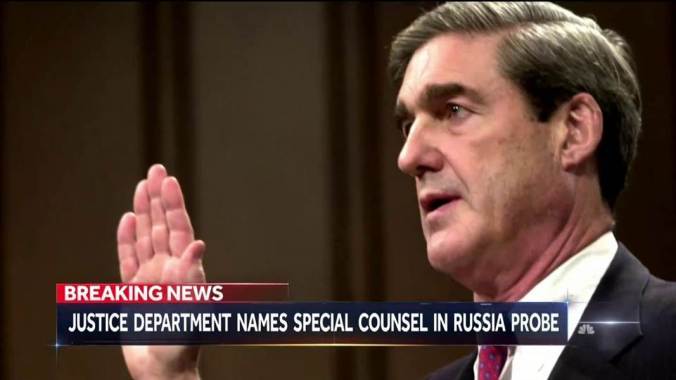
The Justice Department appointed Robert S. Mueller III (above), a former F.B.I. director, as special counsel to handle the Russia probe.

I am reading conservative pundits fuming over this development for a number of reasons, some of them valid and troubling. However, there is no good argument to be made that a Special Counsel isn’t necessary now.

Assistant Attorney General Rod Rosenstein explained his decision to make the appointment (remember, he is acting AG in the Russian investigation, because Jeff Sessions was bullied and hectored into recusing himself, also unavoidable):

“In my capacity as acting Attorney General, I determined that it is in the public interest for me to exercise my authority and appoint a Special Counsel to assume responsibility for this matter.My decision is not a finding that crimes have been committed or that any prosecution is warranted. I have made no such determination. What I have determined is that based upon the unique circumstances, the public interest requires me to place this investigation under the authority of a person who exercises a degree of independence from the normal chain of command.”

Exactly. As for the last sentence, President Trump has no one to blame but himself. His own, typical, blundering, blathering ways created this atmosphere—that and “Deep State” leaks calculated to undermine him, and a news media feasting on those leaks like sharks on chum.

It is being argued that you can’t appoint a special prosecutor unless there is a finding that crimes have been committed. Here are the relevant sections of the law:

§ 600.1 Grounds for appointing a Special Counsel.

The Attorney General, or in cases in which the Attorney General is recused, the Acting Attorney General, will appoint a Special Counsel when he or she determines that criminal investigation of a person or matter is warranted and –

(a) That investigation or prosecution of that person or matter by a United States Attorney’s Office or litigating Division of the Department of Justice would present a conflict of interest for the Department or other extraordinary circumstances; and

(b) That under the circumstances, it would be in the public interest to appoint an outside Special Counsel to assume responsibility for the matter.

§ 600.2 Alternatives available to the Attorney General.

When matters are brought to the attention of the Attorney General that might warrant consideration of appointment of a Special Counsel, the Attorney General may:

(a) Appoint a Special Counsel;

(b) Direct that an initial investigation, consisting of such factual inquiry or legal research as the Attorney General deems appropriate, be conducted in order to better inform the decision; or

(c) Conclude that under the circumstances of the matter, the public interest would not be served by removing the investigation from the normal processes of the Department, and that the appropriate component of the Department should handle the matter. If the Attorney General reaches this conclusion, he or she may direct that appropriate steps be taken to mitigate any conflicts of interest, such as recusal of particular officials.

I don’t read the law so narrowly. The law requires that there be a determination that a criminal investigation is warranted, not that crimes have been committed. Continue reading →

Ethics Hero: Lindsey Bittorf

I regard people who contribute kidneys to near strangers as residing in a special category of Ethics Hero, in the exemplary ethics category….maybe the exemplary exemplary ethics category.  Considering Don Bedwell, the first individual I learned about who  engaged in this extraordinary act of sacrifice, kindness, and compassion,  I began my 2005 post, “There are special and rare people whose ethical instincts are so pure and keen that they can make the rest of us feel inadequate.”  Bedwell, a traveling businessman, donated his kidney to a waitress who often served him at his favorite Cleveland restaurant when he was passing through the city on business. The second altruistic organ donor was East Haven, Connecticut  Mayor April Capone Almon, who gifted one of her kidneys  to a desperate constituent she barely knew.

Wisconsin police officer Lindsey Bittorf is the most recent example of this special breed of ethics hero.  She saw a Facebook post from a local mother pleading for someone to rescue might  her  8-year-old son, Jackson Arneson, who needed a kidney. The boy’s family and friends had been tested and none were a match. Bittorf didn’t know the child or the family, but got herself tested on a whim. Doctors told her she was an unusually good match,considering that she was not related to the boy.

Last week, Bittorf  rang the doorbell at Jackson’s home to surprise his family with the good news,  ABC News reported. Jackson could have one of her healthy kidneys.The police officer told Jackson’s mom, Kristi Goll, that it was an “early Mother’s Day gift.”  That’s a bit better than flowers, you’ll have to admit. Continue reading →