Ethics Dunces : Michigan State University Student Feminists

MSU womens_study_lounge

Higher education progressives, students, professors and administrators alike, are seriously confused about ethics, and some basic principles like fairness, respect, equity, and competence, not to mention common sense. How did they come to such a state?

For various reasons, none of them reasonable, Michigan State University had maintained that gender segregation was appropriate in the student Union, and  a study lounge there was designated for women only. Perhaps we can forgive the school’s initial judgment in this case, since the Union’s Women’s Lounge, located on the main floor of the MSU Union, debuted in 1925, just five years after women gained the right to vote.Men vastly outnumbered women then, and were looked upon as oddities, or perhaps temptation.

It is 2016, however, and women are demanding equality where it may already exist, and declaring gender discrimination where it may not, so the continued existence of the male excluding lounge was more than a bit anachronistic. After all, Harvard College just declared war on any male student who dared to belong to off-campus all-male clubs, since even freedom of association away from school is deeply offensive to the progressive values of Ivy League educators.

Then a University of Michigan-Flint professor named Mark Perry, filed a complaint to the Michigan Department of Civil Rights towards MSU alleging that the lounge violated federal anti-discrimination law, which it obviously does. Continue reading

Observations On The Gadsden Flag Controversy

Gadsden Flag

On the Volokh Conspiracy, now featured on the Washington Post website, Prof. Volokh applies his First Amendment expertise to a recent EEOC decision which ruled that a complaint from an African-American that a fellow worker who repeatedly wore a cap with the famous “Don’t Tread On Me” insignia from the Gadsden flag may have created a hostile work environment at the federal agency both worked for. The Equal Employment Opportunity Commission called for further investigation, including an interview of the cap-owner’s intention in wearing the symbol, concluding,

“In light of the ambiguity in the current meaning of this symbol, we find that Complainant’s claim must be investigated to determine the specific context in which C1 displayed the symbol in the workplace. In so finding, we are not prejudging the merits of Complainant’s complaint. Instead, we are precluding a procedural dismissal that would deprive us of evidence that would illuminate the meaning conveyed by C1’s display of the symbol.”

Observations:

1. Now this is the slippery slope. Because murderous racist Dylan Roof posed with the Confederate flag, a tipping point was reached that resulted in the symbol and the flag being effectively and in some respects officially banned. The EEOC had already ruled the wearing a Confederate flag T-shirt constituted racial harassment,. Now the banning of historically significant symbols is threatening to spread to a flag that had no relationship to race whatsoever, in large part because of who has chosen to display it.

2. There is a whole website devoted to the Gadsden flag, from which we learn that…

  • It first appeared in October of 1775, as the British were occupying Boston and the desperate Continental Army was dug in in nearby Cambridge, lacking sufficient arms and ammunition.  In October, a merchant ship returning to Philadelphia from a voyage to England brought private letters to the Second Continental Congress informing it that  England was sending two cargo ships to America loaded with arms and gunpowder for the British troops.
  • Congress decided Washington’s troops’ plight required that those ships and their cargo be captured. It authorized the creation of a Continental Navy, then only four vessels, to take the ships. Congress also authorized the mustering of five companies of Marines. Some of the Marines enlisting that month in Philadelphia carried drums painted yellow, emblazoned with a  rattlesnake with thirteen rattles, coiled and ready to strike, accompanied by the motto “Don’t Tread on Me.”
  • That same December, a citizen calling himself  “An American Guesser,” anonymously wrote to the Pennsylvania Journal, saying in part:

“I observed on one of the drums belonging to the marines now raising, there was painted a Rattle-Snake, with this modest motto under it, ‘Don’t tread on me.’ As I know it is the custom to have some device on the arms of every country, I supposed this may have been intended for the arms of America…the Rattle-Snake is found in no other quarter of the world besides America….She never begins an attack, nor, when once engaged, ever surrenders: She is therefore an emblem of magnanimity and true courage. … she never wounds ’till she has generously given notice, even to her enemy, and cautioned him against the danger of treading on her..

I confess I was wholly at a loss what to make of the rattles, ’till I went back and counted them and found them just thirteen, exactly the number of the Colonies united in America; and I recollected too that this was the only part of the Snake which increased in numbers. …Tis curious and amazing to observe how distinct and independent of each other the rattles of this animal are, and yet how firmly they are united together, so as never to be separated but by breaking them to pieces. One of those rattles singly, is incapable of producing sound, but the ringing of thirteen together, is sufficient to alarm the boldest man living.”

It is generally agreed that the writer was really Benjamin Franklin. Ben had a hand in the design of the flag, since the first use of a rattlesnake to represent the colonies was his own “Join or die” cartoon,

800px-Benjamin_Franklin_-_Join_or_Die

…published years earlier. Continue reading

Ethics Hero: Angela Martin, As St. Paul Strangers Prevent A Suicide

Angela Matin

Remember Raymond Zack?  In 2011, 50-year-old Raymond Zack waded into the surf at an Alameda, California beach and stood calmly in the 54-degree water, apparently waiting to die. His suicide took nearly an hour, but eventually he drowned, with no rescue attempts from any of the 75 San Franciscans, including firefighters, who gathered on the shore to watch the entire tragedy. I am so used to reading about bystanders allowing desperate people, sick, wounded or otherwise in peril, to perish because they “didn’t want to get involved” that a story like this one, the opposite of the Raymond Zack tragedy from St. Paul, Minnesota, comes as a shock.

How sad is that?

Motorist Angela Martin  saw a woman  climb onto a concrete wall and scale a chain-link fence above Interstate 94 in St. Paul, Minnesota. Martin could have continued driving, but she acted immediately, parking her car and calling 911. But she sensed there was no time to lose. Martin ran over to the woman, who  having climbed over chain-link fence was now clinging to it with her fingers above heavy highway traffic.

“ No, honey. Don’t do this,” she shouted. Martin told reporters that the distraught young woman kept repeating,  “My mom don’t love me. My mom don’t care for me.’”

“No, we love you, ” Martin told her. Martin reached through the links  and grabbed the woman’s shirt and  belt, just as the would-be suicide released her grip so she could fall to her death. Other motorists on the overpass saw the unfolding scene and came to Martin’s aid, and joined her in reaching through the fence to keep the woman from falling. Continue reading

Obama’s Iran-Contra Moment

fake-ransom-note1

As you should know by now, the Wall Street Journal reported

“The Obama administration secretly organized an airlift of $400 million worth of cash to Iran that coincided with the January release of four Americans detained in Tehran, according to U.S. and European officials and congressional staff briefed on the operation afterward.

Wooden pallets stacked with euros, Swiss francs and other currencies were flown into Iran on an unmarked cargo plane, according to these officials. The U.S. procured the money from the central banks of the Netherlands and Switzerland, they said.

The money represented the first installment of a $1.7 billion settlement the Obama administration reached with Iran to resolve a decades-old dispute over a failed arms deal signed just before the 1979 fall of Iran’s last monarch, Shah Mohammad Reza Pahlavi….Senior U.S. officials denied any link between the payment and the prisoner exchange. They say the way the various strands came together simultaneously was coincidental, not the result of any quid pro quo….But U.S. officials also acknowledge that Iranian negotiators on the prisoner exchange said they wanted the cash to show they had gained something tangible….Iranian press reports have quoted senior Iranian defense officials describing the cash as a ransom payment. 

Isn’t this, then, the equivalent of paying ransom for hostages? Continue reading

More Unethical—But NICE!— Police Tricks

This nice officer appears to be lobotomized, which at least gives him an excuse for his conduct...

This nice Halifax, VA. officer appears to be lobotomized, which at least gives him an excuse for his conduct…

The politically-fanned hatred and distrust for police has seemingly caused the profession to lose its bearings entirely. We have the Ferguson Effect in major cities, where police avoid proactive law enforcement for fear of getting in any confrontations with  African Americans, and now the desperate efforts of police to be loved is starting to spawn the Police As Cuddly Do-Gooders movement.

This will not end well.

Last week on a hot Friday in Virginia, Halifax police pulled drivers over to—SURPRISE!— hand out ice cream instead of tickets, and captured some of the reactions on camera. Officer Brian Warner said his officers “just wanted to spread some summer sweetness in the community.” They had patrol cars  equipped with coolers of ice cream, and they stopped about 20 motorists, handing out cones instead of tickets after the drivers were convinced they were being stopped for infractions.

Awww!

Warner, I’m afraid, is an idiot. Stopping a car to do anything unrelated to police work is an abuse of power and authority, and unethical. It doesn’t matter if it’s a well-intentioned abuse of power, or a nice abuse of power. It’s wrong, and I would make the case that it’s also illegal, no matter how nice it is.

I’m glad I wasn’t caught on camera, because my message would have been this: Continue reading

So It Has Come To This: Criminalizing Burps In Middle School

At  Cleveland Middle School in Albuquerque, a persistent class clown, age 13, kept burping in class, followed by the usual titters from his classmates.

I was in class with one of these characters in the 8th grade, and I must admit, his burp was something: loud, long, low, and seemingly inexhaustible. He was yanked out of class, he was sent to detention, his parents were called, he was suspended, and eventually, without too much conflict, he learned to cut it out. (They never caught the guy who shouted “HOG!” in a raucous voice during study hall.) Apparently this method was beyond the abilities of the  Cleveland Middle School staff to execute.

The teacher, Ms. Mines-Hornbeck, called the police, who arrested and eventually cuffed the boy. Principal Susan LaBarge and Assistant Principal Ann Holmes  not only suspended him for the rest of the school year, but allowed the criminal justice process to proceed, with the boy being processed for the charge of  violating a New Mexico statute, N.M. Stat. Ann. § 30-20-13(D), that reads…

No person shall willfully interfere with the educational process of any public or private school by committing, threatening to commit or inciting others to commit any act which would disrupt, impair, interfere with or obstruct the lawful mission, processes, procedures or functions of a public or private school.

That’s right: arrest and criminal prosecution for burping in class.

None of the staff at the school, apparently, had an ethics alarm go off that induced them to point out that the year long suspension was an unethically harsh punishment, and the criminal charge was tantamount to child abuse. I remember that in the fourth grade at Parmenter School in Arlington, Mass, my friend Timmy Russell was moved to leap to his feet during a math lesson and do a ten second imitation of Elvis singing “Hound Dog.” Everyone laughed, including the teacher. Then, that burst of childish energy over, she went on with the lesson, because she was a confident professional.

In New Mexico, 2016, Timmy would have broken the law. Continue reading

Ethics Quiz: “Advertising” Safe Zones

illegal crossing sign

Interesting.

The U.S. Customs and Border Protection (CBP) includes information on its website about “Sensitive Locations,” which is CBP-speak for “Places where we won’t arrest you if you are an illegal immigrant.”  In careful, oh-so-delicate and respectful language, the agency explains that immigration laws are not to be enforced at  designated “sensitive locations”  so that illegal aliens can be “free” to live their lives “without fear or hesitation.”

It reads in part…

“The policies provide that enforcement actions at or focused on sensitive locations such as schools, places of worship, and hospitals should generally be avoided, and that such actions may only take place when (a) prior approval is obtained from an appropriate supervisory official, or (b) there are exigent circumstances necessitating immediate action without supervisor approval.  The policies are meant to ensure that ICE and CBP officers and agents exercise sound judgment when enforcing federal law at or focused on sensitive locations, to enhance the public understanding and trust, and to ensure that people seeking to participate in activities or utilize services provided at any sensitive location are free to do so, without fear or hesitation.”

“This policy is designed to ensure that these enforcement actions do not occur at nor are focused on sensitive locations such as schools and churches” without meeting special exceptions, the  ICE Sensitive Locations Policy states.

Locations covered by  Sensitive Locations Policy  include, but are not limited to:

  • Schools, such as known and licensed daycares, pre-schools and other early learning programs; primary schools; secondary schools; post-secondary schools up to and including colleges and universities; as well as scholastic or education-related activities or events, and school bus stops that are marked and/or known to the officer, during periods when school children are present at the stop;
  • Medical treatment and health care facilities, such as hospitals, doctors’ offices, accredited health clinics, and emergent or urgent care facilities;
  • Places of worship, such as churches, synagogues, mosques, and temples;
  • Religious or civil ceremonies or observances, such as funerals and weddings; and
  • During public demonstration, such as a march, rally, or parade.

“The enforcement actions covered by this policy are (1) arrests; (2) interviews; (3) searches; and (4) for the purposes of immigration enforcement only, surveillance,” the ICE  further explains.

The CBP  “FAQ” answers are accompanied by a Spanish translation, and the CBP website  provides a toll-free number and email address so aggrieved illegal aliens can report immigration that violate these policies.

As I said…

Interesting.

Your Ethics Alarms Ethics Quiz of the Day is…

Is this a responsible, competent and ethical exercise of government power?

Continue reading

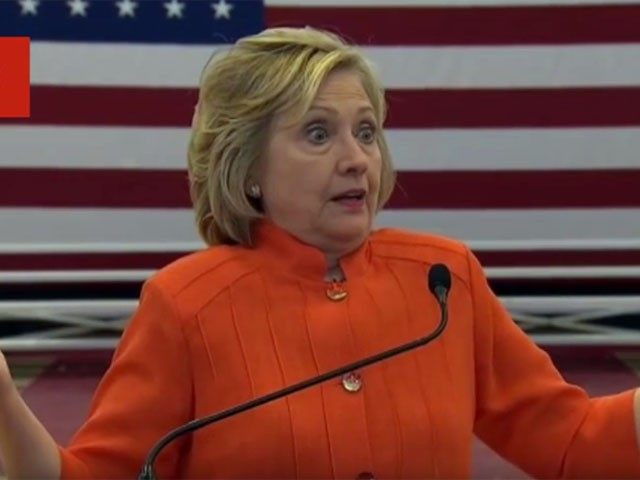
Jumbo, Ethics Dunce, Kaboom And Unethical Quote Of The Month: Hillary’s Jaw-Dropping Lie To Chris Wallace

hillary and Wallace

“Director Comey said my answers were truthful, and what I’ve said is consistent with what I have told the American people, that there were decisions discussed and made to classify retroactively certain of the emails.”

—-Hillary Clinton to Chris Wallace on Fox News Sunday, asserting that what was demonstrably false was true, regarding a public statement by Comey that can be Googled and watched on YouTube instantly.

My reaction when I saw that: KABOOM! The top of my head blew right off, bounced off the ceiling and knocked over the lamp. Wallace asked Clinton directly about what she had been saying to the public about her e-mails since May of 2015: that she did nothing wrong, that her private, secret e-mail server was approved by the State Department, that she never received or sent a classified e-mail…okay, that didn’t work, that she never knowingly sent a classified e-mail…wait, wait, that she never sent or received an  e-mail that was marked classified. Comey, in his televised, live statement announcing his decision not to recommend prosecution for Clinton, directly contradicted her.

In his careful statement Comey said,

“Although we did not find clear evidence that Secretary Clinton or her colleagues intended to violate laws governing the handling of classified information, there is evidence that they were extremely careless in their handling of very sensitive, highly classified information.,,,seven e-mail chains concern matters that were classified at the Top Secret/Special Access Program level when they were sent and received. These chains involved Secretary Clinton both sending e-mails about those matters and receiving e-mails from others about the same matters. …There is evidence to support a conclusion that any reasonable person in Secretary Clinton’s position, or in the position of those government employees with whom she was corresponding about these matters, should have known that an unclassified system was no place for that conversation…even if information is not marked ‘classified’ in an e-mail, participants who know or should know that the subject matter is classified are still obligated to protect it.”

There is no way that an individual of normal facility with the English language can listen to or read that statement and conclude that Comey was saying that Hillary’s answers to questions about the e-mails to the American public and the news media–for over a year!–were truthful, as in “full of truth.” A technical argument can be made, if one wishes, that  Comey didn’t say that Clinton lied, because maybe she is an idiot and incompetent, and didn’t know or understand what “any reasonable person in Secretary Clinton’s position” should have known and understood, leading to her factually false (and constantly evolving as more facts where uncovered) explanations over months and months. Continue reading

Four Supreme Court Decisions: Abortion, Guns, Affirmative Action, Corruption…And Ethics. Part 4: Voisine v. United States

"Aw, come on, that was a love tap! Now put some ice on that while I go out and buy a Glock...."

“Aw, come on, that was a love tap! Now put some ice on that while I go out and buy a Glock….”

Be honest, now: you thought I’d never finish this series, did you? (Part 1 was posted June 28.)

In Voisine v. United States, a 6-2 U.S. Supreme Court holding issued on June 27 approved extending a federal statute banning firearms possession by anyone convicted of a “misdemeanor crime of domestic violence” to include individuals who have “misdemeanor assault convictions for reckless (as contrasted to knowing or intentional) conduct.”

Justice Elena Kagan, writing for the majority, said that “the federal ban on firearms possession applies to any person with a prior misdemeanor conviction for the ‘use…of physical force’ against a domestic relation. That language, naturally read, encompasses acts of force undertaken recklessly—i.e., with conscious disregard of a substantial risk of harm.”

The opinion isn’t remarkable, nor is it a significant attack on gun rights. The case is really about language, as so many Supreme Court cases are. From the opinion:

“Congress’s definition of a “misdemeanor crime of violence” contains no exclusion for convictions based on reckless behavior. A person who assaults another recklessly “use[s]” force, no less than one who carries out that same action knowingly or intentionally. The relevant text thus supports prohibiting petitioners, and others with similar criminal records, from possessing firearms.”

The real question, from an ethical standpoint, is whether Congress can and should remove a citizen’s Second Amendment right based on a misdemeanor conviction for domestic abuse. Is that fair? Sure it is. It is already settled law that it is Constitutional to prevent convicted felons from owning  guns, even if it was a non-violent felony. From an ethical public policy standpoint, why would it be overly restrictive to ban gun ownership from those who engage in a violent misdemeanor?

Writing in dissent, Justice Clarence Thomas, joined by Justice Sonia Sotomayor (of all people), rejected the majority’s “overly broad conception of a use of force.” In the view of the two dissenters, “the majority blurs the distinction between recklessness and intentional wrongdoing” and thereby does a grave injustice to criminal defendants. Continue reading

Unethical Website Of The Month: Bye-Bye Snopes…You’re Dead To Me Now [UPDATED 10/12/2016]

bye bye

Ethics Alarms has been tracking the increasing political bias exhibited by Snopes, once the definitive “Urban Legends” web source to identify false stories on the internet, e-mail hoaxes and other pollution of public information. The website has made the disastrous decision to wade into political topics and to hire some new social justice warriors and wanna-be Democratic Party operatives to cover them, resulting in the site becoming a bad imitation of PolitiFact.

The disturbing trend really established itself this month, but it was in evidence earlier. For example, Snopes rushed to defend Hillary Clinton when the story of her defense of a child rapist was used to smear her. (Ethics Alarms explained, correctly, unlike Snopes, what was unethical about the attacks on Clinton—all defendants deserve a zealous defense, no matter what the charge, and a lawyer isn’t endorsing or supporting a client’s crimes by doing her professional duty.) The Snopes defense, in contrast, was dishonest and misleading. Quoth Snopes, via its primary left-biased reporter, Kim LaCapria.

Claim: Hillary Clinton successfully defended an accused child rapist and later laughed about the case.

MOSTLY FALSE

WHAT’S TRUE: In 1975, young lawyer Hillary Rodham was appointed to represent a defendant charged with raping a 12-year-old girl. Clinton reluctantly took on the case, which ended with a plea bargain for the defendant.

WHAT’S FALSE: Hillary Clinton did not volunteer to be the defendant’s lawyer, she did not laugh about the the case’s outcome, she did not assert that the complainant “made up the rape story,” she did not claim she knew the defendant to be guilty, and she did not “free” the defendant.

Notice that the TRUE and FALSE sections don’t match the claim. That’s because Snopes is playing the logical fallacy game of moving the goalposts and using straw men. The claim, as stated by Snopes, is 100% true. Continue reading