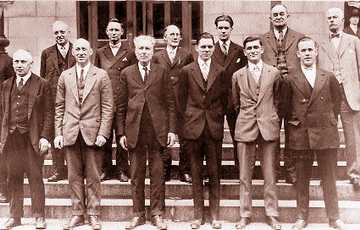
Clarence Darrow, in 1926, On Why Black Lives Matter

The all white Detroit jury that acquitted Dr. Sweet.

The all white Detroit jury that acquitted Dr. Sweet.

When I referred to Clarence Darrow’s support for terrorist John Brown in the previous post, I reviewed other references to the great trial lawyer that have appeared here. (As you may know, I authored a one-man play about Darrow, still performed to legal groups by actor (and my friend) Paul Morella, and with historian Ed Larson compiled selections from Darrow’s writings, court appearances and speeches, The Essential Words and Writings of Clarence Darrow.) I have also posted on his famous Leopold and Loeb argument against capital punishment, but I was shocked to find out that I never posted any part of his closing argument in the murder trial of Dr. Sweet.  I need to remedy that omission now. That courtroom oratory is not only the best of Darrow’s closing arguments, but also the most relevant to current events. It is a masterpiece, and  also astonishingly prescient and wise.

In 1925, Dr. Henry Ossian Sweet, a black man, moved his family into a house in a previously segregated section of Detroit. Mobs of whites gathered outside the house with torches, clubs and guns the first two nights of their residence, as police stood by passively. On the second night, a gunshot coming from the house killed one of the demonstrators, and all 11 residents of the home, including Dr. Sweet, were charged with murder. The National Association for the Advancement of Colored People hired Clarence Darrow to handle the defense.

There were two trials, the first ending in a hung jury. In the second, Darrow performed a seven hour closing argument, aspects of which have inspired homages in “To Kill A Mockingbird” and “A Time to Kill.” Despite the all-white jury, Dr. Sweet was acquitted, and the charges against the others were dropped. Darrow isn’t a legend for nothing.

I have left out the parts of the closing argument that recount the testimony and the facts of the case: you can read about the trials on Doug Linder’s excellent website, and you can read Darrow’s whole closing here. This redacted version focuses on Darrow comments about race and race relations. It is longer than the version we used in the play, but this is the version I would have used if audiences could tolerate a three hour one man show.

I continue to believe that this was the high point of Darrow’s incredible career, and also one of the most impressive—and gutsy—speeches in our history. Only Clarence Darrow would challenge an all-white jury like this in 1925. It is also unbearably moving. Paul, when he performs the selection, ends with tears streaming down his face, as Darrow did. You might too. Try reading it aloud to your kid. Or to yourself.

This post also relates to another recent post, the one about jury nullification. That is really what Darrow is arguing here, in the context of confronting racial injustice and bigotry for the survival of the nation and society. The white victim of the shooting was shot in the back. Darrow, at one point, calls it murder himself. Nonetheless, he argues that acquitting Sweet and his family is the right thing to do, whatever the law says.


Here is my abridged version of the epic closing argument made by Clarence Darrow, May 11, 1926, in defense of Dr. Sweet and his family.

Continue reading →

Ethics Hero, Maybe For The Ages: The Center for Medical Progress

As I said with the release of the first surreptitious “sting video” of Planned Parenthood released under auspices of the anti-abortion group, the Center for Medical Progress, such videos are, in principle, unethical. However, while the unethical should be used in pursuit of a greater good only with great reluctance, moral certainty and a minimum of harm, there are instances when utilitarianism must apply.

This is one of them.

In the case of abortion, the prospect of saving the lives of millions of unborn is certainly worth the incursion on the ethical values of honesty and respect for privacy implicated by these videos. Indeed, it is worth a great deal more. With the seventh video, released yesterday, the conclusion is unavoidable that we, the public, the nation, and humanity, owe a debt of gratitude to the Center for taking radical action to force  confrontation with the reality of abortion so that there can be a real, open and honest debate  that doesn’t duck the central issue. That issue  is not women’s control over their lives, but the ethics of killing innocent human beings to achieve it.

The latest video, like the earlier ones, compels any fair, emotionally functioning and rational observer to accept the brutality and near complete callousness towards human life that the abortion machine creates and requires. In this respect the seven videos—with more to come— are abortion’s equivalent of “Uncle Tom’s Cabin,” forcing genteel, moral, good people by their own confident assessment to confront the horrors that have been occurring under their noses with their passive approval. Because they chose not to think about what abortion really involved, just as so many Americans had no idea what  slavery was like until Harriet Beecher Stowe forced them to consider it as more than an abstraction, abortion advocates, passive and active, have an ethical obligation to watch these videos. Those who refuse are admitting that they are incapable of letting facts disturb their ideologies. Continue reading →

Ethics Quiz: Good Samaritan Drug Overdose Laws

heroinoverdoseI know how this one will break down, but it’s an interesting issue nonetheless. And it doesn’t involve Hillary, Donald Trump of Bill Cosby!

Many states have addressed drug-related deaths by allowing junkies using illegal drugs to call 911 for a fellow shooter or snorter in life-threatening distress and be immune from prosecution.   New Mexico passed a “Good Samaritan law” in 2007 that granted limited immunity from prosecution on simple possession charges for people who used 911 to report a drug overdose going on in front of them. The Drug Policy Alliance reports that 28 states and the District of Columbia have passed laws differing in exact provisions but providing limited freedom from prosecution in exchange for saving lives.

There is an explosion of heroin use nationwide, and therefore heroin deaths, right now. (The government abandoning its vital statements via law that drug use is wrong has a lot to do with causing this, but that is for another day.) As always, the first proposals to address a drug crisis involve loosening enforcement. Slate writes,

“In the end, of course, it doesn’t much matter how or why states pass these laws, as long as they pass them. A University of Washington study evaluating the initial results of Washington state’s Good Samaritan policy found in a survey that drug users who were aware of the law were 88 percent more likely to call 911 in the event of an overdose than before. “Despite lingering concerns about possible negative consequences of the new law, such as prosecutions being impeded, no evidence of negative consequences has been found to date,” the study concluded. Good Samaritan laws are humane and sensible. There are no compelling reasons to oppose them.”

Your Ethics Alarms Ethics Quiz of the Day:

Are there really “no compelling” ethical reasons to oppose such laws?

Continue reading →

Bad News For Hillary: Someone At CNN Told Carol Costello To Stop Helping Her, And Clinton’s Talking Points Are Wearing Thin…OK, THINNER

This was fascinating. I was trying to decide whether to post today about the latest spin tactics by Hillary’s minions and her dwindling but still formidable media allies  in light of Clinton’s awkward press conference where she insisted that she didn’t do anything “wrong” regarding the mishandled State e-mails. Earlier in the day the Washington Post’s Chris Cillizza, a usually decent journalist whom it is sad to see succumbing to the  Clinton Corruption Virus (you would think there would be a vaccine by now!), had used this same talking point—and it is a campaign talking point. In a column that could be used in a public service announcement, Cillizza seriously wondered why Hillary was in trouble. Gee, he mused, maybe Hillary just isn’t very good at campaigning! What else could possibly explain why she isn’t cruising to the nomination?

In other words, the fact that she has lied constantly, used her foundation to profit from influence-seeking foreign powers, was a flop as a Secretary of State, put U.S. security at risk and destroyed potential evidence so she could avoid getting caught in her complex political/financial machinations—Allegedly! Allegedly!—wouldn’t matter at all to Democrats, voters or Chris if she was just better at fooling the public. Darn!

“This is Chris, and this is the tragedy of Clinton Corruption Syndrome. Won’t you help?”

Then he wrote, “The appearance here — even if Clinton did nothing wrong (and there is no proof she did at this point) — is terrible.”

What? WHAT? Of course she did things that were wrong. Isn’t lying like crazy wrong, Chris? Isn’t paying people to throw the media off the track and confuse the public using deceit and misrepresentations wrong, Chris?  Isn’t the tactic of smearing the messengers wrong, and sending out statements like the infamous “nonsense” letter wrong? Is intentionally breaking your own Department’s policies wrong? Is sending and receiving sensitive information in a manner that makes it vulnerable to hacking by foriegn governments wrong, Chris? Do you even know what wrong means any more, Chris?

That’s when it hit me, and that’s why I decided I had to post, again, on the Hillary Clinton E-mail Ethics Train Wreck, which is really just part of the The Hillary Clinton Presidential Candidacy Ethics Train Wreck. The Clinton campaign’s current strategy is now to make the public understand right and wrong the way the Clintons do. If it isn’t illegal, it isn’t wrong. (This is on the Ethics Alarms Rationalization list, incidentally: #4. Marion Barry’s Misdirection, or “If it isn’t illegal, it’s ethical.” Marion Berry went to jail.)

Talk about waving a red flag in front of an ethicist! Continue reading →

The Cake And The Clerk: If Living In A Pluralistic And Democratic Society Offends You, It May Be Time To Find Another One

Davis Protest

The kicking and screaming of the anti-gay marriage bitter-enders is becoming a national embarrassment, especially since some of the Republican Presidential candidates can’t seem to resist pandering to them. The social contract in a democracy involves accepting where the system decides to go and following along to the extent the law requires. If we don’t like a law, or a war or a government program, we are free to complain and to try to get them changed, or to pay the price for defying the law as part of the contract. We may not unilaterally declare that the law doesn’t apply to us. No, not even if we think God agrees. He’s not a party to the contract.

This is straightforward and clear. The ethics of citizenship requires it. Two current situations that have had significant developments in recent days illustrate the principle in the breach of it.

The Cake.

Jack Phillips, who is yet another Christian cake baker, lost an appeal that asserted that he had a First Amendment right to refuse to provide a cake for a gay couple to celebrate their wedding. Continue reading →

Suggested Journalism Ethics Rule For The Washington Post: If You Want To Publish Race Hate, Anti-American Op-Ed Pieces,At Least Insist That They Don’t Misrepresent The Facts.

Is that too much to ask?

Sunday last,  the Washington Posts’s Outlook section included an anti-American diatribe against police and whites by a California public defender named Raha Jorjani. I know there are black racists that see the world, law enforcement and government as he does, and there is nothing wrong or irresponsible in the Post allowing such screeds to see the light of day in its pages—all the better to expose them. I would feel better if the equivilent racist bile from the white side was not treated differently, but I tire of pointing out this double standard, at least right now.

But no editor should allow such a piece to include factual distortions on the scale of the opening paragraph, which begins,

Suppose a client walked into my office and told me that police officers in his country had choked a man to death over a petty crime. Suppose he said police fatally shot another man in the back as he ran away. That they arrested a woman during a traffic stop and placed her in jail, where she died three days later. That a 12-year-old boy in his country was shot and killed by the police as he played in the park.

Suppose he told me that all of those victims were from the same ethnic community — a community whose members fear being harmed, tortured or killed by police or prison guards. And that this is true in cities and towns across his nation. At that point, as an immigration lawyer, I’d tell him he had a strong claim for asylum protection under U.S. law.

What if, next, he told me he was from America? Black people in the United States face such racial violence that they could qualify as refugees.

The short and well-earned response to his last sentence is “Bullshit.” Before one can even get to his offensive and absurd (and paranoia-seeding: the lawyer must regard it as good for business) thesis, the utter dishonesty of his premises disqualify the op-ed for serious consideration, as well as raise question about the way this guy would practice law. If that is how he represents facts in court, he won’t be a lawyer long: Continue reading →

KABOOM! Sen. McCaskill Disgraces Herself On National Television

head blowsWhat a horrible thing for a U.S. Senator to inflict on her state. Brains must have been splattering all over ceilings, furniture, family members and TV screens during her excruciating live interview with Martha Raddatz on ABC’s “This Week With George Stephanopoulos.”  There she was, a member of the U.S. Senate representing the great state of Missouri, grinning like a zany and spewing the Clinton campaign’s desperate talking points—from March!—falsely and insultingly insisting that in maintaining a secret and non-conforming private e-mail server while Secretary of State that, as Democratic hack Donna Brazile said later on a truncated round table, that Clinton did nothing wrong.

Just violating policy, being irresponsible, placing official data in jeopardy, destroying potential evidence, and lying about it, but nothing wrong...

“This is a partisan witch hunt!” said Senator McCaskill. Hillary has been forthcoming and complied with every request! She wasn’t the first Secretary of State to use private e-mail! The materials weren’t classified when she had them! There’s no indication she had a motive to expose national secrets! (This is a new one on the talking points list and an audacious straw man. Nobody has argued that Clinton was a spy or committing treason; what she did was place State Department communications at risk to hackers and exposure for her own protection and advantage.) Then McCaskill paraphrased the “let’s change the subject” talking point we have heard now almost verbatim from Clinton and her surrogates: “Hillary Clinton is a fighter, and she will fight through this and continue fighting for Americans”—all while smiling madly as if the whole thing was a big joke, since it all is “nonsense.” Continue reading →

The Clinton E-Mail Scandal, Part Two: The Corrupter, The Corrupt And The Corrupted

corrupted2

Like so many political scandals, the Hillary Clinton e-mail mess has multiple benefits even as it reveals the scabrous underside of the American political culture. Prime among the benefits is that it provides a useful test of who is trustworthy and perceptive, and who is untrustworthy due to an excess of bias, partisan fervor, warped values or just mush-for-brains.

The stunningly cynical and dishonest statement by Clinton communications chief Jennifer Palmieri, dissected in Part One, revealed that the Clinton machine really does have zero respect for the intellect of the American public, that the Clintons still believe that you can lie your way out of anything (even if the lies make no sense), and that a lack of ethics really does eat away at gray matter.

Look: every week, sometimes three times a week, I harangue lawyers about how they are ethically obligated to take careful measures to protect proprietary client information that is stored or communicated through electronic means. They immediately comprehend how it is essential, especially government lawyers. Why? Because the government is the most vulnerable of clients, among those who can be most hurt by careless information technology, and is ahead of much of industry and the private sector in developing policies and methods of keeping information as secure as possible. Hillary Clinton’s casual lies about how her “home-brewed” server was no big deal is literally stunning to these lawyers, because they know that no high ranking government official is as cavalier about official e-mails as Clinton’s repeated statements would suggest she was.  As is a pattern among Democrats during the Obama administration, Clinton’s dissembling is designed to fool the ignorant, because the ignorant are many and useful.  It is based on the assumption that nobody, certainly not the news media, will enlighten them sufficiently to understand the magnitude of what Clinton did, and the breathtaking audacity of her lies. Continue reading →

The Clinton E-Mail Scandal, Part One: Ethics Corrupter For President! Her Campaign’s “Nonsense” Memo

I'm just making an analogy here--I'm not saying those tentacle-shooting vamps in The Strain are Clinton supporters. That doesn't mean they aren't, though...

I’m just making an analogy here–I’m not saying those tentacle-shooting vamps in The Strain are Clinton supporters. That doesn’t mean they aren’t, though…

Portraying the currently developing scandal regarding Hillary Clinton’s e-mails while Secretary of State as just politics and the “kind of nonsense” that “comes with the territory,” Clinton flack Jennifer Palmieri  sent out a detailed message to Clinton supporters and Democrats. It is designed to mislead them about the critical issues raised by this matter, which are certainly not nonsense, to coordinate with the news media, which is trying desperately and unsuccessfully to embargo this story because it is damaging to Democrats (more on this in Part Two), to make the public dumber about how leadership and government works, and to provide slick rationalizations to those Clinton supporters inclined to be part of the disinformation campaign.

This is sinister and disgusting stuff, the essence of ethics corruption. For an unethical leader, like Clinton, to gain power, she must make a large proportion of the public insensitive or outright ignorant of basic ethical principles, and, if possible, as unethical as possible. The effort to trivialize this serious example of what’s so wrong with Hillary Clinton as just another “vast right wing conspiracy” is part of this process. Continue reading →

Fake Charities Update: The Unethical Conduct That Makes All Of Us Worse

scamsIt’s one of the world’s oldest scams, one of the most lucrative and perhaps the most damaging: people preying on the best instincts of human beings to take their money for personal gain. The internet has made it easier to do than ever, and the  con is flourishing. I don’t often write about the incidents when they arise, in part because there’s nothing to argue about: everybody agrees that it’s not just unethical conduct, but bordering on evil. Fake charities are worse than scams, however, because they actively make people less kind, generous and caring for their own protection. Every fake charity exposed makes it harder for real charities to help people who genuinely need it. Like a friend of mine who never helped a homeless person again after seeing a beggar whom he had just given 20 bucks on a New York City street briefly get out of his battered wheel chair and nimbly run over to get a cigarette from a compatriot, those who stop trusting pleas for help seldom start trusting again. The fakes make us less kind and generous, and that makes society worse for everyone.

Fake charities large and small have been much in the news lately, so a little catch-up is warranted. Continue reading →