July 3: A Day To Honor Custer’s FIRST Stand, At Gettysburg… And Reflect On How Our Greatest Strengths Can Be Our Fatal Flaws

custercharge

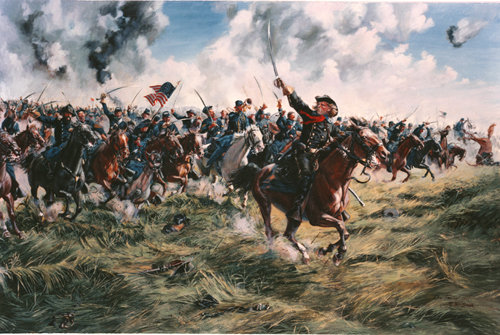
I wrote this post two years ago, concerning my favorite neglected episode of the Civil War, when young George Armstrong Custer shocked Confederate J.E.B. Stuart with his unexpected and furious resistance to Stuart’s attempt at disrupting the Union flank while Gen. Meade’s army defended itself against Pickett’s Charge. As with the First Minnesota’s suicidal stand on the second day of the Battle of Gettysburg, Custer’s crucial moment of truth has been largely neglected in the assembly of the battle’s heroes; I don’t think it has ever been depicted in a Civil War film, for example, though there is at least one book about it.

The incident is especially fascinating to me because of the its multiple ironies. Custer succeeded when his nation needed him most because of the exact same qualities that led him to doom at the Little Big Horn years later. Moreover, this man who for decades was wrongly celebrated in popular culture as an American hero for a shameful botched command that was the culmination of a series of genocidal atrocities actually was an American hero in an earlier, pivotal moment in our history, and almost nobody knows about it.

Thus it is that among the brave soldiers of the Blue and Gray who should be remembered on this 150th anniversary of the greatest battle ever fought on this continent is a figure whose reputation has sunk to the depths, a figure of derision and ridicule, a symbol of America’s mistreatment of its native population. Had George Armstrong Custer perished on July 3, 1863, he might well have become an iconic figure in Gettysburg history. The ethics verdict on a lifetime, however, is never settled until the final heartbeat. His story also commands us to realize this disturbing truth: whether we engage in admirable conduct or wrongful deeds is often less a consequence of our character than of the context in which that character is tested.

Here is the post, slightly lengthened:

July 3, 1863 was the date of Pickett’s Charge, when Confederate General Robert E. Lee ordered a desperate Napoleonic advance against the Union line at Gettysburg in what has come to be a cautionary tale in human bravery and military hubris. The same day marked the zenith of the career of George Armstrong Custer, the head-strong, dashing cavalry officer who would later achieve both martyrdom and infamy as the unwitting architect of the massacre known as Custer’s Last Stand. Continue reading →
Unethical Quote of the Week: Senate Majority Leader Harry Reid

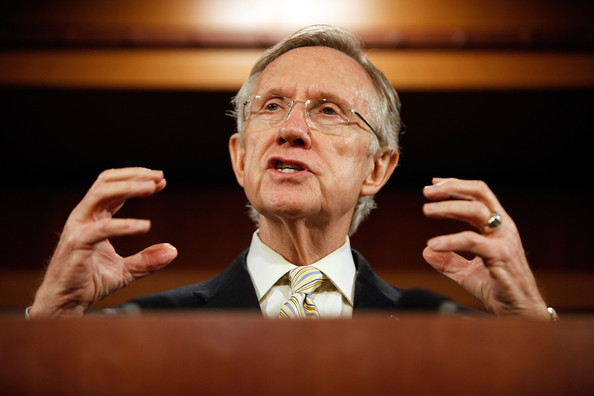
“The idea that allowing two loving, committed people to marry would have a negative impact on anyone else, or on our nation as a whole, has always struck me as absurd.”

—Senate Majority Leader Harry Reid, after calling Wednesday’s Supreme Court ruling striking down the Defense of Marriage Act “a great, historic day for equality in America.” Reid voted for the law when it was overwhelmingly passed by the U.S. Senate, back when treating gays like second-class citizens was popular.

Harry Reid, embracing absurdity when it is politically expedient...

Harry Reid, embracing absurdity when it is politically expedient…

It’s hard to say which of the legislative lions prowling the cloak rooms of Capital Hill are more loathsome—Republican Mich McConnell, Nancy Pelosi, or Harry Reid. It’s easy to decide which is more shamelessly cynical and hypocritical, however. That would be Harry Reid.

If he “always” thought that DOMA was “absurd,” why did he vote for it? Are we to take from this that he not only is willing to vote for absurd measures (he has voted for many), but also votes for measures when he believes they are absurd? Or does he just say whatever he thinks will sound good to the low-information, knee-jerk progressives who have a memory of about two weeks (if that) regarding any issue, and possess the naïve belief, also absurd, that only Republicans lie to them? Continue reading →

Blaming God For An Unfair Decision

"Yes, I agree, Patrick; I've been thinking the same thing. Paige needs to be playing field hockey. Let it be written. Let it be done."

“Yes, I agree, Patrick; I’ve been thinking the same thing. Maddy Paige needs to be playing field hockey. Let it be written. Let it be done.”

Maddy Paige is a 12-year-old girl from Locust Grove, Georgia who was the starting defensive tackle for her sixth grade football team at Strong Rock Christian School until the school’s head, Patrick Stuart, decided that the order of the universe depended on his implementing a new policy declaring that “Middle school girls play girls’ sports and middle school boys play boys’ sports.”

For all the benefits and wisdom a conservative approach to public policy can add to society’s progress, conservatives will always erode their credibility and trustworthiness by their tendency to stubbornly insist on unjust and arbitrary rules because “that’s just the way it’s always been.” This will be the impact of  conservative opposition to gay marriage, now officially shown to be futile by the Supreme Court’s DOMA rejection yesterday on Due Process and Equal Protection grounds under the Fifth and Fourteenth Amendment, and it is the lesson to be harvested from Stuart’s fatuous move. Continue reading →

The Illegal Immigration Bill: A 37 Year Ethics Train Wreck Rumbles On, With No End In Sight

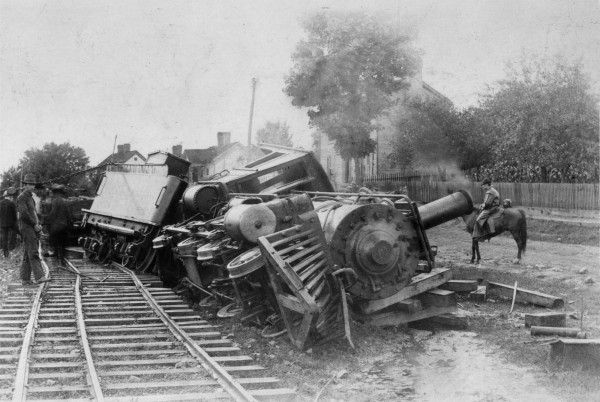
trainwreck6

The details of the “immigration reform bill” moving through Congress like a water buffalo through a snake are less important than the fact that some action is being taken regarding a problem that has been cynically, incompetently, dishonestly and negligently allowed to fester since the last illegal immigrant accommodation law was passed in 1986. This is one of the rare cases in which doing almost anything is more responsible than doing nothing, and that is the beginning and the end of the list of the bill’s virtues. This is an ugly ethics train wreck  in which there are no heroes, only dunces and villains. There may be a worse one, but at the moment, I can’t think of it.

The 11,000,000 or more illegal aliens in this country have to be given some way to attain citizenship and get out of the shadows. That is an unavoidable, pragmatic reality, the best of a stinking pile of unethical options. All the rationalizations for doing this are unethical, except one: they are here, we allowed them to get here and allowed them to stay, and now we are out of choices. It’s our fault, which is to say our incompetent, irresponsible government’s, and now we have to swallow hard and accept the consequences. Continue reading →

Of Teenage Tweets, Politics, Fairness, and Acorns

How about scrutinizing the trees, and not the acorns?

How about scrutinizing the trees, and not the acorns?

Two GOP Congressmen are apologizing for the offensive tweets of their teenage sons, as well they should. But to what extent do the homophobic, racist and otherwise vile social network comment of a couple of high school students with famous fathers tell us anything about their legislator parents? Are such communications newsworthy? Should the kids be exposed to “Gotchas!” as if they were the elected officials, not their dads, and are their indiscretions legitimate clubs for political and journalistic foes to beat their fathers with?

I think these are difficult ethics questions, and I don’t much care for any of them.  Let’s examine the ethical conduct of some of the participants in this icky drama: Continue reading →

Flat, Flat, Flat…and Infuriating

This was bound to happen.

A graph of President Obama's leadership learning curve since January, 2009. This is actually a new graph, including data since the last one of these I posted, though I recognize that the difference is hard to see...

A graph of President Obama’s leadership learning curve since January, 2009. This is actually a new graph, including data since the last one of these I posted, though I recognize that the difference is hard to see…

Waaay back in 2009, when the new President improvidently and recklessly commented on a local dispute between a Harvard professor and a Cambridge policeman, I pointed out that Obama needed to learnthe ethical limits on his power and influence. Teddy Roosevelt’s “bully pulpit” is not license for the highest office-holder in the land to try to mold public opinion on every conceivable matter, local or national, and to influence decisions solely within the authority of others. For the President to state his personal verdict on anything he wakes up concerned about risks putting a weighty thumb on the scales of justice. It is an abuse of power—a President behaving like an emperor.

This is not a difficult concept; indeed, with occasional lapses, every other President has grasped it instinctively. Not Barack Obama. Brilliant Barack Obama. “Constitutional scholar” Barack Obama. For while the Gates episode may have been a rookie mistake, he has engaged in exactly the same unethical, arrogant conduct repeatedly, here, and here, and here and here, and here, and especially here—and I’m sure I may have missed a few.

Each time I pointed out this inexcusable habit, I was barraged by glossy-eyed readers who made excuses for Obama  and rationalized his grandstanding remarks, accusing me of being biased and hypercritical. But with each new instance, it should have been progressively clearer that I correctly diagnosed this malady in 2009. Now, after Obama has done it yet again, commenting inappropriately about the military sexual harassment scandal, this proclivity has finally had tangible legal consequences. You can’t say I didn’t warn him. Continue reading →

Anti-Terror Surveillance Flip-Flops, Fools, Converts and Heroes

Flag peek

There has been much ink and pixels spilled about the supposed hypocrisy of Republicans and Democrats in their disparate reactions to the revaluation of far more extensive phone and internet data-gathering by the government than those of us not wearing tin-foil on out heads ever suspected. For example, a recent Pew survey shows this...

Pew survey

Naturally, Republicans and Democrats are calling each other hypocrites, suggesting dishonesty and lack of integrity. There are surely some hypocrites in there, but for the most part, the flip-flopping is neither dishonest nor theoretically unreasonable. Even if we assume that the level of NSA intrusion under Bush and Obama administrations are the same (and to be fair, it appears that the current gathering of all domestic phone records goes well beyond what we understood to be the limited surveillance permitted under the Patriot Act), they are materially different in one key aspect, from the perspective of partisan citizens.

Think about it this way: Let’s say on successive days you discover your best friend and your business rival, both of whom visited your home for various reasons, looking through bills and financial papers on your desk. They did the same thing, but while you might be peeved at your friend, if he had a credible explanation like “I think I can save you some taxes,” you would not view his actions as sinister, and might even be grateful for it. When you found your rival looking over the same private papers, however, you would be furious, suspicious, and justly so. The difference is a matter of trust. You trust your friend, his motives and loyalty; you don’t trust your rival. Continue reading →

Ethics Observations On The NSA Surveillance Revelations….

NSA

My current ethics observations on the unfolding NSA story:

  • I do not have enough facts to conclude that what NSA whistleblower Edward Snowden did was truly heroic, but if one is going to be a whistleblower, Snowden did it the ethical way. Snowden decided not to hide his identity, and accepted responsibility for his actions. If his motives are as he has represented them-—“I understand that I will be made to suffer for my actions,” but “I will be satisfied if the federation of secret law, unequal pardon and irresistible executive powers that rule the world that I love are revealed even for an instant,” he wrote in a note accompanying his first set of leaked documents—-then he acted courageously and selflessly. Whether or not he also acted responsibly depends on whether he correctly weighed the possible harm of his leak against its benefits. Since its benefits include exposing what may well be ruled to be an unconstitutional and overly broad violation of citizens’ rights, I’m not certain any harm would sufficiently outweigh them in ethical balancing.
  • If it is true, as he says, that Snowden himself had the power to examine private communications of citizens who were not suspected of any crime, then the representations of Sen. Feinstein, the President and others that the NSA program was reasonable and not an abuse of power is not only untrue, but a lie. Snowden is a high school dropout, a consultant, about whose judgment, reliability and trustworthiness the NSA knew next to nothing, and what they thought they knew was obviously wrong, since he betrayed the agency. If such massive power to invade private communications and thoughts is casually placed in the hands of such an individual by a security agency, what other faceless future power-abusers have been similarly armed? Continue reading →

Eric Holder Has President Obama’s “Confidence”—What Does That MEAN?

Uh, Mr. President? When "mediocre" is puffery, something's wrong.

Uh, Mr. President? When “mediocre” is puffery, something’s wrong.

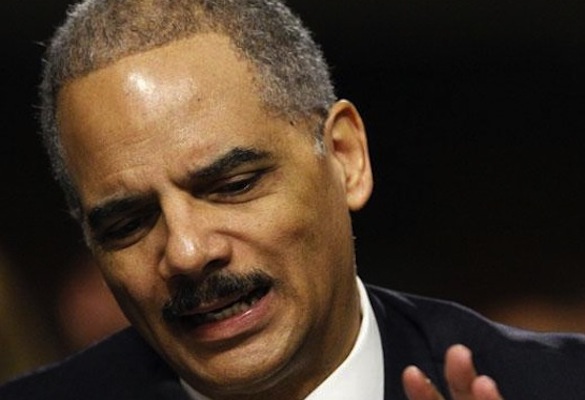
Two weeks ago, the various pundits on multiple current events talk shows agreed that the hopeless, untrustworthy, bunging and double-talking Attorney General, Eric Holder, would remain in office despite evidence beyond a reasonable doubt that he is a liability in the job, as long as “he retains the President’s confidence.” Sure enough, after another week in which Holder’s Justice Department came under even more bipartisan fire, White House political hatchet-woman Valerie Jarrett told the press that Holder  “will be in his position for quite a while” and “continues to have the president’s full confidence and respect.”

Not to be unkind, but this tells us that… Continue reading →

Ethics Dunces: The Wall Street Journal Editors

nsa-wiretap-eagle_0There may be good arguments to support that massive trolling of Verizon Business phone records by the NSA revealed yesterday, but so far, the justifications are either disingenuous, rationalizations, or leaps down the slippery slope. None exemplified this better than the Wall Street Journal, in its editorial defending the recently revealed surveillance. My favorite paragraph:

“The critics nonetheless say the NSA program is a violation of privacy, or illegal, or unconstitutional, or all of the above. But nobody’s civil liberties are violated by tech companies or banks that constantly run the same kinds of data analysis. We bow to no one in our desire to limit government power, but data-mining is less intrusive on individuals than routine airport security. The data sweep is worth it if it prevents terror attacks that would lead politicians to endorse far greater harm to civil liberties.”

Hmmm.

  • “The critics nonetheless say the NSA program is a violation of privacy, or illegal, or unconstitutional, or all of the above.” “The critics?” Can someone honestly say that taking my personal and private phone communications data without my knowledge or consent is not a violation of privacy?  To argue that is the definition of Orwellian. “We’re not violating your privacy, we’re just secretly examining your private communications.” Oh. Continue reading →