 (Part I is here.)
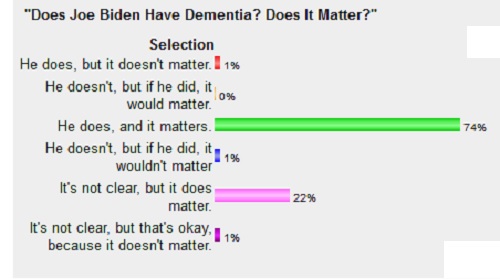
The poll above was offered to her blog’s readers by Ann Althouse this morning. Those were the early results, but they haven’t changed significantly. The fact that she felt the need to have the poll is significant, as is the fact that only 1% (its doubled, to 2%) would say that Joe Biden definitely didn’t have dementia. This isn’t a right wing rumor or organized slander, like so many of the “resistance” big lies. People have eyes and ears. They notice.
The hypocrisy demonstrated by the Democrats, who have been claiming that Trump is mentally unfit to be President, now apparently determined to nominate a man who is clinically unfit or soon will be is astounding. The only historical analogue that comes close is in 1944, hen the Democrats went through with nominating Franklin Roosevelt, though he was deathly ill and nobody who saw him or spent any time with him could fail to know it. FDR had already been President for twelve years, though, and there was still a war on. That’s some excuse, though not much.
Today’s Democrats have none. Here’s left-wing cartoonist Ted Rall:
Now Democrats are conspiring to gaslight the American people by engineering the presidential election of a man clearly suffering from dementia, Joe Biden. This is no time to be “polite.” We are talking about the presidency. As always, we need a frank, intelligent discussion and debate about the issues and the candidates….Contrary to current ridiculous Democratic talking points, it is not ageist to point this out. One out of seven Americans over the age of 70 suffers from dementia. (Biden is 77.) If it’s ageist to talk about dementia among the elderly, it’s ageist to talk about immaturity among the young. It is neither necessary nor possible to scientifically determine whether the former vice president has dementia. On the other hand, you don’t need an astronomer to know that the sun rises in the east. If you have encountered dementia, you know Joe Biden has it.
This may be the only time I have agreed with Ted Rall about anything.
Rall also makes the point, which I have made elsewhere, that Democrats have been trapped into supporting Biden because they believe defeating Trump is so important that they are willing to use a disabled man on the verge of incoherence to do it. That–I would say “if true” except that its truth seems undeniable—is so wrong and irresponsible that it almost defies belief. The party’s duty, any party’s duty, is to give the American people a candidate who will, in their view, be an effective President. Choosing Biden, in contrast, is like the Moors mounting the corpse of El Cid on his horse to “lead” the army during the siege of Valencia.
If the party was preparing to open the convention and take extraordinary measures to stop Bernie Sanders from leading the party to defeat on a platform of socialism, a responsible party should deem it equally urgent to block the nomination of candidate in Biden’s condition. That the party, and so many of its Trump-Deranged members and supporters, can’t or won’t see that is yet another indication of how completely hatred and anger over the 2016 election has corrupted it.
Much of the February 19 Ethics Alarms post about how hatred had driven Democrats into the hypocritical position of embracing Michael Bloomberg is applicable to the resurgence of Biden with just the substitution of names. This paragraph, however, needs no changes: Continue reading →




 Ethics Alarms