Merry Christmas, everyone!
I can’t wait to see what ethical gifts you ethics angels leave under our metaphorical tree!
I can’t wait to see what ethical gifts you ethics angels leave under our metaphorical tree!
Tonight, starting at 6 pm, EST, I’ll be facilitating a three hours CLE seminar via (yecchh) Zoom for the D.C. Bar. You can use the credits for other bars’ mandatory ethics requirements, so if you need them, I’d love to have you in the group. It’s all interactive, of course. I’ve been doing a year end legal ethics wrap-up, usually a re-boot of a seminar I present earlier in the year, for, oh, almost 20 years now. It’s not too late to register. The information is here, along with a promotional video I made a few months ago. They say video takes away 15 pounds of hair…
On the Christmas movie front: one Christmas movie that needs no ethics critique is 1947’s “The Bishop’s Wife,” an inexplicably under-seen classic film starring Cary Grant (as a very un-Clarence-like angel), Loretta Young and David Niven. It is as good as any of the Christmas classics and better than most, with a religious undertone that is missing from most of the others. In its time, “The Bishop’s Wife” was nominated for several Oscars, including Best Picture. Grant’s performance is especially deft, as he walks an extremely thin line, both in the plot and in his interpretation of the character. I was wondering last night why it hasn’t been remade, but it was: there is a 1996 musicalized version directed by Penny Marshall with Denzel Washington replacing Grant, Courtney Vance taking over for Niven, and Whitney Houston as a singing version of Loretta Young’s character. Justifiable remakes of classic films have to have a “why,” and this one’s justification was apparently that every classic with white stars has to be remade with black ones, or something. The reason I had never heard of it is that the film was generally regarded as inferior to the original, but I am going to have to track it down now and see for myself.
1. Believe all women/accusers/”survivors”… And if a career and a life is ruined unjustly, well, you gotta break some eggs to make an omelette, right? Chris Noth of “Law and Order,” “Sex in the City” and “The Good Wife” fame is now out of a job, having been fired from his supporting role on the CBS/Universal series “The Equalizer.” The reason: a Hollywood Reporter story revealed allegations of sexual assault against Noth by two as yet un-named women, one who says Noth sexually assaulted her in 2004 in Los Angeles, and another who alleges he assaulted her in his New York apartment in 2015.
Jeez, you’d think he had been nominated for the Supreme Court or something. Noth has denied the accusations, but never mind: they are enough, before any investigation, any trial, even any identification of the accusers, to get him “cancelled.”
Seems unfair, somehow….
[The previous post reminded me of this one, from 2015. Here it is again, slightly updated and edited. It’s as accurate now as it was then, unfortunately.]
At the rate things are going, I am certain that before long no pop vocal interpretations of traditional Christmas music will be easily accessible on the radio. This is a cultural loss—it’s a large body of beautiful and evocative music—and someone should have, one would think, the obligation of preventing it. But I have no idea who.
I realized this when I felt myself getting nostalgic and sad as I listened to a series of “Christmas classics.” For one thing, they all reminded me of my parents, whose absence beginning in 2011 permanently kicked my enjoyment of the season in the groin. For another, all the artists were dead. Bing: dead. Frank: dead. Elvis: probably dead. Andy Williams, Nat King Cole, Dean Martin, Judy Garland, Burl Ives, Gene Autry, The Andrews Sisters, Perry Como, Elvis, Karen Carpenter, John Denver–dead. Long dead, in most cases. Christmas has become a serenade of dead artists. Except for the narrow range of country music stars for those who enjoy “O Holy Night” with a twang, living pop artists don’t sing these songs. OK, Mariah Carey, Josh Groban and Michael Bublé. Not many others. A few years ago, Sirius-XM was so desperate to find living artists that it was playing the Seth McFarland Christmas album. Seth can sing, but I’m sorry, but it’s hard to enjoy “Silent Night” while picturing “The Family Guy.”
[Nat King Cole’s rendition of this song always makes me smile: his German is so dreadful. But what a voice! It’s like hot cocoa with a marshmallow melting in it.]
Well, the 8-foot Concolor fir tree goes up today, meaning about four hours of prickles and dead light strands lie ahead. Can’t wait!
I have a Christmas ethics dilemma on which advice would be appreciated. As I think I mentioned, Spuds, who is a canine battering ram, was romping at night in the field behind our house with a group of dog pals when one of the owners, a next door neighbor of thirty years, zigged when she should have zagged and Spuds ran right into her. Her leg was broken in two places, and now her 71-year-old husband is facing caring for her for at least several months, also taking care of their two large Belgian Shepherds, as well as a disabled family member who lives a few houses down the street. Lots of the dog-owners have dropped off holiday food for the couple, and we want to send a nice Harry and David package. How do we frame the gift in a way that sends the implied message we want to convey (“We’re thinking of you, and hope you can enjoy the Christmas in spite of everything”) and not “Please don’t sue us!” ? (I am not at all concerned on that score, for reasons social and legal.) Should Spuds sign the card, along with us?
I’ll be damned before I ask “The Ethicist,” or worse still, “Social Qs”…
1. Look! A competent list for a change! The Independent issued a list of “The Magnificent 20: the Top 2O Westerns of All Time.” I’ve lectured and written about this most ethics-minded and American of film genres, and I was pleasantly surprised that almost all of the Westerns I regard as essential made the list. Graeme Ross, the author, knows his stuff. That doesn’t mean I agree with all of it. I am not a Sergio Leone fan, and consider all of the spaghetti westerns as anti-Westerns at heart, so those are two slots I’d fill differently. As usual “The Searchers” is too high (it’s #1), and “Unforgiven” made the list, a film that I thought was over-rated from the second it came out (Sorry Clint.)
Still, only one of the Westerns included is affirmatively dreadful (Brando’s misbegotten “One-Eyed Jacks”) and an unforgivable choice. On my list (which is longer), “Lonesome Dove” is #1 (“Shane” is #2) but it’s not technically a movie, I guess. I also would include “Silverado” in the top 20. “The Man Who Shot Liberty Valence” is an essential inclusion on such a list; I don’t know how it was missed. Still, a responsible, respectful and fair effort—and John Wayne has more movies on the list than anyone else, even without “The Man Who Shot Liberty Valance.” Good.
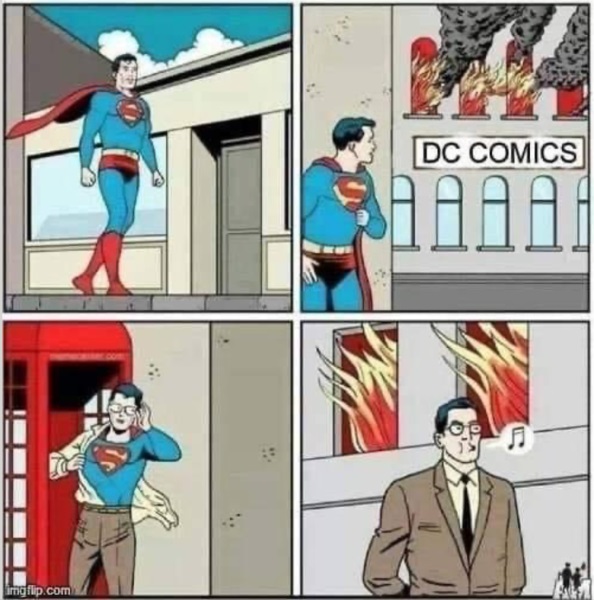
I know, I know…enough Superman already. What is this, “Seinfeld”? I was fully intending to have a Superman-free zone this weekend, but Steve-O-in NJ’s deft and historically illuminating comment on the second of the four honored comments on the last ethics quiz could not be ignored.
Here is his Comment of the Day on Steve Witherspoon’s Comment of the Day on “Ethics Quiz: Superman Ethics”
I think it shouldn’t be lost on folks here that Superman first appeared in Action Comics No. 1 in 1938. He came to be during the Depression, when this country was at its lowest and believing in itself the least. He was the creation of two aspiring Jewish writers named Jerry Siegel and Joe Shuster, who first conceived of him as a mind-reading, super-strong, and bald (!) villain given his powers by an experimental drug in a 1932 story called “Reign of the Supermen.” It wasn’t until 1935 that Superman became a hero and acquired his now well-known background, cape, and uniform. They had really wanted to get published in the comics pages as a strip, but when they kept getting turned down, eventually they signed away the rights to Jack Liebowitz, who had just formed Detective Comics, which would later become simply “DC” (although Detective Comics would continue to be published as a title and a year later Batman would debut there, but that’s another story). At least they’d finally see Superman published.
The rest, as they say, is history. However, Superman has, at least to some degree, always been an idealized “man of his times.” In the first few issues he was actually a bit of a smart aleck, and at one point anti-industrialist. Among other things, at one point he but two munitions manufacturers out of business, blaming them for war (THAT vanished with the coming of WW2). A real shocker was early on when he confronted a woman who had murdered someone. She drew a gun on him, whereupon he crushed the barrel out of shape, grabbed her hand, and asked her if she would surrender, “or shall I give you a taste of how that gun felt when I applied the pressure?” She of course surrendered, ruefully admitting that she would get the chair for the murder. Superman pitilessly replied, “you should have thought of that before you took a human life.” Obviously this would not fly now. It gets better when the character takes to radio in 1940, with a slightly modified origin story where he ages on the journey to Earth from Krypton and steps fully formed from the spacecraft, including being able to speak English. At one point he goes to confront a villain at his home, but finds only his Filipino houseboy, who of course speaks with a very exaggerated accent. He proceeds to intimidate him physically, and warn him, including a mild ethnic slur, that if he’s lied to him he’ll come back and kill him.
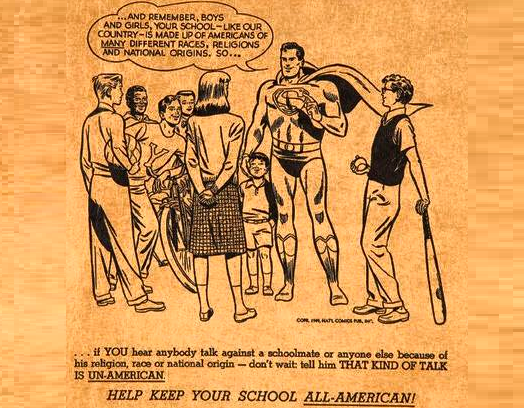
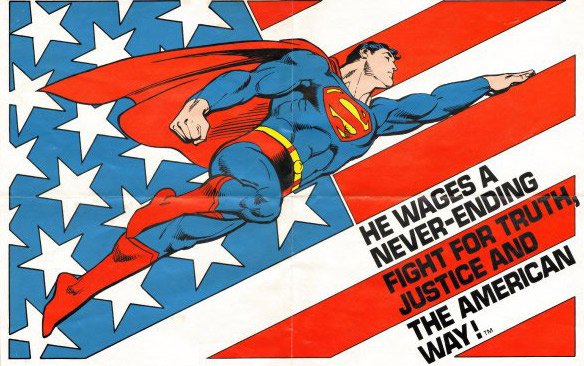
This, a Comment of the Day by Humble Talent, is the 4th of four fascinating and varied Comments of the Day that arrived quickly after I posted the ethics quiz about the evolving Superman mission statement. Now he’s not fighting for “the American way,” but for ” a “better tomorrow,” which is even more vague than “the American way.” (Consider the positions the far Left advocacy group People for the American Way has promoted.)
The four neatly explain why I made this episode in the culture wars (or was it?) an ethics quiz in the first place. I am pulled to both polls: the “Why should we care about the updating of a motto that is as corny as it comes relating to a comic book character whose importance is historical rather than current when it will have no effect on anything?” reaction, expressed in varying ways by Curmie and Humble, and the “This is part of the death of a thousand cuts being inflicted upon national pride and American exceptionalism by those who don’t like what the United States of America stands for and want to reject the Founders’ vision and the values that have served this nation and its citizens so well” response, represented here in differing shades by A.M. Golden and Steve Witherspoon (and in an upcoming Comment of the Day on Steve’s comment by Steve-O-in NJ).
My analysis is that yes, sometimes, as Dr. Freud would have said if he was a Superman fan, a comic book slogan is just a comic book slogan. I am fairly certain that’s how the soulless DC Comics honchos look at it; that’s how they have looked at everything else. “Gee, how can we get some more publicity and compete with Marvel comics, which everyone thinks is cooler? Let’s kill Superman! Let’s put him in a black and gray costume! Let’s make Ma and Pa Kent young again! Let’s have Superman fight Batman, as ridiculous as that is. Let’s make Superman’s son gay! Let’s make Lois mutate into a Squid-Woman!”
OK, they haven’t done that yet, but I wouldn’t put it past them. Superman’s mission was arguably the last remaining part of his classic intro that wasn’t already retired as outdated. “Faster than a speeding bullet…more powerful than a locomotive…able to leap tall buildings at a single bound”—that one’s great and nostalgic, but I haven’t seen a trace of it in decades. The same goes for the wonderful, “Look! Up in the sky! It’s a bird…it’s a plane…it’s SUPERMAN!” At least Superman’s motto is surviving in some form…not that I care. I watched the first Christopher Reeve “Superman” movie and admired the funky, “He can fly!” poetic section as a brave innovation, but the climax where Supie reversed time by making the world spin backwards was one of the most insulting things I’ve ever had rammed into my eyes by a major film, and that was the end of movies with Superman in them for me. And yet…
As I have discussed on Ethics Alarms before, there is a crucial difference between introducing something new and changing something. When a company (or a government) changes something that is already in place, it signals, intentionally or not, that what was in place was wrong, and had to be replaced. That may not be the intent, but that is what it does. The effect may be subliminal, but the change also can be exploited by those who believe that what what has been removed was wrong. It’s a victory for them.
I will give the international corporation that owns the copyright to Superman the benefit of the doubt and assume that its decision was based solely on seeking better penetration in international markets and pandering to the young, who are more likely to assume “a better tomorrow” means defeating climate change, ending “social injustice,” achieving world peace and generally making John Lennon’s twaddle come true. That’s good old fashioned capitalism, as well as classic marketing: appeal to the idiots out there, because their money is as good as anyone else’s.
However, at a time in our history where the foundations of American values are under coordinated attack and the public’s appreciation of its nation’s immense contributions to humanity and the world is being undermined, the symbolic import of stripping fighting for “the American way” from an American hero’s goals should not be ignored, and cannot be credibly denied. DC has allied its iconic character with those who want to dishonor Thomas Jefferson, replace the National Anthem and cripple the Bill of Rights. That’s how it will be seen, and perception, in this case, is reality. The United States needs all the allies of liberty it can get, and that means this is no time for Superman to go woke.
The change was irresponsible and disloyal.
That’s where I come out on the quiz. Now here is Humble Talent’s answer, his Comment of the Day on “Ethics Quiz: Superman Ethics”:
***
I think that we are rapidly falling into a trap, and that it’s in our best interests not to take the bait.
A DC Comics artist announced that recent decisions by the venerable comic book company to wokify its iconic hero were causing him to quit in protest. “I’m finishing out my contract with DC. I’m tired of this shit, I’m tired of them ruining these characters; they don’t have a right to do this,” said colorist Gabe Eltaeb during a recent podcast. “What really pissed me off was [changing Superman’s credo] to “truth, justice, and a better world,” Eltaeb added. “Fuck that! It was Truth, Justice, and the American way! My Grandpa almost died in World War II; we don’t have a right to destroy shit that people died for to give [to] us. It’s a bunch of fucking nonsense!”
What do you really think, Gabe? First, you should know what you’re quitting about: the new slogan is “Fighting for Truth, Justice, and a better world.” And the company obviously has a right to change the big guy’s slogan to whatever they want to. But yes, “the American way” has been sent to the ash heap of history.
Over at Fox News, they were freaking out, as usual. Fox News contributor Raymond Arroyo said on a Sunday talking heads show that DC Comics altering Superman’s motto to eliminate fighting for “the American Way” was a “disservice to fans.” “Now you have a multinational corporation, D.C. Comics, that decided it would rather politically grandstand and build foreign markets than respect their character and the audience that built him. You don’t need Kryptonite to kill Superman when you have D.C. Comics doing a great job. This is a huge disservice to fans and I’m waiting for Superman to turn up in a red costume and we will just call him Super Person. Lex Luthor should send DC Comics a thank-you card for sidelining and killing Superman.”
“This is clearly a distortion and a disservice to anyone who loved Superman that read the comic books and watched those movies,” Arroyo told “The Big Sunday Show.” “Remember, this was about an alien from another planet, a dying planet that comes and lands in the heartland of America and embodies the American ideals of freedom, justice. He wears red, white and blue for goodness sake!”
There were two recent developments in the DC Comics universe that provoked all the angst: the longtime publisher of Superman comics, changed Superman’s 80-year-old slogan from fighting for “truth, justice, and the American way” to “truth, justice and a better tomorrow,” and also revealed that the younger version of Superman, the son of Lois Lane and Clark Kent, is bi-sexual, and was drawn kissing a guy.
OK, the last one is obviously blatant pandering, but what about the motto?
Your Ethics Alarms Ethics Quiz of the Day is…

Oh, great: a fake blackface controversy again.
Composer and musician Bright Sheng, is the Chinese-born Leonard Bernstein Distinguished University Professor of Composition at the University of Michigan. When he received a MacArthur “genius” fellowship in 2001, the Foundation described him as “an innovative composer whose skillful orchestrations bridge East and West, lyrical and dissonant styles, and historical and contemporary themes to create compositions that resonate with audiences around the world.”
Sheng screened the 1965 film version of Shakespeare’s “Othello” in his class as part of a lesson about how the tragedy was adapted for the opera. It stars the late Sir Laurence Olivier, widely regarded as the greatest living English actor of his day and a definitive interpreter of Shakespeare, as the tragic hero Othello, a Moor. Some students who saw the film—hell, maybe all of them: they’ve all been indoctrinated into knee-jerk progressive conformity– were upset that Olivier’s face was covered in black make-up, though he was white and the character he was playing is black, so such a disguise would seem to be obligatory. This is the function of what actors call “make-up.”
Students complained to the administration that Olivier’s make-up made them feel “unsafe.” Unsafe from what? From the make-up? From Olivier, who is long-dead? From Iago, the white villain of the play?
I have to admit, Frances Haugen has played this beautifully. Like many so-called whistleblowers (not all), she picked an ideal moment to betray her previous employer, in this case Facebook, leak proprietary documents, turn herself into an instant media star, guarantee books deals, speaking tours and TV stardom, and be praised to the skies by gullible, grandstanding and cynical politicians.
“I’m here today because I believe Facebook’s products harm children, stoke division and weaken our democracy,” the former Facebook product manager said before a Senate subcommittee on Tuesday. Perfect. I wonder if her media advisor helped her draft it.
Here is all you need to know about Haugan: According to her own website, Haugen was a member of Facebook’s internal Civic Integrity team in 2020. That means she was part of the team that made the decision to ban the Hunter Biden laptop story by the New York Post from Facebook in October 2020. Facebook, and its evil twin Twitter, refused to allow circulation of the story, accepting without evidence the defensive Democratic talking point that the laptop was a plant was tied to Russian intelligence. Those claims were disinformation, we now know, and the laptop really did belong to Hunter Biden. Facebook’s partisan embargo on the truth might have determined the election. Is blocking a story that might defeat Joe Biden what the whistleblower considers avoiding division and protecting democracy?
It’s a rebuttable presumption. I don’t trust Haugan, her motives, or her message.

Singer Janis Joplin died of a heroin overdose on October 4, 1970. The anniversary prompts me to make an unkind observation that I was tempted to make after reading all of the tributes and expansive rhetoric praising “The Wire” actor Michael K. Williams after he died of an overdose of fentanyl and heroin on September 6. For at least a hundred years, anyone who takes heroin does so knowing that it is addictive and frequently fatal. My attitude toward Joplin, Williams, John Belushi, Phillip Seymour Hoffman, Billy Holliday, and many other artists who have killed themselves this way involves more anger than sympathy. The world was robbed of their gifts because they were reckless. In the case of black artists, they endanger their admirers by creating a romantic aura for what is, in the final analysis, stupid and irresponsible conduct. How hard can it be not to start using an addictive substance that you know might kill you? The fact that the drug is illegal should be a big clue.
1. And speaking of the joys of recreational drugs...In a new study published in Psychological Medicine, researchers in the University of Birmingham’s Institute for Mental Health and the Institute of Applied Health Research found a strong link between “general practice recorded cannabis use” and mental ill health. Senior author Dr. Clara Humpston said: “Cannabis is often considered to be one of the ‘safer’ drugs and has also shown promise in medical therapies, leading to calls for it be legalized globally. Although we are unable to establish a direct causal relationship, our findings suggest we should continue to exercise caution since the notion of cannabis being a safe drug may well be mistaken.”
Continue to exercise caution? Who’s exercising caution? Popular culture and upper-middle class whites have been issuing pro-pot propaganda for half a century, while mocking government efforts to discourage widespread use and acceptance of another destructive recreational drug. Now nearly every state is on a path to legalize it, especially because they smell tax revenue.

