James Dean, who died in a 1955 car crash at the age of 24, is making an unexpected return to the big screen. The cultural icon, known for Rebel Without a Cause and East of Eden, has been posthumously cast in the Vietnam era action-drama Finding Jack.
Directed by Anton Ernst and Tati Golykh, the project comes from the filmmakers’ own recently launched production house Magic City Films, which obtained the rights to use Dean’s image from his family. Canadian VFX banner Imagine Engine will be working alongside South African VFX company MOI Worldwide to re-create what the filmmakers describe as “a realistic version of James Dean.”
We all saw this coming, didn’t we? Since this is about involuntarily resuscitating dead actors so greedy family members can put them to work doing whatever a director screenwriter wants them to do, I feel no need to write a new post, especially since my position hasn’t changed one bit from the other instances in which I looked at this issue. So here it is again, lightly edited… Continue reading →
My best friend of long standing’s favorite singer is Nat King Cole. He really doesn’t sound like anyone else, does he? I wonder how many millennials have heard his amazing voice, or would have the perspective to appreciate it.
Speaking of listening, I was prompted this morning to reflect on what a vital life-competence skill listening is. It is really an acquired skill: various Facebook discussions make it clear that most of the Facebook Borg warriors are no longer listening (or otherwise paying attention) to any information that doesn’t bolster their confirmation bias.
What made me think about this today was happening upon an early morning showing of “Casablanca” on Turner Movie Classics. I must have seen the classic a hundred or more times since first watched the whole movie in college, and yet today was the first time I heard what “Rick” Blaine’s real first name was. All the other times I watched the movie, this passed by my consciousness without leaving a trace, but his real name is used three times. (Hint: it’s not Richard, though that’s what Ingrid Bergman calls him…)
1. A great President in many ways, but also a terrible human being. Watch the culture and the news media bury this. “The Jews Should Keep Quiet: Franklin D. Roosevelt, Rabbi Stephen S. Wise and the Holocaust,” a new book (published in September) reveals new archival evidence that shows FDR’s callous and bigoted treatment of European Jews prior to and during the Holocaust. I know the author, Dr. Rafael Medoff of the David S. Wyman Institute for Holocaust Studies, as a result of his assisting The American Century Theater with several productions that involved the Jews and Israel.
The book’s revelations are not shocking to anyone who had looked at the evidence objectively even before this new material, but Roosevelt is a hallowed Democrat Party icon, and it has been, and I assume will continue to be, resistant to any effort to inform the public of this horrific moral and ethical failing, one of many FDR was guilty of inflicting. From a review:Continue reading →
It was little noticed, but Houston Astros pitcher Gerrit Cole did something admirable and unusual last night on the way to dominating Washington Nationals hitters and leading his team to a 3-2 lead in the best-of-seven series. At one point in the game, Nationals first-baseman Ryan Zimmerman laid off a tantalizing pitch just off the plate with two strikes on him. Cole could be seen saluting the batter and saying “Good take!” It is rare to see a baseball player acknowledge an adversary’s skill on the field.
I wouldn’t mind seeing such gestures more often.
The President not only attended the game last night, but stayed unusually long for a dignitary, who usually go to baseball games to be seen more than to watch. Trump stayed until the 8th inning, when much of the discouraged Nats fandom was streaming to the exits. I wrote last week that I hoped he would subject himself to the fans’ ugliness, and they responded as we knew they would, loudly jeering and chanting “Lock him up!” It was a black eye for Washington, D.C., not President Trump.
1. Unethical non-traditional casting. Harvey Fierstein is playing Bella Abzug on Broadway. I know that Harvey, being a very large, undisguisably gay, 65-year old actor with a voice that sounds like he gargles piranha, has a tough time finding outlets for his acting and comic ability (he can be terrific, as he was in his Emmy-winning performance in “Torch Song Trilogy”), but that’s no reason to take it out on the late New York Congresswoman. Abzug was a woman, and being a woman was central to her career, appeal, legend, and legacy. She was not, to say the least, an attractive woman, but that does not mean that it is fair or respectful to cast a 275 pound unattarctive MAN to play her on Broadway. Feirstein is an LGBTQ activist and icon, but he’s ethically confused here.
2. Trump shouldn’t have backed down from holding the Group of 7 Summit at the Trump luxery golf club in Miami. Apparently he did so because Republican members of Congress complained about it, and they complained about it because they knew it would spark more bogus accusations of Emoluments Clause violations (Impeachment Plan C).
Any and every negotiations specialist will tell you that holding a meeting of adversaries in your own territory is a massive advantage. That is why such meetings are often held in Switzerland, or other neutral sites. Holding the Summit at a Trump property makes the President stronger at the meeting, and that benefits the country.
It would have been nice—responsible, educational, fair, honest—if the news media explained this basic principle to the public, but it doesn’t want to justify the President’s decisions or find benign reasons for them. It is in thrall to “the resistance,” and doing a complete analysis of factors involved in a decision like where to hold the Summit just detracts from the effort to undermine President Trump and characterize him as a corrupt and crooked fascist who must be removed from office at all costs.
Republican joined the ignorant stampede because, unfortunately, they aren’t very bright, or very brave. Thus the U.S. voluntarily forfeited a diplomatic advantage because Republicans couldn’t articulate why there was nothing sinister, and much advantageous, about a world leader holding a meeting at a property that bears his name. Continue reading →
I was not eager to see “The Mule,” for many reasons. Stories in which the protagonist is a drug dealer don’t interest me at all; I avoided “Breaking Bad” and “Weeds” for the same reason. The popular culture, especially Hollywood, played a major role in breaking down society’s consensus disapproval of recreational drug use, and I hope they are proud of all the harm they have caused, and the greater harm yet to come.
Then there is the fact that seeing Clint Eastwood looking like the Cryptkeeper (from HBO’s “Tales of the Crypt”) depresses me. I remember Clint from his “Rawhide” days, and seeing his ruined beauty makes me feel like I’m watching the villain rot at the end of “Indiana Jones and the Last Crusade” when he “chooses poorly,” but for real. I admired Cary Grant’s decision to stop making movies when he began to stop looking like Cary Grant, and Marlene Dietrich’s determination not to appear in public so that people would remember her as one of Hollywood’s great beauties, and not as an old lady.
But as often in the case for me, having limited options of films to watch while stuck in in a hotel made Eastwood’s latest directorial and performing effort the best of a bad group of entertainment choices. The film is based on the true story of a ninety-year-old man (Clint isn’t quite that old, but he looks it) who became a drug mule, transporting cocaine for a Mexican drug cartel. The film has an excellent supporting cast including Bradley Cooper, Laurence Fishburne, Dianne Wiest and Andy Garcia. (who also looks like hell), though none of them have much to do except be props for Clint’s star turn.
To do as little spoiling as possible, I’ll just say that the story involves an aging—aged—narcissist who has neglected his family outrageously, falls into a lucrative gig transporting drugs because he loves to drive, has never had a ticket, and is unlikely to attract attention. Then he suddenly decides to make the needs of his family a priority over work for the first time in his life, getting him arrested and almost killed.
Clint still has his screen presence and charm, which is fortunate, because the central character, Earl Stone, is a selfish jerk. His toxic personal habits don’t seem so bad when the victims are drug smugglers, but when, early in the movie, he skips his daughter’s wedding without warning because he’d rather be at a sales convention partying with his colleagues, it is hard to care what happens to him.
We quickly learn that this betrayal was characteristic of Earl, and that he rationalizes them all, arguing that he was absent from his family to provide for them, and is blameless. It’s clearly a lie: his family bores him, and he does exactly what he wants to do, always. Sometimes Earl helps people and is randomly kind, as when we see him pause in one of his drug runs to help a couple stranded on the road. Other times, he doesn’t give a damn.
When a family argument breaks out as he attempts to attend his grand-daughter’s bridal shower, a guest overhears that Earl has lost his home and business (that’s really why he showed up at his granddaughter’s place—that and the fact that she was the only family member still on speaking terms with him) and gives him a phone number. These people will pay him well just for driving, Earl is told. Continue reading →
The problem is that when it comes time to honor those who have made a positive contribution to our country and culture, nobody remembers who they are. I confess, it drives me nuts. Today a medical technician revealed that she had no idea what “Ben-Hur” was. No chariot race, no galley slave scene. Well, she’s a drag on the culture. Catch up.
Actress and singer Diahann Carroll, 84, died on October 4, and her death received small and momentary notice. Yet she was another one of the brave, trail-blazing African Americans whose intelligence, charm, talent and willingness to take risks helped move the stubborn needle toward racial conciliation and away from bigotry. Of course, she was remarkable–unusually gorgeous, unusually talented, unusually intelligent. It never seemed like she set out to become a civil rights and cultural icon, but somehow the position just found her. Most important of all, when she was given the chance to make white people think differently about black people, she did it. She also made it look easy. Continue reading →
Before it went down the tubes, the leftist commentary website ThinkProgress posted a typical piece (that is, so crippled by bias and a progressive agenda that it was useless as advocacy unless the reader already agreed with it) bemoaning the fate of LGBTQ performers in Hollywood like Kristen Stewart. Stewart, once a rising young star with the “Twilight” Saga films, now approaching 30 without a clear career path.
You’ll get the article’s point of view from the kick-off:
“In an interview with Harper’s Bazaar UK, actor Kristen Stewart, who has been romantically linked to model Stella Maxwell since 2017, said, “I have fully been told, ‘If you just like do yourself a favor, and don’t go out holding your girlfriend’s hand in public, you might get a Marvel movie.’ I don’t want to work with people like that.” Stewart has said publicly she does not identify as bisexual or lesbian, and doesn’t want to choose a label for her sexuality. In the same interview she added, “I was informed by an old school mentality, which is — you want to preserve your career and your success and your productivity, and there are people in the world who don’t like you, and they don’t like that you date girls, and they don’t like that you don’t identify as a quote unquote ‘lesbian’, but you also don’t identify as a quote unquote ‘heterosexual’. And people like to know stuff, so what the fuck are you?’”
Although it may, at times, appear as though LGBTQ representation and participation in Hollywood has achieved some semblance of parity, Stewart’s experience is far from unique. Several young, openly LGBTQ actors such as Ellen Page and Ezra Miller have talked about how their gender and sexuality have affected how people talk to them about their careers.”
“The Bad Seed” began as a novel by American writer William March, then became a 1954 Broadway play by playwright Maxwell Anderson, and ultimately a 1956 Academy Award-nominated film. The disturbing plot involves Rhoda Penmark, a charming little girl who is also a murderous psychopath. In the play’s climax, which the film version didn’t have the guts to follow, Rhoda’s single mother resolves, once it is clear that her daughter is killing people, to kill Rhoda herself, in a twist the anticipates such films as “The Omen.” She fails, however, and the sweet-looking serial killer in pigtails is alive and plotting at the play’s end.
A real life bad seed scenario is playing out in Chicago. A 9-year-old boy has been charged with five counts of first-degree murder, two counts of arson and one count of aggravated arson. The evidence suggests that he deliberately started a fire in a mobile home east of Peoria, Illinois, that claimed the lives of the boy’s two half-siblings, a cousin, his mother’s fiance and his great-grandmother.
The boy’s mother says her son suffers from schizophrenia, bipolar disorder and ADHD. She also says things like “he’s not a monster,” “he just made a terrible mistake” and my personal favorite, “he does have a good heart.”
Your Ethics Alarms Ethics Quiz of the Day is…
Is it ethical to charge a child so young with first degree murder?
Unlike the National Basketball Association, satirists Parker and Stone know that their duties as Americans include representing American values to the world and standing by them even when threatened with negative consequences.
After “South Park’s” latest episode, which mocked China’s influence over Hollywood, the Chinese government banned the series. The Hollywood Reporter revealed that China removed all hints of”South Park” from its Internet, eliminating any social media references as well as episodes and clips from the streaming service Youku.
In response, the “South Park” creators issued a pointed satirical “apology” to China:
“Like the NBA, we welcome the Chinese censors into our homes and into our hearts. We too love money more than freedom and democracy. Xi doesn’t look like Winnie the Pooh at all. Tune into our 300th episode this Wednesday at 10! Long live the great Communist Party of China. May the autumn’s sorghum harvest be bountiful. We good now China?”
Perfect. Now watch the NBA condemn “South Park” as racist, or something.
“The Joker,” opening this week and presenting Joaquin Phoenix’s portrayal of Batman’s arch-enemy as fitting the classic mass-shooter profile, has provoked all sorts of ethics- related debates. Is it responsible to release a film that may risk triggering the psychopathic loaners with access to guns we all know lurk in the shadows? Is the studio risking another Aurora-style theater shooting? Should such films be boycotted? Regulated?
These debates, which are retreads of the same old refrains the nation has been tortured by since dime novels through Warner Brothers gangster movies, EC comics, “The Untouchables” TV series, the Legion of Decency’s reign, Sam Peckinpah films and “A Clockwork Orange,” are all appeals to censorship using “Think of the Children!” rationalizations, and are essentially attacks on free speech. The contrived debate is alarming but not difficult to call: the would-be censors are wrong, motivated by emotion, and that’s that.
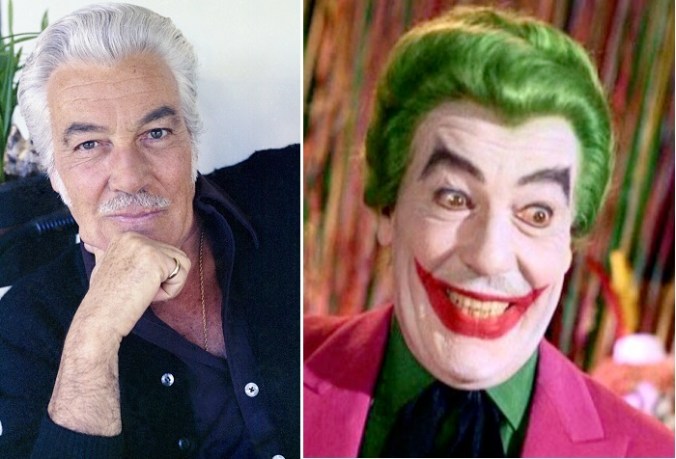
No, the really interesting ethics debate the new movie has revived is another old one: Was it ethical for actor Cesar Romero to keep his moustache when he played the Joker?
Cesar Romero (February 15, 1907 – January 1, 1994) is now largely forgotten, but he was a familiar presence in films, radio, and television for almost 60 years. Sort of a Grade B Riccardo Montalban, Romero had a rather narrow range, with his portrayal of dashing Latin lovers, historical figures in costume dramas, and characters in light comedies all looking and behaving similarly. Romero’s trademark was his moustache, especially in the post-Errol Flynn era when leading men seldom wore them.
When the 1966 camp TV show Batman became a brief sensation in 1966, the casting of Romero as the Joker was a shock. He had never played any role remotely like it, nor was broad, silly comedy his typical milieu. Most shocking of all, when the Joker finally made his appearance on the show it was obvious that Romero hadn’t shaved his upper lip. Reportedly the actor refused to eliminate his moustache for the role, and so the supervillain’s white face makeup was thickly smeared over it throughout the series’ three-year run and for Romero’s co-starring appearance in the 1966 film. Continue reading →



 Ethics Alarms