In 2017, “Game of Thrones” creators David Benioff and D.B. Weiss announced that HBO would carry their new original series “Confederate,” an alternate history show taking place in an alternate reality where the South won the Civil War, creating a new nation in which slavery remains legal and continues as a modern institution. (yes, presumably they knew this was unlikely, bordering on impossible. )Their release added, “The story follows a broad swath of characters on both sides of the Mason-Dixon Demilitarized Zone — freedom fighters, slave hunters, politicians, abolitionists, journalists, the executives of a slave-holding conglomerate and the families of people in their thrall.”
While I generally dislike alternate history fiction (unless it involves extravagant revenge on unequivocal villains, like in “Inglorious Basterds” or “Once Upon A Time In Hollywood,)” the genre, done well, has the potential to be enlightening and provocative, like Amazon’s The Man in the High Tower,” a series based on Philip K. Dick’s novel about a world in which Germany and Japan defeated the U.S. in World War II.
…. HBO president Casey Bloys officially confirms to TVLine that the…long-gestating, controversial slavery drama Confederate will not be moving forward.
The 2017 announcement was greeted by the same people who want to see all statues of slave-holders and Confederate soldiers melted down (and the Confederate flag regarded with the same revulsion as the Nazi swastika) as a dangerous white supremacy plot. Benioff and Weiss even felt they had to make it clear in interviews that they knew “slavery was wrong.” Here’s an example of the social media brickbats the announcement of the series spawned in 2017: Continue reading →
1. Thoughts on the announced Oscar nominations. Well, very few African Americans made it, and no female director despite all the blatant lobbying for “Little Women” director Greta Gerwig. Thus I have to conclude that the Academy of Motion Picture Sciences DOES have a measure of integrity after all, because it will catch all sorts of hell for this. Even after adding many voters “of color” and kicking out some ancient, unwoke voters members, it’s still a mostly white field, maybe because the most deserving candidates happened to be the wrong color this year. It doesn’t matter: the Academy will be beseiged again for implicit racism. Watch. And it will seek “reforms.” The problem is that race-based categories looks like apartheid. The only other alternative is to have secret quotas, which is what I thought were already in effect.
It doesn’t help that both Al Pacino and Joe Pesci were nominated as Best Supporting Actors for, in Pacino’s case, standard issue Al, and in Pesci’s case, an embarrassingly flat performance. If the Academy is going to give out legacy nominations, why not some token nominations for minorities? I bet there were 50 “of color” performances this year objectively superior to these two from the dead-fish “The Irishman.”
2. It amazes me that so many Americans defend Meghan Markle’s “Megxit.” I know, I already wrote about this, but her conduct appears to be a continuation of the Obama phenomenon, where a prominent individual exploits her race to declare all criticism as based on racial bias. “Black Britons” as the New York Times calls them, are lining up to support Markel because they allege she was “savaged” by the British tabloids because of her race. Similarly, the Times finds dark implications in the fact that the Royal Family didn’t rally to her side when she came under fire: they must be racists too. All the evidence I’ve seen suggests that they didn’t support Markel because she’s an annoying jerk: Occam’s Razor applies.
If she really married into the Royal Family and didn’t know that the tabloids would be dissecting her every word and move, she was negligent and foolish. Did she consider chatting with Sarah Ferguson, or did Markle think the Duchess of York was attacked because of media bias against redheads?
For once I agree with ex-CNN talking head Piers Morgan, who wrote, “I’ve seen some disgraceful royal antics in my time, but for pure arrogance, entitlement, greed and willful disrespect, nothing has ever quite matched the behavior of the ‘Duke and Duchess of Sussex.’
She has provoked a crisis in the monarchy to further her own goals of unearned mega-celebrity. I have a Facebook friend who argues that since royalty is unethical, Meghan should be praised for setting out to bring it down in England. (Yes, he’s a Communist.) The real Markle is already becoming more apparent. She has said that she will only move back to the U.S. after President Trump is out of office, already pandering to the Angry Woke. Disney announced that it had a voice-over deal with her, with her compensation to be donated to a charity….but she made that deal as a Royal, not a rebel. Disney has the right, but not the guts, to void the arrangement. Continue reading →
“Seinfeld” fans remember Jerry’s Uncle Leo, whose trademark was an over-enthusiastic, “Hel-LO!” The recurring character was played by the late Len Lesser, an obscure Hollywood bit player until the “Seinfeld” gig made him a familiar face. Well, I was watching “Bells Are Ringing,“ the 1960 film version of the hit Broadway musical known for the standards “Just in Time” and “The Party’s Over” (one of my Mom’s favorite songs), on TCM. The film is a reminder of just how luminous Judy Holliday was; she had won the Tony for playing the musical’s starring role on Broadway, and attention should be paid. Tragically, his was her last movie—during filming she was fighting the cancer that eventually killed her —-and I don’t know if there has ever been a female musical comedy star of greater range and presence. Anyway, there’s a number in the film where Judy tells Dean Martin that New York’s grim mass of humanity during rush hours will thaw if strangers only say “hello” to each other. Dean is skeptical, but he tries it on a dour-looking man waiting in the mob, whose face instantly breaks into a brilliant smile at the greeting. “Hel-LO!” the man responds to a surprised Dino, and soon everyone is happily saying hello to each other. You guessed it: the dour-looking man was played by “Uncle Leo” himself, Len Lesser. His catch phrase in “Seinfeld” was a deliberate reference to that bit, one of the very few memorable moments in the elderly actor’s career.
This is really a long introduction to a different point: I get a lot of ethics ideas from watching old movies. For example, I watched 1967’s “The St. Valentine’s Day Massacre,“ one of schlockmeister Roger Corman’s few films with an A-list cast and a big budget. The film’s solemn narrator is uncredited, but he is obviously meant to make the casual audience member think it’s Orson Welles. It wasn’t Welles, however: it was master vocal artist Paul Frees, who had a great, and often used, Welles impression. I assume he was uncredited so no one would realize that the narrator wasn’t the weighty Welles, but the voice of Boris Badinov from “Rocky and Bullwinkle.”
I don’t know how Corman got away with this.
1. Ah, the accurate, trustworthy news media. Reuters reports, “A South African military plane crash-landed on Thursday at the Goma airport in eastern Democratic Republic of Congo, a U.N. spokesman said….two sources at the airport, speaking on condition of anonymity, said there did not appear to be major damage to the plane.”
Here’s the plane:
2. Apparently the Democratic Party’s strategy regarding the economy is to just flagrantly lie about it. “The U.S. economy is working just fine for people like me. But it is badly broken for the vast majority of Americans,” Mike Bloomberg said this week. That counter-factual statement echoes Joe Biden, Elizabeth Warren, Bernie Sanders…pretty much the Democratic field, and it is demonstrably false.
The Atlanta Federal Reserve Bank’s monthly Wage Growth Tracker shows that Americans in the lower wage brackets are making more money, and at a better rate than they have for a very long time. Here’s a graph: Continue reading →
People appear to be going nuts….in many cases, the exact same people who have, in the recent past, pressed Impeachment/Removal Plan E, ”Trump is mentally ill so this should trigger the 25th Amendment.” Ironic.
This week I stumbled across a comedy now playing on Netflix starring Stephen Yeun, most memorably seen on “The Walking Dead” with half his head caved in and his eyeball hanging out. The movie is called“Mayhem,”and is about a kind of flu that removes people’s impulse control, causing them to do and say whatever they feel like doing or saying, no matter how inappropriate or illegal. The illness strikes a BIgLaw firm, which is quarantined and locked down while its employees go bananas. It’s an excellent metaphor for what is going on right now, but much funnier.
And so far, at least, bloodier.
So far.
1. And now for something completely stupid...Even after being warned at the Golen Globes by Ricky Gervais that they know nothing about the real world and should avoid making political pronouncements, Best Actor winner Joaquin Phoenix announced after the award show that in order to help save the planet from climate change, he would wear the same tux to all the awards shows this year. He really said that. No, seriously, he really did, and he was not engaging in satire (but if the Babylon Bee used that as a story, everyone would assume it was satire.) Then designer Stella McCartney company, also apparently seriously, tweeted (because that tux the actor will be wearing is one of theirs), “This man is a winner… wearing custom Stella because he chooses to make choices for the future of the planet. He has also chosen to wear this same Tux for the entire award season to reduce waste. I am proud to join forces with you.”
I’ve worn the same tux for ten years. Phoenix doesn’t even pay for his tuxes (I pay for mine!), like his female colleagues who get their designer gowns free. There have been some funny jokes about the actor’s ridiculous virtue signaling, many involving underwear, but never mind: what I want to know is, how can anyone take people who think like this seriously, or respect anyone who solemnly nods when they hear about such pompous nonsense, “Hey, right on, man. Save the planet”? Yet a substantial chunk of an entire political party appears to be this far gone.
2. Wait—are they trying to make our heads explode like those robots and computers that Captian Kirk would destroy by making them think about a contradictory statement? Is that their plan? I admit: I don’t understand this at all. A “Saved by the Bell” reboot, sequel, whatever you want to call it, is on the way. Starring original stars Mario Lopez (who now hosts celebrity gossip shows) and Elizabeth Berkley (whose career never recovered from her starring in the camp classic “Showgirls,” the plot sounds nauseatingly ‘woke,” as it involves now California Govetnor Zack Morris (the gown up character in the original played then by Mark Gosselaar, who actually has a career and doesn’t need to stoop this low) being criticized for closing too many low-income high schools, so he announces that the affected students will be sent to the highest-performing schools in the state, including his old stomping grounds, Bayside High. Hilarious! I smell a hit! But here’s the beauty part: playing the role of the cutest, most popular cheerleader at Bayside, the role originally played by Tiffany Amber Thiessen, will be played by Josie Totah, a transgender female ( transgender male? I’m still unsure of the right terminology. She began life as a male). Isn’t this just a stunt? On one hand, I’ll fight to the death for the right of any actor to play any role, wear any make-up, use any device, as long as the vehicle itself doesn’t suffer. On the other hand, by casting a transgender actress who has made a point of publicizing her biological origins, the production guarantees that nobody will be able to watch “Lexi” without thinking about things that have nothing to do with “Saved by the Bell.” Continue reading →
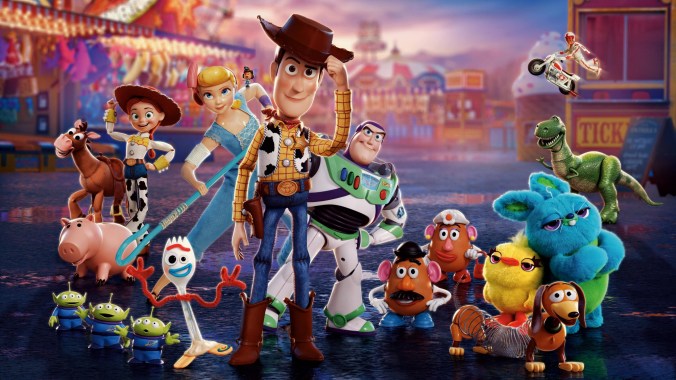
Track with me ,if you will, the fevered discourse of some poor social justice warrior named Stephen Galloway, who authored what apparently is intended as a serious critique in the Hollywood Reporter titled, “The Whiteness of ‘Toy Story 4.”
He begins,
Was there any movie this past year as exuberantly entertaining, as creatively conceived as Toy Story 4? Ever since the franchise was launched in 1995, it’s been a cornucopia of riches, from its indelible characters to its unparalleled animation…The picture … left me in awe.
Well, that’s the end of the matter, isn’t it? It should be. This was, the the other three films, a vehicle of entertainment. Virtually everyone who saw it was entertained, even me, and I found it the least of its three predecessors and annoying for its blatant pandering to feminists (Bo Peep suddenly morphed into Lara Croft).
But alas, no..
So why did a slightly bitter taste linger, a sense that something was naggingly wrong? Because in many ways TS4′s worldview seems like an Eisenhower-era fantasy, a vision of America that might have come from the most die-hard reactionary: lovely if you’re wealthy and white, but alarming if you’re black or brown or gay or a member of any other minority — in other words, more than half the U.S. population.
Oh, bite me. The characters are toys. Toys don’t have races. They don’t have sex. I wonder if a single child saw this film and spent one second wondering about why there wasn’t a gay or Hispanic toy, or thought about whether the Potato Heads are “of color,’ being brown, or if “Bunny,” voiced by African-American actor Jordan Peele, is “of color” because he’s blue. Nobody normal, of any age, thinks like that, unless they have been brain-washed into a miserable world view….like the author, who really complains that one of the new characters is “a very white fork.” Oh! Right! The second I saw “Forkie,” I thought, “Another white guy!” Continue reading →
My son is an auto tech and car enthusiast as well as a lover of speed (sufficiently to get him in trouble), so when he told me that I should see “Ford v Ferrari” and that he loved it, it was no surprise. I knew nothing about the film other than its title: no reviews, no background. My son said he would eagerly see it again, and was our guide as my wife and I attended a New Year’s Day afternoon showing (which was packed, incidentally.)
To get the basics out of the way up front, “Ford v Ferrari” is a wonderful movie. It immediately takes its place as one of the great sports movies of all time (with “Rocky,” The Natural,” “Hoosiers,” “The Bad News Bears,” “Sea Biscuit,” and a few others we could argue about), but it is also just a great movie. Christian Bale is astonishing, as usual, and the rest of the cast is uniformly excellent, as is the direction, film editing and screenplay. It is the best film I have see this year, easily leaving such critic’s favorites as “The Irishman” and “Once Upon A Time in Hollywood” in the dust. That, however, is beside the point….
1. Is it me, or is this TV commercial indefensibly gross, and signals the impending end of civilization?
2. Reasons not to duck the New York Times op-ed pages…Yale student Kathryn Hu contributed a sane and thoughtful essay on the topic of classic operas with characters and plot elements that seem sexist or racist to today’s more enlightened audiences. As we know, today’s “woke” censors of the arts and arbiters of what we are allowed to watch and hear have their own solution: never do the piece again, despite its obvious virtues, or interpret and rewrite it out of existance or into nausea, like John Legend injecting “It’s your body and your choice” into the lyrics of “Baby It’s Cold Outside.” I had to suppress my gorge from rising while reading this article, for example, that described the current production of J.M Barry’s 1904 classic “Peter Pan” in Washington D.C:
In [Playwright Lauren Gunderson’s] version now playing at Shakespeare Theatre Company (retitled Peter Pan and Wendy…), the character of Tiger Lily has been completely reconceived. No more the helpless princess in distress, Tiger Lily is now a spirited and fearless Native rights activist whose people thrived in Neverland long before Captain Hook’s pirate ship dropped anchor and Peter showed up with the Lost Boys.
Because as we know, there were so many Native American activists in 1904. To anyone with brain cells and cultural perspective that haven’t been woked to death, it is obvious that Barry’s Neverland is a child’s fanciful impression of Indians, pirates, and friendly wild animals. It has nothing to do with reality , so imposing current day adult political views on the and characters is neither fair nor necessary.
Hu’s solution to the supposed horrors of 19th Century biases and social mores in opera: Continue reading →
The position here has always been that nobody has any business telling you how to spend your money. This topic usually comes up in the context of charity, as in, “How dare that individual spend money on what they think is important when they should be spending money on what I think is important!” A couple of recent developments have raised the issue in a different context, however: incompetent and irresponsible expenditures of large amounts of money.
Take “Cats,” for example. The already immortal flop film cost a reported $100,000,000 to make, and marketing costs are on top of that. It is sure to lose many, many millions of dollars, and the question becomes, “How could movie professionals make a blunder like that?”
I always assumed that “Cats” could not be a successful movie because of its purely theatrical nature. Surely the lesson of the film version of “A Chorus Line,” another Broadway musical that never should have move to the screen, was guide enough. Yet it happened. The fiasco put me in mind of other infamous and avoidable screen disasters, like 1978’s “Sgt. Pepper’s Lonely Hearts Club Band” starring Peter Frampton and the Beegees. Before the film’s release, Robin Gibb of the Bee Gees announced: “There is no such thing as the Beatles now. They don’t exist as a band and never performed Sgt Pepper live in any case. When ours comes out, it will be, in effect, as if theirs never existed.”
Good prediction. The huge MGM film with dozens of celebrity cameos was instantly and universally reviled. Even worse, a few years later, was “The Pirate Movie,” another misbegotten big budget musical. The idea here was to do a new version of “The Pirates of Penzance” but without the dialogue, plot and music that has made the Gilbert and Sullivan show popular for more than a century….and to star Kristy MacNichol, the androgynous, non-singing teen star, as the heroine. How could such a brilliant concept fail? Continue reading →
Is it still clickbait when a link virtually screams “CLICKBAIT!”? Maybe, but if someone is going to claim that they have made a “perfect list,” he had better do a better job than this. My earlier comments today about Pauline Kael apply: some of this guy’s assessments of what is “definitive” disqualify him as a useful or credible authority. For example, Field, who reveals himself as an Ella Fitzgerald fan boy, chooses Ella’s rendition of “Have Yourself A Merry Little Christmas” as ‘the best, saying, “If you think Garland’s rendition is better than Ella’s, you’re probably also a Liza Minnelli fan.” Well, I’m not a Liza fan; she sounded nothing like her mother, and Garland’s rendition is better, indeed the “definitive” version. Old Blue Eyes’ rendition finishes second for sure, but Judy’s tumbling scales were never more affecting or emotionally eloquent, and this is her song. Similarly, Field picks Andy Williams’ version of “Do You Hear What I Hear?” as “the best.” That’s ridiculous. I know this song especially well: I watched “The Hollywood Palace” as a kid the night Bing Crosby introduced it. I’ve written about it on Ethics Alarms, researched it, put it into a Christmas revue and staged it. Crosby’s version is the only one that manages to give the song sufficient heft and gravity: he shifts deep into his chest baritone in the final verse, and decades after hearing the song for the first time, Bing still gives me chills. Lots of male singers, including Williams, have done respectable covers, but they are all chasing Bing.
Look, anyone can have a preference for any professional version of any of the Christmas standards and carols, and there is no point arguing about it. However, if one is going to use the descriptor “definitive,” it has to involve more than personal taste. What is the singer’s connection to the song? Why is it identified with him or her, or is it? Do other singers obviously evoke that singers’ performance? Generational familiarity aside, is the version generally recognized as being definitive? Has the singer’s version become iconic? If one were describing the singer, would the song immediately come to mind?
Here’s my definitive list of the definitive versions of Christmas standards:Continue reading →
Once again, I am re-posting the first Ethics Alarms Christmas post from way back in 2010, its first full year. (The last time I revived this post was in 2016.) I’m not inclined to change it, though I did fix some typos.
In the 2016 introduction, I wrote, “The ascendant attitude toward Christmas is both anti-religious and non-ethical.” That is still true. In my extended neighborhood, there are giant penguins, snowmen, Santas, dragons, unicorns, the Grinch and Christmas Storm Troopers on lawns, and exactly one manger or reference to Jesus. There is no mention of peace, good will or love. My wishes of “Merry Christmas!” are returned, I’d estimate, about 20% of the time. Often I get glares, because saying “Merry Christmas!” must mean that I have a MAGA cap in my closet.
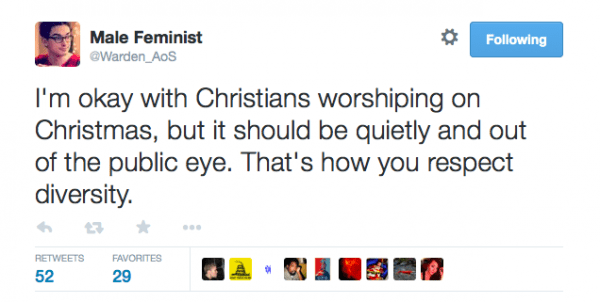
Those who might be otherwise tempted to show some signs of faith may be intimidated by the Diversity Fascists, like this guy:
Yes, many people–they call themselves “progressives”— believe that a healthy national culture embracing love, charity, generosity and kindness is disrespectful. The culture seems to be capitulating to the bullying without a fight. The two most prominent Christmas movies on cable this year are the mildly cynical “A Christmas Story” and the wretched “Christmas Vacation,” which isn’t even a good Griswald movie, much less a decent Christmas movie. I have been searching for the original “Miracle on 34th Street”—yes, I know I haven’t finished the ethics review–and keep finding arguably the worst version, the one with Richard Attenborough playing Kris Kringle. “Four Christmases,” another bitter comedy, has appeared many times. “A Christmas Carol” is now rare fare, but we get many showings of “Scrooged,” with Tiny Tim played by MaryLou Retton.
Some of the Hallmark Christmas stations have been playing a Whitney Houston version of “A Christmas Song” that interjects “Happy Kwanza” in the lyrics. Thanks to John Legend, we now have a Christmastime ditty that endorses abortion.
Think about that a minute.
I don’t know how to reverse the damage already inflicted on our society, but I do know that we have to try.