New Jersey lawyer Brian LeBon Calpin might still be practicing law instead of serving a suspension for a year if he had only perused the Ethics Alarms Rationalization List. Or if he had followed ABA ethics opinions. Or if he had properly functioning ethics alarms.
A former client, a massage parlor owner, had given him negative online reviews of legal skills and acumen. In retaliation, Calpin posted a negative review of her business, which he later defended with the “what is good for the goose is good for the gander” line. (It’s “sauce for the goose,”not “good,” you illiterate clod!) Calpin wrote,
“Well, Angee is a convicted felon for fleeing the state with children. A wonderful parent. Additionally, she has been convicted of shoplifting from a supermarket. Hide your wallets well during a massage. Oops, almost forgot about the DWI conviction. Well, maybe a couple of beers during the massage would be nice.”
Unfortunately, as Calpin would have known if he attended my last ethics seminar, the ABA has clarified in a recent ethics opinion what other state bar associations have held, which is that just because information about a former client is published and available to someone looking for it, unless it is is generally known as in “widely recognized by members of the public in the relevant geographic area”or “widely recognized in the former client’s industry, profession or trade,” the information is still protected by attorney-client confidentiality, and cannot be disclosed by the client’s lawyer. That’s the professional ethics prohibition on what Calpin did. The Ethics Alarms list explains what’s unethical about “sauce for the goose is sauce for the gander” in Rationalizations 1, 2, 2A, 7, 11A, 17, 24A, 40A, 53, and 59.
As is usually the case, Calpin’s career shows other evidence of flawed ethics alarms. The disciplinary board noted that he had previously violated ethics rules regarding neglect, diligence, keeping clients informed, delivering client funds or property, and returning client property after representation. He’s lucky that he’ll get his license back after only a year.
Whether New Jersey residents should consider that lucky is another issue.
The first use of the tag “fake news” on this website was on March 4, 2015. That’s more than three months before Donald Trump announced his candidacy for President on June 16, 2015; the oft-published claim that Trump launched the term “fake news” to deride the news media for criticizing him and his Presidency is, ironically enough, fake news.
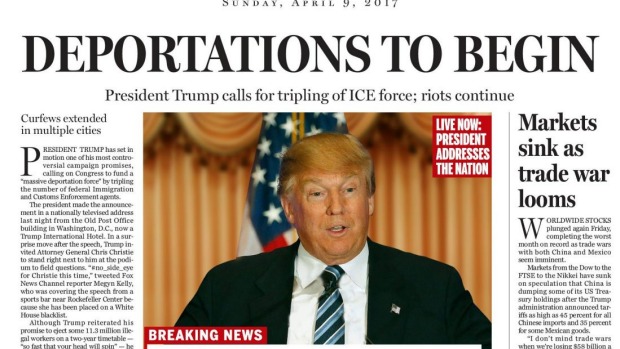
The 2015 piece was about CNBC publishing as legitimate news a press release by an anti-vaxx group, a category of fake news called “Hearsay news” in today’s directory to come. I posted three more articles tagged “fake news” before Trump was elected. One of them was the Mother of All Fake News episodes, when the Boston Globe hit the news stands and front walks on April 10, 2016 featuring a satirical front page with headlines about a fictional, dystopian Donald Trump Presidency. “This is Donald Trump’s America. What you read on this page is what might happen if the GOP frontrunner can put his ideas into practice, his words into action,” went the introduction. I wrote in part…
This is a spectacular failure of professionalism and a journalistic disgrace. A newspaper is pledged to report the news, not imagine it. It is not ethically entitled to morph into Saturday Night Live or the Onion because it really, really, really feels strongly about an issue….No paper published such a “future news” piece about the world under Nazi rule, or the race war if civil rights laws didn’t change. No respectable publication predicted a similar dystopian future under President Huey Long, or Joe McCarthy, or what a U.S. with open borders would look like, or what a Ron Paul style US with heroin for sale off drug store counters would lead to. That is because this means of political advocacy and commentary is reserved for the features and entertainment sections, not where facts are supposed to be, and where readers must be able to expect a reasonable attempt at truth, not a showboating effort to distort it.
The episode marked, as it turned out, the beginning of an epidemic of metaphorical canaries dying in the poisoned mine of American journalism. Continue reading →
I have to be nicer to the Democrat hypocrites who are saying that they will support Joe Biden even after insisting that #MeToo and condemning sexual harassment and sexual assault was a core value of their party and their own beliefs. I owe them a debt of gratitude for eliminating any question in my mind regarding who I won’t be voting for when the election rolls around.
It won’t be anyone in the Democrat Party; I knew that even before Joe Biden started looking like the the Presidential candidate. The Democrats cannot be trusted with national power in their current anti-democracy, anti-Constitution, anti-American mindset; they really need to change their name, to what, I don’t know.
Nor can the unconscionable strategy they have been pursuing since they lost the Presidential election in 2016 be permitted to succeed. If it does succeed, and, tragically, perhaps even if it doesn’t, American democracy will be permanently scarred. Completely embracing the ends justify the means as a party philosophy, Democrats set out to destroy an elected President before he ever had a chance to do his job, a stunning defiance of basic democratic norms as once stated by the exact same individuals who led the revolt. They did this in defiance of law and ethics; they encouraged internal betrayal, illegal sabotage, and the breach of basic decency, loyalty, and responsibility. Taken as a whole, the party’s attack on American institutions was far worse than what Richard Nixon and his cronies did, and it continues today.
I predicted that if he was elected, President Trump’s flamboyant lack of character would corrupt public discourse as well as much of the public. That has proven true, but the damage done to the nation by “the resistance” and Democrats has been far more damaging, and, I fear, far deeper and long-lasting. It has, for example, completely corrupted the news media, meaning that the “informed electorate” the Founders pronounced essential to a functioning United States of America no longer has a strong and trustworthy institution that can ensure that, even in its previous far-from-perfect state. It has, for another example, managed to undo in a little more than a decade much of the progress the U.S. had made in racial trust and accord by seeking to ruthlessly exploit racial division in sick mimicry of the GOP strategy of the Seventies.
Regarding the Democratic Party and the fate it has earned for itself, I am repeatedly reminded of the memorable line uttered by actor Jeff Corey (written by William Goldman) as Sheriff Bledsoe in “Butch Cassidy and the Sundance Kid.” The two likable outlaws come to him in desperation, hoping for some way out of their dilemma, which has a price on their heads and a relentless, highly-paid posse on their trail. The sheriff, an old friend, shatters their hopes, saying, essentially, that they are doomed.
“It’s over, don’t you get that?” he says. “Your time is over and you’re gonna die bloody, and all you can do is choose where.”
That is the fate the Democrats deserve, and I fervently hope it is the one they get. My willingness to say this, however does not mean that I can or will vote for Donald Trump.
The reason I cannot is the same reason (well, one of the reasons) I find Nancy Pelosi, Alyssa Milano, Senator Klobuchar and so many of my Facebook friends contemptible who now say that they must vote for Joe Biden because beating Trump is more important than what they once said was a moral imperative. Their fecklessness and hypocrisy proves that it was never a moral imperative; it was a posture of convenience.
My position as an ethicist and a leadership consultant cannot be a posture of convenience. I have to stand for certain essential principles, and I do not have the luxury, as some do, indeed as virtually anyone reading this post does, of deciding that circumstances require, in this rare ethics conflict, rejecting the principles my credibility and integrity rest upon in pursuit of a greater good. That would be what the #MeToo hypocrites are doing, or think they are.
Absent my professional and public assessments as a professional ethicist, I would have no difficulty at all in officially concluding that Donald Trump is the preferable, indeed essential, choice to lead the country in the next four years when the alternative is a party that has revealed the corruption and antagonism toward American ideals as has the Democratic Party. But President Trump, as I pointed out repeatedly in 2015 and 2016, is the antithesis of the kind of leader my knowledge and expertise indicates should ever be placed in a leadership position of any kind, or in a position of power and trust.
For me to vote for such an individual would render my credibility in my profession, and what is more important, my personal and professional integrity, void.
An ethicist cannot, in my view, support or vote for Donald Trump as President, nor can an ethicist, at least this ethicist, have any position but the rejection of the current iteration of the Democratic party as antithetical to American values.
1. Now THIS is incompetence...The makers of Ritz crackers have issued a nationwide recall of mislabeled Ritz cracker boxes after discovering that some packages labeled cheese really contained pairs of crackers with peanut butter between them, according to a statement posted on the Food and Drug Administration’s website yesterday.
Oops!
Fortunately, almost all Ritz fans regularly check the Food and Drug administration site.
2. In the category of “professionals embarrassing themselves,” I offer this: Len Niehoff is a “Professor from Practice at the University of Michigan Law School” according to the editors at the Detroit Free Press. This is a bad start: I don’t know what a “professor from Practice” is. I assume they meant he teaches legal practice, or trial practice. Obviously they have no more understanding of law than the average guppy, which also explains why they published the professor’s article titled, “Law professor: Virus reveals we all need a class in evidence.” He begins,
“Numerous public officials and individuals have made dreadful decisions about how to assess and respond to the threat posed by COVID-19. Those errors reveal a fundamental flaw in our K-12 and collegiate education systems. We have failed to teach a subject of critical importance, and as a result have imperiled our health, our economy, and our republic. We teach it in law school. We call it Evidence.”
Hilariously, in his essay about evidence, the professor doesn’t offer a single piece of evidence indicating any of that assertion is correct, or might be correct. He does offer, without evidence, statements like, “National and local political leaders have made decisions that ignored the evidence. Members of the general public have proved slow to accept the evidence. Measures adopted to help flatten the curve have been met with virulent protests, despite the evidence that they are working.” Really? What is your evidence for those propositions? Those are opinions, not evidence.
Moreover, the rules of evidence he is extolling are specifically designed for trials, which involve very specialized forms of decision-making. Hearsay evidence, for example, is generally inadmissible in a trial, but in many other activities, it is valuable. Similarly, trials settle generally narrow issues. We don’t use trials, or juries, to settle more complex issues like “how long should we shut down the economy to minimize the effects of a pandemic?” The professor seems to be laboring under the delusion that it is clear what is and what isn’t relevant to such decisions.
One of my benighted Facebook friends posted this thing on Facebook as if it was meaningful. It is useful for one purpose: it is strong evidence for the proposition that if the only tool one has is a hammer, every problem looks like a nail.
3. Ringer ethics. In a famous 1992 episode of “The Simpsons,” evil nuclear power tycoon Montgomery Burns’ stacks his Springfield Nuclear Power Plant baseball squad with major league baseball players for the league championship game. Using “ringers” in such situations is unethical (but often permitted due to rules loopholes), but here is a story about something akin to Mr. Burns’ cheat that nobody seemed to mind.
In the late 1980s, a softball team known as Spike & Fat Boy was entered in a local softball beer league. The team included three active major leaguers, Kevin Mitchell, John Kruk and Randy Ready. Not only did they displace the regular players when they showed up (“You talk about pressure on a manager,” the team’s skipper says now, “What could I do? I had to put those guys in the lineup!”) and the three hit exactly as you would expect them to.
Says Ready, “We didn’t lose a single game. It was domination.”
Gee. What an achievement.
4. Laws and social distancing are for the little people. Great Britain had a juicy scandal when Neil Ferguson, a prominent epidemiologist who advised the UK government on its pandemic response and warned that it was possible that 500,000 British citizens would perish if the lockdown was disobeyed, defied the lockdown himself (and obviously social distancing <cough>) in a rendezvous with his married lover. He was caught, shamed, and resigned his government post. Opines Spiked! in a tough editorial, the episode is significant in that it reveals
“…a great deal about the 21st-century elites and how they view their relationship with the masses. It’s one rule for them and another for us. They can carry on enjoying sneaky freedoms because their lives and jobs are important; we can’t because we are mere little people, whose silly work lives can casually be disrupted, whose love lives can be turned upside down, and whose families can be ripped apart. The Ferguson affair provides an illuminating insight into the new elitism..Ferguson’s scaremongering, his predictions of mass death if society didn’t close itself down, was the key justification for the lockdown in the UK. It influenced lockdowns elsewhere, too…Anyone who questioned the wisdom of the lockdown, or merely suggested it should be very brief, would find themselves being battered by Ferguson’s figures. Almost overnight it became tantamount to blasphemy to question these models…. It was the political class’s dodging of moral responsibility for tackling Covid without destroying the economy, and the media’s searing intolerance towards anyone who questioned the lockdown, which led to the ossification of his models into tablets of stone that you queried at your peril.”
Sound familiar?
The U.S. has had its Fergusons too. Senior White House adviser and First Daughter Ivanka Trump traveled from D.C. to the Trump National Golf Club Bedminster in New Jersey to celebrate Passover, though she had posted social media videos urging “those lucky enough to be in a position to stay at home, please, please do so.” Michelle Obama lectured Americans to stay home as her husband was putting on the golf course. Chicago’s Mayor Lori Lightfoot had her hair done by a salon stylist while demanding that citizens of her city eschew such frivolous services. The mayor of Beaumont Texas locked her town down, then went to a nail salon. NYC Mayor Bill de Blasio put gyms on his “non-essential” business list, then went to one to work out. Williamson County Judge Bill Gravell and his wife attended his grandson’s birthday party (using county resources in the process, a nice touch ) after ordering residents to stay home amid the Wuhan virus outbreak. I do not doubt that plenty of other examples exist showing our betters behaving similarly, just more discretely.
The global elites really do think they’re better than us. They’re riding high and mighty, collecting their paychecks and visiting their mistresses, as they lecture to us from their golden pedestals. Meanwhile, small business owners are watching what they’ve toiled and sacrificed for years to build crumble, as they and others deemed “non-essential” wonder how they’ll feed their families tonight.
Progressives, who increasingly sound like they want another Depression—all the better to “re-engineer society” (and, of course, defeat Donald Trump) , deride such assessments in the news media and social media as “right-wing conspiracy theories.”
This story first came to the attention of the legal community in February, when a plaintiff in an employment discrimination suit against Chevron filed a Motion for Sanctions against Chevron’s Houston-based attorney, Dennis Duffy. It began by stating that Duffy had engaged in “a campaign of abusive and intolerable conduct that began with profanity-laced conversation” and escalated to “discriminatory slurs.” Then she alleged, things got really bad. The motion further alleged,Continue reading →
[Warning:I’m sure there are typos below; I’ll be fixing them, but I’m a bit swamped, and I want to get this post up. It’s a utilitarian decision. Update: I think I’ve fixed them all.]
I have been consciously avoiding wading into this issue, first, because its components are beyond my expertise in two fields, second, because to do a proper job would take a book rather than a blog post, and third, because to even do an inadequate job, I will have to quote extensively from the arguments of others, which I try to do as little as possible (believe it or not). I detest appeals to authority, which is basically all I get from my deranged Facebook friends all day long. Nonetheless, I can’t put this post off any longer, because this is an ethics issue encompassing several related ethics issues. I also can’t cover it in a post of reasonable length, so this will be Part I.
The grand ethics issue facing the nation, the public, the President and our future is when to begin re-opening the economy, allowing people to get on with their lives. Let’s begin with ten stipulations:
1. This is an ethics conflict, not an ethics dilemma. There are ethical considerations and values on both sides of the equation.
2. Many, too many, of those involved in the problem are going to approach it as an ethics dilemma, in which ethical values compete with non-ethical considerations. Unfortunately, that group includes almost all, and maybe all, politicians and elected officials, including the President.
3. It is a cruel trick of fate, or a bizarre joke by a sadistic Creator, that this crisis is occurring in an election year, and with a national leader with the personal characteristics, chaotic leadership, management style, and divided constituency of Donald Trump….but that’s the situation. It is particularly unfortunate that he does not have a reserve of public trust, because that, if not essential now, would sure help a lot as he makes some difficult decisions. He is significantly responsible for that trust deficit; the media and “the resistance” are even more responsible. That doesn’t matter right now. It is a different issue, though a related one.
4. We still do not have adequate information to make a fully informed decision, and will not have before a choice is unavoidable. That’s a fact. We still aren’t certain how the virus is transmitted, or the degree of infectiousness by the asymptomatic. We don’t know why some areas of the country are experiencing higher rates of infection than others. We cannot compare the U.S. statistics with other countries, because we can’t be sure of the accuracy of those foreign statistics. We aren’t even sure of the effectiveness of the supposedly essential precautions, like masks and social distancing. For example, I have articles on file from the last 30 days by credentialed medical professionals arguing that wearing masks may increase the likelihood of infection. I don’t care if this is a minority opinion; minority opinions are often right. Meanwhile, I just watched HLN interviewing a researcher who claims that social distancing should be 12 feet or more, after measuring how “droplets” from coughs spread. But a social distance requirement of much more than six feet is impractical, meaning that it’s not worth talking about.
5. Making important decisions without perfect information is what effective leaders have to do. Two recent weak Presidents, Barack Obama and Jimmy Carter, were marked by a habitual reluctance to make difficult and urgent choices without “all the facts,” and this resulted in multiple fiascos. The danger in making a premature decision, as defined by those two intelligent men, is that the decision will be subject to second guessing after the missing facts are known. President Trump has to be courageous and responsible and make any choice, knowing that whatever he does will be attacked whatever happens. He has to place his fate in the hands of moral luck, and the fate of the country as well. That’s a terrible situation to be in, but that’s the job. Continue reading →
A quote in an obituary for long-time NASA chief James Beggs, who died this week at the age of 94, shocked me into realizing once again how alien basic ethics have become to our leaders in business, government, politics…hell, just about anywhere. And once again, I’m wondering what good I’m doing, and why I bother.
Beggs had overseen more than 20 successful space shuttle launches, but he was on administrative leave due to an investigation of his conduct when the Challenger launched and exploded in 1986. As we have discussed on Ethics Alarms, a landmark example of failed ethics and decision-making caused the temporary leadership of NASA to ignore dire warnings from two engineers and send the shuttle and its precious human cargo up in dangerously cold weather. Indeed Beggs called NASA from his exile that fateful day to express his concern about icing. He resigned from NASA in 1986, about a month after the Challenger disaster.
Beggs was reluctant to criticize his former agency’s culpability in the accident, but he was adamant that “they shouldn’t have launched.” “Whether I would have done anything different at the time, I’ve thought about that,” he said. “I think I would have, but that’s pure conjecture.”
Remarkable. How often does a critic of a past decision have the intrinsic fairness and integrity to say that? The Wuhan virus landscape has been polluted by extravagant and unjust second-guessing from the start, as everyone from politicians to pundits to plumbers are just certain that they would have known how to handle an unprecedented situation with significant unknown factors and substantial risk. They would have reached a different, quicker,better approach than the individual who actually had to make the call.
It’s a disgusting spectacle, and an unethical one. The “right” decision can always be made to seem obvious after the fact; critics cannot possibly know what their state of mind would have been at the actual time the decision had to be made by someone else. Beggs’ acknowledgement of that, in a situation where he could have credibly second-guessed his colleagues without equivocation, demonstrates the character of a decent and ethical professional determined to do and say the right thing even when opportunities are present for personal gain.
1. Feel the restraints on free expression that inconveniences ideological agendas tightening? I do… A couple of friends and commenters confirm that Zscaler, a service many companies use to monitor and block employee traffic on the web, blocks my ethics blog as containing “Pornography, Adult Content, Nudity, Hacking, Illegal, Racism, Hate or Violence, Phishing.” Nice. So good for my reputation and business too.
2. It’s past time to conclude that no polls are trustworthy, and no one who cites polls as evidence regarding public opinion is trustworthy. All week long I’ve been reading progressive blogs and sites telling us that the President’s support as measured by the polls is “collapsing.” Then today I see the latest Gallup survey claims that 49% of adults approve of the President’s performance, up from 43% two weeks ago. That would be the highest yet according to Gallup, if you trust any of these things now. I don’t, and you shouldn’t. Continue reading →
This is going to be uncharacteristically short, but I feel the story deserves its own post
The Ohio Supreme Court has indefinitely suspended lawyerAustin Roan Buttars of Dublin, Ohio for transferring more than $147,000 from the accounts of a mentally ill client though the lawyer and his law firm were only owed about $19,000. Buttars acquired the other $128,000 by stealing from or overcharging the client
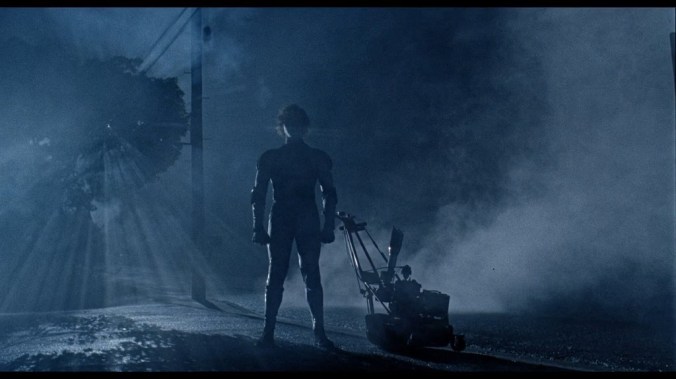
Not that he didn’t work for his money. For example, the Court found that Buttars charged his legal hourly rate for mowing her lawn.
It is seldom that I strongly disagree with NYU philosophy professor Kwame Anthony Appiah, “The Ethicist” of the New York Times Magazine’s long-running advice column. A month ago I did, and emphatically so.
The question posed to him involved a professional ethics dilemma, and “The Ethicist” was so certain he had the correct answer that he was uncharacteristically terse about it. I’m pretty certain about the answer too, except that my certainty is that he’s wrong. But I have some doubts, based on my ethical positions in related situations.
The inquirer was a a nurse practitioner working at a primary care clinic for low-income patients. She said that a 16-year-old patient told her that she had stopped coming by the clinic to have her birth control pills replenished because she and her partner were trying to have a baby together. She had been having unprotected sex for a while, and she was concerned that she might have some physical problem preventing her from conceiving. The nurse practitioner asked, “Would it be ethical for me to steer her away from trying to get pregnant? …Or, as her health care provider, do I have an ethical duty to try to help her conceive?”
Appiah doesn’t see any wiggle room. He says,
“You’re her health care provider. You should certainly tell her about the medical consequences of pregnancy. But the social and economic consequences don’t fall within your professional competence. An intervention about her life choices may seem moralizing and intrusive to her, and it could drive her away; and then she’d be losing your guidance on the things you are trained to help her with.”