Fake History Ethics, Baseball Division.

Yesterday was the anniversary of a famous day in baseball and American race relations history. From Nationalpastime.com:

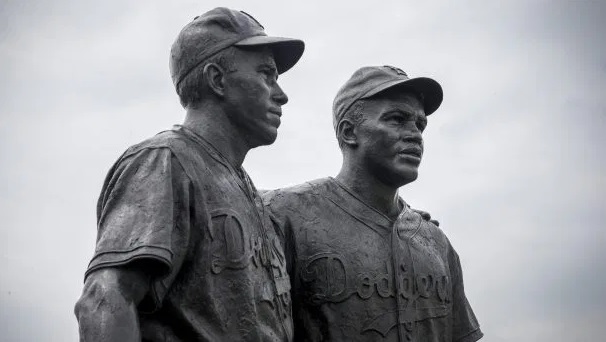
May 13, 1947: During the pregame infield practice, a barrage of racial slurs is directed at Jackie Robinson by the Cincinnati fans during the Dodgers’ first visit to Crosley Field this season. Brooklyn shortstop Pee Wee Reese, a Southerner from Kentucky with friends attending the game and captain of the team, engages the black infielder in conversation, and then put his arm around his teammate’s shoulder, a gesture that stuns and silences the crowd.

This  episode in the well-known saga of Jackie Robinson breaking the color line in baseball has taken on the status of legend. It is in the (excellent) biopic about Robinson, “42.” It was re-told in Ken Burns’ documentary “Baseball.” Most enduring of all, the moment is memorialized forever in the statue outside Dodger Stadium—well, forever until Robinson or Reese is cancelled because something unforgivable is unearthed in their past, whereupon UCLA students will pull the thing down as progressives cheer.

I’m preparing a program for the Smithsonian Associates on how baseball has influenced American values, culture, politics, language and society, so it is of special interest to me that there is considerable controversy over whether Reese’s mid-game gesture ever happened. Writes much-lauded baseball essayist Joe Posnanski,

“There is no mention at all of the embrace in the newspapers. Quite the opposite, in fact. The Cincinnati Enquirer wrote that very day that Robinson “was applauded every time he stepped to the plate.” Meanwhile, there is no mention of it in the black press either; Burns insists that the embrace had happened, the black papers “would have done 15 related articles.” There is no photo of it. Robinson’s 1948 book about his first season called “Jackie Robinson: My Own Story” does not mention any such incident….There isn’t a single contemporary account of the embrace in any of the newspapers or magazines.”

Theories abound. The episode happened on a different date. It happened, but not in view of the fans. It is a story that accurately describes what Reese’s support of Robinson—Reese was a white southerner and a team leader, and he and Robinson did become close friends—meant to the black rookie as he battled abuse and racism in that first season of 1947, but there was no literal arm around the shoulder.  Craig Calcaterra, recycling  the controversy yesterday on his NBC blog, theorized, Continue reading
Ethics Alarms Expresses Its Gratitude To CNN For Providing Such A Superb Illustration Of “Fake News” As I Compile The Directory Of Same

The fake news category is “polls.”

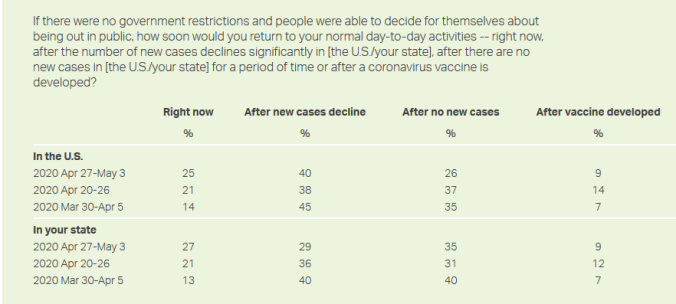
Gallup released the results of a survey in which various attitudes regarding the pandemic were explored. One question asked “How soon would you return to your normal day-to-day activities” if “there were no government restrictions,” giving respondants four options to choose among. The most popular answer was “after the number of new cases declines significantly,” getting 40% in the most recent results. The least popular answer was “after a coronavirus vaccine is developed,” with  9 %  choosing that.

Here is how CNN reported the results: Continue reading

Comment Of The Day: “The Pandemic Creates A Classic And Difficult Ethics Conflict, But The Resolution Is Clear, Part I: Stipulations”

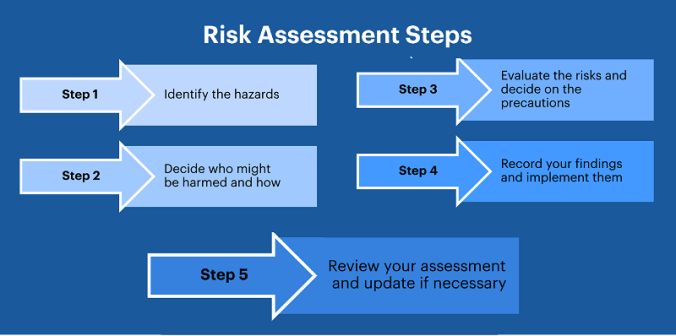
Matthew B fulfilled my fervent wish (as did Michael R, whose comment will be going up later today) by dealing with the risk assessment issue authoritatively and clearly so I wouldn’t have to.

Here is his Comment of the Day on the post, “The Pandemic Creates A Classic And Difficult Ethics Conflict, But The Resolution Is Clear, Part I: Stipulations”:

We’re seeing the problem with the vast majority of people’s inability to grasp statistics, and in particular the statistics of risk. That’s the problem here – with the Wuhan flu, we’re talking about something that – at most – could kill 1 in 100 people. We’re seeing higher numbers for death rates in many places, but they’re talking about case fatality rate. 1% in the US means 3 million people die, and we’re at 70K dead as of this morning in the US, 3.2 million short in 1% of American’s dying. Yes, I get many haven’t been infected and many more will die, but we’re absolutely on a trajectory far short of a 1% fatality rate.

As soon as you’re talking about numbers that low, far too many people’s brains stop being logical and emotion takes over. The tell for this is the saying “if it just saves one life.” People say that, but they’re turn a blind eye to so many things that kill people an no one addresses. Because there is no critical thought being applied, they remain illogical and darn near impossible to considering any position other than those formed by emotion.

We take risks every day that we don’t think about and we ignore things that people die from because of normalization of that risk. If you’re under 45, your odds of suicide, homicide and accidents killing you outweighs your risk of dying of health complications. If you’re under 25, that risk is three to one that it’s something other than a health condition that kills you. Even amongst the health conditions, there are many that are swayed by our own conduct and we ignore that.

Through most of the existence of the automobile, it’s ranked as the number one cause of premature death in the United States. Only in the last decade has the rise of the opioid epidemic managed to surpass the death rate of automobile fatalities. The opioid epidemic is a harder one to discuss, so I’ll start with the automobile. Automobile deaths are ignored, few people are afraid to get into a car because it might kill them. There are marginal improvements in automobile safety, but many of the key contributors have had little improvement. Mass use of air travel has had about 1/2 the time of the mass use of the automobile, but air travel has had massive improvements. At first there were many crashes because airplanes broke and directly or indirectly through the distractions they caused resulted in mass fatalities. That got fixed first. Then aviation regulators figured out that a growing fraction of accidents were pilots flying perfectly good airplanes into the ground or each other. They borrowed ideas from the nuclear industry, and instituted many policies that have resulted in a remarkable fall in airline fatalities. Do you realize the last time an passenger aircraft went down in the United States was November, 2001? 19 years. The only other crash was a 777 in San Francisco that stalled on approach, and most of the passengers came out with no or minor injuries. That’s truly remarkable. Continue reading

The Knight-Gallup Freedom Of Speech Survey

A survey just released by the Knight Foundation and Gallup shows that More than 75% of the college students surveyed want “safe spaces” on  campuses that are free of “threatening actions, ideas, or conversations.” However, a majority of the same students support President Trump’s threat to withhold taxpayer dollars from universities that restrict speech.

Though 97% of college students believe that free speech is “an essential pillar of American democracy”, a  majority of students support policies to restrict of speech on campus. 78% of students support “safe spaces” where threatening ideas and conversations would be barred. 80%  favor the establishment of a “free-speech zone” where pre-approved protests and the distribution of literature are permitted. Continue reading

The Pandemic Creates A Classic And Difficult Ethics Conflict, But The Resolution Is Clear, Part I: Stipulations [CORRECTED]

[Warning: I’m sure there are typos below; I’ll be fixing them, but I’m a bit swamped, and I want to get this post up. It’s a utilitarian decision. Update: I think I’ve fixed them all.]

I have been consciously avoiding wading into this issue, first, because its components are beyond my expertise in two fields, second, because to do a proper job would take a book rather than a  blog post, and third, because to even do an inadequate  job, I will have to quote extensively from the arguments of others, which I try to do as little as possible (believe it or not). I detest appeals to authority, which is basically all I get from my deranged Facebook friends all day long.  Nonetheless, I can’t put this post off any longer, because this is an ethics issue encompassing several related ethics issues. I also can’t cover it in a post of reasonable length, so this will be Part I.

The grand ethics issue facing the nation, the public, the President and our future is when to begin re-opening the  economy, allowing people to get on with their lives. Let’s begin with ten stipulations:

1. This is an ethics conflict, not an ethics dilemma. There are ethical considerations and values on both sides of the equation.

2. Many, too many, of those involved in the problem are going to approach it as an ethics dilemma, in which ethical values compete with non-ethical considerations. Unfortunately, that group includes almost all, and maybe all, politicians and elected officials, including the President.

3. It is a cruel trick of fate, or a bizarre joke by a sadistic Creator, that this crisis is occurring in an election year, and with a national leader with the personal characteristics, chaotic leadership, management style, and divided constituency of Donald Trump….but that’s the situation. It is particularly unfortunate that he does not have a reserve of public trust, because that, if not essential now, would sure help a lot as he makes some difficult decisions. He is significantly responsible for that trust deficit; the media and “the resistance” are even more responsible. That doesn’t matter right now. It is a different issue, though a related one.

4. We still do not have adequate information to make a fully informed decision, and will not have before a choice is unavoidable. That’s a fact. We still aren’t certain how the virus is transmitted, or the degree of infectiousness by the asymptomatic. We don’t know why some areas of the country are experiencing higher rates of infection than others. We cannot compare the U.S. statistics with other countries, because we can’t be sure of the accuracy of those foreign statistics. We aren’t even sure of the effectiveness of the supposedly essential precautions, like masks and social distancing. For example, I have articles on file from the last 30 days by credentialed medical professionals arguing that wearing masks may increase the likelihood of infection. I don’t care if this is a minority opinion; minority opinions are often right. Meanwhile, I just watched HLN interviewing a researcher who claims that social distancing should be 12 feet or more, after measuring how “droplets” from coughs spread. But a social distance requirement of much more than six feet is impractical, meaning that it’s not worth talking about.

5. Making important decisions without perfect information is what effective leaders have to do. Two recent weak Presidents, Barack Obama and Jimmy Carter, were marked by a habitual reluctance to make difficult and urgent choices without “all the facts,” and this resulted in multiple fiascos. The danger in making a premature decision, as defined by those two intelligent men, is that the decision will be subject to second guessing after the missing facts are known. President Trump has to be courageous and responsible and make any choice, knowing that whatever he does will be attacked whatever happens. He has to place his fate in the hands of moral luck, and the fate of the country as well. That’s a terrible situation to be in, but that’s the job. Continue reading

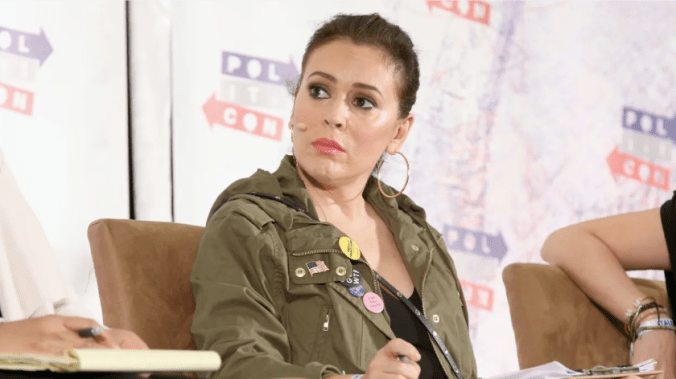
Alyssa Milano Gives Us A Sad Reminder That Celebrities Are Usually Over Their Heads When They Try To Opine On Policy, Law, Or Ethics [CORRECTED]

This raises the disturbing question of why anyone in their right mind is influenced by such celebrities. Presumably it is mostly those who are even more limited intellectually than the celebrity in question, or, in this case, big fans of “Who’s the Boss?”

Milano’s guest column in Deadline explaining why the #MeToo shill still supports Joe Biden is signature significance for someone who desperately needed to get a better education, or at least read a lot more before trying to “explain” anything, much less hang out a virtual shingle as an opinion-maker.

She outs herself as a victim of the Dunning-Kruger Effect right off the bat (I miss baseball). There’s no need to read on after this becomes obvious, by the third paragraph of her essay:

“As an activist, it can be very easy to develop a black and white view of the world: things are clearly wrong or clearly right. Harvey Weinstein’s decades of rape were clearly wrong. Donald Trump’s alleged sexual assaults were clearly wrong. Brett Kavanaugh’s actions, told consistently over decades by his victim (and supported by her polygraph results), were clearly wrong. So were Matt Lauer’s, Bill Cosby’s and so many others. As we started holding politicians and business leaders and celebrities around the world accountable for their actions, it was easy to sort things into their respective buckets: this is wrong, this is right. Holding people accountable for their actions was not only right, it was just. Except it’s not always so easy, and living in the gray areas is something we’re trying to figure out in the world of social media. But here’s something social media doesn’t afford us–nuance. The world is gray. And as uncomfortable as that makes people, gray is where the real change happens. Black and white is easy… Gray is where the conversations which continue to swirl around powerful men get started…. It’s not up to women to admonish or absolve perpetrators, or be regarded as complicit when we don’t denounce them. Nothing makes this clearer than the women who are still supporting Joe Biden even with these accusations. Hillary Clinton, Kamala Harris, Stacey Abrams, Amy Klobuchar, Nancy Pelosi, and Elizabeth Warren have all endorsed Biden and like me, continue to support him…. This is the shitty position we are in as women….  Believing women was never about ‘Believe all women no matter what they say,’ it was about changing the culture of NOT believing women by default…. I hope you’ll meet me in the gray to talk and to help us both find the way out.”

Wait..what? Obviously—well, “obviously” if you know what the words you are using mean—“Donald Trump’s alleged sexual assaults” are not “clearly wrong,” because they are alleged and unproven, so we don’t know if they occurred. If they didn’t occur as claimed, they aren’t “clearly wrong.” Continue reading

Evening Ethics Cool-Down, 4/28/2020: Ethics Clouds In My Coffee

Good evening.

1. Here’s an ethics quote I need to use more often…I was watching the 1941 film “The Devil and Daniel Webster,” about a jury trial to determine whether the Devil will get a farmer’s soul as contracted.  It reminded me of a quote by Kurt Vonnegut: “A soul is the part of you that let’s you know when your brain isn’t working properly.”

A better definition of an ethics alarm you could not devise.

2. So where were the souls of the judges who voted for this? Thousands of prisoners have been released from incarceration to protect them from the outbreak of the Wuhan virus inside jails and prisons.  The theory is that subjecting prisoners to this special peril is cruel and unusual punishment. The theory’s not wrong, but it’s a bit unbalanced. Their peril is not entirely  society’s fault, after all.

There are activists at the extreme end of the progressive spectrum —a division getting larger all the time, it seems—who seem to want to eliminate penal punishment completely.  Not letting a crisis go to waste, a group of them , Columbia Legal Services, began pushing for inmates over 50 years old in Washington state to be released as a compassionate act to save them from the virus.

Among the intended beneficiaries: Gary Ridgeway, the Green River Killer, and Isaac Zamora,  serving a life sentence for going on  a shooting rampage and killing six  people. Ridgeway is one of the nation’s most frightening serial killers, eventually confessing to 71 murders. Over the three decades of the 1970s, ’80s and ’90s, Ridgeway captured women and girls, raped them, and  strangled them. He loved watching the life go out of their eyes as they died by his hand, though sometimes he used a  rope. Then he  would pose with the corpses. If he really liked his victim,  he’d have post mortem sex with her body. His first victims were found in the Green River, giving him a catchy name.

Ridgeway was sentenced to 500 years in prison with no possibility of parole. The victim’s families were promised that he would never be released. Ah, but poor Gary is 71 now, and thus at risk of succumbing to the pandemic, and presumed to be too feeble to be a threat. That, at least, is what Columbia Legal Services argued. (You know, I’m not much younger than Ridgeway, and I’m pretty certain I could murder someone. In fact, I’m getting ideas…)

Q13 News reported  that prosecutors protested that “the Petitioners [Columbia Legal Services] demand that 2/3 of the prison population be released into the community, a number which includes serial killers and capital murderers.” You would think that their argument would be a slam dunk. You would be wrong. Continue reading

No A Study Did Not Prove That Trump’s “Touted” Drug Didn’t Work. Not Exactly Fake News, But Close Enough.

Salon: Trump-touted hydroxychloroquine may increase risk of death from COVID-19; “largest study yet finds no benefits but higher deaths,”

CNN: Study finds no benefit, higher death rate in patients taking hydroxychloroquine for Covid-19.

Fox News: COVID-19 treatment hydroxychloroquine showed no benefit, more deaths in VA virus study

The Washington Post wrote, “On Tuesday, a new government study was published suggesting the drug didn’t offer any benefit in fighting covid-19, the disease caused by the virus, and worse, that its use was correlated with more deaths.”

To be fair to the Post, at least it said that the study should be be viewed “with caution,” and provided a link to the study, not that most of its readers would actually read it. If they had, they would have realized that the study was wildly over-hyped in the media, and didn’t really “suggest” anything of the sort. Once again, this was another example of the news media playing to the confirmation bias of those who want to see the President be wrong. Are they cheering for the pandemic to do as much damage as possible? I refuse to believe that, but some of them sure manage to sound like they do.

I wasn’t going to discuss this tonight, but a smart, usually fair Facebook friend wrote a false description of the study calculated to appeal to the Trump Deranged. I don’t think he would have done that if he had read it, but he hates Trump too, and he doesn’t think the news media is biased—they agree with him, after all, so they must be fair– so he’ll trust the headlines, or the spin, every time. Continue reading

“1,825 Words You Can Never Say On Facebook”

This is ominous: it’s the second time this month that I’ve had good reason to quote George. Did the Democrats already take over?

In 1972, the late George Carlin debuted his famous routine called “ “The Seven Words You Can Never Say on Television.” The words were: shit, piss, fuck, cunt, cocksucker, motherfucker, and tits, all of which you can hear on television today. (Who says life doesn’t keep getting better? ) But George would be fine: I have it on good authority that in Stand-Up Heaven, where Henny Youngman has St. Peter’s job, George is knocking celestial audiences dead (metaphorically, of course,) with his new monologue, “1,825 Words You Can Never Say On Facebook.”

It’s hilarious, if a little long.

The Foundation For Individual Rights In Education has released a report based on its investigation of how public universities—that’s the government, remember—engage in surreptitious censorship of student expression.  Censorship of student expression is illegal, but The FIRE exists because so many universities find that concept too complex to grasp.

Implicated in the results: Facebook, which provides  the tools for censorship, including its automated content filters. These allow state institutions to automatically “hide” users’ comments if they contain words included on Facebook’s undisclosed list of offensive words, or a government entity’s customized list of prohibited words. The filters allow  public universities to quietly remove critical Facebook posts, restricting open campus and public discourse.

The  FIRE surveyed over 200 public universities and colleges across 47 states and the District of Columbia. It found that fully half of the surveyed institutions  use Facebook’s “strong” profanity filter, while nearly a third use the “medium” filter. That means  about 77% of surveyed institutions use an undiclosed  blacklist of prohibited words. Nearly a third of the universities surveyed (59, or 30.3%) created a custom blacklist, collectively censoring 1,825  words and phrases in order to, among other unconstitutional objectives, “block animal rights activists’ criticism of food vendors,” suppress “debate over the fate of  a campus Confederate monument,” and stifle debate over controversial faculty, politicians, and sports teams.

Public universities can and do manipulate Facebook comments to distort the  public discourse. Wright State University, FIRE tells us, deleted comments supporting a faculty strike from its Facebook page,  confining debate over the action to a rigged community forum that appeared supportive of the university’s administration while being critical of striking faculty.

Yup, that’s how fascism works!

 Facebook doesn’t alert a user when their post has been removed, or tell the public that comments have been censored, so this system is perfect for mind and opinion molding. FIRE says,

These automated methods of censorship are not only contrary to a commitment to freedom of expression, but also provide government actors with tools that—in light of recent federal court rulings concerning President Trump’s Twitter feed—violate the government actors’ legal obligations under the First Amendment.

Below are the words that Facebook helps universities control speech and thought by censoring. Some will be relieved to know that “retard” is on it. Then again, so is “poor”…

Comment Of The Day: “Afternoon Ethics Alarms, 4/19/2020: Facebook, Harvard, Broadway And You Know, Morons…” (Item #2)

The post touching on a Harvard  professor’s criticism of homeschooling  (also discussed here) sparked a lot of debate here as it has elsewhere.

Here is JimHodgson’s Comment of the Day on Item #2 in the post, “Afternoon Ethics Alarms, 4/19/2020: Facebook, Harvard, Broadway And You Know, Morons…”

The resistance to and denigration of homeschooling by academia is a source of constant irritation to me. It is another case of “our minds are made up, don’t confuse us with the facts. It’s like they just can’t stand a parent who declines letting the dysfunctional village raise their children.

The current societal shut-down due to the Chinese flu has made homeschoolers of many parents who are enjoying the experience. (This is based on conversations with my extended family and fellow church members, your mileage may vary.) My niece’s two girls, ages 6 and 9, exiled from their regular school, have easily kept up their school work, completed several art and STEM projects, and learned how to plant a vegetable garden. They are outside every day, weather permitting. My daughter’s homeschooling process continues without a hitch with her boys. The article’s undercurrent of opposition to parents actually raising their own children is ominous. Continue reading