My JFK Ethics Tale

 Shredded Files

As regular readers here  know, I am not an admirer of the character of John Fitzgerald Kennedy, though he had some notable leadership skills that I respect. His reputation as a great man and President is vastly inflated and, in a strange way, I may share some of the responsibility for that.

Several years ago, I had just completed an ethics seminar for the DC Bar. One of the issues I discussed was the lawyer’s ethical duty to protect  attorney-client confidences in perpetuity, even after the death of the client. An elderly gentleman approached me, and said he had an important question to ask. He was retired, he said, and teased that I would want to hear his story. I don’t generally give out ethics advice on the fly like this, but I was intrigued.

“My late law partner, long before he began working with me, was Joseph P. Kennedy’s “‘fixer,'” he began, hooking me immediately. “Whenever Jack, Bobby or Teddy got in trouble, legal or otherwise, Joe would pay my partner to ‘take care of it,’ whatever that might entail. Well, my partner died last week, and when I saw him for the last time, he gave me the number of a storage facility, the contract, and the combination to the lock. He said that I should take possession of what was in there, and that I would know what to do. Continue reading

Print The Legend Ethics: The “War of the Worlds” Panic

OrsonWellesDailyNews

One of the worst results of an untrustworthy news media is that it becomes difficult, as time passes, to determine with any certainty what the truth is.

A classic example is on display today, in Slate, which celebrates the 75th anniversary of young, svelte, Orson Welles’ famous Halloween Eve broadcast of his radio adaptation of H.G. Wells’ “War of the Worlds,” with no Tom Cruise or Dakota Fanning but a nice conceit that involved telling the story through fake news flashes and eye-witness interviews. (One reporter is fried on the air by the Martian invasion vehicles.) An new NPR program and a PBS documentary both tell the familiar story of how the realistic-sounding radio play caused widespread panic among radio listeners who missed the opening credits, leading them to think that Earth was really under attack. Newspapers of the day headlined mass panic, and gave accounts of citizens running for cover, huddling in the basement, and cringing in terror.  The episode made Orson Welles a national celebrity, and launched him on his meteoric, long and strange career.

According to Slate authors Jefferson Pooley and Michael Socolow, it never happened. Declaring the story of the “War of the Worlds” panic a myth, the authors state without equivocation that the newspaper accounts, headlines, commentary and interviews, were fabricated:

“Radio had siphoned off advertising revenue from print during the Depression, badly damaging the newspaper industry. So the papers seized the opportunity presented by Welles’ program to discredit radio as a source of news. The newspaper industry sensationalized the panic to prove to advertisers, and regulators, that radio management was irresponsible and not to be trusted. In an editorial titled “Terror by Radio,” the New York Times reproached “radio officials” for approving the interweaving of “blood-curdling fiction” with news flashes “offered in exactly the manner that real news would have been given.” Warned Editor and Publisher, the newspaper industry’s trade journal, “The nation as a whole continues to face the danger of incomplete, misunderstood news over a medium which has yet to prove … that it is competent to perform the news job.” Continue reading

Hyping “Extreme Weather”=”Untrustworthy”…Also “Al Gore”

sharknado

In their effort to create enough climate change hysteria to rally the public in support of scientifically dubious and possibly futile—but expensive!— regulations, some media outlets have resorted to censoring commentary that is hostile to current global warming cant, even though few if any of the editors involved  comprehend the data, research, or models. I propose that they would do more to bolster the push to accept  man-made climate change if they stopped publishing blatant and misleading hype, and they could begin by not quoting Al Gore.

Stipulated: both sides of the climate change debate are guilty of misrepresentation, lies, exaggeration and nonsense. The difference is that most of the news media adopts and legitimizes the pro-climate change misrepresentation, lies, exaggeration and nonsense, with this year’s model being the claim that climate change is already increasing “extreme weather events.” Continue reading

Ethics Quote of the Month: Illya Somin

“Democracy is supposed to be rule of the people, by the people, and for the people. But in order to rule effectively, the people need political knowledge. If they know little or nothing about government, it becomes difficult to hold political leaders accountable for their performance. Unfortunately, public knowledge about politics is disturbingly low. In addition, the public also often does a poor job of evaluating the political information they do know. This state of affairs has persisted despite rising education levels, increased availability of information thanks to modern technology, and even rising IQ scores. It is mostly the result of rational behavior, not stupidity. Such widespread and persistent political ignorance and irrationality strengthens the case for limiting and decentralizing the power of government.”

Illya Somin, Professor of Law at George Mason University School of Law, from his paper and 2013 book of the same name, “Democracy and Political Ignorance.”

Those were the days...

Those were the days…

Somin, who writes frequently on the mostly libertarian law wonk blog The Volokh conspiracy, is a political scientist, but big government progressives should restrain themselves from dismissing his statement (and my endorsement of it) as right wing or partisan rhetoric. Facts and logic should not be partisan or ideological, and it seem inarguable to me that Somin’s statement is correct, and that certain ethical truths follow. If one is going to dispute his conclusion, one must be able to fairly contest the assertions leading up to it. Let’s examine them in that light:

  • “Democracy is supposed to be rule of the people, by the people, and for the people.” Yes, we can agree on that, can’t we?
  • “But in order to rule effectively, the people need political knowledge.” True… at least this was the conviction of Madison, Adam Smith and virtually all of the political philosophers who championed democratic government. I have never heard it seriously questioned. Continue reading

The Authority Trap: Elizabeth O’Bagey’s Three Ethics Strikes

Woman-pulling-off-a-mask

It is not, you see, enough to have a good idea, an original argument, or a brilliant solution.There must be reason for important people, people who make decisions that affect lives, to pay any more attention to you than they do anyone else who claims to have such things, because its is often difficult for even intelligent and experienced individuals to distinguish genius from well-expressed garbage. There must be something that elevates that unique and valuable perspective you bring to a problem above the swirling mess and noise generated by the blabbering and shouting competition, and the thing is, if you really have a valuable perspective to contribute, you owe it to not just yourself, but to your country, even humanity.

There is one asset, if you are otherwise unknown, that will provide that elevation besides the inherent virtues of your brilliant idea, and that is authority...a book, a connection everybody knows and respects, or, perhaps most of all, academic credentials. And there are two things that will make it impossible to raise your special contribution above the throng, and they are a conflict of interest, and a reputation for hiding the truth. These are the murderers of trust.

This brings us to the strange case of Elizabeth O’Bagy, a senior analyst at the Institute for the Study of War, who managed to get the Wall Street Journal to publish her analysis of the civil war in Syria, and her conclusions, based, we were to assume, on her study, analysis and time in the country, regarding the benefits of U.S. employment of military force in the region. Continue reading

Regarding the New, Improved Second Amendment, Indoctrination and Hanlon’s Razor

Just in time for the latest round of political exploitation of a gun-related tragedy, it has been discovered that a school history textbook used in some Texas  high schools (and probably others) mis-states the meaning of the Second Amendment, neatly editing away the part that all the controversy is about.

In fact, John J. Newman’s “United States History: Preparing for the Advanced Placement Examination,” rewrites the Second Amendment to the United States Constitution. On page 102 of Newman’s book (page 134 of the PDF version), the author summarizes the amendment in a way that distorts its meaning:

newman-book-1

Could this be intentional? Well, it is certainly wrong, and one is not being conspiratorial to wonder how such a blatant error 1) got into a history text in the first place , 2) passed any review process, and 3) lasted this long.

It is well-established that the Second Amendment  guarantees the individual’s right to keep and bear arms, and not only in a militia. How far that guarantee extends is indeed a matter of intense debate, but Newman has misleadingly limited that right only to those who are members of a government militia, essentially editing the amendment right into obsolescence.  Though that is clearly where many anti-gun zealots, including Senator Diane Fienstein, CNN talk-meister Piers Morgan, and many others would like to see it go, it is not the current state of the law, and never has been.The Supreme Court opinion in  District of Columbia vs Heller (2008), which is not mentioned in the textbook, held that the Second Amendment “protects an individual right to possess a firearm unconnected with service in a militia, and to use that arm for traditionally lawful purposes, such as self-defense within the home.”

There is no defending Newman’s textbook, except as a justifiable attempt to destroy the Second Amendment by teaching students that the right to bear arms doesn’t exist in the modern world—in other words, by using deception and indoctrination. Continue reading

Don’t Blame The Lawyers: The Ethical, Unethical, NFL Settlement

Watch your heads!

Watch your heads!

When is a $765 million dollar law suit settlement “chump change”?  This is when, reading the reactions to the NFL’s announcement last week of its agreement with former players who sued the league over crippling  concussion injuries sustained while playing professional football:

  • It is inadequate when half of that will be ladled out over seventeen years, and all of it will be reduced by the lawyer’s fees, to be determined but unlikely to be less than a third.  That means that each former player (or his heirs and family) will get, at most, $114, 000 or so.
  • It is inadequate when the league paying the damages will split the payment among its 32 franchises, making each responsible for paying $24 million over 20 years, which comes to about $1.2 million a year. Remember that projected NFL revenues this season are $10 billion, and the NFL gets more than $40 billion on top of that through 2022, thanks to media rights.

In other words, chump change.

Or, if you prefer, “I gave my brain, mind and health to the NFL, and all I got was this lousy settlement.” Continue reading

No, Mary, A Cure For Down Syndrome Isn’t Wrong, But Infecting Readers With Your Warped Ethical Reasoning Is

Let me know when Mary's gone and it safe to take my boot off.

Let me know when Mary’s gone and it’s safe to take the boot off.

The internet can carry the contagion of horrible reasoning with astounding speed, especially since so many of us have been slow to accept that being published no longer creates any likelihood that a writer has a coherent thought worth reading. Even knowing this, I was still taken aback by the startling ethics illiteracy on display in blogger Mary Fischer’s post  titled “Possible ‘Cure’ for Down Syndrome Seems So Wrong.” This is the kind of undisciplined, emotion-driven, bias and rationalization besotted thinking about life issues that Ethics Alarms was launched to combat, and yet reading Fischer’s sloppy substitute for thought, I still found myself wondering: How does someone get this way? How do they function in life if their method of determining right from wrong reaches conclusions like this? How many people read posts so devoid of anything resembling legitimate ethical analysis and  allow it to become part of their belief system?

I’m not even sure that I want to know the answers to these questions. Continue reading

Al Gore, Hustler

Gore Hustler

Al, as he is portrayed by the climate change skeptic community. He has no one to blame but himself.

I have mixed feelings about Al Gore. On one hand, I have great compassion for the man, as one of two Presidential candidates in our history to win more popular votes than his adversary, still lose the Presidency, and fail to take the office in a subsequent attempt. I know that would make me angry, bitter and perhaps a little crazy, and in that respect, Al has handled his misfortune well.

On the other hand, I wouldn’t trust Al Gore to deliver a birthday card to John Edwards. Back when I was running a struggling national health care promotion and education non-profit, Senator Gore was the organization’s patron saint, giving us endorsements, opening doors to corporate contributors, and generally bolstering our efforts. I was warned, though, by one of his staffers, not to get too dependent on Gore’s passion. “The Senator likes to find the hot issue and lead it,” she told me. “But he’s been on health care for a while now, and if history is any measure, he’ll move on to something else soon. Don’t rely on his support.” Sure enough, Gore became the herald of “the information super-highway,” later known as the internet, shortly thereafter, and dropped my organization and the health promotion issue flat, without a warning or a good-bye. He just stopped answering our calls.

Gore finally found his perfect hot issue, literally in this case, as the front man for global warming. He has made millions from the issue and the notoriety it brought him, which is fine; he also greatly contributed to public awareness of the issue, which is a good thing: any public awareness of any real public policy issue is an improvement. On the minus side, Gore failed to follow through on his responsibilities and obligations as a spokesperson for climate change policies. He never educated himself on the science of climate change sufficiently to avoid making embarrassing gaffes, and he has continued to over-hype the topic, making apocalyptic pronouncements, treating projections and models as more conclusive than they are, making irresponsible and factually misleading statements,  and generally imitating the technique of the Bush Administration regarding Iraq’s “weapons of mass destruction.”

He was at it again this week, conclusively affirming that he has crossed the line from advocate to hustler. Continue reading

Language Ethics: Letting The Inarticulate Control Expression

literally

I know, I know.

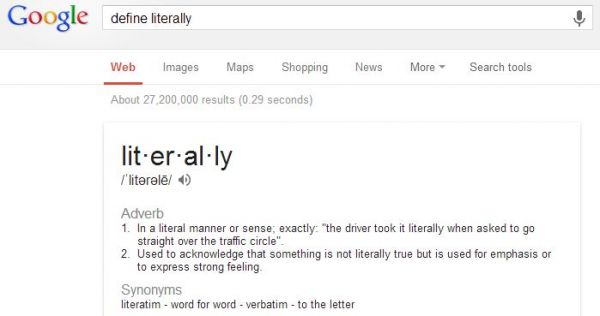
Tell me about how the English language is dynamic. Next, “irregardless” will be in the dictionary—heck, maybe it is already; I’m afraid to look. Baloney. The fact that “everybody does it,” defined as “people in high places, like Joe Biden, who should know better but don’t,” does not justify treating inarticulate, lazy, careless, embarrassingly stupid language as acceptable. If “literally” means figuratively, then nothing means literally. When someone says that “her marriage was literally destroyed,” thanks to Google and the rest, the only way we know whether her marriage was destroyed or not is if we can find out whether or not the speaker is literate, and maybe not even then.

Call me a stickler, call me a crank, but making the public dumber and communication harder by declaring that those who are poor speakers and lazy thinkers are right and those who champion expressive and accurate language are wrong is not ethical. It is literally irresponsible.

_______________________________

Pointer: Fark