“BULLY!” Is The New “WITCH!”

"Bully!"

“Bully!”

The Texas father of a high school football player would have been right at home in Salem, in the British New World colony of Massachusetts, around 1692. Then, thanks to hysteria about witchcraft, a vengeful citizen could permanently set the populace against a neighbor who had offended him, say, by winning a lawsuit, stealing a recipe or looking lustfully at his or her significant other, by accusing that neighbor of being a witch. This would inevitably spark an investigation, suspicion, infamy, maybe even a trial…and if the accusation stuck, a sadistic execution, perhaps by piling rocks on the neighbor’s witchy chest until everyone heard the sounds of squishing and cracking.

The cry of “Witch!” doesn’t work so well any more, but accusing someone of being a bully works almost as well. It can cause schools to impose punishment for words and activities that have nothing to do with school, and give law enforcement officials the power to pile rocks on the First Amendment. Now a vengeful father who watched his son’s hapless football team get the just desserts of all hapless teams—losing badly—has successfully punished the victors for being stronger, faster, and better coached, by accusing the superior team—it beat his son’s squad by a score of 91-0—of “bullying.” This mandates an investigation, so the winning team’s coach is now under a cloud, and in peril of seeing his career and reputation squished and cracked.

Mission accomplished! Continue reading

Better Never Than Late: Steve Bartman’s False Exoneration

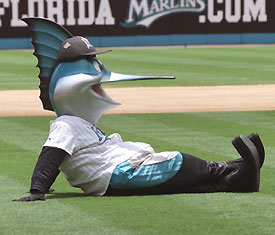
ALCS - Detroit Tigers v Boston Red Sox - Game TwoMy mind is much on the baseball play-offs today, an unavoidable hangover from last night’s amazing and exhilerating Red Sox-Tigers game, in which Boston went from hitless, five runs down and doomed in the 6th inning to miraculously victorious in the 9th thanks to a storybook grand slam by David Ortiz (you can see the immortal end result of that mighty blow in the photo to the left). It is 10 years to the day from when another remarkable play-off game occurred, infamous in Chicago, in which a fly ball foul that wasn’t caught by Cubs outfielder Moises Alou led to a furious rally by the Florida Marlins that resulted in the hapless Cubs being denied a trip to the World Series—the team’s first since 1935— that their fans thought was in the bag. The reason Alou missed the ball, or so the legend goes, was that a clueless Cubs fan wearing earphones reached out and deflected the ball. That fan, Steve Bartman, was awarded instant villain status. It was accompanied by media attacks and death threats, and poor Bartman left the city and may well have joined the witness protection program or jumped into a volcano. Nobody has heard from him in many years.

There is an ethics lesson in what happened to Bartman: one is never truly a bystander, and you have a duty to pay attention to your surroundings and to be ready to act. If you are present, you can make a difference, and might be needed, even it it is only to get out of the way. Call it the Duty of Life Competence.

The following post, however, is not about Bartman as much as it what happened to him, and how someone who could have come to his aid waited five years—too long—to do it. It was first posted on The Ethics Scoreboard in 2008:

Continue reading

The President And The Redskins: Learning Curve Flat As Ever

An updated graph of President Obama's learning curve on his practice of gratuitous commentary on the jobs, businesses, and duties of others. Oddly, it looks exactly like the last such graph, and the graph before that...

The  updated graph of President Obama’s learning curve regarding the Presidential practice of gratuitous commentary on the jobs, businesses, and duties of others. Oddly, it looks exactly like the last such graph, and the graph before that…

In the long list of example of President Obama interfering with private decisions, court cases and local matters that the occupant of highest office in the land has an obligation not to meddle in, his comments on the Washington Redskins are among the least annoying. It was a wishy-washy statement, all in all, that he gave to the AP:

“If I were the owner of the team and I knew that there was a name of my team — even if it had a storied history — that was offending a sizable group of people, I’d think about changing it.”

Does anyone doubt that owner of the Washington Redskins, Dan Snyder, hasn’t thought about it? On its face, the statement is petty, but of course, as the President resolutely refuses to learn, everything the President of the United States says, scripted or non-, regarding national policy or local matters, be they about red lines or how victims of gun violence look like his son, the President’s comments are seized upon, blown out of proportion, spun, used as weapons, provocations and ammunition, and generally warp public policy discourse, public opinion and personal and local decision-making. Continue reading

Ethics Lessons From The Baseball Playoffs: Joe Madden’s Confirmation Bias

Joe Maddon...victim.

Joe Maddon…victim.

Confirmation bias is the most pernicious of all biases, the most natural, and the hardest one to deal with, since it is hard-wired into everyone’s brain. It is nearly indistinguishable from wisdom and experience, you see, but it is a bias nonetheless, and like all biases, makes us stupid. Confirmation bias prevents us from accepting and processing new information objectively, and leads us to see it in the light most favorable to what we already believe, sometimes when that light is decidedly dim or even non-existent.

Baseball is full of vivid ethics lessons, and the post-season, with such high-profile games and thick media coverage is annually an ethics smorgasbord, if you look hard enough. Saturday, Tampa Bay manager Joe Maddon, widely regarded as the smartest manager in the game, showed us how confirmation bias works, and the damage it can do. Continue reading

Case Study In How Sports Encourages Consequentialism: The 1968 Detroit Tigers

Mickey Stanley in 1968: learning a new position in the World Series, making us dumber...

Mickey Stanley in 1968: learning a new position in the World Series, making us dumber…

Frequent readers here know that I often inveigh against consequentialism in its various forms, from labeling sound decisions “mistakes” when they don’t pan out due to uncontrollable factors, to pronouncing unethical conduct as ethical because it chanced to have some beneficent results. This particular hydra seems to be a tough one to kill, and one of the reasons is, I realize, the pervasiveness of sports in our culture.

Reflecting on sporting contests, particularly those involving teams, routinely generates hindsight bias on the part of fans and sports commentators….for one thing, it’s fun to second guess managers and coaches from the safety of an armschair or from behind a computer screen. Unfortunately, the practice endorses consequentialism. Decisions that result in a win are seldom criticized, no matter how moronic or misguided they may have been; tactics that ended in defeat are always called “mistakes,” or worse.

The baseball post-season began yesterday. We won’t see a World Series game until October is almost over, but there was a time, children, long ago, before divisions and the designated hitter, before steroids and ESPN, when in major league baseball, the World Series was the post season. This was the case 45 years ago, in 1968, when the Detroit Tigers, who had clobbered the American League competition on the way to a 103-59 record, including the last 30 game-winning season by any pitcher, turned in by Denny McLain. They were about to face the reigning baseball champions from 1967, the NL’s St. Louis Cardinals, led by future Hall of Famers Lou Brock, Orlando Cepeda, and Bob Gibson. Both were veteran teams and well-balanced; there was every reason to believe that each had a good chance at victory. Certainly, neither was in need of any last-minute overhaul.

Nonetheless, Tigers manager Mayo Smith decided to take a gamble. Continue reading

Ethics Hero: Sid Bream

sid_breamYou all remember Sid Bream, don’t you? Well, probably not: he was a mediocre first baseman about 20 years ago who played for the Pittsburgh Pirates and the Atlanta Braves. He hasn’t been heard from in a long time, being quietly retired, but the Braves may be hosting the Pirates in an upcoming National League Division Playoff Series as the baseball post season gets underway, and they invited Bream to throw out the first pitch in Game #1 if that is the case—-Pittsburgh has to win a wildcard play-off game with Cincinnati first. You see, the one thing in his career that Bream is remembered for, at least in Atlanta, is scoring the run that won the National League Championship Series over the Pirates in 1992, in a close play that also lives in Pirates’ fans nightmares.

Throwing out the first pitch is fun: the team flies you in and pays for your hotel, gives you a prime ticket, and then announces your name as you trot on the field to cheers. If you have kept your arm in shape, you might even get off a throw to the catcher from the pitcher’s mound that doesn’t embarrass you, and that will acquire more cheers. from the packed stadium. Wait…this is Atlanta, not Boston. OK, from the two-thirds filled stadium. Even then, what’s not to like?

But Sid Bream turned the Braves down. Remember that I began by saying that he played for both the Braves and the Pirates. He said,

“Whatever their motive (for the invite) was, I don’t want to be involved. I wasn’t surprised (by the offer). Whether their motive was to rub it in the Pirates’ faces, I don’t know. I think it was just more of a gesture to commemorate those two teams getting back together in the postseason. But I’ll stay neutral. I’m not going to do anything to tell the fans in Atlanta or Pittsburgh that I’m (rooting) one way or the other.”

Oh, I think it’s fair to say that rubbing the Pirates’ faces in their last loss to the Braves in a postseason game was exactly what the Braves had in mind. This kind of voodoo has been a standard part of baseball gamesmanship for a long time: nobody believes that the Yankees had Bucky Dent throw out the first pitch when the Yankees had a crucial playoff game against Boston (which they lost) in 2004 “to commemorate those two teams getting back together in the postseason.” It’s psychological warfare, and more or less good-natured; there’s nothing wrong with it, and there would have been nothing wrong with Bream agreeing to play along.

But Sid Bream is, it seems, loyal. He was a Pittsburgh Pirate for a long time, a Brave only for a couple of years, and he doesn’t feel like being part of one of his former teams’ effort to unsettle the other one, even though its’ no big deal, and even though his old team won’t hold it against him. It just would feel right to him.

This is called integrity.

Good for Sid Bream.

_______________________

Pointer, Graphic and Facts: NBC Sports


Celebrity Values: The Good, The Bad And The Ugly

Sprouse-West-Cano

Celebrities have the opportunity to use their disproportionate and sometimes unexplainable fame to pass along good values, priorities and ethical habits to those who admire and follow them. The problem is that the U.S. culture’s current values are in a muddled state, with virtues sometimes being treated as embarrassments, and the enthusiastic embrace of non-ethical goals that once were regarded as the seven deadly sins are now often looked upon as the norm, and even appropriate. Here are some recent events in the strange world of celebrity values:

The Good: This headline on numerous web sources piqued my interest: “Dylan Sprouse Defends Restaurant Host Job.” Dylan Sprouse is a former Disney child star, a long time lead, with his brother, on the long-running “The Suite Life of Zach & Cody,” one of those loud, hyper-frenetic tween comedies that Disney and Nickelodeon acquire from some production company in Hell. Dylan was seen working in a restaurant, and this immediately spawned multiple rumors that he was broke, had blown through his millions, and was, in brief, a pathetic loser….because he has the same kind of job most American twenty-somethings fresh out of college would be thrilled to have.

Thus Dylan, who along with his brother decided to get out of the child star rat-race that has recently put Lindsay Lohan in rehab, Amanda Bynes in a mental health treatment facility and Miley Cyrus naked on a wrecking ball, and start a more conventional life with a college education (at NYU). Sprouse decided to address the weird criticism being sent his way on social media and in the gossip blogs by writing, Continue reading

Ethics Hero: Matt Labrum, Union High (Roosevelt, Utah) Football Coach

Six Pillars

Matt Labrum, head coach of Union High School in Roosevelt, Utah, suspended all 80 of his players, citing  a lack of character. He instructed them all to turn in their jerseys and their equipment, and announced that there would be no football until they earned the privilege to play. Labrum gave his shocked players a letter titled “Union Football Character” which declared in part,

“The lack of character we are showing off the field is outshining what we are achieving on the field. It is a privilege to play this wonderful game! We must earn the opportunity to have the honor to put on our high school jerseys each Thursday and Friday night!”

Instead of practicing during the days leading up to this weekend’s game, the students were ordered to perform community service, to attend study hall and go to a class on character development. They were also required to perform service for their own families, and write a report about their actions. Academically, the players were told to be on time for classes, and to improve their grades.

It is unclear what prompted the coach’s action, though some of the players, he felt, had engaged in cyber bullying, and he was aware of other instances in which various players had not, in his view, lived up to exemplary standards of behavior. Several of them had been rude and obnoxious, he had learned to other students and teachers—in other words, they were behaving like high school football players. Rather than punish individual students, Coach Labrum decided to impose team wide measures designed to foster good character. His theory, clearly, was to encourage a team culture of ethical conduct, strengthened  by group encouragement and enforcement of shared values. Labrum is also a gifted salesman, since it appears that opposition from students, their parents and the school administration has been minimal.

In many schools, including colleges, football players are the biggest jerks on campus: the culture of school sports too often nurtures entitlement and arrogance. Imagine a school athletic culture in which the athletes were expected to embody the best of ethical values both on and off the field.

The implications are staggering.

_________________________

Pointer: Lianne Best

Sources: Yard Barker Deseret News

Ethics Dunces: The Los Angeles Dodgers

The Los Angeles Dodgers clinched the National League West regular season championship last night by beating their divisional rivals, the Arizona Diamondbacks. Traditionally, when such moments occur away from the winner’s home park, they are celebrated with a happy mob scene around the pitcher’s mound and then a retreat to the clubhouse, where campaign and revelry reign.

But not in the case of the 2013 Dodgers. Seeing the inviting swimming pool that is a unique center field feature of Chase Field, the giddy Dodger team jumped the fence and splashed into the pool to celebrate. The Arizona Republic, in an editorial today, accurately expressed the reaction of the Diamondback fans and community:

“In the interests of good sportsmanship, here’s to the 2013 National League West Division champs.Congratulations are in order. Even to a bunch as classless as the Los Angeles Dodgers, the first players not wearing Diamondbacks uniforms to celebrate a championship by diving into the Chase Field pool. Informally, the Arizona Diamondbacks management had asked their Dodgers counterparts, should their lads clinch the division at Chase Field, to kindly celebrate in the clubhouse until the fans cleared out. For safety’s sake. Well, the Diamondbacks got their answer. Effectively: We got some “safety,” for you. Right here….” Continue reading

Disaster Ethics: The D.C. Naval Yard Shooting

Twelve dead? This is great---we can make another push for gun control!!!"

“Twelve dead? This is great—we can make another push for gun control!!!”

About 10 minutes from where I live, unidentified gunmen have killed 12 people (one of the gunmen is also dead) in an unexplained rampage. The facts are still being sorted out, and at least one shooter is still at large as I write this, but already two predictable examples of unethical disaster and crisis response have been on display:

1.  Reflex anti-gun tragedy exploitation

Apparently from now until the Second Amendment is but a distant memory, some Democratic politicians and anti-gun zealots will use every gun-related tragedy as a springboard to lobby for more regulations, and the facts be damned. At this point, we have not been told why the attack took place, who the shooters were, whether it was a terrorist act or not, whether the killers were Americans, whether or not the weapons were obtained illegally and what kind of guns they were. Never mind: interviewed on the radio, D.C. Delegate Eleanor Holmes Norton, Congress’s non-voting member, immediately pointed out that with all the guns that are available in this country, it should be no surprise to anyone that tragedies like this occur. I’m sure she would have liked to have been able to claim that global warming also played a part, except that it is a cool day in Washington. Continue reading