The Penn State-Sandusky Disgrace: Time For Paterno Worshippers To Face Facts

Amity’s Mayor Larry Vaughn, a.k.a Joe Paterno

Yesterday CNN revealed that e-mails uncovered in Penn State’s internal investigation of the Jerry Sandusky scandal show that beloved, ever-so-ethical Jo Pa appears to have stopped the university from reporting the child-molesting ex-coach to authorities. The e-mail trail seems to show, the New York Times reported, that the university’s president, Graham B. Spanier; the athletic director, Tim Curley, and the official in charge of the campus police, Gary Schultz, were ready to report Sandusky in the wake of assistant football coach Mike McQueery’s eye-witness account of seeing Sandusky molesting a child in the showers.  Curley then wrote the group that talks with Paterno had persuaded him that it would be more “humane” to confront Sandusky, bar him from bringing his young victims on campus, and  urge him to get professional help. This, of course, freed Sandusky for a decade more of  child sexual predation, with the kids foundation he had founded serving as his hunting grounds.

Humane indeed. Continue reading

A Trivial But Vivid Case Study In Unethical Journalism

“Wait…did we leave out something from that story?”

Yes, I know: it’s another Boston baseball story (“Yoooouk!”), and I’m sure there are similar stories from other cities. And yes, I know that the journalists at issue are sports writers, which have traditionally been to journalism what a Big Mac is to gourmet cuisine. Nonetheless, this is an instance where some members of the Boston media have gone out of their way to misrepresent the facts of a story specifically to impugn the character of an innocent athlete and to rile up people  –in this case, Boston Red Sox fans, who often mutate into something far scarier than “people”—who depend on them for information, and who can be counted upon to over-react to everything.

Red Sox starting pitcher Clay Buchholtz recently ended up in the hospital and on the disabled list with a dangerous episode of internal bleeding. After a few days he was released, weak and medicated, and told that he could resume normal activities immediately. Baseball needed to wait a bit longer, understandably, and anyway, he isn’t eligible to play in a game for two weeks. Last night, he attended an event that he had committed to attend before his medical problem, a charity event to raise money for the Greg Hill Foundation. Lest there be any question, this is a good thing, and noble. Buchholtz could have begged off, for he was just hospitalized and surely doesn’t feel great, but he didn’t, choosing instead to assist a group that raises funds to help local families touched by tragedy.

And here is how this is being covered by some of the Boston sports media: Continue reading

Jay Carney: How to Destroy Your Credibility Pointlessly

I have great sympathy for White House spokespeople like Jay Carney. It is almost impossible to avoid coming off as a weasel. You have to face the press and fend off questions, never revealing more than the White House chooses to reveal, seldom being fully candid, always being governed by talking points. Of course, being in such a role for an Administration that promised, in the person of its leader, to be transparent above all others shouldn’t be quite so hard, but we all know that this promise lies molding in the Trash Heap of Cynicism, buried by Guantanamo Bay, the  waivers of conflicts for lobbyists, the Obama Super-Pac, and especially the recent assertion of executive privilege. Eventually all Presidential spokesmen reach the point where they are barely believed and no longer trusted, which is all the more reason not to rush the process and savage one’s credibility by uttering stupid and pointless lies that are both unbelievable but also easily disproved. Continue reading

When Your Genius Is A Dunce: The Depressing Self-Outing of Rays’ Manager Joe Madden

I trusted you, Joe. You broke my heart..

Organizations and institutions tell us a lot about themselves by the individuals they hold up as exemplary. To cite an example much on my mind these days, the conservative blogosphere’s canonization of the late Andrew Breitbart, master of the intentional half-truth, makes me dubious about its reliability and integrity. On  the other side of the spectrum, the fact that so many Democrats, and especially Democratic women, worship Bill Clinton reflects horribly on their values and tolerance for hypocrisy. Now, in the wake of Roger Clemens’ well-deserved acquittal for denying under oath acts that he almost certainly did, we have strong confirmation that a prominent individual Major League Baseball holds up as exemplifying, in the immortal and irritatingly pretentious words of “Terence Mann” about that corn field in Iowa, “all that once was good and it could be again”* is in truth an Ethics Dunce, and a big one at that. His name is Joe Madden, the American League’s 2011 Manager of the Year, and I am disappointed and depressed. (Yes, I have named Joe an Ethics Hero in the past.) Continue reading

Ethics Quote of the Week: Washington Sports Writer Sally Jenkins

“Overreaching by government is far more harmful than any of the alleged offenses. It has poured more poison into the system than is contained in any needle.”

—-Sally Jenkins, writing in the Washington Post sports pages about the Roger Clemens prosecution.

Elsewhere in her column, Jenkins writes:

“Someone in authority at the Justice Department should have said to the federal investigators who pursued Clemens since 2007 on perjury charges, “You don’t have the evidence that can win a conviction.” The government never had a case, and knew it didn’t have a case (or at least should have), and brought the case anyway.”

Bringing a case when a prosecutor doesn’t have sufficient evidence is the epitome of unethical prosecution, and the Clemens case certainly qualifies. I can’t write much about this now, because I am preparing to give an ethics seminar to Washington D.C. government attorneys about legal ethics in government practice. I always find the government attorneys to be extraordinarily informed regarding ethical standards, and to have excellent ethical instincts. I will be talking about the Clemens case, and the Ted Stevens prosecution that went so horribly wrong, and the Fast and Furious investigation, in which a Federal Prosecutor announced his intention to take the Fifth Amendment if he was called before Congress. I will be talking about a lot of things.

There is obviously a problem.

___________________________

Spark: Ron Sarro

Source: Washington Post

Graphic: The Cell Phone Junkie

Ethics Alarms attempts to give proper attribution and credit to all sources of facts, analysis and other assistance that go into its blog posts. If you are aware of one I missed, or believe your own work was used in any way without proper attribution, please contact me, Jack Marshall, at  jamproethics@verizon.net.

Roger Clemens Was Acquitted, Not “Vindicated”

The first ethics breach is the utter incompetence of reporters who nonetheless are permitted to go on the air and mislead the public. A jury acquitted baseball great Roger Clemens  of 6 counts of perjury today, and I have just screamed in my car, frightening Rugby (my Jack Russell Terrier), after hearing three reporters on three radio stations say that Clemens was “vindicated.”

Incompetents. Ignoramuses. Continue reading

Armstrong’s Unmasking: Better Late Than Never

Don’t worry, Barry; Lance should be joining you soon.

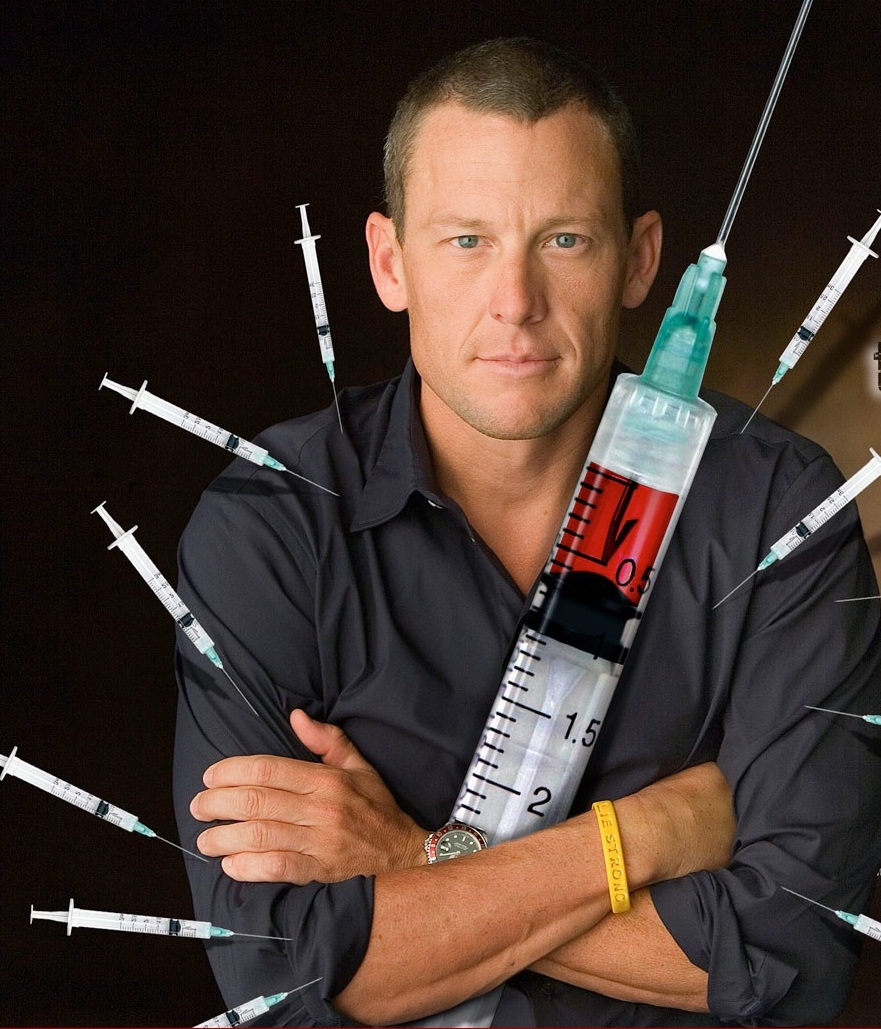
Well, I guess I  have to hand it to Lance Armstrong, a bit like Ozzie Guillen when he praised Fidel Castro for surviving his dictatorship against all odds. The evidence, circumstantial and otherwise, that Armstrong is a  prohibited drug cheater ( like most successful cyclists) has been mounting for over a decade, and yet he has managed to hold on to much of his prestige and iconic status. Meanwhile, retired baseball slugger Barry Bonds has been reviled, condemned, prosecuted and vilified, by me among many others, for presumed illicit performing enhancing drug use in his sport that is backed by very similar kinds of evidence that  incriminate Armstrong. Yet while Bonds faces the humiliation of being rejected for election to baseball’s Hall of Fame next year when he becomes eligible, despite being the sport’s all-time career home run leader, Armstrong was preparing to race again to cheering throngs  in an upcoming iron man triathlon.

Then came the news, yesterday, that the U.S. Anti-Doping Agency has brought formal doping charges against him.  No one should underestimate Armstrong’s skill in wiggling off the hook, but this really should settle the issue of whether he is a hero or a manipulative charlatan. He is the latter. Whether he was a good but weak man trapped in a lie, or a sociopathic con man and cheat can be investigated by biographers and sportswriter, and psychologists. The harm that will be done when his false heroism is irrefutably exposed, however, will be the same no matter how Armstrong came about causing it.  His sport will be permanently tarnished beyond recovery. Scores of children and teens will be disillusioned, betrayed into a cynicism about role models and human nature that should only descend later in life. Worst of all,. his example will stand for some as proof that cheating pays. Armstrong, whatever happens to him, will be rich, like Barry Bonds, even if he is disgraced. He will, as my father liked to say, cry all the way to the bank. Continue reading

Hurray for the “O!” in “The Star Spangled Banner,” And The Man Who Put It There

Wild Bill Hagy, on the job

When the Washington Nationals hosted the Baltimore Orioles in an interleague baseball game, many Orioles fans attended to root for their team, the long-diminishes but suddenly (and, I fear, temporarily) resurgent O’s from Charm City. Nobody who has attended Orioles games in Camden Yards was surprised that the Orioles fans shouted out a loud “O!” as the National Anthem reached its climax, in the line, “Oh say does that star-spangled banner yet wave?” They have been doing this, joyfully and with full-throated enthusiasm, for over four decades.

Washington Post sportswriter Mike Wise to his keyboard to express his annoyance and indignation. Calling the O’s fans who engage in the traditional shout “cretins,” Wise wrote,

“…By claiming the lyrics, if only for a moment, you fundamentally undermine the idea that the song was written to unite instead of divide. A national anthem is a national anthem, not a convenient vehicle for one’s immense pride in his or her team.”

Allow me to retort!

Baloney. Continue reading

Comment of the Day: “Ethical If We Want It To Be: NBA Flopping and Fooling the Ref”

This is a wonderful comment by Dwayne N. Zechman, which goes to the heart of what makes sports ethics so perplexing. Let me leave it to Dwayne now, and I’ll have some comments at the end. Here is his Comment of the Day on the post Ethical If We Want It To Be: NBA Flopping and Fooling the Ref:

“I admit I’m having a little trouble with this one.

“If I understand correctly, your premise is that each sport has its rulebook, and what’s ethical or not is mostly determined by what’s in that rulebook. The outside margins of “mostly” come from long-standing traditions, and de facto rules related to safety or practicality. The game isn’t life–it’s a distinct “closed system” if you will, and the rules about life might not apply. Or perhaps it’s better to say that we can choose to declare (in the rulebook or through tradition) that certain rules of life do not apply within the game and that’s okay. Doing so diminishes neither the ethical rule nor the game itself.

“So the beginning of my trouble is that this smacks a little of a combination of “Everybody does it”, “If it isn’t illegal, it’s ethical”, and The Compliance Dodge. Okay, I can accept that, though, because we’ve already stipulated that specific ethical principles can be exempted from a game/sport.

“Next comes my own dissonance in trying to reconcile this article with other recent articles here on Ethics Alarms about pro football, where the same exemption of ethical principles is applied, but somehow shouldn’t be. Okay, I can accept this, too. There is a distinction in that an ethical principle shouldn’t be exempted from the game when there are clear, demonstrable consequences to the player that persist after the game is over and the player’s real life resumes. In a situation such as that, it’s impossible to exempt an ethical principle JUST for the game because the exemption itself renders the game no longer a “closed system”. Continue reading

Ethical If We Want It To Be: NBA Flopping and Fooling the Ref

“And in the category of Best Feigned Foul in An NBA Play-Off Game, the nominees are….”

Once again, the issue of players in professional sports intentionally deceiving the referees is enlivening the sports pages. I welcome it: the intersection of sports and ethics is always fascinating. This particular intersection is as old as sports itself. Is deceiving the referee (or umpire) for the benefit of one’s team competitive gamesmanship or cheating? Is it an accepted tactic, or poor sportsmanship? In short, is it ethical or unethical?

The current version of this controversy has broken out in the National Basketball Association, where  Commissioner Daniel Stern  has declared war on “flopping”—the maneuver where a player draws an undeserved foul on an opposing player by acting as if minor contact or even no contact at all was near-criminal battery. Stern has suggested that the NBA needs to start handing out major fines for these performances, which in the heat and speed of the game are often only detectable with the aid of slow-motion replay after the fact Continue reading