Oh-Oh, Now I’m Really In Trouble: Democrats Want To Criminalize Typos

Somehow I missed this, but it does fit in nicely with the previous post on the totalitarian drift of our oldest political party.

Stacey Plaskett, a non-voting Democrat Representative of the Virgin Islands, the ranking member of the House Judiciary Select Subcommittee on the Weaponization of the Federal Government, authored a letter that accused journalist Matt Taibbi of perjury in his testimony before Congress on the flimsiest of pretexts. In one “Twitter Files’ tweet and in his subsequent Congressional testimony, Taibbi, suddenly a villain in Democratic eyes because he was one of the independent reporters given access to “the Twitter files” for public release purposes, had mistakenly confused CISA, the government’s Cybersecurity and Infrastructure Security Agency, with CIS, the Center for Internet Security, a non-profit private entity. Or he had added an “A’ by mistake, which is what I would have done. Taibbi corrected the tweet, but Plaskett accused him of deliberate dishonesty in his testimony that quoted it, writing,

Continue reading →

Ethics Update: The Bud Light-Dylan Mulvaney Ethics Train Wreck [Corrected]

The main development is that after Budweiser’s CEO’s fatuous non-apology fell flat, Alissa Heinerscheid, the marketing VP of the Bud Light brand, was placed on “leave of absence” status, meaning she’s been canned but the company wants to try to let passions cool down so it isn’t attacked by a non-beer-drinking LGTBQ mob accusing it of being transphobic.

Good. She deserved to be fired. She placed political DEI grandstanding ahead of her job, which is to sell beer. It is fine to try to expand a market, but the trick is to do that without alienating the market you have. This isn’t really an exotic concept, though it appears to have eluded Disney as well. It’s stunningly simple. If someone likes and has loyalty to a product, and the product deliberately links itself to an image or spokesperson that the loyal consumer doesn’t like, doesn’t want to endorse, doesn’t agree with, or just finds off-putting or icky, the consumer is very likely to have second thoughts about the brand. What’s so hard about that?

Before making the blunder [Notice of Correction: Here I originally wrote “after,” which was wrong. Sorry. ], Heinerscheid had arrogantly described her approach as a necessary turn away from “fratty, kind of out of touch humor.” Then she led her company to embrace a controversial drag performer whom many regard as ridiculing women while repulsing men. She must have thought she was immune from consequences, as a “historic” DEI hire by a beer company. She set back the cause of female executives in her industry while hurting the product she was supposed to help.

Continue reading →

Unethical Website Of The Month: Only Dinosaurs

I’ve seen weirder websites, but not many.

Only Dinosaurs is the website of the “Custom Animatronic Dinosaur Manufacturing Expert,” which describes itself as providing “cost-effective realistic animatronic dinosaur manufacturing services from China.” You can get instant online quotes in minutes, orders in days! But that’s not the reason the site is unethical.

The amount of mistaken and confused information the public gets on the web ranges from harmless to deadly, and Only Dinosaurs has managed to perpetrate some that I never thought was information at all.

The site has a page called “The Top 15 Friendliest Dinosaurs.” It begins with this fifth grade English exposition (I’m guessing the whole site is translated from Chinese, and none too well at that):

If you’ve watched the movie, “Jurassic Park,” you might probably believe that all dinosaurs are big and scary, and they all eat humans. That’s not particularly true. So, if you find yourself really scared of dinosaurs, I have news for you — not all dinosaurs are mean and scary. In fact, some of them are actually pretty friendly and downright cute. So, enough about the T-Rex; let’s have a look at some of the friendliest dinosaurs ever. The tip here is, if the dinosaur is an herbivore, then it’s probably going to be a friendly one since it’s not after blood. However, you can’t risk guessing it right? Therefore, here is a quick list first so you can take them all in:

Whoever wrote that hadn’t seen “Jurassic Park,” which is remarkable for a site that sells animatronic dinosaurs, since the movie represented the most successful and influential use of animatronic dinosaurs of all time. The movie doesn’t present all dinosaurs as “big and scary’: some are presented as big and harmless (the Brachiosurus; the Triceratops), and others are presented as not-so-big and deadly (the Dilophosaurus that eats “Newman,” though the actual beast was larger and a “veggiesaur.”) What does “not particularly true” mean? The statement that all dinosaurs were “big and scary” is definitely not true. Then the passage starts to sound like the writer believes dinosaurs are still around, but that’s okay, it’s all in fun, presumably. Nevertheless, presuming to know which dinosaur species were “friendly” is bonkers. No paleontologist has ever claimed to have discovered that from the fossil record, because the temperaments of prehistoric animals is unknown.

Continue reading →

For Your Ethics Reading List…

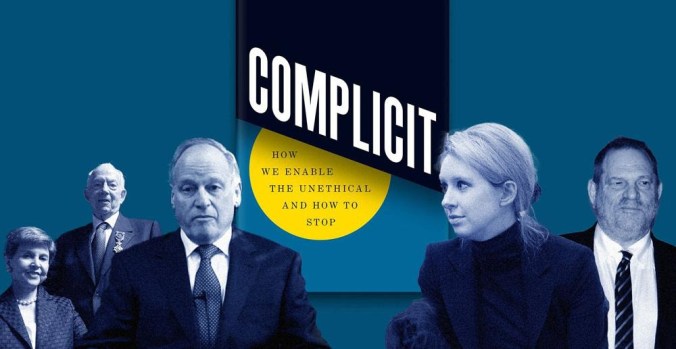
I’ve just ordered “Complicit: How We Enable the Unethical and How to Stop”by Harvard business school professor Max Bazerman. Having read about the book, I’m curious to see if any of his strategies have not already been discussed on Ethics Alarms extensively. I suspect not.

On his website, Bazerman writes in part,

[A]lmost all of us have been complicit in the unethical behavior of others. “Complicit” tells compelling stories of those who enabled the Theranos and WeWork scandals, the opioid crisis, the sexual abuse that led to the #MeToo movement, and the January 6th U.S. Capitol attack. The book describes seven different behavioral profiles that can lead to complicity in wrongdoing…and offers concrete and detailed solutions, describing how individuals, leaders, and organizations can more effectively prevent complicity. By challenging the notion that a few bad apples are responsible for society’s ills, “Complicit” implicates us all—and offers a path for creating a more ethical world.

The Harvard connection is one red flag; another is Bazerman’s inclusion of “systemic privilege, including white privilege” among his markers of complicity in unethical conduct and corruption. He is clearly a reliably woke member of the progressive academic mob, but that doesn’t necessarily mean that he has nothing to contribute to the topic.

Continue reading →

Psst! When You’re This Estranged From Human, Societal And Cultural Norms And Standards, No Advice Columnist Can Save You

The New York Times “Ethicist” got a jaw-dropping inquiry this week:

Nearly a year ago, I began dating two friends — I’ll call them Rachel and Dave — who were already themselves in a relationship. We all had no experience with polyamory. The throuple ended fairly quickly, with no one being at fault; the other two continued to date but broke up not too long afterward. Since then, Rachel and Dave have dated on and off, Rachel and I were casually together and Dave and I have been close friends who sleep together occasionally. There have also been relationships with others outside this group. At times, we have all behaved badly, sleeping together behind the other’s back, knowing the knowledge would hurt the other. Strong emotions, love and pain have arisen on all sides.

Throughout the past year, as multiple complex situations arose, we have all wished for a model of behavior. Monogamy-centered media suggests that one should avoid dating a friend’s ex-partner. Is this correct? And if so, can this concept be universalized? Do Rachel and Dave get “priority,” in that they should be together and I should not pursue either, because they dated first? What do we owe to our romantic partners and friends when the situations are complex?

His advice doesn’t interest me; you can read it here if it interests you. My focus is on the inquirer, predictably signed in as “Name Withheld.”

Continue reading →

Back To The Justice Thomas Scandal: Do Conservatives Really Not Understand The Appearance of Impropriety Judicial Ethics Prohibition, Or Are They Just Choosing To Ignore It?

Ugh.

From the Daily Caller:

Conservative legal scholars are calling attacks on Clarence Thomas for his alleged ethics violations hypocritical in light of Ketanji Brown Jackson’s financial disclosure as a nominee, which shows she omitted portions of her income on previous filings, including money from her husband’s consulting work.

These “conservative scholars” are partisan hacks.

Their argument is that because Jackson’s SCOTUS nominee disclosure papers filed in March 2022 “inadvertently omitted” income her spouse “periodically receives from consulting on medical malpractice cases” (which was disclosed on prior reports), there is a double standard applied to conservative justices. Utter garbage, and I suspect intentionally misleading. There would be no demands for Thomas’s resignation if all that was at issue was the failure to report some ambiguous gifts on his annual disclosure forms. SCOTUS justices have done this many times in the past: it is grounds for criticism and a necessary “Sorry, I won’t do that again” statement. The reason Thomas’s 20 years of unreported vacations with ultra-conservative billionaire real estate developer Harlan Crow is that it looks bad, to the public, to objective judicial ethicists, and to me.

Continue reading →

Open Forum!

It sure seems like lots of ethics stuff is swirling around today, and I have no idea where I’ll be going with it at this point.

I’m counting on you to help sort it all out…

On Waco, “Waco,” And Cults

Another horrible occurrence that I did not mention yesterday while review the ethics-related events of April 19 through the centuries was the tragic conclusion of the FBI’s seige against Mount Carmel in Waco, Texas, in 1993. After a 51-day stand-off between the federal government and an armed religious cult, the compound burned to the ground, with about 80 members of Branch Davidians, including 22 children, dying in the blaze.

This was an ethics train wreck to be sure, and an unusually deadly one. There are so many documentaries and online accounts of the incident (of various quality and accuracy) that I’m not going to add to them here. I do recommend the 2018 Showtime docudrama series “Waco,” which is now streaming with a fascinating new sequel, “Waco: Aftermath,” currently being presented on Showtime.

There is a natural bias in “Waco”: its main sources were a book by one of the survivors and cult members whose wife perished in the fire, and another by an FBI negotiator who was extremely critical of how the agency handled the situation. Both authors come off as heroes of the disaster to the extent that such a botch can have heroes. When the docudrama premiered in 2018, many reviewers complained that the writers treated the FBI as the villains of the story, with cult leader David Koresh portrayed too sympathetically.

My impression, seeing “Waco” now, is that the series’ creators were on to something that has come into sharper focus in recent years. The FBI abuses its power, is badly managed, has too much autonomy, and can’t be trusted. That should have sunk in in 1993, but the news media was determined to let the hallowed law enforcement agency, Attorney General Janet Reno, and especially President Bill Clinton off the hook. I remember the coverage well: Koresh’s cult was lumped into the paramilitary and survivalist anti-government movement of the period. The Waco siege followed on the heels of the Ruby Ridge fiasco the year before, involving the same federal agencies, the FBI and the ATF. Even though that fatal showdown was ultimately shown to be exacerbated by the Feds (and a lawsuit found the agencies liable for damages), the public and media still were conditioned to regard the FBI as the “good guys.” Sure, it was tragic that people died, but the consensus was that they brought it on themselves, sad as the outcome was. At the time, I found it astounding that Reno wasn’t forced to resign, and that President Clinton escaped any accountability at all.

Much of that result was because of the subsequent Oklahoma City Bombing by Timothy McVeigh in 1995. Public opinion was turning against the trend of over-aggressive government following Waco: Rush Limbaugh in particular was leading a daily attack on what he saw as as Big Government restrictions on personal liberties (like the right to live out in the desert with fellow followers of a deranged but charismatic religious fanatic who claimed to be chosen by God). Once McVeigh’s truck brought down the Alfred P. Murrah Federal Building, destroyed or damaged 324 other buildings within a 16-block radius, killed 168 people and injured 680, however, public opinion turned decisively the government’s way. McVeigh cited Waco as a major reason for his terrorism, and the Cognitive Dissonance Scale worked its predictable magic: now the Branch Davidians were linked to pure evil. The FBI, and thus the U.S. government, propelled to the other side of the scale, the “good guys” at Waco, at Ruby Ridge, and always.

They aren’t, and weren’t. “Waco,” for all its flaws, makes that contrary conclusion unavoidable.

Continue reading →
A “Great Stupid” Classic! Addressing Crash Dummy Employment Discrimination

Res ipsa loquitur.

The scary thing: nobody laughed.

Morning Ethics Round-Up, 4/19/2023: Madness, Violence, Harm, Trust And Fairness

Lots of bad stuff has happened on April 19, but at dawn on this date in 1776, just about 20 minutes from where I grew up in Arlington, Massachusetts, 700 British troops on the way to capture Sam Adams and John Hancock and snuff out the rebellion of the colonists, marched into Lexington. Just 77 minutemen were gathered on the town’s common, Lexington Green, to stop them, having been warned that night by Paul Revere and William Dawes. The Patriots lost the battle, of course, but the Revolution had begun, and the world should be grateful for it. The Green is still there, but it is in the middle of a traffic circle now; it’s hard to imagine that the great American experiment, a nation created to embody ethical values, started in such a place.

1. Madness! Rice is a main food source for about 3.5 billion people, but some of the climate change cultists want it banned. The AFP News Agency posted a video on Twitter that argued, “Rice is to blame for around 10 percent of global emissions of methane, a gas that over two decades, traps about 80 times as much heat as carbon dioxide. Scientists say that if the world wants to reduce greenhouse gas emissions, rice cannot be ignored.” This is, of course, bonkers, though whether it is more or less bonkers than the climate change fanatics insisting that we stop eating meat and start learning to like bugs is a matter of, uh, taste. After Legal Insurrection flagged the video, those who thought it would be persuasive propaganda had second thoughts, and this is all that remains today:

Remember: this is a cult. Causing a famine and widespread death and suffering to “save the planet” is a necessary trade-off to such fanatics.

2. Someone needs to explain to Biden Administration “historic” and “diversity” hires that they still can’t get away with embarrassing the government. Well, they can’t count on it, anyway. Kayla Denker is a transgender activist who U.S. Forest Service and tweeted a video showing her with a gun accompanied by the message, “While advocating for trans people to ‘arm ourselves’ is not any kind of a solution to the genocide we are facing, I do want to say that if any of you transphobes do try to come for me I am taking a few of you with me.” Then a trans ex-student shot up a Nashville Christian grade school, and the tweet went “viral.”

Continue reading →