Now That Judge Jackson Has Settled One SCOTUS Recusal Issue, Another, Much Tougher One, Looms, Part 2: The Decision

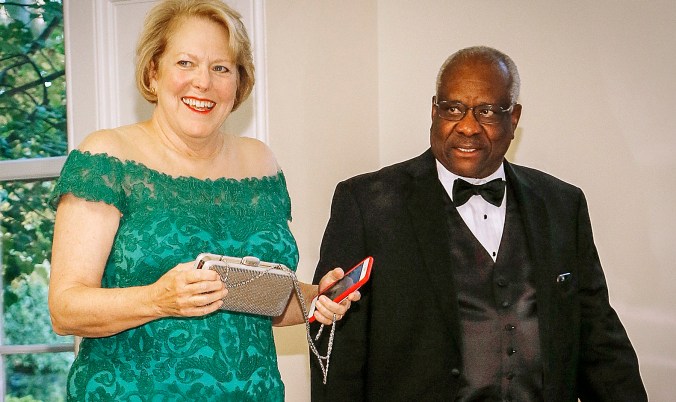
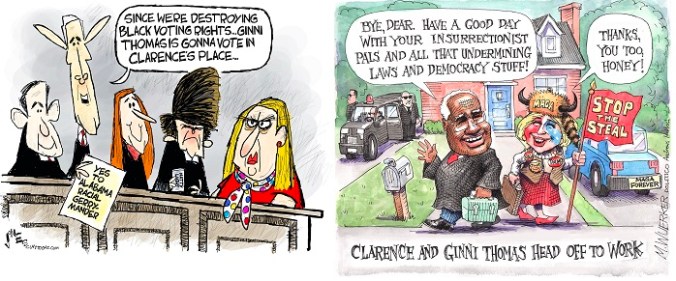
Under normal circumstances—but what is normal any more?—my conclusion regarding whether Clarence Thomas should or should not recuse himself in any cases involving the January 6 riot (which the Washington Post again calls “an insurrection” today)because of his conservative activist wife’s vocal support of vigorous responses by the Trump White House in response to what she felt was a fraudulent 2020 election would follow the same reasoning that my analysis of Justice Scalia’s recusal controversy trod almost exactly 18 years ago. The question then was whether Scalia’s participation in a duck hunt with Vice-president Cheney and his pals created a sufficient conflict of interest to trigger the “appearance of impropriety” standard that is supposed to govern judicial decisions whether to recuse, since Cheney was technically—but only technically—a party to lawsuit that had ended up in the Supreme Court.

Scalia adamantly insisted that there was no conflict and no impropriety, and authored an impressive memorandum to support his position. He indeed judged that case. I wrote in part,

Those who have criticized Scalia for his stance on this controversy have an obligation to read the Justice’s memorandum. They are sure to learn some things, such as why it is unwise to trust media accounts regarding anything more complicated than your typical Sponge Bob Square Pants episode; what constitutes a legally persuasive argument and why even Scalia’s ideological foes admire his sharp intellect and lively writing….

[I make] no pretense of being able to match Justice Scalia’s intellect or knowledge of the law. And he makes one especially chilling point: is appearance of impropriety sufficient to force recusal when that appearance is a false illusion created by inaccurate reporting, sloppy analysis, and misinformed reading of the law? It looked like an easy call based on what appeared in the papers; Scalia’s memorandum is a clarification that shows that his position is not just a product of stubbornness, but of careful scholarship. He wins the debate, hands down.

He should still recuse himself….

Scalia is right: there is the potential here for more than one bad precedent, and justices should not permit themselves to be run out of deliberating on politically sensitive cases by partisan misinformation campaigns. But the damage is done. To most of the public, the raw circumstances of the Scalia-Cheney outing will call Scalia’s impartiality into question, and because it is a high profile case, this will damage the public’s faith in the Supreme Court. It isn’t worth it. Americans, even Americans that don’t comprehend the legal requirements of recusal, need to believe in the integrity of the Supreme Court.

Next, the Court should recognize the new political realities of its role, and devise a review system that would make the whole court the arbiter of whether one of the brethren has a conflict, or an unacceptable appearance of one. Such a system would have made Scalia’s current dilemma less of a lightning rod for criticism.

For now, though, Justice Scalia needs to face facts: he may be right on the law, but he’s a dead man walking.

I like that post a great deal; I think I was right. (I also look wistfully back at the time when I could spend up to a week a week polishing a single post.) The parallels between Justice Thomas’s Left-and-news media contrived conflict is similar to Scalia’s. But if you think that means that I now must side with those who are pushing for Thomas’s recusal, you are wrong. Continue reading →
Looking Back: This Week’s Ethics Alarms Monday Retrospective

I guess I should mark this weeks selection “BWSC”: Before Will Slapped Chris.”

Here are my top five picks from last week:

I’m cheating a bit here; this one was 8 days ago, but I didn’t do a Monday Retrospective last week (I forgot) and this is an important topic. Come for the post, stay for the comments.

From 3/21, and too astounding to miss.

On 3/22, we discussed how the District government, among others, are trying to over-ride parental rights.

From 3/24…, and,

From 2/26, just in time for Part 2 today.

Comment Of The Day: “Additional Morning Thoughts: ‘Smith Vs. Rock At The Oscars'”

You never know.

I assumed yesterday that I wouldn’t be writing anything about the Oscars, which have politicized and wokified the ceremony into irrelevance, and here we are with the third Oscars-related post, following my my earlier ones here and here. This, a Comment of the Day by one of Ethics Alarms’ most veteran (and most restrained) commenters, Tim LeVier, is also by far the best, delving fearlessly and perceptively into the ethical issues raised by Will Smith’s astounding physical attack on Chris Rock in front  of the Hollywood glitterati and an American TV audience of diminished but still significant numbers.

Before turning things over to Tim, I will mention here, because I may forget later, that my print version of the New York Times today included a story covering last night’s awards and broadcast that did not mention the Smith-Rock episode at all. How do you explain that? The story included Oscar fashions and the “historic” awards (apparently whoever plays Anita in “West Side Story” must get a statuette); it mentioned the three smug hosts’ infantile “Gay, gay, gay!” chant. But a major star attacking a major comic on stage in an iconic awards ceremony wasn’t deemed by the New York Times as “news.”

What a great newspaper. If anything called for the “Naked Gun” clip, this does...

Now, here is Tim’s Comment of the Day on the post, “Additional Morning Thoughts: ‘Smith Vs. Rock At The Oscars'”….

***

Honestly, I’m more interested in the public reaction than the event itself. People seem to have this immediate need for clear thinking and the next chapter of the story. It’s a problem in our society more commonly referred to as instant gratification. Most of the posts and hot takes are in this vein but with varying objectives.

The pearl clutchers are the worst. “Why didn’t a police officer go an arrest him?” “Why didn’t the show director eject him?” “Why didn’t security intervene?”

Police need a complaint. The director needs time. Security aren’t in on the performance and have a tough time knowing reality from fiction particularly when the assaulted party engages with the assaulter and the assaulter casually moves into position.

It will be interesting to hear from Glenn Wiess the director and any producer about the mental gymnastics they were doing to figure out how to proceed. In the moment, during that commercial break, I’m sure it was “Is everyone cooled down now?” “Can we get through the remainder of the program?” “Am I required to take action?” “What does Chris Rock have to say?”

It was an unprecedented moment for sure and I guarantee there are some figures having discussions this morning on how to treat this going forward. There will be bright line rules put in place for the future. Everyone has now considered this predicament. Should it happen again, that person will be ejected….and then we’ll get to hear about “double standards” and “hypocrisy”. Continue reading →

Smith Vs Rock At The Oscars: Res Ipsa Loquitur, And In So Many Ways

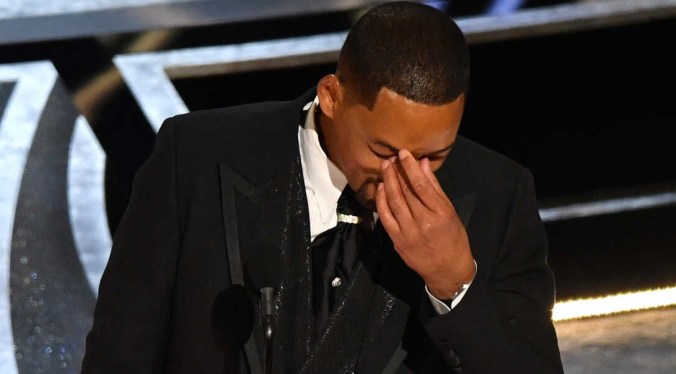
Yes, that’s actor Will Smith, who later was awarded the Best Actor Oscar, physically battering comedian Chris Rock during the live Academy Awards Broadcast last night. Rock staggered back and said,  “Wow, Will Smith just smacked the shit out of me!” Then Smith returned to his seat and shouted: “Keep my wife’s name out of your fucking mouth!”

Rock had made an ill-considered wisecrack about Jada Pinkett, Mrs. Will Smith.

I know the headline is “Res Ipsa Loquitur” (“The thing speaks for itself”) and the photo does, but I’m going to list some ethics observations anyway. Continue reading →

Sunday Ethics Break, 3/27/2022: An Oscars Date That Will Live In Infamy

I’m squeezing today’s potpourri in while I labor to finish a client’s opinion letter on a weird type of lawyer conflict of interest where an attorney represents multiple clients seeking damages from the same defendant who doesn’t have the assets to satisfy everyone. Yes, compared to technical legal ethics, thinking about the rest is recreation.

Tonight is the Oscars broadcast, which I will assiduously miss despite having seen at least some of more Best Picture nominees than in recent years. From an ethics point of view, I must note that on this date in 1973, Marlon Brando confirmed his status as one of the biggest jerks in Hollywood by declines his Academy Award for Best Actor in “The Godfather.” Instead, he inflicted Native American activist Sasheen Littlefeather (that’s her, today and then) on the attendees and the TV audience. She appeared in Brando’s place and said that the actor “very regretfully” would not accept the award, in protest of the portrayals of Native Americans in film. This abuse of the ceremony for narcissistic political grandstanding helped start the Oscars on their long decline from being a celebration of popular entertainment to becoming an obnoxious platform for ill-educated and ill-informed celebrities to presume to lecture the American public.

1. From New York City, a “laws are for the little people” classic. NYC Mayor Eric Adams formally announced last week that he was lifting the vaccine mandate in for professional athletes and performers. He can spin all he wants, and the news media will spin for him, but there is no ethical way out of the hypocrisy. Adams claimed that his decision was driven by concern for the economic recovery of the city from the pandemic, noting that sports and entertainment played vital roles in generating jobs and tax dollars. Yes, and they also poured thousands of dollars into lobbying for this exemption. Adams said he had always believed it to be unfair that New York City-based athletes had to be vaccinated to play but visiting players did not, under an earlier Mayor De Blasio executive order dating to the prior administration. The disparate treatment of highly paid, celebrity workers and less starry, influential and powerful ones looks bad, and is bad.

Continue reading →

Ethics Quiz: The Death Of Dr. Cat Pause [Corrected]

Massey University (New Zealand) Fat studies scholar Cat Pause ( I cannot determine if this was her real name) has died suddenly and unexpectedly. The PhD specialized in “Fat studies” and lectured on “fat positivity,” how to fight “fat stigma,” and achieving well-being for overweight people.

She was just 42 years old. [Notice of Correction: My original source said she was 50. That was wrong.]

Your Ethics Alarms Ethics Quiz of the Day—it’s more of a query than a quiz, really—is

What is the most ethical reaction to this news?

I ask because I’m puzzled, frankly. Obviously, it’s a tragedy for a woman to die so young. On the other hand, as Capt. Hook used to say, this doesn’t exactly validate her life’s work, does it? If you devote your research to showing how being obese is nothing to hide from, worry about or accept criticism for, I’m inclined to say that you better make damned sure you don’t drop dead suddenly at the tender age of 42. Isn’t this like defiant smokers getting lung cancer before retirement age, or Timothy Treadwell, aka “Grizzly Man,” getting mauled to death by a bear at 46?

Stipulated: It is mean and heartless to find such outrageously predictable demises funny, or to think, “They asked for it, they got it.” So what should we think that is constructive as well as compassionate?

Saturday Ethics Reflux, 3/16/2022: Annoying Song Weekend Continues! [Corrected And Updated!]

Upon reflection, I don’t see how there could be a more annoying song than “Surfin’ Bird” by the appropriately named band, The Trashmen,” in 1963. It covers all the requirements: 1) It is repetitious 2) It has an ugly melody that is still an earworm. 3) It is sung by a soloist with an annoying voice. 4) The lyrics make no sense 5) it goes on and on forever. I think it was intended to be annoying. Incredibly, the song has been covered by other bands many times, and included in the soundtracks of several films, including Kubrick’s “Full Metal Jacket.” It is also a running gag on the deliberately tasteless animated show “The Family Guy,” ever since there was an episode in which Peter wouldn’t stop singing it and drove his family nuts.

1. Abandoned scooters: The birth of an unethical slippery slope. The number of those E-scooters that users just leave wherever they feel like leaving them has multiplied vastly: I can see four from my office window. Some riders leave them blocking sidewalks, driveways and roads. I’d like to see an ordinance making the E-scooter distributors liable for tickets when the damn things are left on private property or city property where they are a hazard or an obstruction. But I digress; here is the slippery slope: children in my neighborhood now think that this is the proper way to care for all scooters. They are leaving their own, non-electric scooters wherever they lose interest in riding them. I saw four while walking Spuds this morning.

2. The Kings Pass/Star Syndrome in action. Wow, what an ethics swamp the NFL is—but you knew that. The NFL’s Cleveland Browns traded for quarterback Deshaun Watson, giving up of six draft picks and paying him $230 million, despite the fact that 22 women, all massage therapists, accused him of sexually harassing them as he used their massage services. He denied any wrongdoing, they were just massage ladies, he was a big football star, they were nobodies, so in the classic battle of “he said/she said,” the grand jury believed the celebrity, as they usually do. As for Watson, his explanation of his obsession with massage therapists was less than edifying. Asked the question, “Deshaun, as details have come out, some people have wondered why you’ve used the number of massage therapists that you’ve used? Can you kind of explain that number?”

The Browns’ latest superstar replied,

“Uh yeah. I can’t get too far into the detail because there’s an ongoing investigation still, but I can say with this day and age, especially with my age group, social media is a big business part that goes into it. So that’s a factor into it, but as far as the details, I can’t get too far into it because there’s an investigation going on . Hopefully, once everything is resolved, I can speak freely on it.”

Continue reading →

Now That Judge Jackson Has Settled One SCOTUS Recusal Issue, Another, Much Tougher One, Looms, Part I: The Issues


As tracked here at Ethics Alarms, presumptive Supreme Court Justice Ketanji Brown Jackson faced a serious conflict of interest problem in her position as a member of Harvard’s Board of Overseers because her first case on the Court was likely to involve Harvard’s constitutionally questionable affirmative action admission policies. She properly ended speculation by announcing at her confirmation hearing that she would recuse herself from the case. It was clearly the ethical move, but, as an almost certain member of the land’s highest court, she was not required to make it by law or binding regulation.

Now, not for the first time, progressives, activists, Democrats and Clarence Thomas haters are calling for the arch-conservative Justice to recuse himself, this time from all cases involving the January 6 Capitol riot (or as the mainstream media and Democrats will falsely tell you daily, the “deadly insurrection.”) Should he? The ethical considerations are more complicated and uncertain than in Jackson’s situation.

Continue reading →

Midnight Ethics Curtain Call, 3/25/22: (OK, OK, It Went Up Late, But I Started It Before Midnight!)

This date in 1911, March 25, is one of those special dark days that should be taught in public schools but isn’t, and wasn’t when I was kid either. The Triangle Shirtwaist Company factory in New York City burned down, killing 146 workers in little more than 30 minutes.  Owned by Max Blanck and Isaac Harris, the factory was located in the top three floors of the 10-story building in downtown Manhattan, and was truly a sweatshop literally and figuratively. Poor, lower class workers, mostly immigrants, were stuffed into  a hot, suffocatingly cramped space. The majority were teenage women who spoke no English. There were four elevators,  but only one was worked properly and it held only 12 people at a time. There were two stairways down to the street, but one was locked from the outside; the other opened inward only. The fire escape was crumbling, and couldn’t support the weight of more than a few women at a time.

Blanck and Harris had a nasty habit of deliberately torching their workplaces before business hours  to collect on the large fire-insurance policies they had purchased. Because of this proclivity, the owners refused to install sprinkler systems and take other anti-fire  measures in case they needed another arson job. The 1911 fire wasn’t intentional, but it might as well have been.

The endangered employees were worked 12 hours a day, 7 days a week, and received just 15 dollars for such a week. there were 600 of them on the job when a fire broke out in a rag bin on the eighth floor. The manager tried to turned a fire hose on it, but the hose was rotted and its valve was rusted shut. There was a factory-wide panic. The  only functioning elevator broke down after four trips; frenzied employees, trapped, began jumping down the shaft. Some picked the blocked set of stairs and burned alive. Women trapped on the eighth floor began jumping out of the windows. Meanwhile, the falling bodies impeded firefighters, whose ladders only  went as high as the seventh floor, Their nets were not strong enough to catch the women from such a height, especially since they were jumping in groups.

The guilty owners escaped by climbing up to the roof and jumping over to an adjoining building.

A  union march on April 5 was attended by 80,000 people, protesting the horrible conditions that led to the disaster. Blanck and Harris managed to escape criminal penalties, but the fire became a classic example of how terrible events often have beneficial consequences. The Triangle Shirtwaist Company fire led to major fire prevention laws and factory safety regulations, and it galvanized unions an pro-labor activists, which were already ascending in political power. 

It also began the journey of the Democratic Party, which had only elected a single President since the Civil War, into its role as a reform party and the party of the disenfranchised. [Pointer: James Hodgson]

2. This was, of course, inevitable. Thanks to a recently passed “Equity and Diversity” law affecting educational training, Washington schools are, in some districts, adopting “race-based discipline,” which is exactly what it sounds like, as well as illegal.

The Clover Park School Board, for example, adopted a revised student discipline policy at its March 14 meeting. The new policy holds that disruptive students may face “exclusionary as well as positive and supportive forms of discipline.” The focus  is to keep students in the classroom and provide “equitable educational opportunities.” The policy must meet “individual student needs in a culturally responsive manner” via “culturally responsive discipline,’ with  “culturally responsive” defines as “knowledge of student cultural histories and contexts, as well as family norms and values in different cultures; knowledge and skills in accessing community resources and community and parent outreach; and skills in adapting instruction to students’ experiences and identifying cultural contexts for individual students.”

In other words, Authentic Frontier Gibberish. Continue reading →

Open Forum (And I Predict A Cranky One)

At least I know I’m cranky. I made the mistake early this morning of trying to watch Biden’s press conference from the “summit,” or whatever it is, since no substantive action from the attendees is likely, especially absent clear leadership from the U.S. The most notable moment was the President insulting the ABC reporter who attempted to remind Biden that his too-late sanctions had not functioned as a deterrent to Putin, followed later by Fox News (but none of the other media sources) gleefully replaying video of Sec. Blinken, Jen Psaki, Kamala Harris and others stating directly that sanctions were intended as deterrents.

That wasn’t the most disturbing moment, though—those would be Biden’s stuttering, dead-eyed, confused, energyless, weak answers to all the other questions. How in the world did Donald Trump manage to blow the first debate against this zombie? How stupid was it that Trump boycotted what would have been a third debate, when it would have given more Americans a chance to actually watch who they might be electing? He has some nerve complaining about the election when he tossed away two opportunities for a head-to-head comparison, while letting Joe talk as much as possible.

And I again found myself musing, seeing Biden’s support in one poll inch up slightly from 37% to 39%: Who are these people? What is it they support? How can you watch a performance like Biden’s yesterday and think, “WOW! I sure feel proud and secure knowing that this whiz is in charge! Well, time to go out and buy some more 5 dollar a gallon gas!”? 20% I could understand; 20% of the American public needs Post-It notes to remind them to put on their shoes after the socks. But 39%?

But I digress. This is your column—I’ll shut up unless you make me come back here.