It really is depressing the number of irredeemable, ethically-clueless fools the American public elects to Congress. Yesterday came another reminder:
The House of Representatives passed a resolution declaring its support for Ukraine as the nation fights to resist the Russian invasion, and demanding an “immediate cease-fire.” The resolution, which is nonbinding, says that the House “stands steadfastly, staunchly, proudly, and fervently behind the Ukrainian people in their fight against the authoritarian Putin regime” and calls for the U.S. and its allies “to deliver additional and immediate defensive security assistance to help Ukraine address the armored, airborne, and other threats Ukraine is currently facing from Russian forces.” Congress, the declaration says,“will never recognize or support any illegitimate Russian-controlled leader or government installed through the use of force.”
As a non-binding resolution, all the measure does is announce an official sentiment without committing the House to any action. It passed 426-3. The votes in opposition were those three Republicans: Reps. Paul Gosar of Arizona, Thomas Massie of Kentucky, and Matt Rosendale of Montana.
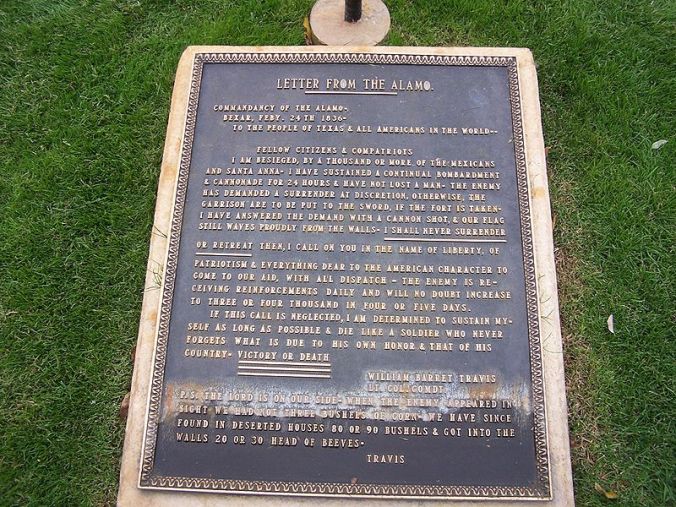
As story of the Alamo heads to its bloody and legendary climax on March 6, 1836, commenter Michael West filed another update on what transpired on yesterday’s date, March 1, but corresponding to today, because 1936 was a Leap Year. Michael’s running account is indispensable, and I am so grateful for it. He writes,
March 1, 1836: The Alamo defenders are down to their last 5 full days.
The “Mina Volunteers” — a militia unit from Bastrop, Texas—departs for the rendezvous in Gonzales. Captain Joseph Lynch begins recruiting up and down the Brazos River to form a company and march to Gonzales. Captain Phil Coe does the same up and down the Colorado River. Captain Robert McNutt and his 2nd in Command Gibson Kuykendall activate a company in San Felipe (west of what would eventually be Houston).
These are just a handful of the many companies gathering across Texas as rapidly as they could to make their way in answer to Colonel Travis’s plea for aid, all while the civil drama plays out in Washington-on-the-Brazos. Texas’s Declaration of Independence, to be officially declared the next day, was finalized by George Childress.
Behind enemy lines, south of Urrea’s “Coastal Column” a somewhat interesting character, Dr. Grant, and the fledgling remains of his wild mission to raise a rebellion in Matamoros continues to wander north, soon to meet its fate in a far less spectacular end that Grant probably had envisioned for himself. Meanwhile, at the Alamo, the truce apparently has come to an end as Santa Ana noted the Texans fired a cannon, ending the truce and apparently cancelling any offer of amnesty he had made. In further Alamo lore involving a fact that seemed too perfect to be true, the shot from one the cannons fired that day actually struck the house that the dictator was occupying.
Santa Ana’s army was still not at full strength, and was not expected until the 3rd of March.
The most distant Texan reinforcements were about 150 miles from the Alamo, the rest closer. At a rate of about 30 miles per day on horseback, the farthest reinforcements could reach the Alamo in five days. As the men rushed westward with all their zeal, they would have been quietly reminded that they were each groups of 15 to 45 men charging headlong out of wooded terrain and into open prairies, towards a Mexican army of several thousand.
Now in more mundane and present day ethics matters;
1. Now THIS is hubris! Talk about not knowing your lane…Dr. Bruce Glavovic, 61, a professor at Massey University in New Zealand, has joined two colleagues in the field of environmental research to declare, in an academic journal, that climate scientists should stage a mass walkout and stop their research until nations take action on global warming. Continue reading →
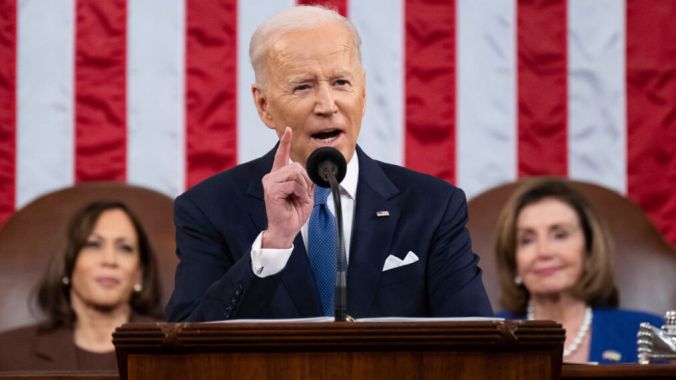
“So on this night, in our 245th year as a nation, I have come to report on the State of the Union. And my report is this: the State of the Union is strong—because you, the American people, are strong. We are stronger today than we were a year ago.”
—President Joe Biden in his State of the Union speech before Congress last night, talking nonsense.
I mentioned yesterday that I would have gained respect for Joe Biden if he had the integrity to say last night, as Gerald Ford did in 1975, “The State of the Union is not good.” I did not expect him to do so, because Biden has no integrity, as the rest of his speech proved.
Unlike most SOTU messages, Biden waited until the very end to give the report to Congress that is supposedly the justification for the whole useless, increasingly embarrassing ritual. Doing so, he might as well have said, “Everything I’ve said before this is calculated dishonesty, just like this false assessment of our nation’s state. But what else am I supposed to do?” One astute wag wrote that the unspoken message of Biden’s speech was perfectly embodied in this immortal “Animal House” clip:
Who, including Biden, could possibly believe that the State of the Union is anything other than in deep, deep trouble, or that—this is even more ridiculous—that it is “stronger today than we were a year ago”? By what measure could that be true?
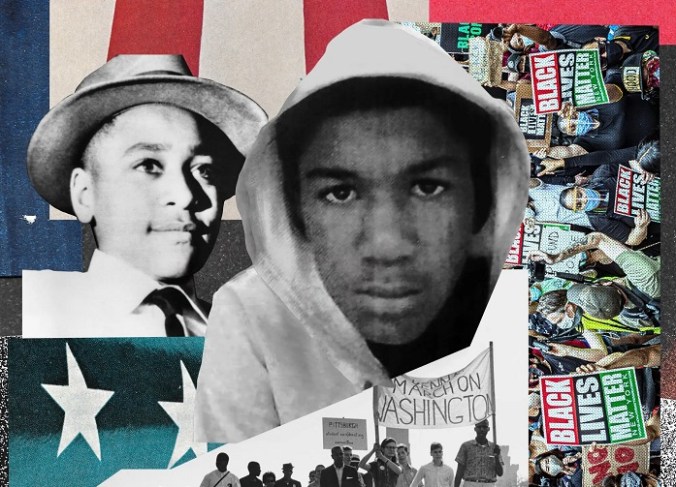
It is not exactly an upset that this column, as dishonest and irresponsible as any I have seen in the New York Times, which is saying a lot, came from the poisoned, bitter and unscrupulous mind of Charles M. Blow. Blow, the most consistently unethical of the Times huge reserve of unethical pundits, never lets fairness and facts get in the way of an anti-white, anti-cop, anti-Republican diatribe when he isn’t writing weekly Trump-hate pieces as he did for four years, nearly without pause. But this week’s column, outrageously coupling a photo of Trayvon Martin with Emmet Till, is special.
Let’s start with the headline: “Trayvon Martin Is Still Making America Confront Its Original Sin.” That’s a lot of misinformation for a headline. The “original sin,” of course, is slavery, this being the New York Times, where Nicole Hannah-Jones contrived the fake history-based “1619 Project” that claimed the United States was created to protect slavery. Slavery was neither original with the American colonies nor did American history begin with the practice, and Blow’s analogy (which was also endorsed by Barack Obama) with “original sin” is a core part of the anti-American theme of Critical Race Theory. That anti-white, anti-American tool holds that nothing the nation has done or can do will erase or compensate for slavery and its long-lasting side-effects, though perpetual white guilt and a special set of standards making African-Americans permanent beneficiaries of legal and society favoritism is absolutely required.
“You may encounter many defeats, but you must not be defeated.” That quote, from Maya Angelou, inspired The Undefeated, an ESPN media platform that, from its start in 2016, has helped shape the national conversation by exploring the intersection of race, sports and culture from a Black point of view. On Monday, ESPN said it would rebrand and expand the operation, which will now go by the name … Andscape…
“It’s time to talk about Black and everything,” Raina Kelley, Andscape’s editor in chief, said in a phone interview. “Far beyond just sports and athletes.” She continued: “How do you be an individual as a Black person in America with your own unique set of interests, some of which are bound together by melanin, but not all of them? And how do you feel whole? We wanted to create a space where Black people could be Black people: Black led, Black P.O.V., absolutely. But also where there were no definitions and no rules about what being Black meant, what you had to talk about.”
I know I’ve run this SNL clip on other March Firsts, but a) it always makes me laugh and I need a laugh today, and 2) it always provokes ethics reflections.
For example, I think about how much healthier the nation’s culture was when its primary weekly source of current events satire was devoted to making all Americans laugh rather than pursuing a one-sided ideological agenda, as it does now. Then there is the brilliant John Belushi, who robbed himself of a career of almost unlimited potential and his nation of the many joys that career would have generated by deliberately violating drug laws that would have kept him alive, if he hadn’t been persuaded by a drug-loving culture that insisted that recreational drugs were cool. Now, of course, our laws send completely muddled messages that ensure that more talented Americans meet Belushi’s sad end than fewer.
In the U.S., ethics came in like a lion, and is going out like a blind shrew rat…
1. Unethical Quote the New Month: President Biden. (I should probably highlight this with a full post, but there is too much political news on the ethics horizon today, so I’m trying to lessen the load.) During a Black History Month event as the White House, the President who promised to heal divisions in society and bridge the partisan divide, said,
“We’re protecting our country’s threshold liberty, the sacred right to vote, which I’ve never seen as under such attack.You know, it’s always made it harder for blacks to vote but this is trying to be able to figure out how to keep the black vote, when it occurs, from even counting.”
Trying to prevent the black vote from counting! No misinformation there! Restricting unlimited mail-in ballots, banning vote harvesting, limiting early voting and drop-boxes, and requiring photo IDs at polls constitutes an “attack” on the sacred right to vote, says the President of the United States.
Among of the most emotionally resonant and thrilling moments in movies are when a large group spontaneously expresses unity of mind, loyalty, sentiment, or just the joy of living by lifting up their voices in song, as one. A healthy society should engender such moments and nourish the shared values and emotions that create them.
What today could prompt a large group to sing together today? The National Anthem once provided such moments, but the NFL has aided race-separatists by forcing the so-called “Black National Anthem” to compete with the “Star-Spangled Banner,” making it, despicably, a “white national anthem.” Today’s preeminent musical form, hip-hop, doesn’t lend itself to mass singalongs.
Here are six memorable examples from the Hollywood archives of movies celebrating the human instinct to burst into shared intense feeling, expressed in song. Incredibly, I found none of these classics in various on-line lists of “greatest movie crowd singing scenes.” The people who put together those lists don’t get it (and also don’t know classic films.) No, the “Wayne’s World’ lip-syncing of “Bohemian Rhapsody” doesn’t qualify, great as it is. It’s not a crowd scene, and Queen is doing all the singing anyway.
The Ethics Alarms top six, in random order:
1. From “The Sound of Music”:“Edelweiss”
This is the only entry from a musical, but the context is entirely dramatic, and the scene could have easily been in a straight drama. The Nazis have taken over Austria. Captain Von Trapp (Christoper Plummer), ordered to take his place in the Nazi navy, mourns the end of the Austria he knew, and knows that his fellow Austrians watching his family perform in a music festival as the uniformed Nazis loom over them, share his sentiments. He sings a simple Austrian folk tune, manages to give the audience an opportunity to express their sadness and defiance.
2. From “San Francisco”: “The Battle Hymn of the Republic”
This isn’t even the best crowd singing moment in the great 1936 Clark Gable/Spencer Tracy/Jeanette McDonald movie that climaxes with the San Francisco earthquake of 1906. At the end of the film, Gable, a cynical rogue whose romance with opera singer McDonald has foundered on his rejection of religion, has searched for her in the ravaged city. He finds her alive and helping survivors, and is so moved that he thanks God for the first time in his life. Then the news comes that the fire is out, and the people of San Francisco resolve to rebuild their city bigger and better than ever, as Jeanette leads them in song…
That’s Ukrainian model Tetiana Gaidar above, nicely symbolizing what old guy Vladimir Putin didn’t get about launching an unethical war in 2022.
Because of social media, 24-7 cable news and the web, world public opinion can–can—quickly coalesce around basic ethical values and arrive at a crushing consensus. Putin is being personally cancelled, and if his nation’s people decide they don’t want to be cancelled too, he might be in bigger trouble that he could have imagined in his worst nightmares. Ethics Alarms already mentioned how Putin forgot the Alamo, always a bad thing to do. He apparently also had forgotten that one of the big cracks in the Iron Curtain was inflicted when Ronald Reagan termed the Soviet Union an “Evil Empire.”
Economist John Kenneth Galbraith, writing in the Sixties about what made huge corporations successful, argued that they created nation-like loyalties by behaving as good corporate citizens, and that there was a crucial benefit in this that went beyond mere profit. The best people, he claimed, would not work for companies perceived as unethical, so becoming an organization that the best and the brightest would be proud to be part of was a matter of long-term survival.
Galbraith, was we have seen, was overly optimistic, but his general point is still important, particularly at the extremes. Too late, Putin is trying to save his reputation by trying the absurd cognitive dissonance trick of associating the Ukraine government with Nazis. It’s not working, because it is so obviously a self-serving lie.
1. If only baseball writers read Ethics Alarms...(or knew what ethics was, for that matter). More than five years after Ethics Alarms explained why Red Sox icon David Ortiz created an unavoidable slippery slope likely to carry Barry Bonds and the other steroid cheat superstars into baseball’s Hall of Fame, esteemed baseball writer Bob Nightengale figured it out, and just announced his brilliant analysis in USA Today. Ortiz was recently voted into the Hall, as EA noted here in the follow-up to the original article. [Much thanks to Jutgory for alerting me to Nightengale’s piece]
See? I’m smart! Not dumb everybody says… I’m smart and I want respect!
2. If the Republicans are going to publicly shun Liz Cheney for joining the political witch trials the Democrats are holding on the January 6 riots, they have no excuse not to take even more decisive action against the GOP Congress members Reps. Marjorie Taylor Greene and Paul Gosar, and AZ State Senator Wendy Rogers, for openly supporting Nick Fuentes, a Holocaust denier who has been correctly labeled a “white supremacist” by the Justice Department, and his organization, the America First Political Action Conference. Republican Gosar and Greene both attended the group’s conference this weekend, and both addressed the all-white throng, which engaged in such fun activities as applauding for Russia for its invasion of Ukraine, and chanting “Putin, Putin!”Continue reading →
1. Remember, we pay for this garbage...An article on NPR‘s “Life Kit” offered helpful suggestions about ways suffering Americans might deal with the crippling stress and anxiety of sitting safely at home in the United States as Ukrainians are fighting for their lives and freedom. Like…
“Do something that feels good for your body and helps you get out of your head….”
[Play] games with family,”
[F]inally re-create Grandpa’s famous lasagna, or learn how to make a prettier pie…”
Joy Behar wrapped up the award for most narcissistic and selfish response to the Ukraine crisis, but NPR is a tax-supported organization, and has decided that enabling American weenie-ism and creating a culture dominated by hyper-vulnerable, self-absorbed navel-gazers is its mission.
1. An animated TV show’s demonstration of support for an invaded nation is, of course, as useless as Michelle Obama’s infamous frowny face “Bring back our girls” photo, and is naked virtue signaling. Still, the hostility to the show for the gesture displayed by ultra-conservative Citizen’s Free Press readers is remarkable.There can be no ethical basis for not supporting Ukraine, or any country Russia invades, or any peaceful nation any country invades. Representative reaction: “Russia = Evil, Because: Trump. Thus, Ukraine isn’t an UNBELIEVABLY CORRUPT FAILED STATE… Ukraine is Saints. Might want to be somewhat skeptical and cynical when Biden, the MSM, and Hollywood is all trying to brainwash everyone into being pro-Ukraine, huh?” Wow. I didn’t know Tucker Carlson had this much influence.
It is a all a necessary reminder that the far right is just as unhinged as the far Left, just less totalitarian (for now).
There are other stories making the rounds…One has it that Trump — noting that Putin seized land from Georgia when George W. Bush was president and seized the Crimean peninsula when Barack Obama was president — warned Putin against a land grab on his watch.
“If you move against Ukraine while I’m president,” Trump is said to have told the Russian leader, “I will hit Moscow.” Putin reportedly scoffed, “No way,” leading Trump to say, “All those beautiful golden turrets will be blown up.”
[Also] Trump reportedly told Xi that any military move against Taiwan would be met with an attack on Beijing. Xi, like Putin, is said to have been stunned…
This unsubstantiated rumor is being reported in many conservative websites as fact. This is deceptive in the extreme. Goodwin says up front that the stories may be false, and he is a columnist, not a reporter. Yet other publications say that “‘The New York Post’ reported that…” using as evidence Trump’s statement to Fox News’ Laura Ingraham that Putin didn’t invade Ukraine during his administration for “a very good reason, and I’ll explain that to you someday.”
I think the story could easily be true, but it’s still a rumor, and should not be reported as fact or as a credible report. Continue reading →