Michael West’s latest Comment of the Day was a provocative note relating to the recent post marking the execution of Capt. Henry Wirz, the Confederate commander of the infamous Andersonville prison camp and the defendant in the first American war crimes trial. Apart from the information, his comment also prompted some research and thought on my part. There are ethical conundrums afoot.
And there’s a monument in memory of Henry Wirz smack dab in the middle of the “main” intersection of Andersonville. The town, which literally had NO connection to Wirz outside of circumstance…has a monument to the man. At least when Southerners were given the option to erect monuments and name installations, they generally associated places with Southerners who had geographic connections with the locale.
Like Fort Bennin: with a military career earning no more than a “yeah, he was there” mention, Fort Benning is named after a man who happened to be born near there. But Henry Wirz gets a monument in the town associated with his notoriety. Perhaps it would be fair to let his monument be the last torn down by the history-eaters, if only to remember that lethal scapegoating is wrong, however temporarily useful.
The examination of the New York Times’ disgraceful editorial of October 26, “The Republican Party’s Supreme Court,” continues. The first section is here;Part I of “A False Narrative Exposed” is here.
“It was never about the supposed mistreatment that Robert Bork, a Reagan nominee, suffered at the hands of Senate Democrats in 1987. That nomination played out exactly as it should have. Senate Democrats gave Judge Bork a full hearing, during which millions of Americans got to experience firsthand his extremist views on the Constitution and federal law. He received an up-or-down vote on the Senate floor, where his nomination was defeated by Democrats and Republicans together. President Ronald Reagan came back with a more mainstream choice, Anthony Kennedy, and Democrats voted to confirm him nine months before the election. Compare that with Republicans’ 2016 blockade of Judge Merrick Garland, whom they refused even to consider, much less to vote on: One was an exercise in a divided but functioning government, the other an exercise in partisan brute force.”
Garland again! Returning to this anomalous and reckless gambit by McConnell signals that the Times has no genuine arguments other than rationalizations. The argument stated amounts to “they rejected our guy’s qualified judge, so we should have been able to reject their guy’s qualified justice!” (Pssst! Times editors! You’re supposed to be objective journalists. You’re not supposed to have a “guy.”)
But the worst is “supposed mistreatment.” Supposed? Here’s the infamous and slander suit-worthy attack on Bork by Senator Ted Kennedy:
“Robert Bork’s America is a land in which women would be forced into back-alley abortions, blacks would sit at segregated lunch counters, rogue police could break down citizens’ doors in midnight raids, schoolchildren could not be taught about evolution, writers and artists would be censored at the whim of government, and the doors of the federal courts would be shut on the fingers of millions of citizens for whom the judiciary is often the only protector of the individual rights that are the heart of our democracy.”
No nominated judge had previously been subjected to insults in this manner, and no judge was after until the Democratics again stooped to such depths in their savaging of Brett Kavanaugh. Robert Bork was a conservative justice, but Justice Antonin Scalia was equally conservative if not more, and Bork was acknowledged to be brilliant by friend and foe. Bork was an intellectual, not an ideologue, and he believed in stare decisus, meaning that he was not a threat to vote to overturn established precedent, as Senator Kennedy, who might have been challenged to have graduate from a correspondence law school, implied. Had the tradition that existed before the Senate Democrats slimed Robert Bork not been obliterated, and the wise rule that if a President nominated a qualified judge for the Court, that judge was confirmed in a bipartisan vote, both Garland and Barrett would have glided through confirmations.
“How will a Justice Barrett rule? The mad dash of her confirmation process tells you all you need to know.”
This is called “not answering the question.” The Times doesn’t know; nobody knows. Trump’s previous two nominations to SCOTUS have surprised, so has Chief Justice Roberts; so have many previous Justices, like Souter, Blackmun, Powell, and others. Interestingly, it is almost always the conservative judges who show the ability to decide cases on their merits rather than knee-jerk ideology, angering the knee-jerk ideologues on the right.
“Republicans pretended that she was not the anti-abortion hard-liner they have all been pining for, but they betrayed themselves with the sheer aggressiveness of their drive to get her seated on the nation’s highest court. Even before Monday’s vote, Republican presidents had appointed 14 of the previous 18 justices. The court has had a majority of Republican-appointed justices for half a century. But it is now as conservative as it has been since the 1930s.”
Again, this is a flat-out misrepresentation. So far, the Roberts Court has not been extremely conservative in its rulings.
The reason for the choice of song will reveal itself at the end of the post…
1. No 2020 Election Train Wreck update this morning, because there are only a few items to report. One stinker from yesterday: the New York Times had an across-the-front page, “This is important!” headline that read, “ELECTION OFFICIALS NATIONWIDE FIND NO FRAUD.”
How did the Times’ ethics fall so far, so fast? That headline is pure propaganda, deceitful on its face. Do the editors think even the most partisan of their readers are that gullible?
2. Then there’s the Washington Post. I almost hate to post this after trying to talk commenter of the day Steve Witherspoon off the ledge in the previous Ethics Alarms entry. USPS whistleblower Richard Hopkins has demanded Tuesday that the false Washington Post story claiming he ‘recanted’ his sword statement regarding directions he was given by his Erie, PA postmaster to backdate ballots mailed after Election Day. He did not recant. In a video, the veteran says,
“My name is Richard Hopkins, I’m a postal employee who came out and whistleblew on the Erie, Pennsylvania postal service, postal office. I am right at this very moment looking at an article written by the Washington Post—it says that I fabricated the allegations of ballot tampering. I’m here to say that I did not recant my statements, that didn’t happen, that is not what happened. You will find out tomorrow, and I would like that the Washington Post recant their wonderful little article that they decided to throw out there, out at random.”
He has been placed on non-pay status by the Erie Post Office, which seems like a violation of whistle-blower laws to me, but I haven’t checked. GoFundMe, based on the Post story, erased the effort to provide him and his family financial support while he is being punished by the USPS.
Steve Witherspoon gets a Comment of the Day nod for a frank expression of his current state of mind, which I’m sure mirrors that of many citizens right now. He’s wrong to be so despairing, because despair is always wrong, and more importantly, it has not been the American way, even in times far, far darker and more ominous than these.
“Hope is dead” he writes. Hope is dead? “That way madness lies,” King Lear said, and the crazy old coot was right for once. Sure, there’s a lot to worry about; there always is. But the American spirit is strong. As long as this race—the American race, which comes in all colors—refuses to be pushed around, and it does, Steve’s gloom will be unwarranted.
I have written too many posts perhaps, and I know regular readers notice a few stories I have cited more than once. This one I am sure I have referenced before, if not in a post then in a comment (incidentally, Ethics Alarms passed 300,000 comments this week!), but when I’m feeling like Steve is this morning, it’s one of American moments that reminds me that there is hope, and why.
When Jimmy Carter, a President we elected when America was momentarily sick of Presidents, lectured the nation in a televised address about sacrifice and doing with less, he told everyone to lower their thermostats in the dead of winter (I don’t recall how low, but the idea was “wear a sweater”). This was because the U.S. was running out of oil and at the mercy of the Middle East cabal, or so we were told. (Windmills and solar panels would solve it all, of course.) All of the media talking heads were nodding like those stupid plastic dogs people used to have in rear windows of their cars. Then a local reporter went into the public square to interview a “man in the street,” who was NOT run down by a lorry like the “man in the street” interviewed on a Monty Python episode. This particular man was asked if he was going to lower his thermostat as President Carter asked/begged/commanded.
The answer was vociferous. “Lower it? Hell, I’m going to raise it. Who the hell is the President to tell me what I can do in my own home?” The interviewer was stunned, and my father started applauding and laughing.
“There it is!” he said. “That’s what I was fighting for! How does someone become President who understands so little about his own country?”
Good question, Dad. Donald Trump, for all of his flaws, gets that aspect of the American spirit at least. The Axis of Unethical Conduct’s four-year Operation Get Trump may have succeeded, smashing ethical principles left and right, but the Democrats and progressives got clobbered in this election. If they don’t heed the obvious warning, they will be clobbered worse in the next one. The sane Democrats know it. Yes, the news media is a big, big problem, perhaps most of the problem, but the fact is that the people who run these news organizations just aren’t very smart: the whole profession of journalism has always attracted mediocre minds. Look what Fox News has done to itself in a single year. Don’t worry too much Steve. They are mostly morons.
“Maybe a couple of cups of coffee will lift this morning’s veil of darkness and improve the psyche.,” Steve concludes. That usually works for me—that, a stirring rendition of a Sousa march, Judy singing “Zing Went The Strings of My Heart” in Carnegie Hall, or seeing the Duke tell Lucky New Pepper, “Fill your hand you sonofabitch!” as he jams the reins of his horse in his mouth and charges, guns blazing.
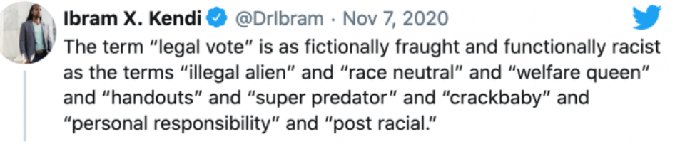
Ibram X. Kendi, the proud author of this neon-bright example of Rationalization #64, Yoo’s Rationalization or “It isn’t what it is,” isn’t just some radical, mind-poisoning, far left ideologue pseudo-intellectual race-baiting wacko. He’s a radical, mind-poisoning, far left ideologue pseudo-intellectual race-baiting wacko who will soon have been twisting young American brains into un-American pretzels for a full decade, fueling the descent of the Democratic Party and the rest of the mutating Left into full Orwellian lunacy.
The tweet should be res ipsa loquitur; no one should have to debunk it, because it is self-debunking. I have to admit, when Andrew McCarthy argued here that the Democratic mantra of “every vote counts” would be used to claim that illegal votes should count while the party continued its long strategy of tarring efforts to prevent illegal voting as voter suppression, I regarded the claim as a bit of pessimistic hyperbole uncharacteristic of the usually-sober and analytical legal expert. Yet here is Kendi, saying it outright: It is racist to insist that votes be legal, just as it is racist to insist that immigrants don’t break our laws by coming here. What a brilliant way to deny voter fraud! There is no such thing! Stuffing the ballot box (or, in the current madness, envelopes) with phony votes is a just a means of achieving racial justice, and thus treating the practice as illegal is racist.
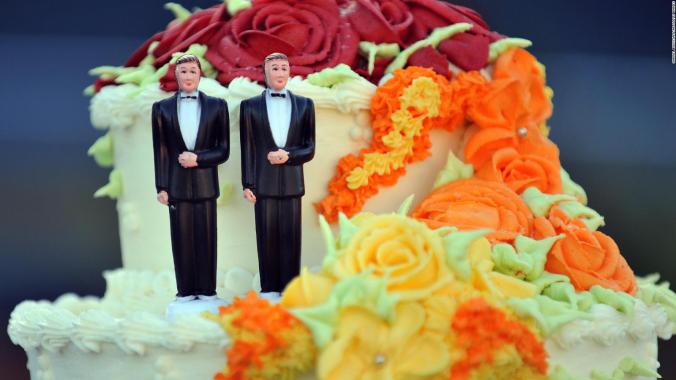
In Fulton v. City of Philadelphia the U.S. Supreme Court will decide yet another legal controversy that should not have occurred at all. Like the various cake-designing law suits, two parties that easily could have come to a mutually agreeable compromise decided, as the old saw goes, “to make a federal case of it.” Now, with the decision bound to abridge somebody’s constitutional right, we will have yet another example of how “Hard cases make bad law.”
This week the Justices heard arguments testing its 2015 decision establishing a right to same-sex marriage with Philadelphia’s decision to bar a Catholic agency that it had hired to screen potential foster parents because the agency refused to screen same-sex couples and approve them, since the position of the Church is that same-sex marriage is a sin. Hence the question: Is Philadelphia discriminating on the basis of religion by refusing to continue using the agency based on its religious mandates? The Church’s lawyer, Lori Windham, says that the agency only wants to continue work that it has been doing for centuries. Besides, she argued, gay couple had ever applied to the agency. If one had, she said, the couple would have been referred to another agency.
What’s the beef, then? Justice Alito says that like the bakery cases (my comparison, not his), LBGT activists want to bend the Church to its will, resulting in Philadelphia acting based on hostility to the Catholic agency’s views.
1. Here’s an 1995 ethics movie to while away the time while waiting for more voter fraud theories: “Crimson Tide.” It has long been a favorite in the Marshall household because of the nuclear submarine captain’s (Gene Hackman) Jack Russell Terrier. Sometimes focusing on a film’s ethics lessons makes it new again, and that was the case when we revisited the film after several years.
The plot involves an ethics conflict with bite: should the sub’s Ex-O submit to his captain’s call that a previous order to launch nuclear missiles at Russia must be followed even though an incomplete message that may be a retraction of the order is in hand? The anti-war second-in-command, played by Denzel Washington, believes that the non-launch scenario must be the default assumption. Different ethics systems and military principles point to different choices, and in the end, all we have is moral luck. If the Russian rebel commander has launched missiles at the US, as he has promised to do, before the sub’s preemptive attack can take them out, Washington’s values have killed a million Americans. If the order was retracted and Hackman launches as the original orders directed, he’s started World War III in error.
One criticism that doesn’t give away the ending: I do not like Hackman’s final reaction on the sub when the truth is revealed. It’s petty, and less than I expected from his character.
2. And now, the rest of the story. The mess we discussed here over San Francisco’s planned memorial to poet Maya Angelou ended this week with the original design being re-approved, after some judicious playing of the Race Card.
I have now seen several reports that Joe Biden is certain to be elected. This is fake news—a lie—and needs to be debunked immediately, not that it’s difficult. Many are pushing the narrative: Chris Wallace, who has pretty much outed himself as a biased, anti-Trump hack this election cycle, stated as fact that if the former VP wins Nevada and Michigan, he’s the next President. Apparently Chris can’t add.
I can, at least better than Chris. The President at this point has 214 electoral votes, fewer than Biden’s 253. he is certain to win Alaska’s 3 votes, making his total 217.
Even Nate Silver, CNN and MSNBC have conceded today that it looks like Trump may pull out a win in Arizona, winning 10 more electoral votes there. That makes 227.
By the way: good election night state-calling there, AP and Fox News.
Trump has to win North Carolina and Georgia, where it is close, but he is leading in both states with only 5% left to count. That’s 31 more in the Electoral College, giving him 258.
At that point, Pennsylvania, where the President is also leading, would give Donald Trump re-election with 8 votes to spare.
This is far from a certain scenario, but it isn’t unlikely either. And we’re not even considering whether the suspicious vote totals in Wisconsin and Michigan stand up to scrutiny.
1. I had written some time ago that the best possible outcome ethically would be a Trump landslide, and the worst would be a Trump win in the Electoral College while losing the popular vote. Somehow I missed the obvious worst scenario, which is what we are getting: a mega-2000 mess, with multiple states in doubt for various questionable factors, resulting in litigation by both sides, stretching on into December.
This was one more example of how the false and biased polls interfered with legitimate analysis.
2. I have frequently praised Richard Nixon for passing on the opportunity to challenge the results in Illinois, Texas and other states after the 1960 election, and saying that it was more important to respect the process and not throw an election into turmoil. Of course, based on what we know about Nixon. That may have been a ploy and virtue signaling: while there was certainly some voting shenanigans, notably in Richard Daley’s notoriously corrupt Chicago, Nixon maybe have been told that he would lose anyway, and that challenging the results would make it harder for him to come back and win in ’64 or ’68. Nonetheless, Nixon set the norm, and Al Gore broke it in 2000. Now it seems insane for a party to not to challenge a close election if there seems to be any question about the legitimacy of the result.
That shift is also a reflection of the widening chasm between the two parties. There wasn’t much difference philosophically between the Democrats and Republicans in 1960, nor between Nixon and Kennedy. (There wasn’t much difference between their ethical instincts either, but we didn’t know that at the time.) Today there is every reason to believe that for a party to just shrug off the possibility that a Presidency has been stolen in the best interests of the nation is a breach of duty and a betrayal of the public trust.
However, a party (like the Democrats since 2016) or a candidate (like Hillary Clinton) continuing to deny the results after they have been validated is unforgivable and destructive.
Tip: The most important observation is the last one.
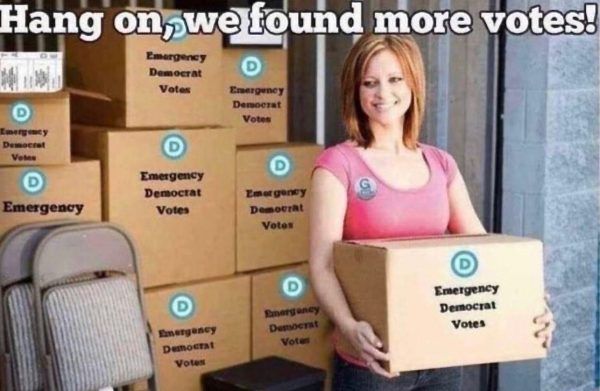
1. In the hours between when I started the last post when I got back out of bed two-and-a half hours later, two crucial states where the President was shown leading flipped to narrow leads for Biden. This does not prove or even suggest chicanery, but under the circumstances it looks bad. (“Gee, they cheat fast!” was a comment on one of the conservative blogs following the election live.) The meme above may be unfair, but it accurately expresses what went through my mind when I saw the new totals.
This is why it is unethical to create “the appearance of impropriety” if you have anything to do with the government. People need to trust the government, its institutions, and the fairness and openness of elections. The appearance of impropriety is just as damaging as actual impropriety. We have already seen this in the aftermath of the Mueller investigation and the prosecution of General Flynn.
2. Both parties have worked to deliberately create suspicion about the political process, and the decision to vastly increase the use of mail-in ballots, in what should have been recognized as a close election, knowing that doing so would delay the process, create opportunity for mischief, and keep the results of the election mired in uncertainty for days and even weeks was either epically incompetent or sinister. Now, instead of the single state having a “too close to call” vote total with the Presidency hanging in the balance as in 2000, we have six, which will presumably multiply litigation and uncertainty. That’s a disaster, no matter what the final result is, and it is a disaster that should have been avoided at all costs. It was unethical and negligent not to avoid it at all costs.