Morning Ethics Warm-Up: 7/21/17

Good Morning!

1. There was one of those moments in a Major League Baseball game yesterday that teaches life lessons in character, and ethics for anyone who is paying attention.

The Boston Red Sox were playing the Toronto Blue Jays in an afternoon game at Fenway Park. Boston led 3-1 in the second inning, but the Red Sox pitcher,  veteran Doug Fister, was struggling with an uncharacteristic control lapse: he walked his third batter in the inning, and also had given up a couple of hard-hit balls that suggested that a gaggle of runs and a blown lead were inevitable. Then, mirabile dictu, Fister caught a break. The next Toronto batter swung mightily and lofted an easy, lazy pop-up to the infield. If there had been one out rather than two, it would have been called an automatic out under the Infield Fly Rule. Everyone, including Fister, who is fighting to preserve his spot on the Sox roster as well as his flagging career, breathed a sigh of relief. The Toronto batter slammed his bat to the ground. Settling under a pop-up not any more difficult than those he had successfully caught as a Little Leaguer was Red Sox utility man Brock Holt, a second baseman this day. He is much admired for his versatility, energy and reliability. Holt is also trying to revive his career after a frightening, season-long battle with vertigo, as well as to show the team that he can fill a yawning void at third base.

Holt dropped the ball. It bounced off his glove, as the Toronto baserunners were charging around the bases at the crack of the bat, since there were already two outs. Two of them scored, and later two more after Fister surrendered hits in te lengthened inning, making the bounty bestowed by Holt’s muff four runs. Fister was soon out of the game, and was charged with his team’s eventual two-run loss by an 8-6 score. (Today’s headline in Boston: “Doug Fister’s Future As Starter Uncertain After Loss To Jays”).

Yet Fister never shot an angry glance at Holt. He’s played the game; he knows how mistakes and random bad luck can turn everything around in an instant. He probably has dropped a similar ball in a crucial situation: I know I’ve done it, at second base, losing a company soft-ball game. Holt trotted to the dugout, got supportive pats on the back and fanny from his team mates, and played the rest of the game with his head high and his skills on display. There is no doubt that he felt terribly about the play, but Holt  didn’t hide under a rock, rend his garments, or make a big display of anger and frustration to signal to the hometown crowd—which didn’t boo or jeer him at any point in the game.

That’s life, as my father used to say, and this is how ethical people handle life. Disaster strikes out of a confluence of factors (a very bright sun undoubtedly helped Holt miss the ball, but professional ballplayers learn to cope with the sun) and all we can do, if we are competent at life as well as fair, responsible and brave, is to accept responsibility, not make excuses, and not allow such events to diminish or destroy us. Both Fister and Holt displayed the character necessary to do that. Neither blamed the other, and no one blamed them. Tomorrow is another day.

Play Ball!

2. Professional troll Ann Coulter is having a public spat with Delta Airlines that reflects badly on both of them. Continue reading


Unethical Quote Of The Day: Valerie Joseph, Wheelchair-Bound Uber User And Class Action Litigant

“I feel frustrated because I have to plan my day.I can’t do things on a whim. I have to plan it days in advance.”

Valerie Joseph, litigant in  class-action lawsuit accusing Uber of discriminating against New York City riders with disabilities by providing inadequate access to wheelchair-accessible cars .

Could there possibly be a better quote to exemplify the entitled mentality of so many Americans, and the unethical values they have somehow extracted from our political culture?

Yes, Valerie, you are handicapped. I’m sorry about that, but I’m not responsible for it. Nor are you entitled to make me, and businesses, and the government pay to ensure that society can mitigate every inconvenience created by your misfortune. You do not have the luxury of doing things “on a whim.” Neither do single mothers. Neither do small business entrepreneurs who have substantial debt. It’s your life, deal with it. I also have to plan my days because of circumstances beyond my control. It’s called adulthood. Grow the hell up.

The lawsuit Valerie champions, filed in State Supreme Court in Manhattan by the non-profit Disability Rights Advocates is a classic. It is seeking to risk putting Uber out of business and remove its lower-cost transportation options for the vast, vast majority of the public by insisting on expensive retrofitting of the company’s cars that would benefit a tiny minority.

The Taxis for All Campaign filed a similar discrimination lawsuit over yellow taxis, virtual legal extortion that resulted in a settlement requiring half of all yellow taxis to be wheelchair accessible by 2020. Thus the litigants in the Uber suit already have an acceptable option: call a cab.  There are now 655 wheelchair accessible taxis in the New York city area.  I’d love to see statistics on how often they are used by the passengers they are designed to serve.  My guess: not that often. As much as anything else, this is an interest group power-play. It is discrimination, they insist,  if handicapped passengers have to wait longer than non-handicapped. New York’s Taxi and Limousine Commission has proposed broad new requirements for wheelchair-accessible service for the entire for-hire industry including Uber and the other ride-hail companies. Naturally: they want to put ride-sharing companies out of business, and this could do it. Continue reading

Morning Ethics Warm-Up: 7/20/17

Καλημέρα!

[This is pronounced “Kaliméra!,” not to be confused with “Calamari!” My father frequently got them confused when he visited Greece with my mom, the former Eleanor Coulouris, and embarrassed her by greeting the natives some mornings by cheerily saying, “Squid!]

1. The newspaper Arts section headline says, “Mayor Ties Arts Money To Diversity.”

The mayor in question is New York City’s DeBlasio, and since his own family is “diverse,” naturally every other entity has to be, or it is baaaad. This is why I oppose government funding of the arts unless it guarantees that the nation, state or city will not attempt to use its support to control the arts organizations in any way.  Of course, governments will never do that, because manipulating the arts to advance  political agendas is usually the underlying motive in arts grants. Ideologues like De Blasio—wow, he’s terrible—will constantly be grandstanding and doing everything in their power to manipulate artists and their art to ensure that they send the “right” messages—you know, like Nazi art and Communist art. It is exactly the same theory and practice: art as political indoctrination.

Quick: who thinks that De Blasio will be focusing on “diversity” in the management (or on the website) of the Dance Theater of Harlem? Even if the government doesn’t attach strings to its support, arts organizations know that there are more of them than there is tax-payer money to disperse, so there is terrible and often irrsistable pressure to distort their product to give their state funders what the artists think they want—just to be safe.

My professional theater company refused to do that, sticking to the integrity of our mission and not resorting to tokens and virtue-signalling. My now defunct professional theater company, that is.

2. Yesterday, I highlighted the head-blasting comments of New York Times film critic A.O. Scott and his alternate-universe pronouncements about the Obama presidency. To be fair to A.O., his entire profession is packed with historical and political ignoramuses who make their readers dumber with every review. I once created a theater reviewer’s code of ethics, which I mailed to a critic, who sent it back to me with a note that said, “Mind your own business.” Years ago, I published an essay that was called “Why Professional Reviewers Are Unethical,” that began,

When Variety announced that it was firing its in-house film and drama reviewers, there was much tut-tutting and garment-rending over the impending demise of professional reviewing in magazines, newspapers and TV stations. The villain, the renders cry, lies, as in the Case of the Slowly Dying Newspapers, with the web, which allows any pajama-clad viewer of bootleg videos to write film reviews, and any blogger who cares to write a review of a play. “I think it’s unfortunate that qualified reviewers are being replaced,” said one movie industry pundit, “but that’s what’s happening.”

I say, “Good. It’s about time.”

It’s not happening quickly enough, though. “Dunkirk” is opening this week, and, as I predicted, film reviewers are showing their utter historical ignorance. The Washington Examiner skewers them deftly in an essay called “Why the (True) History of Dunkirk Matters.” Highlights, or rather lowlights:

  • USA Today critic Brian Truitt complains that “the fact that there are only a couple of women and no lead actors of color may rub some the wrong way.” He is not the only film critic to observe this.

Morons.

  • Slate.com critic Dana Stevens claims that the British Army at Dunkirk was the “last bulwark against Nazi invasion of the British mainland.”

Not even close to true. Continue reading

I Finally Saw “O.J.: Made In America,” And I Am Depressed

Inspired by the upcoming parole hearing, in which double knife-murderer O.J. Simpson is expected to be paroled (and should be), I decided to watch a much-praised documentary series that I had thus far avoided.

Ezra Edelman’s “O.J.: Made in America” (not to be confused with “The People v. O.J. Simpson: American Crime Story,”the dramatic TV mini-series starring Cuba Gooding, Jr. as the fallen football great, released the same year ) is a 2016 documentary produced for ESPN Films and their 30 for 30 series. I saw it a few days ago. I’m sorry I did.

Not that the film isn’t excellent, thorough, fair and though-provoking. It is. Nor was there too much in it that surprised me. Simpson defense attorney Carl Douglas gloating over how the defense team unethically and dishonestly altered Simpson’s home to deceive the jury made me want to punch him in his smug face, but I already knew about that outrageous tactic. Seeing Mark Furmin on the stand invoking the Fifth Amendment when he was asked whether he had ever planted evidence at a crime scene made me want to gag, but it made me want to gag when I saw it live. One more time, I was convinced that the prosecution had so botched the case that there was plenty of reasonable doubt for a jury to employ to acquit O.J., just as it was obvious from the trial that he was guilty as sin. All of this I expected.

I did not expect to be so emotionally troubled and ethically disoriented by the conclusion of the film, in which one African-American after another, most of them speaking in the present day, tells the camera with various levels of offensiveness that O.J.’s acquittal was a great moment for black America, a form of redemption, pay-back for centuries of abuse and decades of  discrimination by police and the justice system, proof that the system can work for African Americans and not merely against them, a well-earned poke in the eyes of white America, sweet vengeance and retribution, and a result to be honored and cherished as victory for blacks everywhere.

A prominent minister and civil rights leader actually compares Simpson’s acquittal to Jackie Robinson breaking baseball’s color barrier. I wonder what Robinson would have thought about that comparison. Continue reading

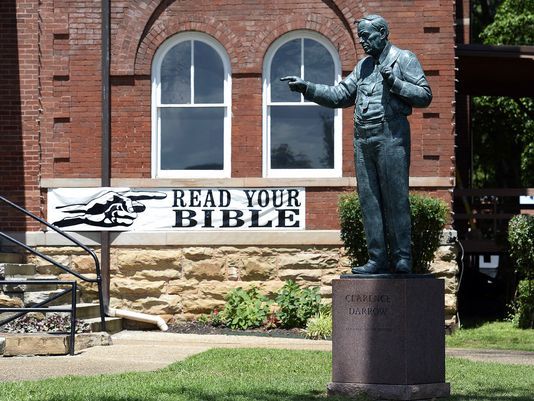
What Clarence Darrow’s Dayton Statue Stands For

Apparently about a third of the population of Tennessee still doesn’t buy Darwin’s Theory of Evolution (according to a 2015 Pew Research Center study) so it should not be too much of a surprise that in Dayton, Tennessee,  site of the famous 1925 Scopes Trial, a newly erected statue of Clarence Darrow in front of the historic red brick courthouse where the trial took place was met with some protests. At a County Commission meeting in the town,  resident Ruth Ann Wilson suggested that bronze Darrow might unleash a plague or a curse. “I rise in opposition to this atheist statue, all right?” she said. “This is very serious, folks.”

No, that isn’t serious, but the persistence of ignorance both generally and about the issues battled over in 1925 are.  Another resident, Brad Putt, is quoted by the New York Times as saying,  “People around here know that if you have a court case, you have to have two sides,” referring to the fact that there has been a Williams Jennings Bryan statue standing in front of the courthouse  since 2005. “You can’t have Optimus Prime unless you have Megatron. You’ve got to have a yin to the yang.” Well, that’s not quite right either, depending on what Bryan and Darrow symbolize. If the idea is to have the most famous opposing counsel in U.S. legal history facing off, okay, that’s fair. If he is saying, as I think he is, that science and religion must counter and balance each other, that’s nonsense. Continue reading

Morning Ethics Warm-Up: 7/18/17

It’s an All-Fred Morning!

Every day, Ethics Alarms head scout Fred sends me multiple suggestions for posts from he finds heaven-know-where. Even when I can’t fit them in, they often serve as references and always are enlightening.

1. I suspect this belongs in the Polarized Nation of Assholes files: For two years, since he returned from service combat zones in Iraq and Afghanistan, Lieutenant Commander Joshua Corney, has kept his promise to salute his fallen comrades in arms by playing a recording of Taps every evening before 8:00 p.m on his five-acre property in Glen Rock, Pennsylvania. It takes 57 seconds. It does not exceed volume limits. My dog barks longer that that every night after midnight when we put him out. Nonetheless, some of Corney’s neighbors have filed objections with the  borough. Now Glen Rock, which allows church bells to ring, among other sounds, ordered Corney to limit the playing of taps to Sundays and what it termed “flag holidays.” Each violation of the borough’s order would bring a criminal fine of 300 dollars. But the borough’s enforcement action involves two big constitutional no-nos: the heckler’s veto and content-based censorship. The borough is relying on a nuisance ordinance that prohibits sound that “annoys or disturbs” others, and just one individual annoyed by the somber Civil War era bugle solo is enough to deliver a “heckler’s veto.’

The ACLU is on the case, and backing Corney as he fights the action. It writes,

“If a “heckler” could shut down anyone who said or played something that annoyed or offended them by complaining to government officials, freedom of speech would be no more. For more than 75 years, it has been black letter First Amendment law that the government cannot censor speech simply because it is not universally appreciated.

Moreover, the borough cannot use its vague nuisance ordinance to single out only Lt. Commander Corney’s musical expression for censorship from the range of sounds that are part of the borough’s regular sonic landscape. The borough has not ordered Lt. Commander Corney to lower the volume of taps or claimed he has violated a noise-level ordinance.

And it could not claim such a violation because the recording neither exceeds any established noise levels nor is it as loud as many other sounds the borough tolerates — including many sounds that do not communicate a message, like lawnmowers, leaf blowers, chainsaws, and vehicles. Censoring clearly protected expression, like taps, for being too loud, while allowing louder sounds that carry no constitutionally protected message turns the First Amendment on its head.”

Bingo. It is in cases like these that the American Civil Liberties Union shows how essential its role is in protecting the freedoms here that are so frequently under attack.

2. I was surprised when I learned some time ago that undercover police officers used to routinely have sexual relations with prostitutes before arresting them (homosexuals too, when they werebeing persecuted and  prosecuted). Just two months ago, Michigan became the last state in the U.S. to make it illegal for police officers to have sexual intercourse with prostitutes in the course of an under-cover (or covers) sting. Now Alaska wants to go an additional step, banning “sexual contact” with “sex workers” entirely. This could be mere touching or kissing. Advocates of Alaska’s House Bill 73 and Senate Bill 112 argue that police catching sex workers in the act by engaging with them sexually is a human rights violation, and Amnesty International has made an official statement supporting that claim: “Such conduct is an abuse of authority and in some instances amounts to rape and/or entrapment.” Police, quite logically, point out that the bill would make  successful undercover investigations impossible, which is, of course, the whole idea.

“[The prostitutes] ask one simple question: ‘Touch my breast.’ OK, I’m out of the car. Done. And the case is over,” Anchorage Police Department Deputy Chief Sean Case told the Alaska Dispatch News in a hypothetical example. “If we make that act (of touching) a misdemeanor, we have absolutely no way of getting involved in that type of arrest.”

Ethics Alarms is anti-prostitution. As with recreational drug use and probably polygamy, prostitution, which harms families and the young women and men exploited and abused to support it, is almost certainly on the road to legalization. Government won’t protect vital society ethics norms, but it will order you to buy health insurance because it’s for your own good. Continue reading

Now THIS Is An Untrustworthy Legislative Staffer…And Incidentally, We’re Doomed

In March of 2016,  Stacey Plaskett, the delegate to the United States House of Representatives from the United States Virgin Islands’s at-large congressional district. entrusted her iPhone and its password to staffer Juan McCullum, who copied nude images and videos of legislator after offering to take the phone to an Apple store for repairs.

After he left Plaskett’s office, McCullum created a Hotmail account and “sent at least eleven e-mail messages to multiple persons, including politicians, members of the media, and other persons known to [Plaskett].” The e-mails contained “one or more of the nude images and videos,” according to this week’s indictment against McCollum. He also created a Facebook account, uploaded the visual content, and then Facebook-friended people in Plaskett’s district to spread the nude images far and wide.

A few questions: Continue reading

The Good Luck Jet Engine Sabotage

China Southern Airlines Flight 380 from Shanghai to Guangzhou was held up at the Shanghai Pudong International Airport after an elderly female passenger threw coins into the plane’s engine to ensure “good luck.” An investigation into the incident is under way, the airlines says.

This bizarre story raises a serious and difficult ethics question. At what point should there be severe societal penalties for egregious life incompetence?

The elderly are obviously the most prone to this sort of thing. At some point many of them just stop paying attention, or lose the ability to keep up. In criminal law, we do not typically punish people for harm they do as a result of ignorance, but there are limits. There have to be.

I have a long delayed post on life competencies on the Ethics Alarms drawing board; it will eventually be a permanent free-standing page, like the Rationalizations List. The topic is difficult. What skills and knowledge are all of us obligated to have, if not master? If our inattention to Continuing Life Education makes us menaces to society, how should society respond? With pity? Sympathy? Compassion? Pat the fools on the head, and give them a stipend?

Being an ethical member of society mandates being able to participate in society’s activities without constantly screwing up. That, in turn, requires a level of personal responsibility. Society needs reasonable, fair, not overly harsh or intrusive ways of persuading everyone to meet this minimum requirement of citizenship. What are they?

It doesn’t have to be as ludicrous as an old lady nearly crashing a jet by throwing good luck coins into its engine, either. As we are increasingly dependent on technology, and as technology moves up a J curve, the damage that can be done by, just to take a wild example that could never happen, someone in a sensitive position using “password” as their computer password, thus enabling a foreign governments to steal confidential data and use it to set off an Ethics Trainwreck, is terrifying. How does a responsible society send a message that is sufficiently persuasive to people before they blunder into chaos ?

I don’t know the answer yet.

I’m just asking.

And now, a song!

Three coins in the engine
Each one risking air distress
Thrown by one stupid granny
How should she pay for the mess?

Three coins in the engine
Each as deadly as the first
There they lie in the engine
See the flames there as they burst!

Which will make the airplane crash?

Three coins in the fountain
Through the turbines how they shine!
Just one wish will be granted
Hope the charred corpse isn’t mine…


________________________

Pointer: Fred

Source: Boing Boing

Ethics Quiz: Should Flat Earthers Be Mocked And Ridiculed? Never Mind, Just Kidding! Of Course They Should…

The Denver Post has an alarming article on the Flat Earthers, a group of Americans who deny astronomy, physics and other known and proven facts about the physical world and universe. They are, says the Post, “thousands strong — perhaps one in every 500 — and have proponents at the highest levels of science, sports, journalism and arts.”

It would be an amusing article, were it not so sad and frightening. These people, who might be nice, kind, and otherwise great neighbors and patriots, are so suspicious and so committed to their own ignorance that they say astounding things, like Cami,  who explains,

“Our YouTube channel gets people to critically think,” she said to the Fort Collins group. “The heliocentric model says that we’re spinning at 1,038 mph. They say you won’t notice it because it’s a continual motion. But you should be able to feel it. You shouldn’t be able to function allegedly spinning that fast.”

Good point, Cami. Continue reading

Morning Ethics Warm-Up: 7/9/17

GOOD MORNING!

1. The Pope gave an interview saying, in Italian of course, that the United States of America, which he offensively grouped with Russia, China, North Korea and Syria, have “a distorted vision of the world.”

The Pope, who has spent the bulk of his adult life seeing the world through the narrowly focused lense of the Catholic Church, and who hails from a South American leftist state, thinks that the United States has a distorted view of the world. Wow. Besides the stunning hubris of this pronouncement, the Pope is engaging in an abuse of position and influence, and a remarkably short-sighted one. If he wants to exercise any influence at all over citizens of the world who have not been indoctrinate since childhood to regard him as a godly sage by virtue of a secret political vote by a bunch of superannuated Cardinals, he has to earn credibility by the evident quality of the statements he makes. Later on, in the same interview, the Pope made it clear that his  undistorted vision of the world involves endorsing open borders.

I think the Pope has a distorted view of the trustworthiness of celibate men who have access to young boys, so I really couldn’t care less what he thinks about U.S. policies when he can’t objectively and responsibly process the terrible realities in his own organization.

2. I’ve been reading and  listening to sportswriters since I was ten, and I have to say that I have little respect for the critical thinking skills of most of them. I was gobsmacked by an example of why this morning, as Steve Buckley, a long-time baseball reporter for the Hub’s #2 paper The Boston Herald, opined in a virtue-signaling mess of a column that “War heroes, not David Ortiz, deserve streets named after them.” David Ortiz, in case you live in a fallout shelter, is the recently retired iconic slugger of the Boston Red Sox. The team recently retired his number, and in a related honor, the city of Boston re-named a small street near the park after him. It had earlier named one of the many bridges in the city after him.

“We should reserve the streets, the corners, the squares, the playgrounds, to remember the men and women who died serving our country.” Buckley writes. Why? He never really gives a reason, he just tells us that this is the way it should be.  Why are the veterans who die in military service more honor-worthy than those who risked their lives but survived? Since when are society’s only real heroes military heroes? Is he a time-traveler from Ancient Sparta? Do contributions to society during peacetime or on the home front matter less to a community than what happens on a foreign battlefield?

What about fallen police officers and fire fighters? Not worth a street name? Philanthropists, inventors and innovators who made life better for all, launched businesses, created jobs, helped families and neighborhood thrive—these don’t warrant a little bit of  local immortality?  David Ortiz made millions of people happy. In a racially divided city, Ortiz, a black man, became the face of Boston sports, at least for those who were nauseated by Tom Brady’s smug countenance.  That was as important as his clutch home runs. Trivializing Ortiz’s contributions to Boston (the relationship of Bostonians to their infuriating baseball team is too complex to explain quickly to anyone who hasn’t been part of it) is trivializing the importance of entertainment and popular culture, which is nothing short of ignorant, especially in the United States. In the District of Columbia, a school is named after Duke Ellington. Good. In Los Angeles, for decades until California leftists finally removed it, a major airport was named after John Wayne. Excellent. And in Boston, the largest tunnel is named after Ted Williams, but maybe Buckley thinks that’s OK because Williams was a combat flier in two wars. (Pssst! Ted’s tunnel isn’t bearing his name because he crash-landed that jet, Steve!)

As a society and a species, we have a duty to remember those who have contributed to the culture we enjoy. There aren’t enough streets, schools, bridges and parks to honor them all, but they all deserve to be honored. Continue reading