
//embed.wbur.org/player/onpoint/2014/12/16/bill-cosby-beverly-johnson-assault
The panel segment starts after the interview with Johnson, about halfway in. You can also listen on the WBUR website, here.
My comments regarding the discussion are here.
//embed.wbur.org/player/onpoint/2014/12/16/bill-cosby-beverly-johnson-assault
The panel segment starts after the interview with Johnson, about halfway in. You can also listen on the WBUR website, here.
My comments regarding the discussion are here.
 In the segment on “Beverly Johnson And The Bill Cosby Scandal” I just completed for NPR’s “On Point” program, out of Boston with the magnificent Michel Martin hosting, I emulated the Sunday morning talk show guests I so revile for answering questions by making their own points that have little or no relevance to what was asked. Michel asked me, as the time left in the hour-long program was ticking down, what ethical obligations consumers—that is, the audience for his concerts, TV shows and albums—have regarding Cosby, in light of the rape allegations against him.
I was still stunned by the comments made by three callers, encompassing several ethically confused assertions that you know I would find annoying:
That last one especially had my head threatening to explode, which would not be good for my relationship with NPR, so I think I can be forgiven for missing Michel’s query. Yes, the UVA rape allegation is exactly like the Cosby scandal, other than the fact that the accusers in Cosby’s case have come forward publicly while “Jackie” has not; that its two dozen (so far) alleged victims for Cosby and one in the UVA case; that one situation is a classic example of abuse of power, wealth and influence and the other is not; that Cosby settled one claim rather than air the allegations in a court of law; and that virtually every part of “Jackie” claim has failed to hold up under scrutiny and investigation, whereas Cosby, the one individual who could offer evidence to counter the allegations against him, has done nothing but have spokesmen and lawyers issue blanket protests and denials.
Yup. Identical.
My answer to Michel should have been this:
“It’s up to Cosby fans, If they still can still laugh and cheer at Cosby’s nice guy schtick and “America’s Dad” persona knowing that he’s a serial rapist, fine: laughter is good, get it where you can. Personally, I can’t laugh at someone whom I know has engaged in horrific acts, hurt women who admired and trusted them, and by his own conduct left another cultural hero lying face-down in the mud. I can’t forgive it, I can’t get past it, and I’m certainly not going to keep laughing. this is no different from the NFL fans who keep wearing Ray Rice jerseys, or for that matter, Democratic women who continue to swoon over Bill Clinton. If they do, they either:
- Can’t get over their cognitive dissonance, and at some level refuse to believe what cannot be rationally denied, or…
- Don’t think the conduct involved—punching women, exploiting women, raping women—is worth getting upset about, or…
- Buy the absurd personal/public dichotomy, and can still cheer wife-beatering athletes, star-struck intern-exploiting leaders, and raping comedians.
All of these are sad and impossible to justify, but they are common. Does the continued support of a Cosby ratify his conduct? Not in the eyes of his undeterred fans, but in the culture? Of course it does. If Bill Cosby’s career escapes relatively unscathed by this, and he is not held accountable by society, the verdict of the culture will be a particularly extreme version of The King’s Pass: if you are rich enough, powerful enough and seen as contributing enough to society, then you will be held to a lower standard, and can get away with, if not murder, serial rape.”

Hello, my name is Skug, and I’ll be your torturer today. Now, if you are innocent, please understand, on balance this works.
—Former V.P. Dick Cheney, giving his reactions on “Meet the Press” regarding the Senate’s critique of the Bush Administration and the CIA’s interrogation methods.
I try to be fair to Dick Cheney, whose character has been distorted beyond all recognition by his partisan foes. Sunday, however, he was apparently attempting to validate all the most terrible things anyone has said about him, as well as providing future students of ethics real life examples of ethical fallacies.
The one quoted above is the pip: so much for the jurisprudential principle that “It is better that ten guilty persons escape, than that one innocent suffer.” Chuck Todd reminded Cheney that 25% of those detained were apparently innocent. The Cheney variation: “It is OK if some innocent persons are unjustly punished as long as the bad guys get what they deserve.”
It is hard to pick the most unethical assertion, however; there are so many horrible statements to choose from. Such as: Continue reading
I’m late to the blog today, because I spent it giving a special program for the Smithsonian Associates called “From Stagecoach to Django Unchained: The Hollywood Western and Its Influence on American Values, Aspirations and Culture.” It consisted of me talking, a terrific Powerpoint presentation by the gifted Grace Marshall, and almost three hours of clips from classic Westerns—the whole session was five hours. My primary message is that anyone who is not literate regarding the Hollywood Western really doesn’t understand the myths and archetypes that powerfully influence U.S. culture to this day. Within that “anyone” are the majority of pundits and journalists, a large percentage of citizens under 50, and the vast majority of women and minorities. This is a problem.
For example, no one can consider the vast influence of the Western genre on American culture and be the least bit surprised that gun control has an uphill battle with the American public. No other culture has as its primary source of heroes, legends and lore figures and events so dependent on firearms as a means to right wrongs, protect the innocent, and punish evil. Frankly, if a pundit doesn’t understand why John Wayne (who died in 1979) just set a Harris poll record by being included in its annual list of top ten most popular movie actors for twenty consecutive years, from 1994 to 2014, I don’t think they can comprehend the nation sufficiently to opine on it.
Joe Biden, however, understands. I have been critical of Joe, as he is frequently an embarrassment, and there was a lot wrong with his comments today as he was honored with the “Voice of Solidarity” award by Vital Voices, a women’s rights charity, at their event celebrating “men who combat violence against women.” Still, Biden proved that whether he knows it or not, he is more atuned to U.S. culture than most of his colleagues. He deserves credit for that, if nothing else.
You see, Biden told a fascinating personal anecdote from his childhood. He related:
“I remember coming back from Mass on Sunday Always the big treat was, we’d stop at the donut shop…We’d get donuts, and my dad would wait in the car. As I was coming out, my sister tugged on me and said, ‘That’s the boy who kicked me off my bicycle.’ So I went home—we only lived about a quarter mile away—and I got on my bicycle and rode back, and he was in the donut shop.”
Biden said the the boy was in a physically vulnerable position,“leaning down on one of those slanted counters,” so he took immediate advantage:
“I walked up behind him and smashed his head next to the counter.His father grabbed me, and I looked at his son and said, ‘If you ever touch my sister again, I’ll come back here again and I’ll kill your son.’ Now, that was a euphemism. I thought I was really, really in trouble… My father never once raised his hand to any one of his children—never once—and I thought I was in trouble. He pulled me aside and said, ‘Joey, you shouldn’t do that, but I’m proud of you, son.’”
The lesson, Biden said, was that one should to “speak up and speak out” to correct wrongdoings. Like much of what come out of Biden’s mouth, this was nonsense in the context of his own story, and was not what the lesson was at all. The lesson was that force, punishment, violence and intimidation is sometimes necessary to stop bullying, discourage misconduct, protect the innocent and vulnerable, set standards, and give more than lip service to core values. Little Joey Biden didn’t “speak up”: he bashed a bully’s head and threatened to kill him. Apparently it worked, too. America, Americans, the culture and our history—as well as the Duke–have long believed that sometimes violence is necessary to stop violence, and send important messages, and can therefore be virtuous and ethical. Biden understood that when he was ten, and somewhere deep in that mess of mush he calls a mind, he understands that now. Continue reading

Amy Pascal, apparently…
You can’t make this stuff up. First North Korea apparently hacks Sony’s emails to punish it for producing a Seth Rogen comedy,—which, by the way, would justify a national response if the current leadership didn’t object to necessary retaliation on principle: this is a foreign attack on American soil, just not a fatal one—-then the revealed e-mails showing enthusiastic Obama supporters Amy Pascal, Sony Pictures co-chair, and movie producer Scott Rudin making racist jokes worthy of the readers of Chimpmania.
Of course, Buzzfeed shouldn’t have published hacked e-mails—private is private— but it couldn’t resist. Let’s see: Buzzfeed, Pascal, Rudin, North Korea…let’s throw in our government being unwilling to stand up against vile foreign governments cyber-attacking citizens and businesses: yes, I’d say this qualifies as an Ethics Train Wreck.
Here was the email exchange between Pascal and “The Social Network” producer Scott Rudin, when Pascal sought his advice on what she should say to the President at an upcoming Hollywood fundraiser:
Rudin: Would he like to finance some movies [?]
Pascal: I doubt it. Should I ask him if he liked DJANGO?” [ The violent Tarentino “Escaped-slave-kills-white-guys” Western mash-up revenge epic ]
Rudin: 12 YEARS [A Slave]”
Pascal: “Or the butler [“Lee Daniels’ The Butler”]. Or think like a man?” [ Steve Harvey comedy “Think Like A Man”]
Rudin: Ride-along. [“Ride Along,” a failed cop buddy movie-action flick starring a mostly black cast] I bet he likes Kevin Hart.
Let me focus for the nonce, however, on the absurd and self-indicting apology by uber-hypocrite Amy Pascal, who said: Continue reading
Cultural events earlier this month brought to light, on two continents, the problem of maintaining the integrity of art and literature under the onslaught of political correctness.
In Sweden, a controversy has erupted over the re-broadcast of a 1969 television adaptation of the Pippi Longstocking books, the children’s classics authored by Astrid Lindgren. The Swedish national TV station, SVT, announced that it is revising a scene from the 1969 television series about Pippi which she says her father is “king of the Negroes,”a direct quote from one of the stories. Believe it or not, this has set off a contentious national debate.
The family has approved the station’s desire to change the TV version, but is keeping the term in future editions of the books. In 2006, the family added a preface explaining that today, the word is considered “offensive,” but that when the books first appeared, “Negro was a common expression for people with black skin who lived in other parts of the world than ours.” That’s a sensible solution. Period and context is important in art and literature: the urge by some to constantly purge the world of any reference, word or attitude in past creations that seem out of place now leads to a form of cultural self-lobotomy. Erik Helmerson, a columnist at Dagens Nyheter, an influential Stockholm newspaper, called the changes a form of censorship. “I’m very sensitive to the fact that people are offended by the N word,” he said in an interview. “I’d never use it myself.” He even called revising the TV series “a huge interference into freedom of speech.” “Where do we draw the line? What do we cut and what do we keep? Who should decide? Who needs to be offended before we cut a word?” Continue reading
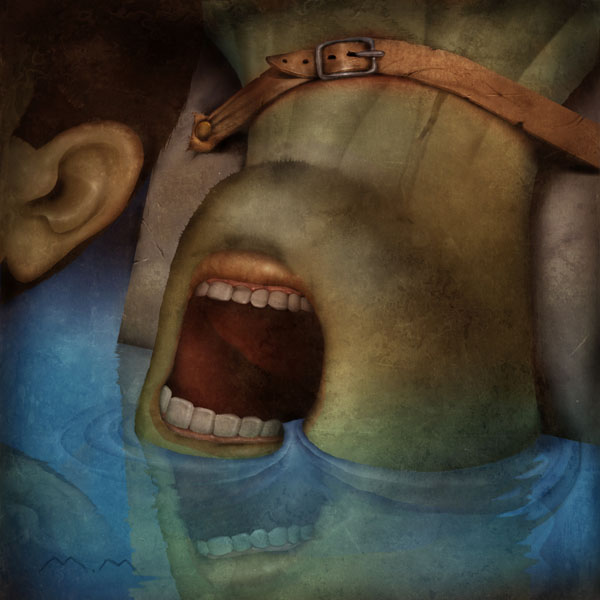
While other Republicans are attacking the Senate report on torture as a political hit piece by Democrats—which, in part, it is, but that doesn’t diminish its significance—the one Senator who has experienced torture is supporting the report’s conclusions and criticism, saying…
I know from personal experience that the abuse of prisoners will produce more bad than good. Most of all, I know the use of torture compromises that which most distinguished us from our enemies.”
Exactly.
My position on this topic is unchanged from what I wrote in 2006, which you can read here.

Stephen Mark Pilling contributes the second consecutive Comment of the Day providing perspective on the issue of police militarization, in response to the first. Here is his Comment of the Day to the post (by dragin_dragon, which you should read first if you haven’t yet), Comment of the Day on “The Perils Of Over-Regulating The Police: A Case Study”
When critics speak of the “militarization” of the police, not all are looking at it from the same viewpoint. Some are, of course, sociopathic or are conspiracy theorists. Some have swallowed the loudly flaunted concept that policemen are evil racists, corrupt ward healers in uniform or just about anything heinous, as they represent law as an absolute, not a relative.
There is a rational based distrust, however. Many of us grew up in a time where the police still walked a beat or patrolled his neighborhood in a squad car, armed with nothing more than a revolver. We’re also the product of an old tradition of law enforcement that stems from the British mold. Unlike the continental European system of paramilitary gendarmes, we adapted a system of localized lawmen, run by an elected county sheriff. The metropolitan police department is still a relatively new phenomenon, started in late 19th Century London.
To many citizens, police who are unaccountable to a directly elected chief and who sport automatic weapons strike a sour note. But recently, people have been seeing them acquiring armored vehicles, military assault training and a tendency to wearing black uniforms. They’ve also noted an increased likelihood of these tactics and weapons being utilized and the increased incidence of “no knock entries”. Likewise, citizens have been imaging police making arrogant idiots out of themselves and caused other cops to become ever more touchy about cell phones, whether they’re right or wrong.
These and other factors have been serving to create a gap between the citizens and the police. That’s never a good thing, of course, because that trust is vital in a free society. Citizen distrust only deepens when they perceive policemen in whom this sense of civil mastery is full blown. As a former military cop, as a private citizen and as a friend or relative of a lot of civilian cops, I’ve seen all this from different angles. I’ve also seen the divide deepen in recent days.
One small note. The funding of police units on all levels directly from federal sources coincides with the worry by many that state and local police units may be more or less within the pocket of federal departments. The actual militarization of once innocuous federal police units and the memory of Obama’s projected National Civilian Defense Force has resulted in fear that this is an intentional part of a program to create an instrument of oppression. For myself, I highly doubt that any street cops would lend themselves to some “martial law” based takeover of the homeland of America. What I’m not sure of, though, is how many in higher authority have not conceived of the notion and would execute it if they could.
Again; it’s vital that the bonds of trust be strengthened between the police departments and those law abiding citizens whom they “serve and protect”. They must never- ever- be heard to make disparaging remarks about “civilians”, as that only deepens the gulf. In the Army Military Police Corps, the official motto is “Of the troops and for the troops”. It’s a good motto. It should also carry over to every local police or sheriff’s department in America. “Of the citizens and for the citizens”. Policemen who embrace that attitude will seldom go wrong. Both they and the communities they serve will benefit.

1. There is near unanimity in the response to the non-indictment by the Staten Island jury in the Eric Garner case. In light of the graphic video, it is hard to see how there wasn’t probable cause to indict. The coroner verdict of “homicide” would see to provide sufficient evidence all by itself. However, in the absence of the complete record of what the grand jury heard and saw, nobody can be certain that this was a miscarriage of justice. However, given the context of the case and its deleterious impact on faith in the justice system, that is no solace and scant mitigation. As in Ferguson, it is prudent and essential that the public see what the decision was based upon. It is true that those who are determined to see injustice, bias and racism will do so regardless of what the evidence shows–again, as in Ferguson—but the only evidence that has been made public, the various videos and the officer’s testimony–only makes the non-prosecution more suspicious.
2. Can the non-prosecution be justified? If so, the only reason I can see would be lack of proof of causation. Causation is tricky, and juries get confused about how to analyze it. Since it is fair to assume Daniel Pantaleo did not intend to kill Eric Garner, the issues are a) whether his actions during the arrest were negligent, and b) whether they were the proximate cause of Garner’s death. That his conduct was negligent is not enough to sustain and indictment—that negligence had to be the reason Garner died. Remember, he was not choked to death. The medical examiner ruled that Garner died from a collection of factors: compression on his chest and throat, the position he was forced into, his obesity, weak heart, and asthma, all causing asphyxia.
In the widely seen video of the arrest, Pantaleo can be seen with his arm around Garner’s neck as Garner is taken to the ground and for some time thereafter, but in watching the video it’s difficult to determine whether Garner was in fact choked. And if he was, it did not appear it was long enough even to render him unconscious, much less kill him…I saw nothing excessive in the manner in which the officers subdued Garner. He was neither beaten with batons nor even punched. To me, it appeared to be a fairly typical scuffle with a large man who had clearly demonstrated his unwillingness to be arrested peacefully.
He misses the point. The question is whether the take-down was excessive for Garner, not some theoretical average arrestee. It is true that with a normal, healthy subject, what the officers did would not typically cause death….but Garner was obviously not normal, nor healthy. He was morbidly obese, and 350 pound middle-aged people tend to have the kinds of heath issues Garner in fact had. Nobody would argue that an elderly woman or a ten-year old girl or someone in a wheelchair should be manhandled like that. Such treatment was negligent for Eric Garner, and the deadly result could and should have been anticipated.
It is true that the officers couldn’t know that Garner had a weak heart and suffered from asthma, but it doesn’t matter: the rule in negligence is that “you take your victim as you find him.” If your negligence is the proximate cause of someone’s death, the fact that it wouldn’t have caused anyone else’s death is no defense. This is the so-called “Egg-shell Skull” rule.
Garner was an egg-shell perp. Continue reading


ABC News Political Analyst and former Bush advisor Matthew Dowd said on ABC’s This Week that the recent cases of police violence involving unarmed African Americans were as much due to the militarization of police forces as race.
“We basically dress up officers as if they’re machines,” Dowd said. “And then we expect them to act like human beings. So what happens is, they confuse power with force. Most of the officers in this country do a great job. But when we militarize our police force and dress them up like machines, they act like machines.”
Technically, he was right: there is no evidence that those tragedies were caused by race or militarization. He had exactly no evidence or documentation that the “militarization of police” caused these deaths, or that alleged militarization has caused any deaths. This appears to be emerging conventional wisdom, just one of those things someone says and everyone nods in agreement with no real thought. Why is the so-called “militarization” of police forces such a threat or cause to distrust police? If police are not trustworthy, that’s a reason not to give them fire-power, but having more fire-power doesn’t make them less trustworthy. It simply makes it more important than ever that police be well trained and responsible.
I was preparing a post about this emerging theme as an example of bias, in this case, pre-existing anti-police bias, being translated into false and discourse-warping assumptions by activists and the police when stalwart commenter dragin_dragon delivered this, the Comment of the Day, on the post The Perils of Over-Regulating the Police: A Case Study: