The Alex Rodriguez Suspension, Barry Bonds, And The Slippery Slope

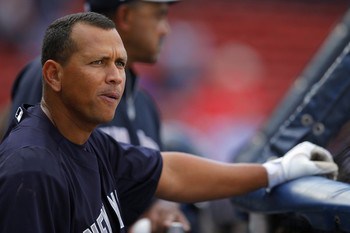
New York Yankees' Alex Rodriguez stretches before American League baseball game at Fenway Park in Boston

In a decision that further defines major league baseball’s cultural standards regarding performance enhancing drugs and the players who use them, New York Yankee Alex Rodriguez was suspended for the entire 2014 season and post-season by an arbitrator yesterday. Rodriguez, a long-time superstar who was once considered a lock to break baseball’s career home run record, and who is the highest paid player in the game, was suspended for illicit drug use without testing positive under the game’s union-negotiated testing system. He was, instead, suspended for a violation of the player’s Basic Agreement under baseball management’s right to police the game and do what is in its best interests.

The evidence that Rodriguez was a flagrant and long-time steroid abuser came from documents obtained from Biogenesis, a lab that developed drugs for athletes and others, as well as convincing testimony. Rodriguez had challenged the suspension in a grievance procedure after MLB handed down a 211 game suspension during the 2013 season. The arbitrator’s ruling, which is confidential, apparently concluded that the player not only cheated, but obstructed efforts to enforce baseball’s intensified anti-drug measures in the wake of the wide-spread use of PEDs in the 90’s and thereafter.

As expected, the result produced the usual complaints and rationalizations from the disturbingly large contingent of baseball fans and writers who remain obdurate regarding the offensiveness of steroid cheating, claiming that it was “a part of the game,” that the objections to it are inconsistent, and that baseball’s vilification of users is hypocritical. They had been practicing these and related arguments for months as they waited for the baseball Hall of Fame voting results announced last week, in which about 65% of the voters showed that they regarded steroid use as a disqualification for the honor, even when a player-user had excelled on the field. Rodriquez’s defeat deeply undermines the cause of the steroid defenders, and the likelihood that their argument will ever prevail. Continue reading

Ethics Observations On Sticks, Leadership, And Chris Christie’s Vindictive Bridge Closing Scandal

Christie apologizes

Before we delve into the starting point for most ethics inquiries—What’s going on here?— a summary…

Last September, the Port Authority of New York and New Jersey closed all but one lane of the George Washington Bridge , horrifically tangling commuter transportation in Fort Lee, New Jersey, just across bridge from Manhattan. The lane closures  delayed emergency responders to four calls, and may have resulted in at least one death. New Jersey Governor Chris Christie’s office had attributed the lane closures to a traffic study.  But smoking gun e-mails emerged proving beyond the shadow of a doubt that the bridge closing was far more sinister: top Christie aides engineered the gridlock specifically to cause problems for Fort Lee, whose mayor had angered the Governor by refusing to endorse him for re-election. It was political payback of a particularly brutal and Machiavellian sort.

“Time for some traffic problems in Fort Lee,” wrote Bridget Anne Kelly, a deputy chief of staff to Christie, in an email on Aug. 13 to David Wildstein, Christie’s appointee at the Port Authority. Wildstein resigned in December after news of the scandal first broke; he has since refused to answer questions in a hearing on the matter, citing the Fifth Amendment. Christie fired Kelly yesterday, and in a long and emotional press conference, profusely apologized while insisting that he knew nothing of the plot, but accepted responsibility for the actions of his staff. The incident is attracting national interest because Christie, a Republican,  is an intriguing and controversial  potential candidate for a 2016 Presidential run.

Observations:

  • This is bad, and there is no defense for it. Government power should never be abused like this, by anyone. Distorting one’s duties to the public to harm members of the public out of such motives as spite, revenge, retribution, intimidation or personal and political gain is the moral equivalent of a crime.
  • In fact, it should be a crime. It can’t be, because the problem is that some degree of such distortions of the duty to act in the public’s best interest are essential political tools that cannot be jettisoned without undermining effective leadership as well. Politics works through the carrot and the stick, and the stick virtually always causes collateral damage. At every level of government, refusing to do what a powerful leader wants must have negative consequences, or nobody will do what the leader wants, and he or she will no longer be effective. That, in the end, hurts the public too–presumably more seriously than the short-term harm from political payback. Continue reading

The Fifth Annual Ethics Alarms Awards: The Worst of Ethics 2013 (Part Two of Three)

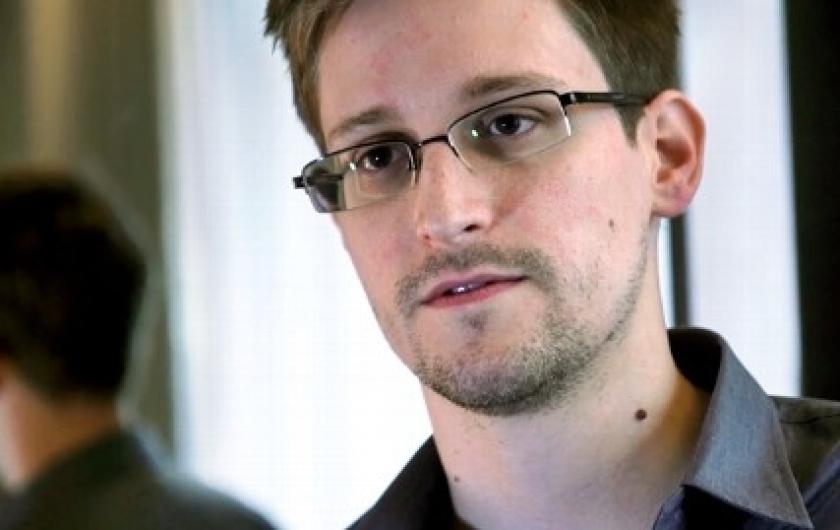
Snowden

The Ethics Alarms review of a truly disheartening year in ethics continues with fallen heroes, ficks, fools and follies with Part Two of the 2013 Worst of Ethics awards….and there’s one last section to come. Be afraid..be very afraid:

Fallen Hero of the Year

Edward Snowden, whose claim to civil disobedience was marred by his unwillingness to accept the consequences of his actions, whose pose as a whistle-blower was ruined by the disclosure that he took his job with the intention of exposing national secrets, and whose status as a freedom-defending patriot lies in ruins as he seeks harbor with not only America’s enemy, but a human rights-crushing enemy at that. The NSA’s over-reach and mismanagement is a scandal, but Snowden proved that he is no hero.

Unmitigated Gall of  The Year

Minnesota divorce lawyer Thomas P. Lowes not only violated the bar’s ethics rules by having sex with his female  client…he also billed her his hourly fee for the time they spent having sex , a breach of the legal profession’s rule against “unreasonable fees.” Yes, he was suspended. But for not long enough…

Jumbo Of The Year

(Awarded To The Most Futile And Obvious Lie)

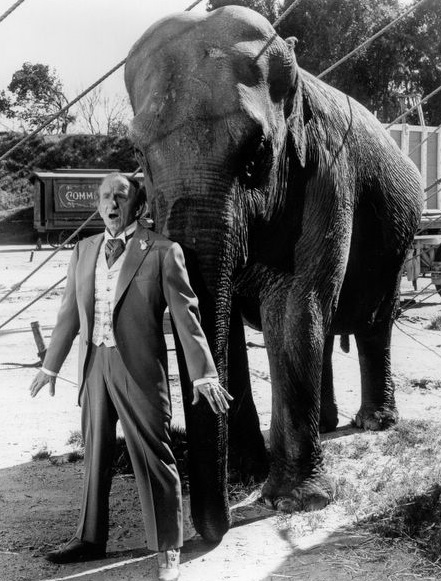
Jumbo film

“Now, if you had one of these plans before the Affordable Care Act came into law and you really liked that plan, what we said was you can keep it if it hasn’t changed since the law passed.”

—–President Obama

2013 Conflicts of Interest of the Year Continue reading

The Strange Case Of The Brain Dead Mother-To-Be

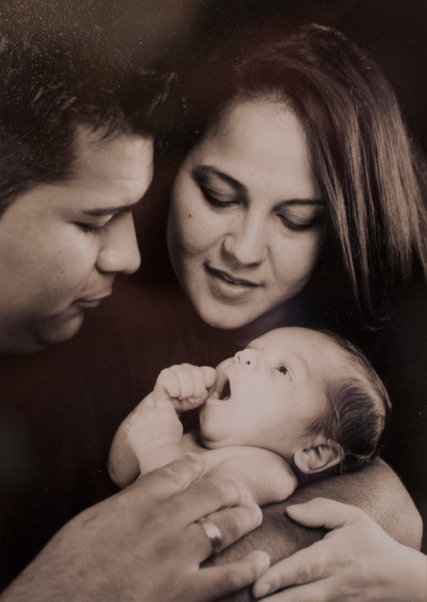
In happier times; Mr. and Mrs. Munoz with their first child. And she really wanted her second child to die with her?

In happier times; Mr. and Mrs. Munoz with their first child. Did  she really want her second child to die with her? Is that a respectable request, if she did?

Dead people are causing a lot of anguish in the ethics world lately. First, a family wants to force a hospital to keep their brain-dead, which is to say, dead, daughter on life support just in case a miracle occurs, while the rest of society pays for it. Now, in Texas, we have a true brain death dilemma that once again highlights the problem with U.S. abortion law and ethics.

Texan mother Marlise Munoz was 14 weeks pregnant with her second child when she collapsed and later died from a blood clot in her lungs. Her parents and husband told the intensive care unit at  Fort Worth’s John Peter Smith Hospital to honor her stated wish not to be left on life support, but the hospital has so far refused to comply with their instructions.  Texas is one of 31  states that prohibit medical officials from cutting off life support to a pregnant patient. Now, more than a month after her brain stopped functioning, the late Marlise Munoz is still connected to life-support machines, and her unborn child is now in its 20th week of development. Continue reading

Michael De Beyer, Like Don Bedwell, An Exemplary Ethics Hero To Inspire Us

Mathis and hero

Writing about my favorite Ethics Hero of all time, Don Bedwell, in 2005, I began, “There are special and rare people whose ethical instincts are so pure and keen that they can make the rest of us feel inadequate.” Like Don Bedwell, Micheal De Beyer is such an individual.

Brittany Mathis, 19, works for De Beyer at his  Kaiserhof Restaurant and Biergarten in Montgomery, Texas, . Her mom and older sister work at the restaurant as well, so she would describe her boss as a family friend. In December, Brittany learned that she has a 1.5 inch brain tumor  She can’t afford to find out whether the tumor is benign or malignant, but her father died from a similar tumor years ago, so her situation is dire. She doesn’t have health insurance.

De Beyer has decided to sell his restaurant, which he opened more than 15 years ago and has an estimated worth of $2 million, to pay for whatever medical treatments are necessary to save Brittany’s life. “I’m not able to just sit by and let it happen,” De Beyer told a local paper. “I couldn’t live with myself; I would never be happy just earning money from my restaurant knowing that she needs help.” Continue reading

The Fifth Annual Ethics Alarms Awards: The Worst of Ethics 2013 (Part One)

This is the first installment of the Worst.  It says something, and not something happy, that this segment of the year-end awards are more than twice as voluminous, and far more competitive, than the “Best” of 2013 ethics. Well, nobody said it would be easy….

Ethics Train Wreck of the Year

trainwreck

Obamacare, a.k.a Affordable Care Act. This is quite an achievement, as there were at least two other three Ethics Train Wrecks rolling along in 2013 that would have been easy victors in a less horrible year. One of them, The Trayvon Martin- George Zimmerman Ethics Train Wreck, was last year’s winner, and still wreaked ethics carnage across the culture, thanks to Zimmerman’s trial (which never should hev been brought), the biased media coverage, the incompetent prosecution, the inept judge, and then afterward, the ignorant and/or racially motivated attacks on the jury for doing its job well and fairly against overwhelming odds. Yet as bad as this hangover from 2012 was, the Sandy Hook Ethics Train Wreck was arguably even worse. The news media decided to go Soviet and abandon all pretense of objectivity, essentially becoming an Obama Administration propaganda tool for gun control. Elected officials lied their heads off; so did the aroused NRA. Gun owners talked and behaved like they were about to be Gulaged. Legislators shamelessly used the grief of victims to stampede public opinion; children became props; fake statistics were everywhere; brain-damaged Gabby Gifford was programmed to read child-like messages as if they were the conclusions of research papers. The President’s total lack of political leadership skill again came front and center, then, when he had failed to do what he promised to do, the opposition was vilified by celebrities like Jim Carrey, who called them murderers and worse.

But the Affordable Care Act lapped both of these. It revealed itself to be a five-year long train wreck that just took a break after an earlier stretch where the bill was passed without due diligence by its supporters and using a cynical by-passing of due process. A Presidential lie intentionally devised to deceive the public was repeated for the five-year span, and then exposed when the law began to take affect….but not before the law inspired Republicans to force a reckless and irresponsible shut-down, a mini-train wreck within the train wreck.  The website debacle was initially spun by the news media (not working worth a damn isn’t a “glich”), then the evidence of near criminal ineptitude became impossible not to report. The indisputable evidence that the President of the United States had sold a program under false pretenses came to light, prompting dozens of politicians, bloggers, pundits and reporters to destroy their credibility forever (I hope) by desperately trying to either rationalize the lie ( “the ends justify the means”), call it something other than what it was (The New York Times’ disgraceful “incorrect promise” was one low point), or simply deny that it was a lie at all (Democratic Chair Debby Wasserman Schultz, setting a new low for personal dishonesty, itself an achievement in her case). Then, when the public pressure and political fall-out became unbearable. the President just began amending the provisions of his own law on the fly, except that it was the nation’s law, and it’s unconstitutional to do that—this, after the mantra from Democrats and the news media during the shut-down debate was that the ACA was “settled law.”  HHS Secretary Sibelius misled Congress, the White House denied that her stated goals were goals once it was obvious they wouldn’t be met; and nobody was held responsible for yet another Obama Administration debacle. And there’s a lot more, with the train wreck still moving at top speed.

Fraud of the Year

Iowa State University biomedical sciences assistant professor Dong-Pyou Han, who resigned after admitting he tainted blood samples to get desired outcomes in research animals, allowing him to claim a break-through in the effort to develop an AIDS vaccine. The National Institutes of Health had awarded Han’s research team $19 million in multi-year grants.

Incompetent Elected Officials of the Year

  • Elected Body (National): House Republicans, who staged a wholly useless, expensive and damaging government shut-down on “principle,” without ever articulating what that principle was sufficiently for anyone responsible to agree with them. Runner-Up: The California House Legislature, which passed a law allowing illegal aliens to practice law.
  • National Elected Official:  President Obama.  From being incapable of working with Congress, to refusing to fire incompetents, to not knowing what was going on in his own administration, to drawing red lines he wasn’t willing to defend (and then advocating killing people just to show he was willing to defend them), to undermining the trust and faith in both his office and himself by uttering unequivocal lies, President Obama had one of the worst years of self-inflicted miscalculations, errors, failures and reversals of any U.S. President in history. I’m sorry to have to say it, but it’s true.
  • Local Elected Official: Storey County (Nevada) Assemblyman Jim Wheeler (R). Wheeler told a group that if his constituents demanded it, he would vote (with a heavy heart)  to reinstate slavery, as he felt doing so would be his duty as a representative. Runner-up: Maryland House of Delegates Member Don Dwyer (R), who after a drunk driving and drunk boat piloting episode, the latter injuring several people, blamed his conduct in part of feeling betrayed over his colleagues approval of gay marriage in Maryland.
Sexual Harasser Of The Year Continue reading

Here’s The Ethics Lesson From The Hall Of Fame Voting Results Tomorrow…

HOF

And that lesson is: sportswriters have no clue when it comes to ethical analysis, or any other kind of analysis, really.

Tomorrow the results of the Major League Baseball Hall of Fame voting will be announced, and those former stars receiving at least 75% of the vote will be officially enshrined as immortals. Every year before the steroid era, the voting was preceded by weird arguments that made no sense, like the one about whether a former player should be a “first time electee.” Some writers would concede that a given player was great enough for the Hall, but not vote for him because “he wasn’t good enough to get in on the first ballot.” This was, and is, ridiculous, and unfair. The question is, “Was this player great enough to deserve enshrinement, when the standards are unchanging?” It’s a yes or no question. “Maybe next year” is not a valid answer.

Thus I suppose that it should be no surprise that these same clods, faced with some really difficult ethical lines to draw in the wake of the so-called steroid era, show themselves to be not merely dunces, but ethics dunces as well. I just heard a sportswriter, Marty Noble, tell a baseball talk show that he won’t vote for any player about whom there is any question whatsoever regarding whether he cheated with steroids, including doubts based on rumors, whispering campaigns, looks, suspicions and drug tests. But he still voted for some players, he says. Well, that’s just wrong, by his own standards—he can’t be 100% sure about anyone. He also said that while he can vote for up to ten players, and agreed that there are more than ten players this year who have strong Hall credentials, he’s only voting for three. Why? Because, he says, the induction ceremony is too long.

Yes, he’s an idiot. Continue reading

Comment Of The Day On Civility And Blog Moderation Ethics, By Ampersand

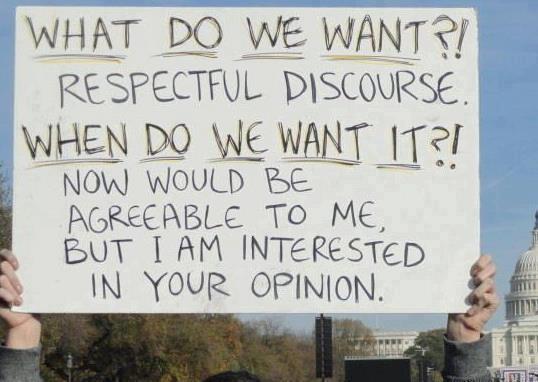
civility sign

It doesn’t really matter what post generated this Comment of the Day (it was the one about Melissa Harris-Perry’s second try at apologizing for inciting her guests to treat Mitt Romney’s adopted black grandchild as the human equivalent of spinach on a fashion model’s front teeth—further ethics developments: Mitt Romney was as gracious as one can be yesterday while accepting Harris-Perry’s mea culpa, and the clueless Alex Baldwin griped that she kept her MSNBC job by playing the weepy girl card, while he was sacked after his umpteenth public meltdown over a paparazzi), because it is off-topic. Ampersand, a.k.a. Barry Deutsch, and I have been fencing about the proper level of invective that should be permitted on blogs like Ethics Alarms and his blog, Alas!.

I take the topic very seriously, as does Barry, because we are both trying to build and maintain an enlightened and diverse community of serious readers and participants in ongoing discussion of serious topics. Barry’s blog is an ideological one; Ethics Alarms, despite being alternatively called on the carpet for being tilting either conservative or liberal, is not. Beyond question, from Barry’s own position on the ideological spectrum, this blog is well to his right. This particular exchange was prompted by complaints by some commenters that my moderation is too loose, that I should censor particular words or eject commenters here who engage in harsh personal denigration. I remain in flux on this problem.

It is true that I have moderated my moderation in recent months, though not as much as some people think. I still bar some commenters, and frequently refuse to accept comments that are nothing but name-calling, as well as those which are objectively moronic. But it is true that regular contributors here who have demonstrated serious intent and valid commentary acquire the privilege of going off the rails, civilly speaking, from time to time. I wish they wouldn’t do it, but despite my belief that civility is critical to societal harmony and professional conduct, I am persuaded that routinely filtering out the passion expressed by vulgarity (and worse) may go too far. I have also been influenced by the recent escalation of political correctness, especially in the media, epitomized when a CNN host announce that the verb “target” was no longer considered appropriate on TV—a threat, don’t you know.

Another factor in my thinking was Popular Science’s decision in September to ban online comments to its articles, rooted in its conclusion that research had proven that aggressively worded contrary opinions could be psychologically persuasive, and were thus “bad for science.” I don’t like the looks of that slippery slope at all.

  I explained my evolving thoughts on the issue in the earlier replies to Barry  and Beth, a commenter here and a personal friend, who has been the target of some of the least civil attacks.  I wrote in part… Continue reading

Ethics Quote Of The Week:

“Voters are significantly more conservative than nonvoters on redistributive issues and have been in every election since 1972. Voters may be more liberal than nonvoters on social issues, but on redistributive issues, they are not. These redistributive issues define a fundamental relationship between citizens and the state . . . and are central to ongoing conflicts about the scope of government. It is on these issues that voters offer a biased voice of the preferences of the electorate.”

—– Political scientists, Jan E. Leighley of American University and Jonathan Nagler of New York University in their new book, “Who Votes Now? Demographics, Issues, Inequality, and Turnout in the United States.”(Quoted by Dan Balz in the Washington Post)

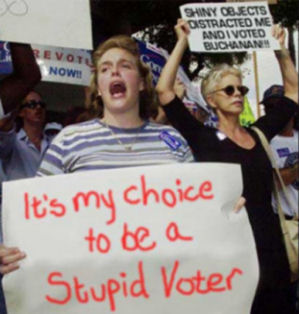
idiot-votersA better example of the warped and unethical thought habits of the Left it would be hard to find.

So the results of an election based on who actually has the initiative, knowledge, civic responsibility and sense to vote are now called “bias,” are they? Talk about academics wearing their own biases tattooed on their foreheads: naturally any conservative consensus is illegitimate, right boys? Continue reading

Dear Legal Profession: How Can We Respect And Trust You When You Police Yourself Like THIS?

Justice_broken3

I’ve been defending my profession a lot here lately, but I also recognize that there is a very good reason why such incidents as the surprisingly generous sentence in the “Affluenza” case and the drug court judge who suffered an alcoholic relapse on the bench are wrongly interpreted as proof of inequities and double standards in the legal system. The reason is that those who oversee the system do inexplicable things that appear to the outside world as not only a lack of integrity but also the apparent inability to realize how such conduct undermines the public trust.

Both of these recent news stories are cases in point:

I. The Imaginary Government Lawyer

In 2012, the Nebraska state supreme court disbarred lawyer David Walocha for not paying his bar dues and proceeding to practice law for 13 years with a suspended license. At the end of 2013, the District of Columbia Bar had to decide what to do with former Justice Department attorney Laura Heiser, who practiced 21 years with a suspended license in the District. What was her punishment? She received an informal admonition, which is the least severe form of disciplinary action.  Continue reading