Comment of The Day: The Same-Sex Marriage Wars

supreme-court-gay-marriage-demonstration

The Inquiring Mind left a plaintive and provocative comment on an earlier post regarding the gay marriage controversy, now once again above the fold, and it was apparently swallowed by my spam file. I haven’t see much of an uptick in Ethics Alarms comments lately (and tgt is on semi-hiatus), but the spam has gotten out of control: apparently this post was deleted, even though I try to check the spam comments (about 500 a day now) to make sure legitimate ones don’t get thrown out with the bath water. I apologize to IM, and am posting the recovered comment partially in compensation, and also because he expresses a sentiment that I have heard and read from others.

I’ll be back at the end; in the meantime, here is Inquiring Mind’s Comment of the Day regarding the tactics of gay marriage advocates:

“Jack, since the aftermath of Prop 8, I have always wondered – is the thuggery/coercion and thought control a “bug” associated with the push for gay marriage, or is it a “feature” that comes with the enactment of gay marriage?

“I just want to review the conduct of gay-marriage supporters: Continue reading

Ethics Poison From Nike and Tiger Woods

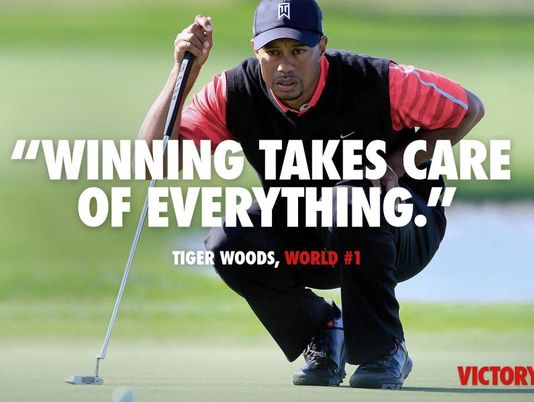
Woods AdWoods Ad2

…and not for the first time, in either case.

But Woods’ new ad for Nike in the wake of his resurgence in his sport, is audaciously unethical, braying a dangerous, corrupting message into the cultural atmosphere, endorsing, in five simple-minded words, consequentialism, the Star Syndrome, the King’s Pass, non-ethical considerations over ethical ones, and “the ends justify the means.” That’s a pretty impressive load of ethics offal in so few words: congratulations to the soulless ignoramus who devised it.

The assorted miscreants, past and present, who would have gladly stood in for Tiger in his damning ad include dictators, despots, mass murderers, gangsters and corrupt politicians like Richard Daley, Marion Barry, Charley Rangel and Tom DeLay, corporate bandits, assassins, robber barons, Wall Street criminals, athletic cheaters like Lance Armstrong and Barry Bonds, serial fathers like the NBA’s priapic stars, arrogant social misfits like Charley Sheen, con artists and liars in all walks of life, and of course, our most popular politician, the man whose entire career is based on Nike’s new motto, William Jefferson Clinton.

I almost forgot the terrorists. Continue reading

Out Of A State Lottery, A Golden Rule Moment

We're NOT going to be selfish and exclusive, even though we can and you expect us to!

“We’re NOT going to be selfish and exclusive, even though we can and you expect us to!”

It never seems to work out this way, and thus it is interesting to speculate why the office lottery pool at Keller Williams Partner Realty in Plantation, Florida treated a dilemma so differently, and so much more ethically, than the key participants here, or here.

Jennifer Maldonado had only been working as an administrative assistant at the company for two weeks, and because she hadn’t received her first pay check, she decided not to join the office Powerball pool when she was approached. The organizer even offered to loan her the money: nope, insisted Maldonado. Not this time; maybe next. Naturally, the pool not only won that week, but won big: a million dollars to be divided among the 12 person staff…except Maldonado, of course.When Maldonado showed up for work and saw everyone screaming, crying and celebrating, she thought they were playing a practical joke in her to teach her a lesson. “I knew I was the only one who hadn’t put in the money, so I thought they were pranking me and going out of their way to make me feel something,” she recalled, that “something” presumably being “rotten.”

Jennifer obviously didn’t know her co-workers yet. Not only weren’t they trying to make her feel badly, they had held a meeting and decided to give her a cut of the winnings even though she hadn’t opted in to the enterprise—not a full share, but a significant amount. Jennifer didn’t expect anything, wasn’t going to sue them or hold a grudge, and yet they made her part of the group’s good fortune anyway. This is the Golden Rule exemplified. It is also exemplary ethics: generosity, kindness, empathy, and inclusiveness. The staff”s gesture said, and eloquently, “Welcome to the family! You can trust us. We care about you. We look out for each other, and we handle each other’s mistakes.”

Perfect. Continue reading

Wanetta Gibson Is Even Worse Than We Thought

How do you treat a monster like Wanetta?

How do you treat a monster like Wanetta?

Of Wanetta Gibson, the woman who sent innocent high school football star Brian Banks to prison for five years for a rape he didn’t commit, collected $750,000 by continuing her lie in a lawsuit against the high school where she and Banks were both students, and then sought forgiveness from him in prison while refusing to exonerate him to prosecutors because she didn’t want to give back the money, I wrote:

“There are not sufficient laws, nor words in the dictionary, nor public shaming, shunning and condemnation to do justice to the likes of Wanetta Gibson. She ruined a young man’s life and stole $1.5 million in the process. She can recant, apologize, say that she found God, weep, express regret and anything else, and it should not insulate her from societal rejection. No one should hire her. No bank should give her a loan or a credit card. No taxpayer should have to contribute to her health insurance or food stamps. No one should befriend her. Absolutely no one should forgive her, consort with her or trust her. The kind of organized hatred that was manufactured against George Zimmerman is appropriate in her case. The Golden Rule? If I behaved like Wanetta Gibson, I would deserve everything I have described, and more.”

And you know what? I think I was too easy on her. Continue reading

Tell-Tale Signs Of An Incompetent Government: Rationalization # 32, Star Trek and Chairman Who?

mao zedon.png.CROP.article568-large

One of the common rationalizations that leads to both unethical conduct and an unethical organizational culture is “The Management Shrug,” often verbalized as “Don’t sweat the small stuff.”  (It is #32 on the Ethics Alarms ever-lengthening Rationalizations List; it really should have been in the top ten.) This is a favorite excuse of self-anointed big thinkers of the arrogant and incompetent breed, and is an attitude at the core of a much more sinister ethical fallacy, “the ends justify the means.” The Obama administration has been habitually guilty of the Management Shrug, as has a national news media that largely refuses to hold it accountable, and the U.S. public, which pretty obviously doesn’t notice or doesn’t care.

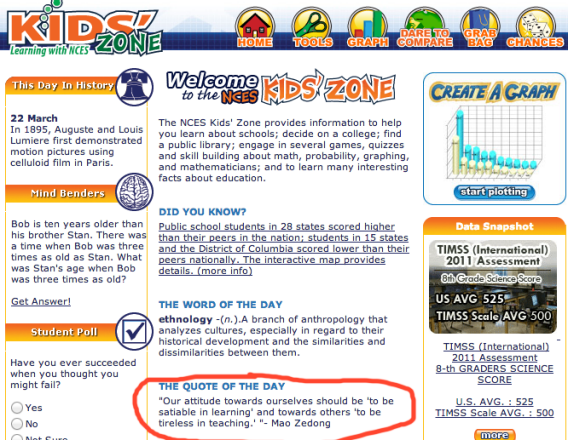
Here’s a ridiculous example: some idiot paid  with your tax dollars thought it was appropriate to place a quote from Chairman Mao on the Kids’ Zone page at the National Center on Education Statistics website. Continue reading

Bloomberg Is Right About Teen Pregnancy, We Are Right To Condemn It

murphy_Brown3

No, Candace, we haven’t forgotten Murphy and her amazing vanishing baby.

Conduct that is harmful to society needs to be rejected and condemned by society, and society has limited options for accomplishing that. It can make destructive and harmful conduct illegal, but some kinds of conduct can’t be illegalized. Uncivil speech, for example, is ugly and causes discord, and the only way to make it less common is to let those who engage in it know that neither they nor their communication habits are appreciated. The Supreme Court has decided that we can’t make lying illegal, but we certainly have the power to make habitual liars feel unpopular.

When society sends mixed messages about destructive conduct, or worse, tell those who engage in it that they are still wonderful people and that their conduct might be just fine for them, it poisons itself. There is a solid, practical reason for Kant’s Rule of Universality, which holds that conduct that would be lead to societal catastrophe if everybody engaged in it is wrong should be discouraged. If everybody doing it would be bad, it’s a good bet that the fewer doing it, the better.

No toxic social conduct illustrates the folly of hesitating to condemn it more vividly than unwed pregnancy, particularly teen pregnancy. While shunning and shaming pregnant teens was undoubtedly cruel, sending the message that unwed motherhood is socially acceptable is arguably crueler. This kinder, gentler response, combined with the warping influence of wealthy celebrities proudly parading their “baby bumps” courtesy of equally rich celebrity boyfriends, has led to an explosion of births without wedlock, especially in the black community. The children of these non-marriages are handicapped from birth, more likely to fall into poverty,substance abuse, illiteracy and crime; the mothers involved less are likely to succeed in careers or life; government programs, funded by taxpayers, are too often required to mitigate the damage. Continue reading

Hand-Out Ethics: Buying Junk Food With Food Stamps, Or A Leap Down The Slippery Slope?

Maybe I got something out of law school after all.

11-nanny stateWhen I read opinion columnist Charles Lane’s lament that food stamp regulations didn’t limit the kinds of nourishment that could be bought by them to things Mrs. Obama would approve of, my mind flew back many decades to a memorable Contracts class in my first year of law school. The late Professor Richard Alan Gordon was thundering in his most stentorian tones—and boy, did he have stentorian tones!— about the class reaction to a case we had just discussed involving a Washington, D.C. family on welfare that had gotten itself in legal trouble by purchasing a stereo system on credit. One poor student was the target of the verbal barrage, having just opined that the family should have spent its government assistance on necessities like food, and not entertainment.

“And who are you, Mr. Anderson, to make the determination of what is a “necessity” for a fellow citizen? Shall the family in question not be permitted to feed its soul, as well as its gut? Is it the attitude role of the government to assume that accepting its assistance in dire circumstances involves one’s surrender of the basic human rights of choice, preference, taste and self-determination?”

I miss Dick Gordon, who became a cherished friend (and a terrific Learned Judge in “Trial by Jury”), and I miss the scathing letter he would have written to Charles Lane. In his column, Lane writes:

“The point is to increase the amount of real nutrition per taxpayer dollar. The counterargument is that it’s not fair to restrict poor people’s grocery choices. You hear this a lot from the food and beverage industry, for which SNAP has grown into a significant subsidy. Sorry, I don’t get it — morally or pragmatically. Of course the federal government should be able to leverage its purchasing power for socially beneficial purposes. If you take Uncle Sam’s help, you play by his rules. I repeat: This is a nutrition program, or so the taxpayers who fund it are told. It should nourish.”

“If you take Uncle Sam’s help, you play by his rules.” This is the crux of Lane’s argument, Mr. Anderson’s, and all the Nanny State advocates who cheer on Mayor Bloomberg’s assault on personal freedom. Ethically, there are strong arguments in all directions: Continue reading

“There Is No Debt Crisis” ? Boy, That’s A Load Off My Mind!

"So far, so good!"

“So far, so good!”

The confluence of head-exploding statements and news keeps coming, with the worst being the recent unconscionable announcements out of the mouths of the President and some of his political adversaries that “there is no debt crisis.”

This is exactly like the old joke about the man falling from a 40 story window, being asked by someone on the tenth floor, shouting through a window as he passes, “How are you doing?” “So far, so good!” he answers. Yet these ridiculous, idiotic or intentionally dishonest statements by President Obama, Speaker Boehner, and others are being cited by the news media as reassuring! No, there’s no debt crisis, if you regard that falling optimist as not being in a smashing-to-pulp-on-the-sidewalk-crisis. The debt increased by a trillion dollars last year, and looks as if it will increase by close to a trillion more by October, 2013. The government has no leadership on the issue, and the various sides appear incapable of forging a solution, with the current Administration actually going out of its way to try to make less than 2% in budget cuts under the absurd sequester hurt as much as possible, to convince a math-deficient public that cutting the size of government is not only impossible but undesirable. This scenario doesn’t demonstrate that there’s a debt crisis? Continue reading

“Being White In Philly” And Mayor Nutter’s Unethical Attack

phillymagcoverPhiladelphia Magazine published an article this month titled “Being White in Philly.” Written by Robert Huber, who includes his personal reflections as well as interviews with white Philadelphians, the piece raises troubling and real problems in current U.S. race relations in an open and fearless way that does not usually characterize the media’s handling of the topic. The letters from readers, which you can also read at the link provided above, demonstrate that the article drilled directly into a nerve, and exposed feelings by white citizens, not just in Philadelphia but elsewhere in America, that need to be considered, analyzed, and dealt with whether or not one believes that they are justified or fair. Huber uncovered some of the most stubborn obstacles to a post-racial U.S., and they persist because we remain reluctant to discuss them

It’s an excellent piece of journalism that reminded me of my late roommate in law school, a young, Irish Catholic ex-Marine from the “rough” parts of Philly, who opened my eyes about racial attitudes like no one else I have ever known. He was intelligent, observant, and beyond any question, a racist, and openly admitted it. He also vividly describe the Philadelphia experiences that he felt justified his racism. I could see his handsome smile as I read Huber’s piece. The article itself, however, is not racist in any way.

Mayor Michael Nutter, however, either out of careless reading, racial identification, foolishness or willful blindness, decided to attack the article and the magazine for running it.  He wrote a furious letter of protest to Philadelphia Magazine, a letter which, as I will shortly demonstrate, crossed bright lines of ethical reasoning and appropriate conduct by a government official. Philadelphia Magazine’s editor, Tom McGrath responded perfectly:

“I applaud the mayor for asking for an inquiry into the state of racial issues in Philadelphia. The need to have a deeper discussion about race in Philadelphia is exactly why we ran our story in the first place. Like any reader, the mayor is entitled to think and say what he wants about the story. That said, his sophomoric statements about the magazine and mischaracterization of the piece make me wonder if he’s more interested in scoring political points than having a serious conversation about the issues. Furthermore, his call for a “rebuke” of the magazine by the PHRC is rich with irony. This is the same mayor who just yesterday was shouted down by an unruly mob in City Council; now he himself wants shut down conversation about an important issue in our city. In short, the mayor loves the First Amendment–as long as he and the government can control what gets said.”

Now let’s consider, piece by piece, Nutter’s letter to the magazine, and why it deserved McGrath’s criticism, and more. My comments will be in bold. Continue reading

The Portman Reversal: Why He Did It DOES Matter

reversalI feel it necessary to return to the topic of  Senator Rob Portman’s reversal of his long-held and much-publicized opposition to same sex marriage and homosexuality in general in the wake of his son’s disclosure that he is gay.

Anyone who required further evidence that current events analysis, not to mention public consciousness, is almost untouched by an understanding of ethics, need look no further than the near universal pronouncements in the editorial pages and the Sunday talk shows that “it doesn’t matter” why  Portman suddenly decided that he was in favor of gay marriage once the issue affected someone he cared about.

It is not yet 11:00 AM in Virginia, and I have already read and heard this reaction so many times that the flashing red light on my head that signals an imminent explosion is flashing bright. It doesn’t matter? It doesn’t matter that Senator Portman firmly, strongly, extensively and consistently declared in public forums, to interviewers and in op-ed pieces that the sanctity of the institution of marriage as well as the moral fiber of the nation depended on withholding the right to marry from millions of law-abiding American citizens, but that the minute one such citizen, someone he actually gave a damn about, risked being adversely affected by his supposedly heart-felt and principled position, he changed his “principles” like he was changing his socks? That doesn’t matter? Continue reading