Of Course Barry Bonds Doesn’t Belong In The Hall Of Fame

Buy a ticket, Barry.

Buy a ticket, Barry.

A full complement of baseball’s steroid class is among the 37 players on the 2013 Hall of Fame ballot, so it was predictable that a new round of arguments would surface claiming that it is unfair, illogical, inconsistent or otherwise unseemly to exclude Barry Bonds and others from enshrinement. Predictable but frustrating: the arguments in favor of Bonds are arguments against maintaining ethical values, in baseball, sports, and American society.  It is also an annoying debate to engage in, and I have been engaging in it in various forms for many years, because Bonds’ defenders typically represent themselves as modern, reasonable, and realistic, while anyone making the quaint argument that cheating on a grand scale should earn shame rather than honors is mocked as judgmental, sanctimonious and naïve.  As ever, I am a glutton for punishment, and since otherwise wise and perceptive commentators like NBC Sports’ Craig Calcaterra choose to ally themselves with Bonds, I really am obligated to point out what a corrupt, illogical and unethical position it is.  If I and people like me don’t persist in this, we’ll have cheating approved as a cultural norm before we know what hit us.

Calcaterra has been supporting Bonds as a Hall of Fame candidate for a while now, but the title of his latest essay, “It’s Lunacy To Keep Barry Bonds and Roger Clemens Out of the Hall of Fame” is a gauntlet that begs to be picked up.  “Bonds and Clemens,” Craig writes, “ are two players who, in a just world, would be unanimous selections for induction…”  I find this an indefensible, even shocking, statement, both before and after the writer attempts to defend it. In a just world, a member of a profession who achieved his prominence in part by breaking the law and the rules, as well as lying about it, should be accorded the highest honor that profession has!  What an astounding point of view.

For simplicity’s sake, I’m going to leave Clemens out of this, in part because I can see a Hall of Fame voter credibly deciding that there isn’t enough evidence to conclude that The Rocket really did use performance enhancing drugs on the way to forging one of the top five pitching careers of all time, and in part because I suspect Craig of pairing Bonds and Clemens to make his various rationalizations more pallatable than they would be in defense of Bonds alone.  Belief in Roger’s steroid cheating rests entirely on the testimony of a proven liar and slime-ball, his former trainer. MLB’s Mitchell Report sided with the trainer, and I’m inclined to as well, but Clemens’ unfitness for the Hall of Fame, unlike Bonds (and Mark McGwire, Rafael Palmeiro, and some others), is not an open-and-shut case.

I give credit to Craig for not raising my least favorite of the Bonds defenses, that he has to be regarded as innocent because he has not been “proven guilty.” Calcaterra is a lawyer, and he understands the over-use and misuse of that cliché, as well as how it only applies when “guilty” means “you’re going to jail.” Indeed, he begins by conceding the obvious, that the evidence that Barry Bonds used steroids is overwhelming, which it is.

His first argument, however, is terrible. Under the ironic heading “Baseball Bonafides,” Calcaterra begins by reciting Bonds’ (and Clemens’) impressive list of achievements, which taken at face value show Barry Bonds to be one the best of the best, not just a qualified Hall of Fame baseball player, but an epitome of a Hall of Fame player along with such legends as Babe Ruth, Walter Johnson , Ted Williams and Willie Mays. “Put simply,” Craig says in conclusion, Bonds is an “immortal.” But he’s not-–not if he cheated, not if he achieved his historic status by corrupting his sport and lying to team mates and fans. And, as Calcaterra admits at the outset, this he did. As a result, the fact that Bonds won a record seven Most Valuable Player Awards is irrelevant. He cheated to win some of those awards. He gets no credit for them.  In Bonds’s case, “baseball bonafides” are not bona fide at all. Continue reading →

I’ve Always Said, If You Want To Know The Values of America, You Have To Watch “Family Feud”

Somehow I missed this significant moment, from 2011.

The clip doesn’t show it, I but I’m guessing “STDs” scored higher in the survey than either answer given.

<sigh>

___________________________

Pointer: Jo Ursini (Thanks, Jo!)

Ethics Dunce Déjà Vu: Drew Curtis’s Fark

"Ma'am, your teenage son was raped by this woman, Isn't that great?"

“Ma’am, your teenage son was raped by this woman, Isn’t that great?”

Once again, one of my favorite news aggregation websites, the prolific and often hilarious Fark, is laughing at child rape. Its comment on the story from Nehalem, Oragon about the arrest of a 31-year-old model for sex crimes involving at least three under-age boys—15 and 16 years old—was this…

“…niiiice”

Not funny. An adult woman using—that’s the correct word, using—teenage boys as her personal sexual aids isn’t niiice—it’s criiiiminal. In October, I gave Fark an ethics dunce cap for an earlier wink-wink-nudge-nudge comment about a teacher who added statutory rape to her duties, and that was surely worse; after all, she was a teacher, and violating the trust of the school, the parents, the students and the community to get herself laid. Nonetheless, the conduct of model Anna Walsh was neither harmless nor trivial. I know: Fark’s official stance is sophomoric; I get that. I also get that sophomores, and other morons, have staked out the position that any male child who has obtained a sufficient level of sexual maturity to be used as a human dildo by a “hot” woman is a lucky dog. Well, that spectacularly stupid and unethical position does a great deal to help sexual predators like Walsh victimize children, who are misled into feeling that something must be wrong with them if they really don’t want be used.

Since the site is a repeat offender, I’m sure Fark’s wags intend to keep doing this. So I guess Ethics Alarms will have to keep reminding everyone what irresponsible ethics dunces their warped sense of appropriate treatment of young boys shows them to be.

“Duuuunce”

____________________________

Spark: Fark

Facts, Graphic: KATU

Football Fashion, Ethics, and Our Wasteful Consumption

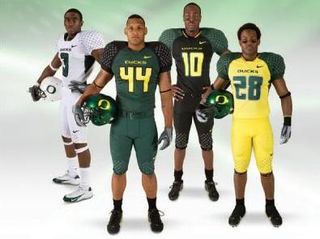
The many fashion choices of the Oregon Ducks...and children are starving in Appalachia.

The many fashion choices of the Oregon Ducks…and children are starving in Appalachia.

On his excellent ethics blog, the Ethics Sage, a.k.a. Dr. Steven Mintz, recently expressed dismay at the increasing trend in college and high school football teams that has them changing uniform designs for no discernible reason, but at significant expense. Focusing on the multiple uniforms used over a season by the Oregon Ducks, he wrote:

“The poverty line threshold in the U.S. ($23,050 for a family of four) is, on a daily basis, about $16 per person per day. If my estimates are close, the cost to outfit the Duck football players for a year is about $48,000, double the poverty level for a family of four and enough to sustain 3,000 people for one day or about 8 people for one year. When you think about the extravagant spending on uniforms by the Ducks, you begin to understand that it reflects a society where glitz and glamor are valued over feeding the hungry — not a pretty picture”

I am not sure what to make of this argument. Is Mintz arguing that the Ducks are ethically obligated to send the money they spend on extravagant uniform diversity to the poor? Isn’t this really just the old “How dare you waste those perfectly good peas when children are starving in Ethiopia?” argument? Realistically , there is no way the university’s football uniform budget is going to be able to help feed the poor. Why pick on the Ducks? He goes on to write, Continue reading →

The Inconvenient Truth About The Second Amendment and Freedom: The Deaths Are Worth It

carl-with-a-gun-The shocking murder-suicide of of the Kansas City Chiefs’ Jovan Belcher has once again unleashed the predictable rants against America’s “culture of guns” and renewed calls for tougher firearms laws. Yes, reasonable restrictions on firearms sales make sense, and the ready availability of guns to the unhinged, criminal and crazy in so many communities is indefensible. Nevertheless, the cries for the banning of hand-guns that follow these periodic and inevitable tragedies are essentially attacks on core national values, and they need to be recognized as such, because the day America decides that its citizens should not have access to guns will also be the day that its core liberties will be in serious peril.

Here is Kansas City sportswriter Jason Whitlock, in the wake of Belcher’s demise:

“Our current gun culture ensures that more and more domestic disputes will end in the ultimate tragedy and that more convenience-store confrontations over loud music coming from a car will leave more teenage boys bloodied and dead. Handguns do not enhance our safety. They exacerbate our flaws, tempt us to escalate arguments, and bait us into embracing confrontation rather than avoiding it… If Jovan Belcher didn’t possess a gun, he and Kasandra Perkins would both be alive today.”

I don’t disagree with a single word of this. Yet everything Whitlock writes about guns can be also said about individual freedom itself. Continue reading →

Keeping Secrets and The Worst Case Scenario

whisperOn Thursday, federal prosecutors in Manhattan charged Thomas Conradt of Denver and David Weishaus of Baltimore, two former stockbrokers, with insider-trading in a sequence of events that netted them more than $1 million in illegal profits.  The scheme was built on confidential information about International Business Machines’s $1.2 billion acquisition of analytics software maker SPSS in 2009, and it was relayed by a trusting young attorney who told his closest friend about some details of the deal. The whole sorry tale can be read here.

The name of the lawyer, an associate who worked for the Manhattan mega-firm Cravath, Swaine and Moore, has yet to be revealed. It is fair to say, however, that his career is in the crapper, and he is likely to face ethics charges, civil penalties and quite possibly legal charges as well. His mistake was a fundamental ethics breach  that I suspect is made every day, in various settings, by hundreds of thousands of professionals including lawyers, accountants, doctors, researchers, law enforcement officials and government agents. He shared confidential information in a casual setting with a close personal associate whom he trusted. Continue reading →

In the Wake Of The BP Disaster, Another Andersonville Trial

Someone has to be held responsible, even if nobody is to blame.

Someone has to be held responsible, even if nobody is to blame.

I don’t know about you, but I was certainly surprised to discover that in the view of the Justice Department, two men I had never heard of, Robert Kaluza and Donald Vidrine, were the ones responsible for the April 20, 2010 explosion of a BP oil rig that caused millions of barrels of oil to leak into the Gulf of Mexico for months, polluting the waters and the shores and causing billions of dollars of damages. That is the clear implication of the decision to prosecute the two rig  supervisors for manslaughter in the deaths of the eleven BP workers who perished in the blast.

Obviously, this makes no sense at all. Other government authorities have treated the BP spill as resulting from a complex series of errors, misjudgments, and regulatory violations on the part of several companies and their management teams. The allocation of responsibilities and damages will take years to unravel. How then can Kaluza and Vidrine, who are accused of disregarding abnormally high pressure readings that according to the government should have alerted them to the danger of a  blowout at BP’s Macondo well, be the ones facing criminal charges and prison time? How can this be fair, just, or even possible?

It isn’t fair or just. It is possible because it is easier to finger the two middle-managers who inherited the flawed well equipment that was a ticking time bomb than to put a whole company, or many companies, behind bars. As the F.B.I. agent investigating the theft of the Declaration of Independence keeps telling Nicholas Cage’s treasure hunter in the Dan Brown rip-off  movie “American Treasure,” “Somebody has to go to jail.” Kaluza and Vidrine may be the designated villains for the BP spill. Their only crime was one of moral luck: they were in the wrong place at the wrong time, the final links in a tangled chain of incompetence, corruption and miscalculations. Continue reading →

Putting My Mouth Where My Blog Is

I’m on the way to New Mexico today, to speak to the news media there and to try to build some consensus—New Mexico is as good a place to start as any—that using faux indignation over manufactured political correctness offenses is no way to run a political system, community, society or culture. It is, in fact, a cynical and despicable practice  used by special interest groups and unscrupulous politicians to stifle legitimate debate, or, as in the case that inspired my trip, to unfairly tar the character and reputation of a political adversary. The victim in the New Mexico incident was attorney Pat Rogers, who saw his obviously satirical e-mail intentionally twisted by partisan foes who almost certainly knew its real meaning into being represented in the press as a gratuitous racist slur—which it was not. I wrote about this here, and a similar incident, with parties reversed in Washington state, here.

What am I going to tell the various interviews and reporters I speak with over the next few days? I will tell them that political blood sport has got to stop. That the effort to discredit political positions by seeking ways to demonize their advocates is unethical and wrong. That contrived accusations of racism (or sexism, homophobia, or any other form of bigotry) should not be aided and abetted by the media or tolerated by the public. I will also assert that political warriors on the right or left who intentionally choose to misinterpret innocent expressions of irony, satire or humor as racist attacks both diminish the charge of true bigotry when it is justified, and expose themselves as polluters of our culture and national cohesion.

I don’t know Pat Rogers well; we have only met once. But I know who he represents: those who have been harmed as collateral damage in a hyper-partisan environment encouraged by Washington, D.C. and cheered on by the vilest members of the blogosphere, to the detriment of our sense of community, decency, and trust. My efforts, whatever they are, will be modest at best, and, in all likelihood, inconsequential. But you never know.

Wish me luck.

The Bakery, Confectionery, Tobacco Workers and Grain Millers International Union Show Us The Way

“The operation was a success, but the patient died.”

“We had to destroy the village to save it.”

Massada. That worked out well too.

I’m sure the Bakery, Confectionery, Tobacco Workers and Grain Millers International Union approves of these classic oxymoronic statements, because its members are currently patting themselves on the back for standing up to Hostess Brands, Inc and not giving an inch in contentious labor negotiations that had put them on the picket line. “I think we’re the first ones who have stood up and said, ‘We’re not going to let you get away with it,’” was the message the union’s resolve sent according to  Sue Tapley, the strike captain at the Biddeford, Maine Hostess plant. “You can fight them. You can shut them down.” “Unions have been losing power for years,” added  a striking worker outside of the same plant. “This is an exceptional case. If Hostess had been allowed to get away with what they’d been trying to do, other corporations would have lined up to try the same tactics. Hopefully, this will be an example to other companies not to break their unions.” Continue reading →

The Despicable Non-Crime of Briana Augustenborg

Alexander Jordan, 2002-2012

In US v. Alvarez, the U.S. Supreme Court upheld the 9th Circuit’s ruling that the Stolen Valor Act, which made it illegal to claim military honors that one has not in fact received, was unconstitutional. There is, the courts say, a Constitutional, First Amendment right to lie. Fraud—using lies for monetary profit, is already a crime, the courts argue, and so is slander. Making up stories about yourself and others may be unwise, annoying, even hurtful. Still, it is protected speech; so sayeth a majority of the U.S. Supreme Court, and it is now the law of the land.

This was a bad ruling, and I was surprised at it. Briana Augustenborg shows why.

One day this year she shared a story with a co-worker about a little 10-year-old boy she knew who was terminally ill with leukemia. The boy, Alex, was a big fan, she said, of Eagle Valley (Colorado) High School’s  football team. The colleague, a woman named Holly Sandoval, had a son that played on the team, and she offered to share the story with her son and get the team to sign a football for Alex. Continue reading →