Accumulated Ethics Notes On The Charlottesville Riots, The Statue-Toppling Orgy and The Confederate Statuary Ethics Train Wreck, Part One

As an introduction, I have to say that this episode, which has quickly turned into an ethics train wreck of sweeping and perhaps catastrophic proportions, frightens me as few issues do. It has become a danger to free speech, to cultural diversity, to liberty, education, historical fairness, cultural cohesion and  common sense. It appears to be the metastasis of all the demonizing rhetoric, self-righteous pandering and virtue-signaling, and totalitarian-minded efforts to remold the past in order to control the future. The level of contempt, hate and intimidation being focused on those who—like me—are attempting to keep the issues in perspective by analyzing complex and emotional ethical components in context is causing the fervor involved to approach  that of unthinking mobs. The damage done by the worst mobs of the past, however, were mostly confined to a restricted region, or, like The Terror in France or the Red Scare here, were immediately repudiated one the fever broke. I’m not sure that this fever will break, at least not before it breaks us. It is the perfect storm of self-righteous fanaticism, as the anti-Trump hysteria collides with Obama era race-baiting and victim-mongering, both of which have run head on into the mania for air-brushing history to remove any mention of events, movements, attitudes or human beings that “trigger” the perpetually outraged of today.

Social media has magnified the intensity of this already deadly storm, by allowing once intelligent people to throttle their brains and judgment into mush by confining their consideration of the issues to partisan echo chambers. Daily, I am embarrassed and horrified by what I read on Facebook by people who I know—I KNOW—are capable of competent critical thought but who have completely abandoned it to be on the “right” side, where facile, half-truths and lazy conclusions are greeted by a myriad “thumbs up” and “hearts.”

And I am angry–contrary to popular opinion, I’m not usually emotionally involved in the issues I write about; like Jessica Rabbit, who isn’t really bad (she’s just drawn that way), I’m not usually as intense as I seem. I just write that way—that I am so tangential and impotent that what see so clearly has little persuasive power at all, because I’ve frittered away my opportunities to be influential in a thousand ways.

I have never allowed futility to stop me, though, because I have spent a lifetime banging my head against walls.

Here are the ethics observations I’ve been accumulating since the first torches were lit in Charlotte:

  • Please watch this video, from Ken Burn’s “The Civil War”:

I was moved when I first saw this, which was in the documentary’s final chapter, and I am moved still. The old Union soldiers moaned when they saw the men who had tried to kill them, and who had killed their friends and comrades, re-enacting their desperate open field march into deadly artillery. Then they dropped their arms and met their former foes, and embraced them.

These men didn’t think of the former Confederates as traitors, or racists, or slavery advocates. They, like the Union veterans, were just men of their times, caught up in a great political and human rights conflict that came too fast and too furiously for any of them to manage. They were caught in the same, violent maelstrom, and knew it even 50 years earlier. Soldiers on both side wrote how they admired the courage of the enemy combatants they were killing, because they knew they were, in all the ways that mattered, just like them. It was the Golden Rule.  After the war, these soldiers who had faced death at the hands of these same generals, officers and troops, did not begrudge them the honor of their statues and memorials, nor their families pride in the bravery of their loved ones.

Yet now,  self-righteous social justice censors who never took up arms for any cause and in many cases never would, employ their pitifully inadequate knowledge of history to proclaim all the Civil War’s combatants on the losing side as racists and traitors, and decree that they should be hidden from future generations in shame. We have honored men and women for the good that they represent, not the mistakes, sins and misconduct that are usually the product of the times and values in which they lived. In doing so, we leave clues, memories, controversies, differing vews, and stories for new generations to consider and better understand their own culture and society, and how it came to be what it is.

Those who want to tear down monuments to the imperfect, whether they know it or not, are impeding knowledge, perspective, wisdom, and understanding. They want only one view of history, because they will only tolerate one that advances their ideology and values—just as the Americans of the past believed in their values. Foolishly, I suppose, they trusted future generations to act on their own ethical enlightenment without corrupting the historical record. Continue reading
Ethics Hero: World War II Veteran Marvin Strombo

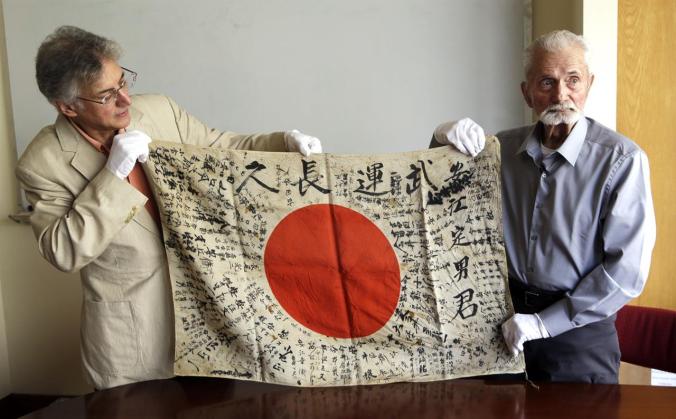
Many Japanese soldiers during World War II went into battle carrying small “Rising sun” flags, the red sphere on the field of white, with the white field decorated by hundreds of classmates, family members and friends. The flags were for good luck, and to link soldiers to their loved ones while they fought for the Emperor.  I had never heard of this practice until today; my father served in the European theater, so he would not have known that many American soldiers took these personal talismans from the bodies of fallen Japanese soldiers as war trophies.

U.S. Marine Marvin Strombo was such a soldier. A member of  an elite sniper platoon during the bloody battle for the Pacific island of Saipan in 1944, he had taken a flag from a dead Japanese soldier lying on his left side—he remembered that the young man looked like he was  asleep—after he noticed something white sticking out from his jacket.

The flag with all the inscriptions on it hung behind glass in Strombo’s gun cabinet in his home in Montana for decades until 2012, when the son of his former commanding officer contacted him for assistance with a book he was writing about the exploits of his father’s platoon. (ARGHHH! I just remembered that I haven’t gotten back to a member of my Dad’s unit who wrote me a couple of months ago!) Working with the author,  Strombo learned about  the Obon Society, a nonprofit organization in Oregon that works to locate and return the personal Japanese flags to the families of the fallen soldiers who carried them. Researchers determined that the dead soldier Marvin’s flag had belonged to was named Yasue Sadao. What Strumbo thought was calligraphy were really the signatures of 180 friends and neighbors, including 42 relatives, who saw Yasue off to war from Higashi Shirakawa, a small village of about 2,400 people in the mountains roughly 200 miles west of Tokyo. Continue reading

From The “Stop Making Me Defend President Trump!” Files, The Unethical Tweet Of The Month By Chelsea Handler

Nice. The cult snarky feminist comic bluntly advocates a military coup. If there is a joke in there, someone show it to me.

These are your stars, progressives; your compatriots, your allies, your spokespersons and “truth-tellers.” They are willing to give up the democracy and the Constitution because they hitched their leftist hopes and fantasies to a corrupt, dishonest, venal woman and the anti-speech, anti-personal liberty, anti-sovereignty, anti-equal protection, anti-due process, anti-democracy party that rigged its process to inflict her on the American public.

You must be so proud.

What the hell’s the matter with you?

Morning Ethics Update: 8/10/17

Good Morning!

1. Less than two weeks after social justice bullies on social media chastised actor Mandy Patinkin for agreeing to take the place of a black actor in Broadway’s “Natasha, Pierre & The Great Comet of 1812,”  causing the politically impeccable Mandy to withdraw with humble mea culpas, and the “woke” creator of the  the Tony winning musical to humbly kowtow to the new show business principle that it is better for a show to close entirely, putting everyone out of work, than for a white actor to take over a role from a black actor who took over the role from a white actor in the first place, “The Great Comet’s” producers announced that the show will close in September.

Good job, everybody!

Morons.

2. First Amendment incursions are creeping in from all sides and all angles so fast it’s hard to slap them down. Cowboy Joe West, the major leagues’ longest-serving umpire,was just suspended for three days for comments he made a in an interview with USA Today published on June 20, to mark   the umpire’s 5,000th regular-season game. Asked which player beefed most frequently about his calls, West said “it’s got to be Adrian Beltre.” Beltre, who recently punched his own ticket into the Hall of Fame by getting his 3000th hit, is apparently something of a human Bermuda Triangle for ethics controversies.

“Every pitch you call that’s a strike, he says, ‘Whoa! Whoa! Whoa!,'” West was quoted as saying.  “I had a game with him recently and the pitch was right down the middle. He tells me, ”That ball is outside.’ I told him, ‘You may be a great ballplayer, but you’re the worst umpire in the league. You stink.'”

MLB suspended West for three days, telling the umpires union in a letter that the discipline was in response to an “appearance of lack of impartiality.” Beltre has said that he never assumed West was being anything but facetious. The umpires union is livid, and West is likely to file a grievance.

There are two theories about this strange episode in the Marshall household. I think it’s more evidence of slippage on the societal slope to speech suppression. My wife thinks baseball is laying the groundwork for replacing umpires on balls and strikes with robo-calls. After all, robots aren’t biased.

I hope she’s right, but I doubt it.

3. Why don’t Democrats want to clean up eligible voter rolls?the Justice Department filed a Supreme Court amicus brief  supporting the state of Ohio as it fights to defend its law that purges names from voter rolls if  those names aren’t attached to votes for a significant period. This reverses the Obama Administration’s position, which backed a lower court decision  that it ran afoul of the 1993 National Voter Registration Act.

Why does Ohio want to de-register voters who don’t vote for two years, then are sent notices asking that they confirm their voter registration, don’t respond to the notices ,and continue to not vote for another four years? I assume it is because the state doesn’t want dead people on the voter rolls. Why do Democrats want the names of dead people listed as eligible voters?

I’ll leave that to your imagination… Continue reading

Unethical Quote Of The Week: San Diego State University Political Science Professor Jonathan Graubart

I find myself annoyed at the groundswell of good wishes for John McCain after his diagnosis of glioblastoma…McCain is a war criminal and, more to the point. someone who as a politician has championed horrifying actions and been lousy on state commitment to public health…But ultimately what troubles me is the urge to send such well wishes to an utter stranger as it reinforces the notion that some lives are more important than others. There are lots of people with glioblastoma and who have died from it (including my mother twenty years ago)….

San Diego State University Political Science Professor Jonathan Graubart on Facebook, prompting some calls for him to be fired, and others on campus to second his opinion.

Is this an Ethics Quote or an Unethical Quote? I could call it  an Ethics Quote because it raises many ethical issues, and mere statements of opinions, even stupid and vicious ones, are not usually unethical in themselves. This quote strongly suggests that the speaker is unethical in  than one respect; it is also, at very least, irresponsible in its context, which is that he is a teacher, and represents the institution.

Jonathan Turley flagged this episode, as he reliably does any time a professor comes under fire for controversial speech. As always, he supports his fellow academic:

“Graubart’s comments are hurtful and hateful. It is a reflection of the incivility that has taken hold of our social and political dialogue. It is always sad to see a fellow academic rush to the bottom of our national discourse. However, we have free speech and academic freedom to protect unpopular, not popular, speech. Popular speech does not need protection. Graubart is expressing his deep political and social viewpoint on social media. He should be able to do that just as his critics have a right to denounce his views.”

San Diego State University is a government institution, and thus subject to the First Amendment, in addition to the principles of academic freedom. However, even a state institution  has a right to protect itself from harm. This isn’t just political speech; it is bona fide asshole speech, signaling that the speaker is not a trustworthy teacher, and that any school that would have someone this intolerant, doctrinaire, vile and contemptuous of kindness and compassion educating, aka indoctrinating students isn’t trustworthy either. Universities, public or not, should be able to insist on a minimal level of professionalism from faculty in their public behavior and pronouncements so the institution isn’t permanently discredited, embarrassed, and harmed.

Here is Graubart’s whole Facebook rant: Continue reading

Morning Ethics Warm-Up: 7/20/17

Καλημέρα!

[This is pronounced “Kaliméra!,” not to be confused with “Calamari!” My father frequently got them confused when he visited Greece with my mom, the former Eleanor Coulouris, and embarrassed her by greeting the natives some mornings by cheerily saying, “Squid!]

1. The newspaper Arts section headline says, “Mayor Ties Arts Money To Diversity.”

The mayor in question is New York City’s DeBlasio, and since his own family is “diverse,” naturally every other entity has to be, or it is baaaad. This is why I oppose government funding of the arts unless it guarantees that the nation, state or city will not attempt to use its support to control the arts organizations in any way.  Of course, governments will never do that, because manipulating the arts to advance  political agendas is usually the underlying motive in arts grants. Ideologues like De Blasio—wow, he’s terrible—will constantly be grandstanding and doing everything in their power to manipulate artists and their art to ensure that they send the “right” messages—you know, like Nazi art and Communist art. It is exactly the same theory and practice: art as political indoctrination.

Quick: who thinks that De Blasio will be focusing on “diversity” in the management (or on the website) of the Dance Theater of Harlem? Even if the government doesn’t attach strings to its support, arts organizations know that there are more of them than there is tax-payer money to disperse, so there is terrible and often irrsistable pressure to distort their product to give their state funders what the artists think they want—just to be safe.

My professional theater company refused to do that, sticking to the integrity of our mission and not resorting to tokens and virtue-signalling. My now defunct professional theater company, that is.

2. Yesterday, I highlighted the head-blasting comments of New York Times film critic A.O. Scott and his alternate-universe pronouncements about the Obama presidency. To be fair to A.O., his entire profession is packed with historical and political ignoramuses who make their readers dumber with every review. I once created a theater reviewer’s code of ethics, which I mailed to a critic, who sent it back to me with a note that said, “Mind your own business.” Years ago, I published an essay that was called “Why Professional Reviewers Are Unethical,” that began,

When Variety announced that it was firing its in-house film and drama reviewers, there was much tut-tutting and garment-rending over the impending demise of professional reviewing in magazines, newspapers and TV stations. The villain, the renders cry, lies, as in the Case of the Slowly Dying Newspapers, with the web, which allows any pajama-clad viewer of bootleg videos to write film reviews, and any blogger who cares to write a review of a play. “I think it’s unfortunate that qualified reviewers are being replaced,” said one movie industry pundit, “but that’s what’s happening.”

I say, “Good. It’s about time.”

It’s not happening quickly enough, though. “Dunkirk” is opening this week, and, as I predicted, film reviewers are showing their utter historical ignorance. The Washington Examiner skewers them deftly in an essay called “Why the (True) History of Dunkirk Matters.” Highlights, or rather lowlights:

  • USA Today critic Brian Truitt complains that “the fact that there are only a couple of women and no lead actors of color may rub some the wrong way.” He is not the only film critic to observe this.

Morons.

  • Slate.com critic Dana Stevens claims that the British Army at Dunkirk was the “last bulwark against Nazi invasion of the British mainland.”

Not even close to true. Continue reading

The Unappreciated Home Depot Hero

It’s more exciting than you think!

Ethics Alarms has dealt with this issue multiple times: an employee violates policy by intervening to prevent a crime or serious injury, and is fired for it.  In 2009, a bank teller named Jim Nicholson turned Batman and foiled a bank robbery, then was fired.. A would-be robber had pushed a black backpack across the bank counter to Nicholson and demanded money. The teller threw the bag to the floor, lunged toward the man and demanded to see a weapon. The robber sprinted for the door with Nicholson in pursuit. Eventually Bat-Teller  knocked the man  to the ground and held him until the police arrived.

The bank had to fire him. The episode could have gone wrong many ways, some resulting in bank customers and employees being injured or killed. Law enforcement repeatedly cautions against such conduct, and the bank’s policies were clear.

In other cases, no-tolerance makes no sense, as no-tolerance often does. In 2012, Ryan Young, then working in the meat department of a Safeway grocery store in Del Rey Oaks, California, witnessed a man beating a pregnant woman, apparently his girlfriend. Young told the man to stop, but when he continued with his assault, shoving and kicking her, Young jumped over his counter, pushed the thug away, and ended the attack.

Safeway fired him. So what would it have had Young do, stand there and wag his finger? This crossed into duty to rescue territory. Young did the right thing, and rather than blindly following a policy that didn’t fit the facts, Safeway should have realized that an exception was called for.. (Eventually public opinion and bad publicity forced Safeway to re-hire the hero). A similar scenario involved a lifeguard who violated his employer’s policy by saving a drowning man off a beach adjacent to the property where he was stationed. Jeff Ellis Management, an Orlando, Florida-based company, fired  21-year-old Tomas Lopez for daring to save a life pro bono, and was similarly pilloried by public opinion. Two lifeguards quit in support of Lopez, and he was also eventually offered his job back. Lopez told Jeff Ellis Management to get bent, or words to that effect. Continue reading

Morning Ethics Warm-Up: 7/9/17

GOOD MORNING!

1. The Pope gave an interview saying, in Italian of course, that the United States of America, which he offensively grouped with Russia, China, North Korea and Syria, have “a distorted vision of the world.”

The Pope, who has spent the bulk of his adult life seeing the world through the narrowly focused lense of the Catholic Church, and who hails from a South American leftist state, thinks that the United States has a distorted view of the world. Wow. Besides the stunning hubris of this pronouncement, the Pope is engaging in an abuse of position and influence, and a remarkably short-sighted one. If he wants to exercise any influence at all over citizens of the world who have not been indoctrinate since childhood to regard him as a godly sage by virtue of a secret political vote by a bunch of superannuated Cardinals, he has to earn credibility by the evident quality of the statements he makes. Later on, in the same interview, the Pope made it clear that his  undistorted vision of the world involves endorsing open borders.

I think the Pope has a distorted view of the trustworthiness of celibate men who have access to young boys, so I really couldn’t care less what he thinks about U.S. policies when he can’t objectively and responsibly process the terrible realities in his own organization.

2. I’ve been reading and  listening to sportswriters since I was ten, and I have to say that I have little respect for the critical thinking skills of most of them. I was gobsmacked by an example of why this morning, as Steve Buckley, a long-time baseball reporter for the Hub’s #2 paper The Boston Herald, opined in a virtue-signaling mess of a column that “War heroes, not David Ortiz, deserve streets named after them.” David Ortiz, in case you live in a fallout shelter, is the recently retired iconic slugger of the Boston Red Sox. The team recently retired his number, and in a related honor, the city of Boston re-named a small street near the park after him. It had earlier named one of the many bridges in the city after him.

“We should reserve the streets, the corners, the squares, the playgrounds, to remember the men and women who died serving our country.” Buckley writes. Why? He never really gives a reason, he just tells us that this is the way it should be.  Why are the veterans who die in military service more honor-worthy than those who risked their lives but survived? Since when are society’s only real heroes military heroes? Is he a time-traveler from Ancient Sparta? Do contributions to society during peacetime or on the home front matter less to a community than what happens on a foreign battlefield?

What about fallen police officers and fire fighters? Not worth a street name? Philanthropists, inventors and innovators who made life better for all, launched businesses, created jobs, helped families and neighborhood thrive—these don’t warrant a little bit of  local immortality?  David Ortiz made millions of people happy. In a racially divided city, Ortiz, a black man, became the face of Boston sports, at least for those who were nauseated by Tom Brady’s smug countenance.  That was as important as his clutch home runs. Trivializing Ortiz’s contributions to Boston (the relationship of Bostonians to their infuriating baseball team is too complex to explain quickly to anyone who hasn’t been part of it) is trivializing the importance of entertainment and popular culture, which is nothing short of ignorant, especially in the United States. In the District of Columbia, a school is named after Duke Ellington. Good. In Los Angeles, for decades until California leftists finally removed it, a major airport was named after John Wayne. Excellent. And in Boston, the largest tunnel is named after Ted Williams, but maybe Buckley thinks that’s OK because Williams was a combat flier in two wars. (Pssst! Ted’s tunnel isn’t bearing his name because he crash-landed that jet, Steve!)

As a society and a species, we have a duty to remember those who have contributed to the culture we enjoy. There aren’t enough streets, schools, bridges and parks to honor them all, but they all deserve to be honored. Continue reading

Comment Of The Day: “Morning Ethics Warm-Up: 7/7/17”

Hamburg, post allied bombing, WWII

Ethics Alarms doesn’t have many discussions of foreign policy, in part because policy is usually less about ethics and more about practical realities, theory and policy. What discussion we do have involves leadership, a secondary passion here. Warfare, in contrast, is an ethics category, but also a grand, meta-ethics morass that isn’t a safe space for ethics generally. I regard war as the ultimate ethical anomaly where the rules and theories break down. We cannot avoid encountering mobius strip sequences like..

War is inherently unethical.

Sometimes war is an  unavoidable and utilitarian necessity.

In such cases, it is essential to end such a war as quickly as possible.

The quickest and the most ethical way to end such a war as quickly as possible is by overwhelming and uncompromising force.

Uncompromising force inevitably involves the maximum loss of innocent life, and is unethical.

Half-measures prolong the damage of war and are also unethical.

Wait…where were we again?

My father—the kindest man I ever knew, a grievously wounded war hero and a natural leader who hated guns, detested war (but hated what he saw at the death camp he helped liberate more), would have devoted his life to the military service of his country if he could have and who told his son that if he chose to duck the draft during the Vietnam War that he had his full support—would repeatedly rail against modern surgical tactics designed to avoid civilian deaths at all costs as madness, and a symptom of weak resolve and cowardly leadership. His reasoning: “We could not have won World War II if the news services had been allowed to publicize what war does to civilian populations. It is as simple as that. We would have lost, and Hitler would have won, killed millions more, and divided up the world between Germany, Japan and the Soviet Union. The public had no concept about the horrible things we had to do, and that I participated in, to win that war. If one side is ruthless and the other side is more concerned about collateral damage than winning…and the ruthless side knows it, then ruthless wins.

He died after only a year of Barack Obama’s Presidency, but believed him to be a dangerously deluded and ignorant man regarding the use of power and military force.

I thought about all of this as I read texagg04’s Comment of the Day on the final item of yesterday’s Morning Warm-up. which began,

5.An ethics  question about the North Korea crisis: do common sense ethics apply to foreign affairs? Listening and reading various experts and authorities, I am struck by how many seem to argue that negotiation with the North Korean regime is the only palatable option. The fact that this is simply and unquestionably agreeing to international blackmail by a resolute evil-doer seems to be either unrecognized or ignored.

Here is his Comment of the Day, which Dad would have admired, on the post. “Morning Ethics Warm-up 7/7/17”: Continue reading

The Easiest Ethics Dunce Call Of All Time: Vox

On Memorial Day, 2017, the progressive commentary website Vox published this article, attacking the U.S. Marine Corps. It is not an unreasonable article and fairly describes a real cultural issue facing theCorps as it moves into a new era. The  article would be appropriate 364 days of the year, but not today. Today is the time for Americans to honor the memories and sacrifices of the more than 40, 000 Marines who lost their lives defending their country and ours.

The only way, the only way, that the editors of Vox could have failed to hear the tiniest tinkle of an ethics alarm as they prepared for publication is that no one in a management position at the publication possesses anything but contempt  or ignorance regarding the Armed Services and what they have done and continue to do to protect the United States. In this, Vox is sadly representative of an especially unethical component of the American Left, a segment of that ideological group lacking historical perspective, respect, gratitude, courage, proportion, competence and the essence of citizenship. If publishing the piece today was accidental, it shows stunning ignorance. If it was intentional, a deliberate thumb in the metaphorical eye of a vital American institution, Vox’s world view and values are so warped that it forfeits credibility and trust.