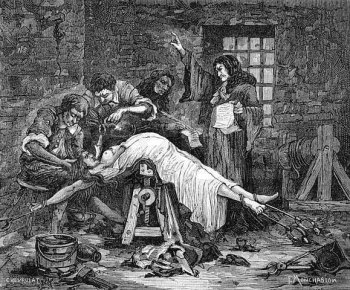
Ethics Bob Asks: “Did Torture Lead Us To Bin Laden”? My Answer: “So What If It Did? It Was Still Wrong.”

It's all for the best.

It’s all for the best.

The last time my friend “Ethics Bob” Stone blogged about ethics, it was way back in August, and he was writing about some guy named “Romney.” Now he’s back on the job, thank goodness, with a comeback post titled “Zero Dark Thirty: Did torture lead us to Osama bin Laden?”. And he’s ticking me off.

“Zero Dark Thirty” is Hollywood’s treatment of the search, apprehension and execution of Osama Bin Laden. The film suggest that methods of torture were employed by the CIA to uncover crucial intelligence that led to the terrorist mastermind’s demise. Torture opponents, including some U.S. Senators, are alarmed by this, and disputing the film’s account. (Imagine that: a movie that misrepresents history!) Meanwhile, conservatives, neocons, Bush administration bitter-enders, talk radio hosts and admirers of Dr. Fu Manchu and James Bond villains are citing the film as confirmation that they were right all along: torture is a wonderful thing.

I am puzzled that Bob got in the middle of this debate as an ethicist. “It worked!” and “It came out all right in the end!” are not valid ethical arguments or justifications. The first is an embrace of a pure “the ends justify the means” rationale, a favorite tool of Auric Goldfinger and Dr. No. The other is consequentialism. When ethicists and principled opponents of torture allow the issue to be adjudicated on this basis, they are surrendering their principles at the outset. “Torture doesn’t work” is a pragmatic argument, not an ethical one. If the societal consensus regarding torture is going to be determined by how much we can benefit by returning to the rack and wheel, then ethical considerations have already been jettisoned. Continue reading

Comment of the Day: “Unethical Quote of the Month: The Washington Post”

militia

I don’t agree with everything in Michael’s  take-down of a comment by Eric R. to my post, “Unethical Quote of the Month: The Washington Post,” but as an example of the genre ( mastered on Ethics Alarms by the 2011 Commenter of the Year tgt and others), it’s a gem. The main point, that the Second Amendment has significant symbolic value as a right that reminds the government that the citizens of a democracy will not bare their throats to central power, is a crucial one, which I touched on in an earlier Ethics Alarms post. An armed insurrection against the government would be a catastrophe, of course. Still, while those Americans who believe that arming citizens against possible government tyranny trust too little, the citizens who argue that the government should be able to disarm the populace in the name of safety trust far too much.

I did remove one small non-substantive part of the post, because I really dislike mockery as a device on Ethics Alarms (the unedited comment is still under the original post.) I particularly think Michael’s identification of the reasons underlying the recent spate of mad dog killings is seriously off the mark. My own list, in order of influence would be…

  1. The difficulty of getting seriously disturbed individuals institutionalized, and the lack of places to keep and treat them.
  2. The availability of assault-type weapons to such disturbed individuals.
  3. The failure to enforce existing gun regulations
  4. The increasing difficulty and complexity of life generally, making it harder for those who are poor, poorly trained, not especially bright, or emotionally fragile to compete and succeed.
  5. The pervasive media, which creates false norms of success and happiness that are unachievable for most Americans.
  6. The culture of guns and violence, which is intensified by the entertainment media, but which is also a core American characteristic that isn’t going away.
  7. The publicity given to mass murderers by the news media.

But I digress.

Here is Michael’s tough Comment of the Day, to the post “Unethical Quote of the Month: The Washington Post”. The bold sections below are quotes from Eric’s comment: Continue reading

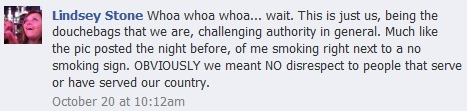
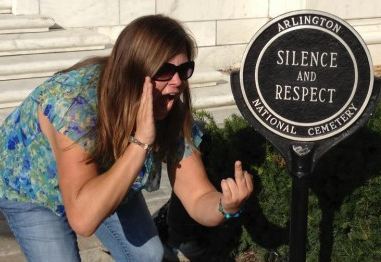
Lindsay Stone Scores A Jumbo: The “I Didn’t Intend To Do What I Did When I Intentionally Did What I Did” Excuse

I have to give Lindsay Stone credit. You will seldom see as pure an example of an outrageous denial of the undeniable in a public apology as the one she just authored. Brava! And good luck with the job hunt.

Stone, who is an idiot, and her friend, who is an idiot whose name has yet to be tracked down by the media, collaborated on a photo showing Stone giving an upturned middle finger to the Tomb of the Unknown Soldier, while yelling something by the sign there that says “Silence and Respect.” The photograph was posted on Stone’s Facebook page and naturally went viral. Thousands of protesters bombarded the website of their employer, Living Independently Forever, with demands that the two be fired. Today, they were.

Before the inevitable axe fell (more on that in a bit), Stone posted this remarkable explanation:

Continue reading

Ethics Dunces: The Petraeus Defenders

I know I have touched on this before regarding the Petraeus scandal (and elsewhere), but it bears emphasizing—especially since so many seem to be unable to process the concept. Leaders cannot be seen as willing to violate their own rules, principles and those of the organizations they represent. Arguing that the rules violated are foolish, or outdated, or too restrictive does not rebut this fact of leadership in any way, but making that argument does show beyond question that the pundit making it doesn’t comprehend the most basic facts of leadership and the building of ethical cultures.

Today’s Sunday papers are awash in editorials and op-ed pieces by former intelligence personnel, lawyers, social scientists and other pundits blaming the widening Petraeus scandal ( now focusing on Gen. John Allen, the U.S. commander in Kabul, and the significance of his exchanging thousands of inappropriate emails with Jill Kelley, the Tampa socialite who is apparently the military equivalent of a rock-and-roll groupie, only older) on antiquated morals and political opportunism. There are too many of these bewildered commentators to count, but their views all ooze from the same basic, shockingly facile, and in some cases intentionally misleading theory, which is that Petraeus’s and Allen’s conduct are irrelevant to their ability to do their jobs. The Washington Post’s David Ignatius, usually one of the more rational and objective of that paper’s leftward chorus, actually reprints verbatim an e-mail he received from an Arab diplomatic source as if it contains illumination rather than naiveté:

“He needs to resign cause he has an affair? What da hell??? He is brilliant!!!! Why like this????” Continue reading

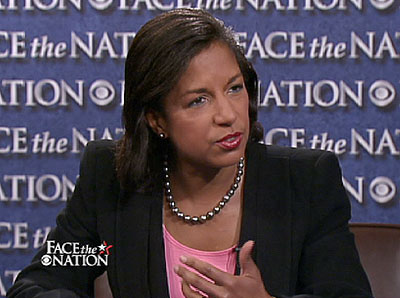
Accountabilty Check: President Obama’s Bizarre Defense of Susan Rice

“Don’t pick on my poor. defenseless, untrustworthy ambassador!”

Add to the list of the Top Ten Outrageous Remarks of President Obama this stunner, the low-light of his first full press conference since March.

“If Sen. McCain and Sen. Graham and others want to go after somebody they should go after me. For them to go after the UN ambassador who had nothing to do with Benghazi…to besmirch her reputation is outrageous.”

“Accountability” continues to be an alien ethical concept to the President, and this proves it. U.N. Ambassador Rice went on the Sunday morning TV shows four days after the deadly Benghazi attack and after U.S. intelligence had determined that the attack that killed the American ambassador in Libya was not a spontaneous demonstration sparked by an anti-Islam video, but a planned, organized, terrorist enterprise. She did this while asserting in no uncertain terms that the attack was not what U.S. intelligence had told the State Department and the White House that it was. Rice, in making this mistaken or dishonest case on behalf of the administration, put her name, her status, her credibility and her position behind it. From the moment she became the Administration’s spokesperson on Benghazi, she had something to do with Benghazi. Continue reading

Gen. Allen, Lockheed, John Edwards, Restraint Bias,and Further Musings on the Petraeus-Broadwell Ethics Train Wreck

Run away!

In no particular order:

  • In a tack that is being duplicated by other commentators on the left, MSNBC’s Rachel Maddow essentially pronounced the scandal as much ado about nothing (Columnist E.J. Dionne dismissively referred to Petraeus’s affair as his “little secret”). See, as long as an incident involves sex, the Left’s default position is that it can’t be that bad. Maddow mocked the actions of Jill Kelley, the woman who Broadwell threatened and who alerted the FBI, saying, “Who contacts the FBI because of threatening e-mails? If I did that, they would have to set up a special division just for me.” Ha ha.  How many of your threatening e-mails credibly suggested that the head of an intelligence agency was having an illicit affair with an unstable wacko, Rachel? Kelley did the responsible, intelligent thing given the possible national security implications. But it’s certainly good to know that you wouldn’t…because it’s only sex, of course.
  • Other pundits are complaining that the FBI became involved when what Petraeus did “wasn’t a crime.”  Yes,  it’s the “It’s legal” rationalization. Why people who can’t comprehend that dangerous, destructive, serious misconduct can occur without breaking any laws are allowed to write newspaper columns, I’ll never understand. Petraeus’s affair was a violation of the ethics rules, in an intelligence agency with major responsibilities in national security. That is serious, inherently dangerous, and easily could have led to security breaches that were illegal. If a leader materially, knowingly and publicly violates an ethics rule, he cannot lead. This is why Petraeus, who understands this, resigned, despite the certainty that the Rachel Maddows of the media would have been happy to shrug off his actions as “no big deal.” because it’s only sex, and “it’s legal.”
  • Kelley still boarded the ethics train wreck, not because of her actions in response to Broadwell’s threat, but in light of the revelation that she was maintaining a hot e-mail relationship with Gen. John R. Allen, the commander of U.S. and NATO troops in Afghanistan. The FBI has uncovered between 20,000 and 30,000 pages of primarily e-mails containing “potentially inappropriate” communication between Allen and Kelley. Wait, what? Between 20,000 and 30,000 pages? What the hell is going on with our generals? This is obsessive, unhealthy behavior, even if he’s just writing her limericks and recipes. Something is serious amiss in the ethical culture of the U.S. military leadership Continue reading

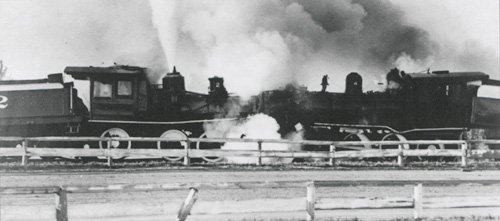
Ethics Train Wreck Watch: The Petraeus-Broadwell Affair

There is too much information awaiting disclosure to do a thorough ethical analysis at this point, but it is already clear beyond question that the David Petraeus-Paula Broadwell scandal is an ethics train wreck, with many more individuals and perhaps institutions involved than the direct participants. Today’s news reports that the adulterous affair prompting the much-respected CIA Director’s sudden resignation was triggered by Broadwell’s  threatening e-mails to another women she suspected of vying for the General’s affections clinches train wreck status. This thing is still rolling.

Other features of the wreck-in-progress: Continue reading

Ethical Quote of the Month: Gen. David Petraeus

“Yesterday afternoon, I went to the White House and asked the President to be allowed, for personal reasons, to resign from my position as D/CIA. After being married for over 37 years, I showed extremely poor judgment by engaging in an extramarital affair. Such behavior is unacceptable, both as a husband and as the leader of an organization such as ours. This afternoon, the President graciously accepted my resignation.”

—-Gen. David H. Petraeus, Director of the Central Intelligence Agency, in a public statement announcing his resignation from that position.

How quaint.

Democrats and Republicans must have felt that they had stumbled into the Way-Back Machine and delivered into England circa. 1904. A high government official resigning over adultery, sex,…”personal misconduct?” How bizarre! Naturally, Sen. Diane Feinstein, who heads the Senate Intelligence Committee,  announced that she would have supported Petraeus if he had chosen to stay. “I wish President Obama had not accepted this resignation, but I understand and respect the decision,” she said in a statement, and described Petraeus’s resignation as an “enormous loss for our nation’s intelligence community and for our country.”

The right way to leave after an affair, apparently, is to try to cover it up, submit to extortion, corrupt others in the process, and only quit when the hideout is surrounded, the hounds are clawing at the door and someone is yelling at you through a bullhorn—you know, like former GOP Sen. John Ensign, who waited two years to resign while his colleagues, like Feinstein, looked the other way. Nobody gets it in Washington—“it” being the ironclad principle that leadership must set the highest example, not the lowest level it can get away with, or the whole system rots below. Nobody, apparently, except the man who just resigned. Continue reading

If You Liked “Enhanced Interrogation,” You’ll Love The “Disposition Matrix”

Is THIS the Administration’s secret weapon against terrorists?

The Washington Post launched a three-part series today about the U.S. drone strike program, in which terrorists abroad are targeted and assassinated from the sky. I’m not prepared to attempt an ethical analysis of this deadly tool against international terrorism, although I will acknowledge that my initial, gut level assessment is that the unique nature of terrorism requires adjustments in the ethics of national security and warfare, and drone killings seem to be a fair and reasonable adjustment.

Yet it is still killing. It is also controversial, with many human rights activists, international law specialists and ethicists vehemently condemning the tactic, especially when used against turn-coat Americans abroad without due process of law. Consequently, the Post’s revelation that the Administration’s “kill list” is called something else rings the ethics alarms.

The Post:

“Over the past two years, the Obama administration has been secretly developing a new blueprint for pursuing terrorists, a next-generation targeting list called the “disposition matrix.” The matrix contains the names of terrorism suspects arrayed against an accounting of the resources being marshaled to track them down, including sealed indictments and clandestine operations. U.S. officials said the database is designed to go beyond existing kill lists, mapping plans for the “disposition” of suspects beyond the reach of American drones.” Continue reading

Ethics Hero Emeritus: Eric Lomax, 1919-2012

Eric Lomax was a hero of forgiveness.

Eric Lomax, his book, the Bridge on the River Kwai,, and his friend, the man who tortured him.

In 1942, Eric Lomax, was a 19 year old  member of the British Royal Corps of Signals stationed in Singapore when he joined thousands of British soldiers in surrendering to the Japanese. It was 1942. He was one of those shipped to Thailand and became one of the slaves laboring to build the Burma Railway, also known as the Death Railway. The building of the railroad and the brutal treatment of the English prisoners by their Japanese captors  formed the plot of the classic 1957 David Lean film, “The Bridge on the River Kwai,”

After Lomax was discovered to have built a radio receiver from spare parts, he was mercilessly tortured and interrogated by his captors.  After his release, fantasies about murdering his main torturer, a man named Nagase Takashi, obsessed him. Lomax spent the early years of his retirement in the 1980s looking for Takashi, and eventually learned that he had become an interpreter for the Allies after the war. In 1992, he stumbled across an article profiling Nagase and noting that he was haunted by guilt over his mistreatment of one British soldier. That soldier, Lomax realized, had been him. He arranged to meet the man who tortured him, and whom he had spent the rest of his life dreaming of murdering.

Torturer and victim met in 1993, on the infamous bridge Lomax had been forced to help construct (and which was not blown up, the film ending notwithstanding). Continue reading