Ethics Quiz: Michael Wilbon’s Politically Incorrect Confession

mike_wilbon

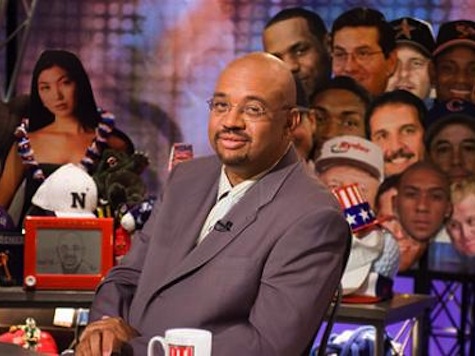
Sportswriter Michael Wilbon, Tony Kornheiser’s African-American foil on the fluffy ESPN show “Pardon the Interruption” and hardly a rabble-rouser, shocked his audience this week when he announced that he is an aficionado of the word “nigger” (but not in public), and objects to being told that there is something wrong with that, especially by white folks. The issue came up regarding an uproar over a tweet, since deleted, from an NBA player using the word to criticize his team mates. [ Aside: It is funny how frequently a single post on Ethics Alarms  about a topic—say political correctness, word censorship, civility and the morass of related ethical issues—seems to trigger an explosion of news stories in the same area. Undoubtedly it is because the proximity of the post itself influences my judgment regarding which events deserve comment, but it sure doesn’t feel that way. This is similar to the phenomenon where you think you have heard a word or phrase for the first time, and suddenly you’re aware of it everywhere.] Wilbon said, unapologetically,

“People can be upset with me if they want, I, like a whole lot of people, use the N-word all day, every day, my whole life … I have a problem with white people framing the discussion for the use of the N-word.”

Your Ethics Alarms Ethics Quiz this weekend is this:

Is Wilbon’s defense of using the word “nigger”ethical? Continue reading

Workplace Ethics: 62 Things That Are Legal, But 22 Of Them Are Unethical

"Oh, sure, he's hell to work for, but he never breaks any laws, so you'll be fine."

“Oh, sure, he’s hell to work for, but he never breaks any laws, so you’ll be fine.”

I have been remiss in not adding the terrific blog Evil HR Lady to the Ethics Alarms links, and will finally do so as soon as I post this entry. No profession deal s with ethical nuances and dilemmas more frequently than human resources professionals, and they can be very difficult, even gut-wrenching. In a recent post, EHRL searched through the archives of questions she has answered over the past years, and compiled an eye-opening list, especially for non-lawyers, of the conduct employers could engage in legally, which is to say, get away with and not be successfully sued, to employees, together with some questionable kinds of conduct that are legal for employees to do to each other.

She listed 62 of them, many of which are reasonable ( it’s okay to fire an employee for “being a jerk”) and some are obvious, or should be;  it is legal to quote the Bible in the office, for example. What is legal is not always good, fair, or right, however, and I perused the list with an eye out for legal workplace conduct that was legal but still unethical. About a third of the types of conduct on the Evil HR Lady’s list made mine. What follows is the sub-list of the 62 things it is legal to do at work, the 22 things it may be legal to do at work, but which are still unethical. The reasons for my unethical verdict follow Evil HR Lady’s items.

Here’s the list of the unethical 22 workplace practices: Continue reading

Can A Prostitute Be Raped?

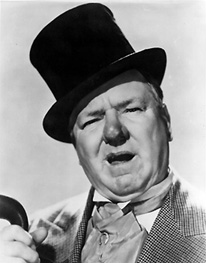
On Nov. 5, we'll find out if W.C. Fields' low opinion of Philadelphia was justified...

On Nov. 5, we’ll find out if W.C. Fields’ low opinion of Philadelphia was justified…

An unethical and incompetent judge in Philadelphia doesn’t think so, thus making a powerful argument against electing judges, being a prostitute, and living in Philadelphia.

Philadelphia Municipal Court judge Teresa Carr Deni ruled that the 2007 rape of a prostitute at gunpoint was merely “theft of services.”The  woman had agreed to meet a man have sex with him for the bargain fee of $150. He asked her if his friend could join in the fun for an additional $100, and she agreed. When these two sterling citizens arrived for the appointment, however, they held her at gunpoint and forced her to have sex with them free of charge.

If this isn’t rape when a prostitute is involved—forced, unconsented intercourse, through the threat of deadly force—then any prostitute can be raped at will, with the worst charge being “theft.” Selling sex doesn’t convert sexual battery into nothing, a non-crime, once consent for that sale is withdrawn. If you know someone is preparing to sell blood to a blood bank, and you attack him, subdue him, and drain his blood to sell yourself, is this merely theft, or a crime of violence? If he was going to be an organ donor, and you rip out his kidney, is that just theft? There is no route through law or reason that allows us to ignore the fact that a woman was forced to have sex with two men without her consent. Judge Deni clearly has a monstrous bias against prostitutes, and thus believes that they shouldn’t receive equal protection under the law. When criticized, her rationalization was that prosecuting the men for rape “minimizes true rape cases and demeans women who are really raped.” Continue reading

World Series Ethics: He Tipped His Cap

What would Ted Williams have done? We know the answer to THAT question...

What would Ted Williams have done? We know the answer to THAT question…

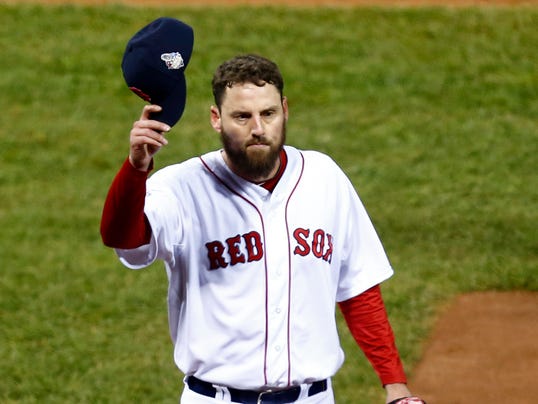
The Boston Red Sox won the World Series last night, making me happy. Something else happened too.

Some background is in order. The great Ted Williams used to give Boston baseball fans the biggest hat tip in baseball as they cheered him after a home run. This was when he was first known as “the Kid’ and indeed was one, as his Hall of Fame trajectory was obvious from the moment he stepped on a major league field in 1939 at the tender age of 19. Gradually but rapidly, a vicious local press and some ugly incidents in response to a few jackasses in the stands caused the Kid to sour on the admission-paying mortals who booed him when he struck out, and he decided to ignore their cheers, refusing to extend the traditional courtesy of a hat tip to the fans as he rounded the bases after a home run—which, since he was Ted Williams, happened frequently. Williams  spent his whole career in the city of Boston playing before those fans who offended him in his twenties, but right up to and after his final home run, which he hit, famously, in his last at bat, the Red Sox fans got no hat tip from Ted. He rounded the bases the final time as they cheered themselves hoarse, and never looked up or acknowledged their praise. Screw ’em.

That was Red Sox pitcher John Lackey’s attitude toward the current generation of Fenway fans, for similar reasons. He had been signed to a rich, long-term contract in 2010 to be a Red Sox mound ace, but arrived in Boston with his arm deteriorating and his abilities diminished. 2010 was a disappointing season for Lackey and 2011 was worse, as he pitched in pain for a team that was short of hurlers. The 2011 Red Sox became infamous for their late-season collapse and underachieving starting pitchers, and no one on that team was jeered on the field or savaged in the call-in sports shows like John Lackey. He missed the entire next Red Sox season recovering from arm surgery after the 2011 collapse, and thus missed the 2012 debacle that was even worse. In 2013, however, Lackey returned with a renewed right arm, a fit body and a fierce determination to finally live up to the big contract. He did, too. He pitched well all season, and became a key factor in the Boston charge to the World Series, as they rose from last place in their division in 2012 to first.

In 2013, Lackey received nothing but cheers from the surprised and grateful Boston fans. Nevertheless, he adamantly maintained the Kid’s attitude—“Screw ’em”—all season long. As he walked into to the Red Sox dugout after being relieved in another fine pitching performance and the Boston fans saluted him, Lackey refused to reciprocate with the traditional hat tip, all season long and through the play-offs. The fans were fickle hypocrites, and their loyalty conditional. They booed him when he was valiantly pitching hurt and embarrassed in 2011, and he wasn’t going to forget it. They were going to get snubbed like they deserved, and that was the way it was going to be.

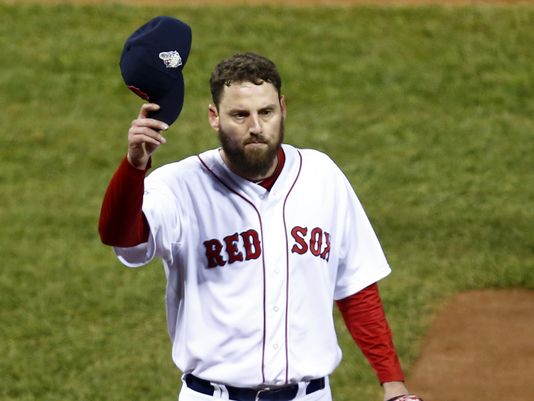
Last night the Boston Red Sox won their third World Series in the last ten years. It was the first time the home team fans had been able to witness the deciding game since 1918 (as the Fox announcers informed the presumably senile audience over and over and over again), and John Lackey was the pitching star for the home town team. The night was a love fest for Boston baseball fans, as they cheered every move of their frequently star-crossed and quirky team, and no Red Sox player was cheered more loudly than John Lackey, as he walked off the field for the final time in 2013 in the 7th inning, with his team safely ahead by five runs. They stood and applauded and chanted his name, as he moved deliberately to the Boston dugout, head down, grim, just like Ted on that gray day in 1960 when he hit homer number 521.

Then he tipped his cap.

It was a small thing, the smallest really, only a gesture and for most players, most of the time, an automatic one…except that it symbolized the ethical virtues of grace, forgiveness, gratitude, humility and fairness. This memorable, wonderful night for the Boston Red Sox and the grand old city it represents—my home town– was no time to let bitterness and resentment prevail. Unlike Ted Williams (who wouldn’t make his peace with Boston fans until years later, when he returned as an opposition manager), John Lackey found the strength and decency to let it go.

It was, as I said, a small thing. But it took character, and it was the right thing to do.

______________________________
Graphic: USA Today

Ethics Quiz: “How You Gonna Keep Her Teaching The Class After It’s Seen Paree?”

horrified students

…..or “It May Not Be The Naked Teacher Principle, But It May Still Be A Problem.”

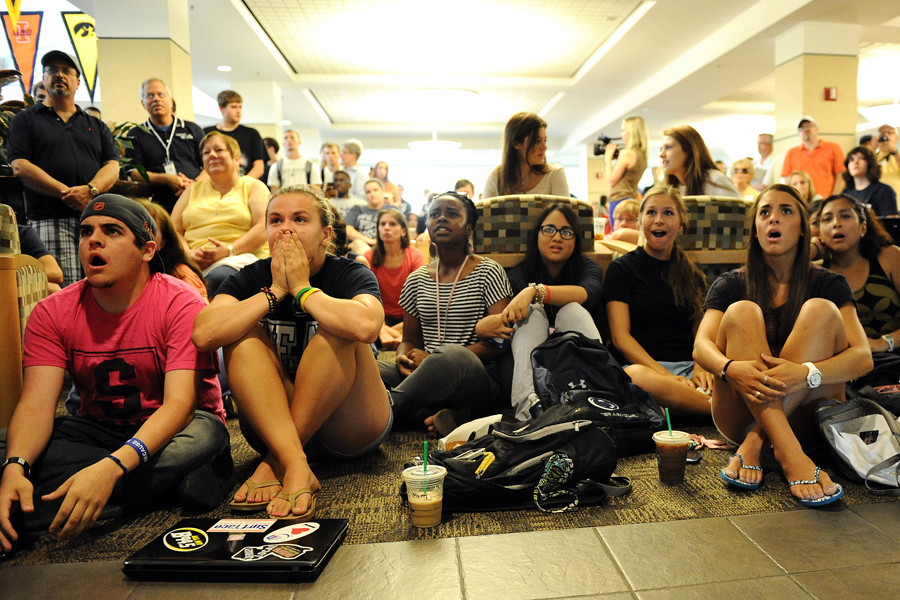
In the wake of the most recent post here about the Naked Teacher Principle, Ethics Alarms received many inquiries from readers who cited the news item about the hapless teaching assistant at the University of Iowa who somehow managed to send her class not merely sexually provocative photos of herself, not merely nude photos of herself, but something much more kinky. Attached to a message that read “Hi Class, I attach the solutions for number 76 and 78 in this email” were a series of images showing the young woman sans clothes and sans inhibitions having a lively cyber-sexting chat with a partner in which the two were pleasuring themselves in front of video equipment while streaming to each other.

Hmmm. That didn’t come out quite right.

Anyway, the question was: Does this conduct, which goes well beyond the conditions of the Naked Teacher Principle but which occurred at a university rather than a high school or middle school, trigger said principle, regardless of intent?

The answer is no, not regardless of intent. Continue reading

The Unprofessional Cause Of Unprofessional Lawyer Brian Zulberti

Brian ZYoung Brian Zulberti may be nice guy. He may even be a competent lawyer, though the chances of his being able to demonstrate that are diminishing daily. Nevertheless, his quixotic and misguided, and dare I say it, really stupid, quest to show that professionalism, judgment and character are not properly relevant to the practice of law is an exercise in hubris that must fail, deserves to fail, and of course, will fail, leaving him to pick up the pieces of fifteen minutes of media fame purchased at the price of a reputation. It looks like he’s having fun, and that’s something, I guess. Ten years from now, I doubt that he’ll think it was worth it.

Shortly after passing the Delaware Bar, Zulberti, a 2009 law school grad,  emailed the entire Bar membership asking for a job. In lieu of his résumé;  he attached a photo of himself in a Villanova Law muscle shirt that would be more at home on a dating site for the shallow. The web also contained his half-naked selfies, and various websites with varying motives picked up the story. Interviewed on YouTube, Zulberti proclaimed that being true to himself was more important to him than getting hired, and that he wasn’t about to change his Facebook privacy settings to portray himself as a traditional, dignified, applicant for legal work.

Let me pause here to say that in many ways I sympathize with Zulberti. Continue reading

The Naked Teacher Principle Strikes In Texas: The Playboy Variation

"Miss DEWEESE?? Ay Caramba!!!"

“Miss DEWEESE?? Ay Caramba!!!”

This version of the NTP is not especially close to the gray area of ethics, nor is the result surprising, though I expect a lot of teeth gnashing about it because the naked teacher in question will attract a lot of, uh, sympathy.

Dallas’s school district has apparently fired Cristy Nicole Deweese, 21, a Spanish teacher for the city’s Townview Magnet High School. Less than three years ago she posed in various provocative positions and states of undress for Playboy, in its February 2011 issue. That magazine is still available, but more to the point, the photos are easily available online. Naturally some students found them, and the core tenets of the Naked Teacher Principle had been triggered.

The Naked Teacher Principle states:

“A secondary school teacher or administrator (or other role model for children) who allows pictures of himself or herself to be widely publicized, as on the web, showing the teacher naked or engaging in sexually provocative poses, cannot complain when he or she is dismissed by the school as a result.”

I won’t keep you in unnecessary suspense. Deweese is almost dead center in the middle of the NTP. Continue reading

Cautionary Tales: When The Law Protects Unethical Creeps

Chaney_Chelsea

Two recent court rulings demonstrate how the law often cannot punish purely unethical conduct if it falls in the cracks of legal language and definitions. When that happens, however, it is incumbent upon the rest of the culture not to allow an Ethics Dunce, or worse,to escape without proper identification and condemnation.

Case A: Curtis Cearley

Director of technology services for the Fayette County (GA) school district.

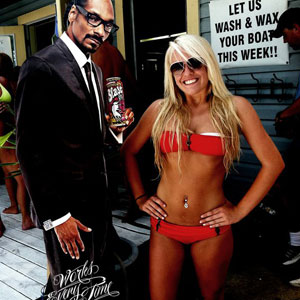
Fayette County high school student Chelsea Chaney used her Facebook page to post a photo of herself wearing a bikini and standing next to a life-size cardboard cut-out of rapper Snoop Dogg holding a can of Blast, the caffeinated alcoholic beverage he promotes. Although it was posted for the student’s friends, Cearley saw it, and used the comely photo in a  presentation at a public forum on the risks of sharing potentially embarrassing personal information on social media. He also used her name, identifying Chaney at the forum which was attended by parents, faculty and  students who attended school with her. He never alerted her, or asked her permission to use her photo as a “Don’t be like Chelsea!” example. The forum was titled “Once It’s There, It’s There to Stay.”

Horrible. This is a pure Golden Rule violation by Cearley, unfair, cruel, thoughtless, mean and intentionally  harmful to a minor, no less: Continue reading

Ethics Dunce: “Saturday Night Live” Cast Member Jay Pharoah

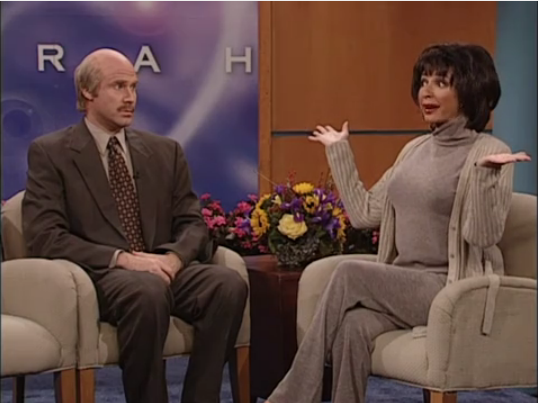
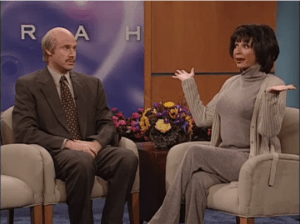
Maya Rudolph being Oprah, being funny, and nothing else should matter.

Maya Rudolph being Oprah, being funny, and nothing else should matter.

In a spontaneous call for more black cast members to be added to NBC’s long-running late-night satire show, “Saturday Night Live,”  veteran cast member Jay Pharoah told an entertainment reporter that he wanted the producers to add actress Darmira Brunson. “Why do I think she should be on the show? Because she’s black first of all, and she’s really talented,” Pharoah said. “She’s amazing. She needs to be on ‘SNL.'”

By logic, rights and justice, Pharoah should be fired for such a statement. He is pushing his show, and therefore his producers and his bosses, into a controversy that they neither want, need, nor deserve. Sure enough, his comments have already ignited debate and commentary in major dailies and in the blogosphere. He can’t be fired, of course—no producer in Hollywood would dare fire a black performer for advocating politically correct causes like diversity and affirmative action, no matter how inappropriate and unfair his comments were—and Pharoah knows that. Breaking reasonable rules of the workplace—criticizing your own boss in public and causing trouble for your employer are pretty basic taboos—because you know you’re immune from punishment doesn’t make the conduct any better.

He’s not the producer, and casting isn’t part of his job. To announce his own candidate for a hire is as outrageous and out-of-bounds as for a Pentagon general to tell reporters who President Obama should appoint as his Secretary of Defense.

Then there is the  statement itself, which in the context of entertainment and show business, is an endorsement of racial bias and discrimination, even more than with most workplace diversity and affirmative action advocacy. “Because she’s black first of all?” First of all must only be “because she’s funny, and the funniest female comic available.” Saturday Night Live’s goal, which it fitfully achieves, is to make its audience laugh. If Brunson is the best performer to accomplish that, then it makes sense to hire her. Her skin color is irrelevant, except to the extent that it opens up comic opportunities for the show. Otherwise, Brunson is pressuring his employers to hire Brunson over  superior white, Hispanic or Asian performers because of some theoretical diversity formula.

The resulting media focus on the imaginary problem to which Pharoah’s comments alluded is full of reflections, names and statistics, but the basic facts are these:

  • Professional performance comedy is completely utilitarian: if a cast entirely made up of black performers of any gender mix could be shown to be the optimum way to get laughs, ratings and make money for the network and SNL’s producers, that’s what we would have.
  • A funny, talented, improvisational skilled black actress has obvious benefits for a weekly satire show, as the reign of Maya Rudolph amply demonstrated.  There is no reason to presume that the producers would not immediately hire such a performer if one was available.
  • The pool of top-rate improvisational comic actors in general isn’t large (if it were, SNL would be funny more often), the pool of such performers who are African-American is much smaller, and the number of female black improvisational comics is tiny. When the African-American Wayans brothers wrote and produced their own satire show (Jim Carrey was the token white), they included only one full-time black female in the cast, and she was their sister (also the weak link in the cast.)

We can argue about the general principle of affirmative action at another time and place, but applying them to entertainment, sports or any field that must be a pure meritocracy is irresponsible and unfair. Saturday Night Live “needs” funny, talented performers who its audience finds funny…like, say, Eddie Murray. It does not need any black performer, male or female, just to have more black performers, and to take away performing and career opportunities from superior performers whose sole deficit is skin color or ethnicity while simultaneously getting fewer laughs and lower ratings.

Oddly, nobody has ever argued that Saturday Night Live discriminates against improvisational comic actors over the age of 35. Only once has it cast an actor of that age—Randy Quaid, in 1985. 1985 was also the most disastrous and unpopular season in the show’s history. Why no middle age or senior cast hires?  The reasons are legion: 1) Improv comedy is demanding physically and psychologically. Few older performers practice it, or are capable of doing it on a regular basis. 2) SNL’s audience is very young (as well as very male and white). Comedy is generational. 3) Older performers are seldom “new faces.” The ensemble’s called the “Not Ready For Prime Time Players” for a reason. 4) Young actors playing older real life figures and comic characters can be funny; old actors playing younger celebrities or characters is seldom funny, and often creepy. Age diversity, in brief, would not improve Saturday Night Live. Diversity is only an asset to the extent that it allows more comic opportunities. The U.S. does not require, not should ikt ask for, a contemporary satire TV show that “looks like America.” What  it needs is a show that is good.

All of which makes Pharoah’s comments irresponsible, unfair, disloyal, and racially offensive.

And not funny.

______________________________________

Sources: Washington Post, Policy Mic

Graphic: Hello Giggles
Now THAT’s Unprofessional!

"911...what is your emergency?"

“911…what is your emergency?”

There are many professions where a whimsical, even a black sense of humor is useful, perhaps essential. If M*A*S*H taught us anything, it taught us that. 911 operator, however, is not one of them.

I say this knowing that I would be dreadful at the job, as I find it hard not to see humor in disasters that befall others, or even myself—-too many Warner Brothers cartoons, perhaps. 911 operators must maintain a cool, calming, respectful demeanor, even when they are being told by a panicked mom that her kid super-glued a rat to his sister, that her home has been invaded by thugs dressed as Muppets, or the house has been engulfed by a flood of molasses. I couldn’t do it.

But then, it’s not my job.

It was the job of the operator on this call, though: Continue reading