Mike Daisey Follow-up: Behold! The Classic Response of the Self-Righteous and Unethical!

Mike Daisey in China. Or, standing in front of a big poster. What difference does it make which, really?

Soon after I posted my article about Mike Daisey’s representation of fabricated events and facts as truth in his January feature on NPR, the actor/activist posted this dismissive explanation on his own blog.  It is Dan Rather’s Memogate excuse taken to the next level, the epitome of self-justification of the unapologetic zealot who believes that all is fair in the battle against (what he regards as) evil, employing a full battery of rationalizations for unethical conduct:

1) Daisey’s lies don’t matter, because they were used to expose a real problem (a.k.a “the ends justify the means”); Continue reading

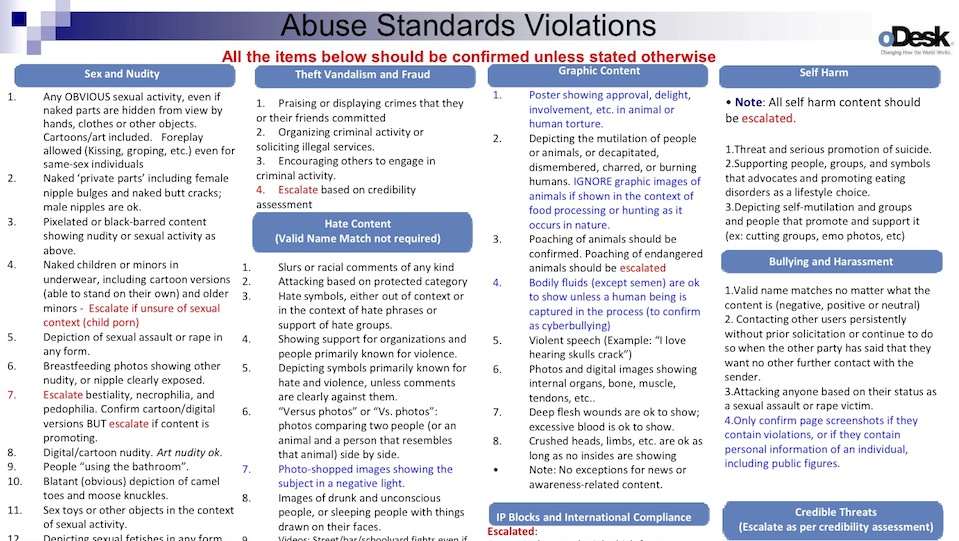
Facebook’s Weird Ethical Standards

I know, they're too small to read. Never mind; they also don't make any sense

The idea of Gawker, a website that shares the ethical standards of the seamier denizens of “Rick’s” in “Casablanca,” doing a legitimate ethics expose gives me a brain cramp, but the gossip site has given a platform to a Facebook whistleblower, sort of.

I say “sort of,” because knowing Gawker, I wouldn’t be surprised to learn that he was paid to rat out his former employers-once-removed (he was hired by  Facebook’s outsourcing firm that handled his training—oDesk), making him ethically less of a whistleblower than a candidate for Gawker’s editorial board. The argument, I suppose, would be that a dollar an hour, which is what Gawker’s source says was his princely reward for doing Facebook’s dirty work, shouldn’t buy much loyalty and confidentiality, if any. Ethically, that’s false: you are obligated to abide by the terms of bad deals if you voluntarily agree to them. Practically speaking, it is true. A worker a company exploits is likely to harbor more animus than good will, and it isn’t the happy workers who blow whistles. Fine: neither Gawker’s source nor Gawker are ethically admirable. On to Facebook.

The whistleblower is Amine Derkaoui, a 21-year-old Moroccan who was recruited by an outsourcing firm to screen illicit Facebook content. This is what he was paid a dollar an hour for, which, when one considers the news reports flying around recently about how rich Mark Zuckerberg is, and after the company filed its record $100 billion IPO, seems unequivocally exploitive. His real exposé, however, involves what he was paid to do, which was to be Facebook’s censor. Derkaoui supplied Gawker with a bootleg copy of part of Facebook’s abuse standards, which lays out what the company believes is appropriate and what it believes should be banned from the web. Thus it is Facebook’s morality, revealing the ethical standards that the company embraces. Continue reading

“Forget Jobs, It’s You Passing Out In Public, Stupid!”

Well, maybe there’s something wrong with Wisconsin after all.

Mayor Ryan, behaving irrelevantly

In Sheboygan, Mayor Bob Ryan, is about to face Terry Van Akkeren in the first mayoral recall election in that Wisconsin city’s history. It was prompted after Ryan was caught on tape passed out in a bar after a drinking binge last summer. More than 4,000 Sheboygan voters signed petitions to force the recall.

As one would expect, the mayor who humiliated his community, set a wretched example for his public (and their kids), showed that he has allowed his alcohol problem to render him unfit to serve, and violated a pledge he had made in 2009 (when he was running for office) that he had given up drinking for good, now argues that the incident is irrelevant. He says that what matters is who can bring the most jobs back to Sheboygan. Continue reading

Punishment for Color Blindness: ESPN’s Unfair and Cowardly Suspension of Max Bretos

What Max Bretos means by "chink in the armor." Not that ESPN cares.

The headline “Chink in the Armor: Jeremy Lin’s 9 Turnovers Cost Knicks in Streak-stopping Loss to Hornets” appeared on ESPN’s mobile web site last week, and it was quickly removed. ESPN apologized, then fired the over-night headline writer who thought it would be cute to make a racially-offensive play on words between the derogatory slur for a person of Chinese descent, and the old, respectable, and the completely non-racial phrase meaning “a flaw or weak point.”

ESPN’s response to the tasteless headline was appropriate.

But it wasn’t enough for ESPN, which was under a full barrage from the  political correctness police and race bullies as well as Jeremy Lin fanatics. So the station also decided to make a victim of  innocent anchor Max Bretos, suspending him for 30 days because he used the expression Wednesday when he asked New York Knicks legend Walt “Clyde” Frazier on air about Lin.

“If there is a chink in the armor, where can he improve his game?” Bretos asked. Continue reading

In The Catholic Institutions vs Obamacare Showdown, Law and Ethics Trump Morality…And Should

The Christian Soldiers are on the wrong side of this argument.

A controversial rule, announced last month as part of President Obama’s health-care overhaul, requires religiously affiliated colleges and hospitals to provide female employees the full range of contraceptive coverage, including contraceptives, the “morning-after pill” and sterilization services. The measure has  Catholic Church-run institutions up in arms over a system that would force them would  to offer plans that contradict their teachings. Catholic bishops have been leading the growing criticism of the rule,  distributing letters and other materials for distribution to millions of worshipers. Talk radio is abuzz with talk of Obama’s escalating “war on religion.” Even the Washington Post editorial staff criticized the move.

Naturally, the Republican-run Congress announced, via Speaker Boehner, that it would protect Freedom of Religion and block the measure with legislation. All in all, it is a spectacular collision of law, morality and ethics the likes of which we seldom see.

As for simple-minded me, I don’t think this is an especially difficult problem from an ethical point of view. Politics? Practicalities? Culture wars? Yes, those are all extremely difficult considerations in this argument, but they are also not my proper realm. The ethics are clear.

President Obama is right. Continue reading

Old Testament Treatment For The Miramonte Elementary School Culture

It could be worse; at least no teachers have been turned into pillars of salt.

Following the discovery that two Miramonte Elementary School teachers, Mark Berndt and Martin Springer,  allegedly engaged  in lewd activity with students, Los Angeles Unified School District made the brave decision to replace all teachers and staff, with everyone being re-assigned. Predictably, there have been protests and criticism. The basic argument: it is excessive and unfair. The good teachers, whoever they were, weren’t at fault.

Yes, they were; at least, they were responsible, and share accountability for a culture they were part of. The school district’s decision correctly assumes that when two members of a relatively small teaching staff abuse young children over a long period, something is rotten at the school beyond those teachers. Oversight is lax, administrators are looking the other way, teachers are protecting colleagues or refusing to acknowledge the implications of what they see or hear. There is a substantial chance that the Miramonte Elementary School didn’t just have some proverbial bad apples, but that it had created a culture that encouraged apples to go bad. There can be no certainty that Berndt and Springer were the only abusers on the staff, and the safety of children is at stake. Clear out the school, and wipe out the culture; have new personnel from top to bottom. It is easier to start over with a rotten culture than to try to fix it: this was God’s attitude in the Old Testament, and He had a point. The difference is that He killed off corrupt cultures with floods and fire, or just made them wander in the desert for generations.  Luckily, this isn’t Congress, Wall Street, Hollywood, or Rupert Murdoch’s empire. You can start all over with a school. Continue reading

Yuri’s Tweets, Flawed Analogies and the School’s Defenders

[Why is it that when I’m traveling and stuck in airports where the supposedly free WiFi doesn’t work and on airplanes that can’t keep on schedule, some post that I assumed was fairly straightforward turns into the Battle of Antietam? I apologize to the various commenter’s whose work product languished waiting for moderation—I just didn’t have the chance. This odyssey ends tonight; I apologize for slowing things down. On the other hand, it’s good to know that my presence is not required for there to be lively and interesting discussions here…thanks, everyone. Good work.]

Don Bosco Prep High School, Class of 1917-1918

That is not to say that sending gross, obscene, or abusive tweets is exemplary conduct; obviously it is not. I have concluded, however, that the proper and ethical use of social media is something that people, including minors, have to learn for themselves by trial, error, research, observing the mistakes and experiences of others, making dumb mistakes and suffering because of them.  Parents and schools, as well as the popular media, have roles to play by giving advice and calling attention to cautionary tales, but heavy-handed attempts to manage social media conduct attempted by authority figures who, as a general rule, neither use nor understand what they are attempting to regulate are both irresponsible and doomed to failure. Like it or not, social media is a primary, and growing, means of communication and interaction in American society, and students are wise….that’s right, wise...to learn how to use it. I was just speaking to a room full of lawyers, and asked them how many used Twitter. The answer: none. But their clients use Twitter, and their client’s adversaries use it, and certainly their children. Their bar associations are making rules about what these lawyers and judges should and shouldn’t be able to do on social media, and most of those bar committee members don’t use Twitter either.As a result, the various jurisdictions have inconsistent rules, based on a lack of knowledge, that are already archaic.

It is fine and responsible for any adult to try to warn a young person that comments on social media need to be considered carefully, that they have a reach far beyond any intended audience and are essentially broadcasts, and that messages or photos can reach people who they hurt or upset, or cause to have a poor opinion of the sender. Ultimately, however, the pioneers in this new frontier of personal expression and mass communication are going to have to learn their own lessons, and better that they learn them now than when they are members of Congress. All punishing students for their tweets teaches them is that people with authority abuse it, and that adults just don’t understand. Because, for the most part, they don’t.

Now the analogies and comparisons:

Public schools vs. Private schools: I gather that the theory here is that if a student voluntarily attends a private school, the student has voluntarily submitted to whatever the school regards as proper discipline, whereas public schools, since they are mandatory and creatures of the government, are constrained by the Constitution. I think I may have encouraged this by a careless reference to the ACLU, which was, of course, a mistake (and I have removed it.) This is ethics, not Constitutional law, and the values are autonomy, fairness, respect, privacy and abuse of power and authority, not Freedom of Speech. I have dealt with several private schools and one Catholic school, and none of them suggested in their printed materials or regulations that they reserved the right to punish my child for what he said, wrote, or communicated during non-school hours, or when he wasn’t physically on school grounds. Neither does Don Bosco, which states as its “philosophy”:

“Don Bosco Prep educates young men so that, through a process of self discovery, each student will come to recognize and acknowledge his talents and limitations, while pursuing academic, athletic, artistic and personal excellence.

“Mindful of both our role and responsibility as a Salesian college prep school, we respect each student as a unique individual. Through active presence in his life, we promote a joyful spirit, intellectual curiosity, self-esteem and emotional maturity. We encourage the development of character and personal responsibility, love for one’s fellow human beings, a concern for the environment and an active commitment to social justice, all of which serve as the cornerstone of each student’s spiritual growth.”

I take none of that, including references to being “an active presence” in a student’s life, “promoting” emotional maturity, and “encouraging” development of character to mean “we can punish your child for absolutely anything he does or says that we disapprove of, no matter where or when it occurs.” It, the school, does all of the things relating to its philosophy in the school, based on the student’s activities and interactions in the school. Any other reading is giving a group of strangers whose biases, background and motivations I can only guess at a blank check to manipulate a child’s life, thoughts and personal activities.

When one teacher from a private school called me to tell me that she felt it was cruel of my son to exclude a classmate whom he did not like from his birthday party, I told her that it was none of her business, and filed a complaint with the school.. Private school does not mean “we can meddle in your child’s private–as opposed to school—activities.

Catholic vs. Secular: All schools should teach character; it happens that Catholic schools do it with more fervor, but that gives them neither a greater obligation nor additional authority. Schools teach good conduct and civility by insisting on appropriate conduct and deportment in school. Are people really prepared to argue that a Catholic school can justify punishing its students for not doing household chores, not washing their hands after using the bathroom in their homes, being cruel to a younger sibling or being disrespectful to a parent? Not only is personal social networking use as unrelated to the school  as any of these, it is also far less significant. How much of a blank check do we want school administrators to have? The right answer to that is that they shouldn’t have a blank check at all, and being a Catholic school changes nothing.

High schools vs. Military Academies: This is just a bad analogy. The student at a military academy has no personal life, and has no privacy. The academy is in loco parentis; the student lives there; authority is total. There is an honor code and a code of conduct, and it applies to everything a student does, including communications. That’s the military. That’s not high school.

High Schools vs. College: Several commenters have referenced the incident from last March when Brigham Young University suspended a star basketball player for having pre-marital sex. Brigham Young is famous for its strict and far-reaching conduct code, which bans drinking, pre-marital sex and many other activities that are virtually courses at other schools. If a student agrees to attend B.Y.U., the student has also agreed to certain conditions unique to the university. Should a more typical college be applauded for suspending a student who has sex with his high school girl friend over Christmas break, in his parents’ home? No; this is none of a college’s business, and attempting to extend its authority beyond the campus and even over state lines in such a fashion is intolerable. If Yuri Wright and his parents signed a document promising that Yuri would never send an offensive tweet during his years at the school, I withdraw my condemnation of Don Bosco’s punishment.

High schools vs. the Workplace: It is true that if an employee engages in conduct outside of work that embarrasses or reflects badly on an employer, ot that interferes with the employee’s ability to do his or her job, the employer is behaving ethically if it chooses to terminate the employee. It is not ethical for an employer to terminate an employee for any private conduct it happens to disapprove of, however. It can’t tell me that I can’t drink or smoke or have sex with men in my own home. It  better not tell me that I can’t vote for Ron Paul or root for the Red Sox, either. The Naked Teacher Principle applies, of course: if I’m a Coca-Cola VP and a Facebook picture shows me chugging Pepsi, that image could undermine my effectiveness at work, and Coke can can me; it’s ethical. If I write an ethics columns for a newspaper and I am caught in an adulterous affair with Marianne Gingrich, the newspaper is only being responsible to fire its unethical, untrustworthy ethicist. None of this applies to Yuri’s tweets. They don’t reflect on the school, or shouldn’t, because the school shouldn’t have any control over his personal communications. They  don’t interfere with his studies, or make him a worse football player.

Expression vs. Conduct: Tweets aren’t conduct. Even if I accept the proposition that a school may, in extreme situations, have some legitimate role in attempting to control student conduct outside of school (and I’m not sure I do), allowing a school to punish a student for the content of his words, uttered or written away from school, is a slippery slope with no braking. If sexually and racially objectionable tweets can get a student expelled, why not tweets critical of President Obama, or cheering on Newt Gingrich? Does Don Bosco’s commitment to “social justice” mean that Yuri can’t tweet that Occupy Wall Street is a crock?

Romney, Firing, Leadership, and Ethics Bob’s Lament

Yes, yes, firing people is one thing Donald Trump does well too. Shut up.

Ethics Bob Stone sent in a comment late last night that I replied to, but that I think deserves more discussion, on several points. Responding to my Ethics Hero designation for Ron Paul for coming to his adversary’s defense over Romney’s now infamous remark about firing people, Bob wrote:

“…I think Romney’s “I like to fire people”–even taken IN context–displays an inner heartlessness. I know about creative destruction, and I myself have taken actions to lay off people, and even fired a couple face-to-face. I did what needed to be done. No apologies.

“But did I like it? I HATED it.

“Romney’s comment seems of a kind with his strapping the family dog on his car roof for a 500-mi trip, or his advocacy of breaking up families to deport the parent or child who’s illegal. Gingrich was right.”

There are several issues here, some minor. Continue reading

Happy 2012! Your New Year’s Ethics Quiz: “Firing Super-Clerk”

Last week, convenience store clerk Eric Henderson was confronted by two female robbers in Pensacola, Florida who demanded that he hand over the cash in his Circle K register.  Henderson  grabbed the gun pointed at him by one of the women, slammed her to the ground, and then chased the two into the street where they fled in a getaway car.

Henderson was promptly fired by Circle K  for violating a company policy that forbids heroics by employees in the middle of attempted robberies. Now Henderson has gone to the media, which is pointing out that he had been unemployed for two years (Occupy Circle K! But how long he had been out of work should have no bearing on the decision whether to to fire him) and that according to Henderson, the unarmed robber was urging her armed companion to shoot him. (Aside: Some of the news accounts also included this hilarious line: “The 30-year-old grabbed the gun pointed at him by one of the alleged robbers… Alleged robbers? Can we all agree that when there is an actual  gun to be grabbed, the term “alleged” is idiotic? What else is someone who points a gun at a convenience store clerk? A practical joker? Some one who wants to trade a Glock for Twinkies?)

Your New Year’s Day Ethics Quiz: Was Circle K right to fire Eric? Continue reading

Ethics Quote of the Week: David Argenter, of the Illinois Supreme Court Commission on Professionalism

"Yes, she's my legal secretary. Yes, she's exactly what I advertised for. Why are you looking at me like that? What??"

“Often, issues of ethics and professionalism raise complicated questions, involve shades of grey, and require serious thought and contemplation to resolve.  Sometimes, however, all it takes to figure out whether a given action or decision is the right one is to ask: ‘Is this stupid?'”

David Argenter, attorney and member of the Illinois Supreme Court Commission on Professionalism, commenting on the mind-boggling case of a lawyer recently suspended from the practice of law for one year for several ethics violations, including one that will live in legal ethics infamy.

Hold onto your hat.

The lawyer in question sought secretarial assistance for his law office on Craigslist.  Oddly, he posted his ad in the “Adult Gigs” section of the site, with the heading “Loop lawyers hiring secretary/legal assistant.” The ad continued…

“Loop law firm looking to hire am [sic] energetic woman for their open secretary/legal assistant position. Duties will include general secretarial work, some paralegal work and additional duties for two lawyers in the firm. No experience required, training will be provided. Generous annual salary and benefits will be provided, including medical, dental, life, disability, 401(k) etc.”

The ad also requested asked for “a few pictures along with a description of your physical features, including measurements.”

Hmmm!

When an applicant  responded with an e-mail inquiring about the “additional duties” referred to in the ad, the lawyer responded,

“As this is posted in the “adult gigs” section, in addition to the legal work, you would be required to have sexual interaction with me and my partner, sometimes together sometimes separate. This part of the job would require sexy dressing and flirtatious interaction with me and my partner, as well as sexual interaction. You will have to be comfortable doing this with us.” Continue reading