
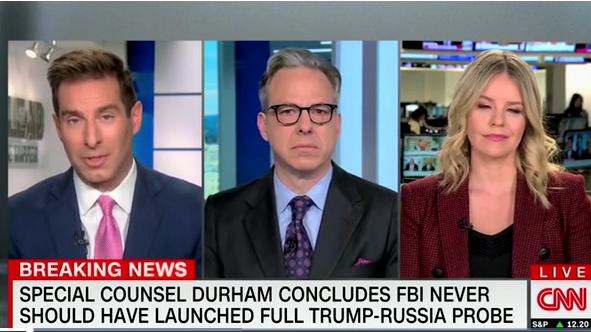
Ace commenter Humble Talent has performed a service to Ethics Alarms and its readers by reading the entire Durham report and explicating it. This was a comment on the previous post on Durham’s investigation, and I encountered it after I had started to write Part II, covering ethics take-aways from the report’s substance. Since Humble’s analysis will be useful background for Assorted Ethics Observations On The Durham Report, Part II, and because no similarly thorough annotation of the report has yet appeared, I’m giving it a stand-alone post.
Thanks, Humble.
***
Churning through it now…. Some of it is unsurprising, but it’s nice to see put in language as clear as he used:
Page 11 (On the Steele Dossier)
“Our investigation determined that the Crossfire Hurricane investigators did not and could not corroborate any of the substantive allegations contained in the Steele reporting. Nor was Steele able to produce corroboration for any of the reported allegations, even after being offered $1 million or more by the FBI for such corroboration. Further, when interviewed by the FBI in January 2017, Danchenko also was unable to corroborate any of the substantive allegations in the Reports. Rather, Danchenko characterized the information he provided to Steele as rumor and speculation and the product of casual conversation.”
Page 60 (On opening Crossfire Hurricane)
“As it relates to predication for opening Crossfire Hurricane as a full investigation, after Strzok and Supervisory Special Agent-1 had traveled to London and interviewed the Australian diplomats on August2, 2016, the following Lync exchange between UKALAT-1 and Supervisory Special Agent – 1 on August 11, 2016 is instructive:
UKALAT- : Dude, are we telling them [British Intelligence Service] everything we know, or is there more to this?
Supervisory Special Agent – 1: that’s all we have
Supervisory Special Agent – 1: not holding anything back
UKALAT- 1 : Damn that’s thin
Supervisory Special Agent- 1: I know
Supervisory Special Agent-1: it sucks
UK ALAT – 1 went on to tell the Inspection Division that in discussing the matter with a senior British Intelligence Service – 1 official, the official was openly skeptical , said the FBI’s plan for an operation made no sense, and asked UK ALAT- 1 why the FBI did not just go to Papadopoulos and ask him what they wanted to know, a sentiment UK ALAT- 1 told investigators that he shared.
Later in the Fall of 2016 , UKALAT- 1 was at FBI Headquarters with some of his British Intelligence Service- counterparts . While there , members of the Crossfire Hurricane team played the audio /visual recordings of CHS- 1’s August 20, 2016 meeting with Carter Page . UKALAT – 1 said the effect on the British Intelligence Service – personnel was not positive because of the lack of any evidence coming out of the conversation:
UKALAT – 1 told the OIG that after watching the video one of his British colleagues said, “For [expletive ] sake , man. You went through a lot of trouble to get him to say nothing.” At a later point in time, after the Mueller Special Counsel team was in place, UKALAT – 1 said that the Brits finally had enough, and in response to a request for some assistance [a British Intelligence Serviceperson] basically said there was “no [expletive] way in hell they were going to do it.”
Continue reading →




 Ethics Alarms