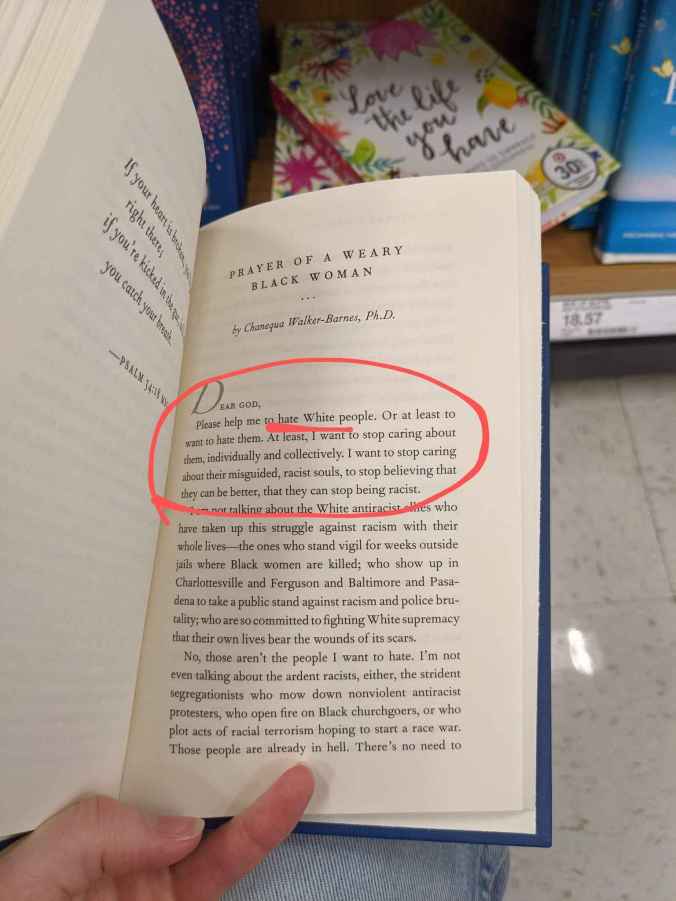
Steve’s reaction, as you might expect if you are familiar with his commentary, is much harder of nose. It it too callous to be ethical? The ethic of the United States, from it’s origins, has always emphasized personal responsibility and the obligation of society and government to allow individuals to live their own lives, address their own failings, achieve what they can achieve, and advance by their own effort and talent. Community, by it’s own nature, implies a group that strives to help when it can, but the bitter attitude reflected in the hateful “prayer” is something quite different.
Steve answers the query, “Have I been dismissive of your burdens, and perhaps even cast blame upon you?,” by stating, “Like I said, I have my problems, you have yours. Deal with them. The one thing all your problems have in common is you.”
This is a Ryan Harkins Super Comment Of The Day, combining a series of his reflections on this prayer for racial hate. Here it is, inspired by “Ethics Observations On “Prayers Of A Weary Black Woman’” and a comment by Glenn Logan:
I wonder, if we had a poll, which of the following people would find more appealing? “Dear God, please help me to hate White people…” or: “Lord, make me an instrument of your peace. Where there is hatred, help me sow love. Where there is injury, pardon. Where there is doubt, faith. Where there is despair, hope. Where there is darkness, light. Where there is sadness, joy. O divine Master, grant that I may not so much seek to be consoled as to console, to be understood as to understand, to be loved as to love. For it is in giving that we receive, it is in pardoning that we are pardoned, and it is in dying that we are born to eternal life.” [Side note: though this prayers if often associated with St. Francis of Assisi, it is entirely absent from his writings. Its use can only be traced back to just before World War I.]
After spending a little more time reflecting on this incredible diatribe, I decided to take a step back and ask what it is about me that would lead to this. Now, I’m not necessarily claiming any direct personal responsibility for this terrible prayer, but my reflections do stem from Matthew 25:31-46. Have I seen you hungry, or thirsty, or a stranger, or naked, or sick, or in prison, and I did not minister to you?
Have I been indifferent to your struggles, since they are not mine? Have I been dismissive of your burdens, and perhaps even cast blame upon you? Did I sneer at your poverty, your drug addiction, your broken relationships, and say they were the just desserts of your poor choices? Have I stood at a distance and shrugged, because someone else would help, or if no one else did, the government would lavish plenitude upon you? Did I think that you were greedy for free money, and not feel the sting to your pride? Did I never feel the self-doubt and the hurt? Did I never extend a hand in genuine friendship, giving in to my own fears, rejecting you for your skin color before you could reject me for mine? If I showed you a smile, was it forced and hollow, because I cared more about not being called a racist than in offering you genuine happiness? Did I always demand you come to me asking, and never came without being asked? Was I the one who demanded you get a job before I’d respect you? Was I the one who belittled you for taking the opportunities offered you, without ever taking a moment to see if you were actually qualified? Did I ever stop to listen to you, to really listen to you, instead of lecturing at you?
This is not white guilt, but perhaps a bit of personal guilt at failing to walk side by side with someone who is hurting. Perhaps trying to walk alongside that person is not what they want, but am I so pusillanimous that I would not bear my heart to be wounded, that I would rather not risk pain in an effort to help another person?
I think this applies broadly. I think it is true that conservative economic theory is better than liberal theory, that it helps more people by increasing capital and opportunities all around. But the temptation for the conservatives is the same for the liberals. Correct me if I’m wrong, and I’m just spouting out my personal failings and shouldn’t indict others in my sins, but it seems that both the right and the left want to skip personally helping someone, and just let the monolithic, impersonal systems do the heavy lifting. If it isn’t letting the government distribute welfare to all those in need, then it is letting the economy generate the jobs that will then give people the opportunity to rise out of poverty.
Yes, I know there will be people who will unjustly hate with the fiercest hate imaginable, and there’s nothing I can do to change that. And there’s too much hate for anyone one person (save for the one person who proved his love for us by dying for us) to handle. But maybe there’s a great deal more hate than there needs to be because I didn’t do my small part to diffuse it.
Historical airbrushing comes to my backyard: the Alexandria School Board voted last week to approve “Alexandria City High School” as the new name for T.C. Williams High School, which is a stone’s throw from my house—in fact, I throw stones at it all the time. You have to admit, the new name is catchy, kind of like “Washington Football Team.” At this point, T.C. Williams was just a name: the man Alexandria’s largest school was named for died in 1963, and I doubt one citizen here in a thousand, and no students in the last 20 years, had a clue who he was or why the school was named for him. In fact, Thomas Chambliss Williams was Alexandria’s Superintendent of Schools from the 1930s to 1963, and presumably the school had been named in his honor to recognize his long and presumably successful service. But, we are told, he “promoted the school division’s resistance to desegregation efforts.” Maybe he did and maybe he didn’t; it’s probably a good bet, given the time period, but these accusations are put out to the public as fact (as in the recent San Francisco fiasco) and nobody bothers to check or challenge them.
CurrentSuperintendent Gregory Hutchings Jr. said in part, “We are excited about the Board’s decision to adopt the [name] of Alexandria City High School…[to] honor the diverse, inclusive and anti-racist community that ACPS is striving to become.” Yeah, if anything says “anti-racist” it’s “Alexandria City High School”! That name brings a tear to my eye, I can tell you. Once upon a time, successors to long-time public servants operated with some fealty to the Golden Rule. Would they like to be smeared forever as terrible people 50 years after their deaths based on a cultural shift, or a faddish, empty catch-phrase like “anti-racist”?
1. Good. Making reasonable accommodations so the handicapped can participate in society is one thing; burdening citizens and organizations with crippling expense so they endure no disadvantages at all is unethical. Since the Americans with Disabilities Act, a troubling number of activists have demonstrated an inability to tell the difference. Thus Ethics Alarms welcomes the 11th Circuit’s ruling last week that websites are not public accommodations that must be accessible to blind users unless they create a barrier that excludes disabled people from accessing goods and services in a physical space, like a store.
The decision supported Winn-Dixie Stores Inc., a grocery chain, in the lawsuit by plaintiff Juan Carlos Gil, who is legally blind. He sued because he was unable to use the Winn-Dixie website with his screen-reader software. Gil wanted to use the website to fill prescriptions because in-person requests could be overheard by other people standing nearby. He felt having to wait 20 to 30 minutes for the prescription after making an in-person request was too much to bear, so he forced the company to engage in long and expensive litigation.
Title III of the ADA limits places of public accommodation to physical locations, the 11th Circuit said in its April 7 opinion. It bans discrimination on the basis of disability “in the full and equal enjoyment of public accommodations,” with “discrimination” occurring when an operator of a place of public accommodation fails to take steps to ensure that no person with a disability “is excluded, denied services, segregated or otherwise treated differently than other individuals because of the absence of auxiliary aids and services.” The law as it stands is bats, embodying the Carter-era delusion, now rampant, that society has an obligation to eliminate all individual disadvantages. The law’s examples of public accommodations included hotels, restaurants, theaters, auditoriums, schools and grocery stores, however, so the 11th Circuit seized on that to limit the law in a way its creators would not have done, if they had any clue what a “website” would be. “No intangible places or spaces, such as websites, are listed. Thus, we conclude that, pursuant to the plain language of Title III of the ADA, public accommodations are limited to actual, physical places.”
Now watch Democrats try to expand the ADA to include websites, raising prices, costing jobs, and creating havoc.
2. More partisan censorship from YouTube<yawn!> Once, this would be shocking news, but now we know, don’t we?
This developing ethics story comes out of baseball, and if you skip the baseball ethics stories, this one shows why that is a mistake. The erstwhile National Pastime is certainly off to a flying start this season in ethics controversies, what with the game’s bone-headed decision to get involved in race-baiting politics seeded by Joe Biden and Stacey Abrams. This new controversy has the advantage of actually being about the game on the field. It also has a marvelous jumble of factors , real and hinted: history, tradition, real rules, unwritten ruled, rationalizations, hypocrisy, persecution, tarnished heroes, and maybe revenge.
Here we go…
Trevor Bauer is a pitcher for the Los Angeles Dodgers whose fame, reputation and salary ($34 million a year for three years) are out of proportion to his record, which stood at 75-64 as this season dawns. At 30, this is roughly the equivalent of the success achieved by such immortals as Chris Young, Ben McDonald, and Chuck Dobson, mediocrities all. But Bauer is 1) unusually articulate 2) a social media master, and 3) had his best two seasons, including winning a Cy Young Award in last year’s shortened, pseudo-season, just as he was nearing free agency. Many players and his primary team in his career, the Cleveland Indians, don’t like Bauer, and not just because opinionated players are never popular with management. He once knocked himself out a crucial post-season start by cutting a pitching hand finger playing with a drone (he loves drones). In 2019, after allowing seven runs, Bauer threw a baseball over the centerfield wall, after seeing his manager Terry Francona come out of the dugout to remove him from the game. Bauer apologized profusely, but it was the final straw, and the Indians traded him.
Bauer, among other opinions, has been among the most vocal critics (and one of the few player critics) of the Houston Astros in particular (see here), and cheating in baseball generally.
After the 1919 Black Sox Scandal, baseball cracked down on pitchers doctoring the ball with foreign substances or by marring the surface to make it do tricks. Nonetheless, that many pitchers continued to try to slip spit, or Vaseline, or slippery elm, or pine tar onto the ball has been assumed, indeed known, ever since. This year, as part of the game trying to cut down on strike-outs which have reached boring levels (baseball is more entertaining the more the ball is put in play), MLB announced that umpires would be checking the balls more carefully and regularly to ensure that the rule against doctoring the ball wasn’t being violated. Lo and Behold, the first pitcher to have his thrown baseballs collected for inspection based on suspicion of doctoring was…Trevor Bauer!
How ironic!
Part of the game’s new policy is examining Statcast spin-rate data to determine unusual upticks for individual pitchers. What does that mean? “Spin-rate,” which now van be measured via computer technology, determines how much a thrown ball moves in curves, sliders and other breaking balls, as well as fastballs. The quicker the spin-rate, the harder the ball is to hit. Bauer has tweeted and spoken about spin-rate, and how using stuff on the ball speeds it up. Coincidentally, while Bauer’s normal spin rate on his fastball was about 2,250 r.p.m. in 2018, which is the league average, his spin rate began rising by 300 r.p.m. is 2019, and rose still more last season. So did his effectiveness.
Dr. Rochelle Walensky, the current Director of the Centers For Disease Control, released a statement last week that declared “racism” a public health threat.
Go ahead and read the statement if you like; that sentence above is all you need to know from an ethics perspective. If “racism”—it’s in quotes because the definition no longer has any coherent meaning, since it has been distorted to mean anything a social justice warrior or an unhappy individual who regards himself/herself/whateverself as a minority needs the word to mean at a given time or in a particular dispute, or, of course, a dictatorial-minded government—is a health issue, almost anything is. Maybe everything.
Walensky’s motives could be just about anything too. Maybe she really believes this and that it’s a legitimate topic for the agency under its mission. If she does believe that, she’s not very bright. The CDC Mission Statement makes it crystal clear that the agency’s purpose in to fight disease, stating at the outset:
Whether diseases start at home or abroad, are chronic or acute, curable or preventable, human error or deliberate attack, CDC fights disease and supports communities and citizens to do the same.
Because that’s what the Mission states at the beginning, the mission cannot suddenly expand elsewhere. (You would think the agency’s name would have precluded doing so as well.) I write mission statements as an occupation (among other things); groups pay me to help them compose theirs. You can’t have an ethical, valid Mission Statement that begins like that, and then goes on to say that the organization is also concerned with cheating at Parcheesi and overcooking good steaks. “Race” is not a disease, and how people treat race is based on emotion, which is not subject to hard science. Continue reading →
I have some major projects and stalled efforts percolating (Yes, Michael Ejercito, including that one!) so I need this post to make sure some interesting items don’t get left on the metaphorical rock…That’s my favorite Charles Addams cartoon above, and the only sad one he ever drew, I think. It was published well before this hit song by the Irish Rovers ( a really big hit in Boston), and I’ve often wondered if the cartoon inspired it. What do you think?
In the NYT workplace advice column “Work Friend,” Roxane Gay was asked by a reader about an office colleague who took up a collection to give condolence gifts to two fellow staffers who had lost their pets. Is this a common practice “in our pet-obsessed society,” she asked, or “is it, as I think, utterly bananas?”
This is, to begin with, an utterly bananas use of an advice columnist, assuming there is a good use. If that’s what she thinks, why does the writer need the confirmation of a stranger? Who is Roxane Gay, other than someone can’t spell “Roxanne”? The writer believes, obviously, in the “appeal to authority” fallacy, and is the kind of person who will tell you that her opinion is right because Charles Blow agrees with it. For the record, Roxane asked what was going on in the writer’s life that had her feeling so callous. In fact, this is an easy ethics call: the passwords are kindness and consideration. It doesn’t matter why a friend or colleague is emotionally devastated, or whether you would be as upset facing the same loss. The point is that your friend has suffered what he or she feels is a great loss, and the kind thing to do is to say, “I’m sorry. I care.”
It’s never occurred to me to send flowers or a card to someone who has lost an beloved animal companion, but thinking about it because of this column, I would have appreciated such a gesture after sweet Patience, our English Mastiff, had to be put down at 7 when her cancer became untreatable, or brilliant and brave Dickens, our first Jack Russell, who once saved our son from a malling by a larger dog, and whose heart and lungs gave out after 14 years, or Rugby, who for 16 years demonstrated how to love every living thing and who would sit on my desk with his head on my arm as I typed out Ethics Alarms posts. I can get choked up thinking about any of them still. It’s not “bananas” to be kind to someone suffering these kind of traumas. It’s called “being nice.” Continue reading →
Talented and bold artist? Shameless self-promoter? Hypocrite? Unethical jerk? Arturo Di Modica, the Sicilian-born sculptor who died earlier this year was all of these. He was also a one-man ethics train wreck.
In mid-December of 1989, the artist illegally dropped his “Charging Bull,” a 3.5 ton bronze sculpture (that’s a similar model he had mounted in China above), in Lower Manhattan one night in 1989. He claimed it was a gift to his adopted country, the United States, urging courage and defiance after its 1988 financial collapse. Maybe. Or he just wanted to grandstand and get publicity. Either way, you cannot put a giant statue in a public place without permission, permits, owning the property involved, little things like that.
This was a planned crime. Di Modica spent weeks prowling the Wall Street area after midnight, noting when and where police officers walked by. He had about forty accomplices waiting at around 1 a.m. when he loaded his sculpture onto a flatbed truck and drove to Broad Street, next to the Stock Exchange. But it was nearing Christmas, and the Stock Exchange had put up a huge Christmas tree where he had planned to drop “Charging Bull.”
1. I can’t mount the intestinal fortitude to even visit Facebook lately.I’m afraid I’ll snap and write something like, “You people are all such hypocritical assholes, at least 90% of you! For four years, you barfed out post after post mocking the President of the United States, attracting boats of “likes” and “loves” for every misspelled word, every exaggeration, every off-the-cuff dumb remark, and when the mentally-failing President you elected completely blows all trust and credibility in less that three months with material lie after lie, deliberate racially inflammatory statements, and outright stupidity “on steroids,” as he would say, your response is ‘Yeah, but what about Trump?’ You’re all a disgrace to your nation, your society, your various institutions of higher education, and basic principles of logic. To hell with you.”
This week, making a case for a fake infrastructure repair bill that appears to be just another pork-laden giveaway to favored Democratic constituencies, Biden said, among other things, “We’re going to talk about commercial aircraft flying at subsonic speeds, supersonic speeds, be able to figuratively, if you may, if we decide to do it, be able to traverse the world in an hour, travel at 21,000 miles an hour…Imagine a world where you and your family can travel coast to coast without a single tank of gas or in a high-speed train, close to as fast as you can go across the country in a plane!”
The speed of 21,000 miles an hour is about Mach 28, or 28 times the speed of sound. The fastest commercial airplane flies at less than Mach 1. Remember the Concorde? A single fatal accident at that plane’s high speed was enough to kill its commercial use. All it would take is one crash of Biden’s miracle plane, where every soul on board was vaporized, and no one would buy another ticket. Think Hindenburg.
To cope with centrifugal force, train tracks tilt on curves; the problem is that the train can only tilt so much before either it or the passengers inside tip over, so the curve must get larger and more gradual to safely carry a super-fast train. “Tracks rated for fifty miles per hour need almost no banking and can have a curve radius of fifteen hundred feet, while a train traveling at a hundred and twenty miles per hour needs a track with significant banking, and a minimum curve radius of more than a mile and a half.” A train track designed for a train going 550 miles per hour would have to have an absolutely gargantuan curve radius. Our current system and routes of train tracks would be completely unsafe for a train moving at that speed; it would fly off the tracks at the first curve.
Meanwhile, over at the House of Althouse, the former hostess, now lecturer, is still desperately trying to justify telling all her banned commenters to shut up and pay attention. The Rationalization of the Day yesterday was in the form of a long-email to Ann from someone agreeing with the killing of comments on the grounds that the regular commenters were predictable, and therefore boring. Does Althouse really think that her opinions and choices of topics aren’t usually predictable? How many amateur photos of sunrises do you need to see?
Any silenced Althouse readers are welcome to come to Ethics Alarms and opine, as long as they stick to the main topic, and follow the Comment Policies above.
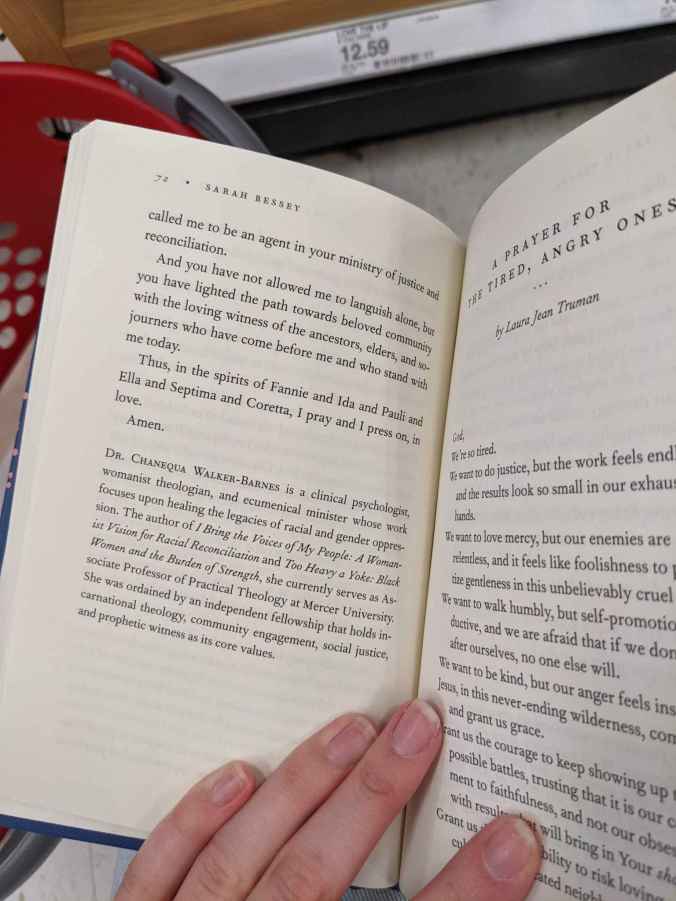
This is an essay in a “devotional” titled “A Rhythm of Prayer” by Sarah Bessey. Containing pieces by many authors, it is available on Amazon. Target sells it online for $14.87 in its “Religion + Beliefs” section and “Christian Life” subsection. It is selling well, I hear. The anti-white screed above was authored by Professor of Theology Chinequa Walker-Barnes of Mercer University.