Dear Progressives: The Failure Of Reality To Conform To Your Biases And Desires Does Not Make It Unethical

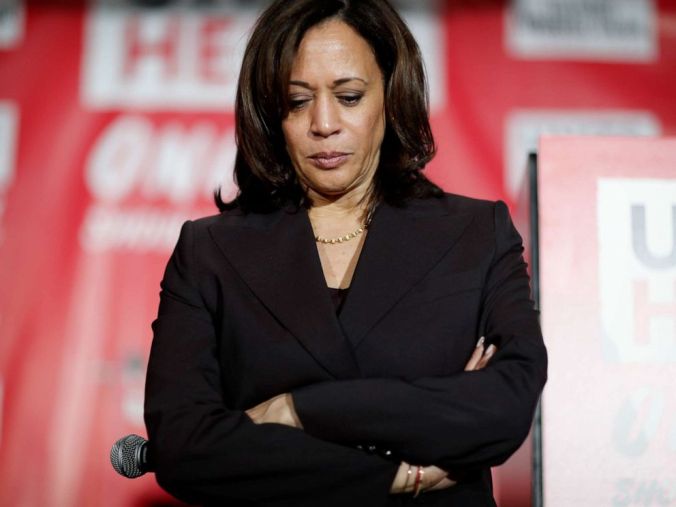
Let us stipulate: the failure of Kamala Harris to thrive in the race for the Democratic nomination for President was not because Democratic voters are racist or sexist.  It is because she was a lousy candidate from the beginning. Checking off boxes is never enough, thank heaven. She is a woman, “of color,” a lawyer and a Senator from a large and powerful state. To top it all off, Harris is relatively young, and attractive. Perfect!

Except it was easy to see that she was an empty suit with a penchant for saying stupid things, often things she couldn’t possibly believe and that contracdicted her record as a prosecutor. She said that it was “outrageous” that the Trump administration wanted to deport illegal immigrants who had committed crimes. [Me: “It is not and cannot be “outrageous” to say that any illegal immigrant, criminal or not, qualifies for deportation. To maintain otherwise is to say that the United States cannot enforce its immigration laws, and not only that, it is “outrageous” to enforce the laws. Is that the position of the Democratic Party? “] She said that she supported legalizing pot because it brought people “joy.” You know, like heroin, rape, and child molesting. She said, when Joe Biden correctly pointed out that a President could not ban “assault weapons” by executive order, she responded, “Well, I mean, I would just say, hey, Joe, instead of saying, no, we can’t, let’s say yes, we can.”  Horrified when she saw the exchange,, law prof Ann Althouse wrote, “The transcript cannot convey the feeling and expression in Kamala Harris’s  [ response]. It is so awful, so lightweight and dismissive of constitutional law (and without any of the dignity of constitutional critique.”

There are plenty more catalogued here, and it is hardly exhaustive. Harris flopped because she proved beyond a shadow of a doubt that she was unqualified to be a Senator, much less a President. As if that wasn’t enough, she couldn’t manage her campaign, which had disintegrated into finger-pointing and defections. When Barack Obama was challenged in 2008 over his lack of leadership experience, he cited the success of his campaign. Slim indeed, but  Harris couldn’t even say that.

As the writing on the wall began to be undeniable, Harris stooped to race- and gender baiting, expressing doubts as to whether a “woman of color” could be elected President (in such a racist, sexist nation, she implied.) No, Senator it’s just that you can’t be elected.

Her polling in free-fall, Harris dropped out today. What was the reaction of the Left’s pundits? Why, outrage over that racism and sexism of the public, of course: Continue reading →
A Cautionary Tale: The Corruption Of Post Columnist Colbert King, Part II

Part I is here.

King refused to apply his usual ethics alarms to Obama, but continued to be a credible and objective analyst where the D.C. government was involved. He was an instant Donald Trump-hater, however. the second the 2016 results were known. I can understand reaction to the two-time runaway winner of the Ethics Alarms “Asshole of the Year” award. But King concluded Trump was a racist—his embrace of  birther accusations against his beloved Obama was enough to guarantee that—and once Trump was elected, King became the Post’s counterpart to Trump-deranged Times columnist Charles M. Blow, except that King at his worst is usually more endurable than Blow at his best.

King’s latest anti-Trump screed, however, shows how far a smart pundit can fall when the cognitive dissonance scale and confirmation bias work in tandem, especially when old age marches on and one is mired in both work and personal bubbles where a single bias dominates.

The column begins with one of my least varieties of fake news, future news, when a journalist sets out to push a negative view of a politician based on what he will do.  The headline is “It’s a good bet Trump pardons his felon allies. Here’s when that’s most likely.”

I don’t think it is a good bet, though it is certainly possible. King assumes it is a good bet, as his column makes clear (along with all of his previous columns relating to Trump) because he thinks of the President as a corrupt racketeer. King’s once nimble mind  is now incapable of imagining a justification for pardoning the “allies” in question, Roger Stone, Mike Flynn, and Paul Manafort. I can: arguably all three of them were indicted and convicted because of the “resistance”effort to try to drive Donald Trump from office, and to send a message to anyone who might be of value to his administration that they would instantly be in cross-hairs if they dared to try to support the President. President  Trump might feel responsible for their plight, and use his absolute clemency power to relieve their burdens. If so, it would not be an unprecedented political or personal use of the pardon and clemency power. King reallywas just using this question as a pretense to vent about the President, whom he detests, shredding his own credibility in the process. For example, Continue reading →

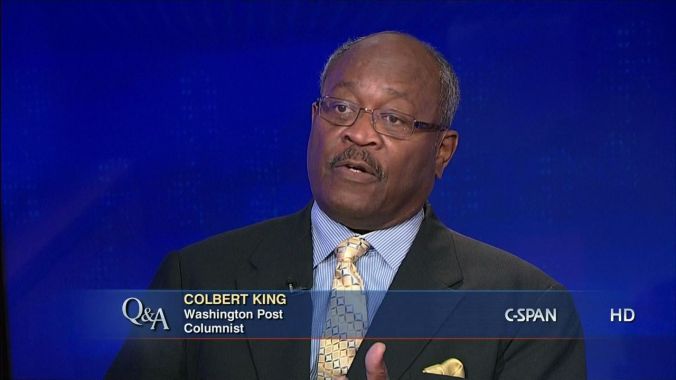
A Cautionary Tale: The Corruption Of Post Columnist Colbert King, Part I

Colbert King is 80 now, but he is still a regular columnist with the Washington Post. As a recent column demonstrated, he has finally fallen prey to the Post culture and no longer is what he once was: the rare pundit, in his case, a liberal one, who could be counted upon for fairness and integrity regardless of the topic. The one-two punches of Barack Obama and Donald Trump showed how cognitive dissonance and confirmation bias can corrupt the best of us, and make no mistake about it, King was once one of the best.

Although he is an African-American, he stood out for decades among his corruption- enabling black colleagues in consistently calling out the D.C. government’s corrupt leadership—notably Marion Barry but many others—on their arrogantly dishonest, venal and untrustworthy practices and attitudes.

Then Barack Obama happened. I listened in surprise on a local Sunday talking head show as King defended Barack Obama’s quiet, decades long assent to the black liberation (that is, anti-white, anti-American rantings of Reverend Wright, Obama’s “spiritual mentor.” Were these rationalizations I heard Colbert King uttering? King reliably mocked rationalizations, and yet here he was using them, notably “Everybody does it,” to defend  a black Presidential candidate’s approval and association with a black racist and demagogue.

Once Obama was elected, King got worse. Not only could Obama do no wrong, but those who criticized were enemies in his eyes; worse, King treated Obama’s appointees and cronies with similar reverence, a complete reversal from his approach to the  parade of incompetent or criminal black politicians in D.C.  Notably, he defended Obama “wing man” Eric Holder, the racialist Attorney General, when he was refusing to comply with a legitimate Congressional inquiry into the Justice Department’s Fast and Furious fiasco. His excuses for Holder and his attacks on Republicans were so redolent of partisan hackery that in 2012 I was moved to write my one-time Ethics Hero the “Open Letter”: Continue reading →

Ethics Quiz: That Peloton Commercial

Hmmmm.

As regular readers here know, I often criticize TV ads for sending unethical messages or endorsing unethical conduct. I have even been accused of being hypersensitive on the subject. With the controversial Peloton commercial above,  I missed it, if there was  an it to miss.

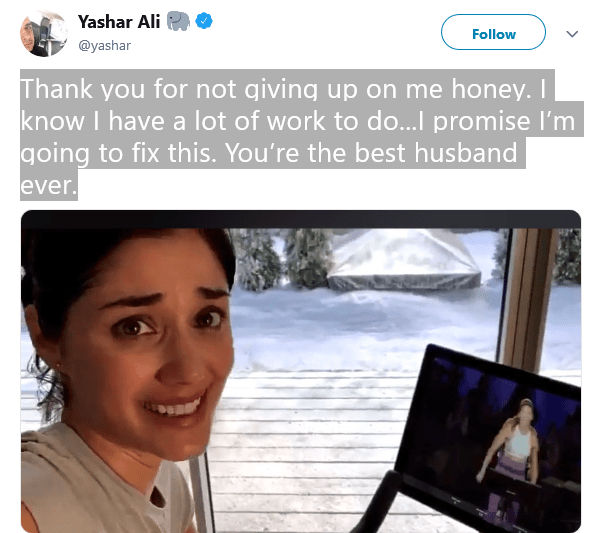
The surprising thing is that a lot of the objections to the ad are coming from the Right. If I had bothered to think about the Peloton commercial, I would have perhaps detected that it was sexist, with a critical husband demanding that his already apparent fit and lovely wife get in better shape, and she dutifully complying. Indeed the Left was annoyed: Yashir Ali, who writes for HuffPo and New York Magazine (and you know what THAT means) captured the spirit of the objections:

Another tweeter wrote, “So sweet. My husband was inspired by the Peloton ad to get me a pair of pants in a child’s medium and a handwritten note that says “Don’t fucking touch me till you can fit into these.”

The Right, however, was equally disdainful. Allahpundit wrote,

The weird part is the … eagerness with which she shows her gratitude. It’s lovely to be grateful for an expensive gift, but she’s *really* grateful and *really, really* wants her husband to know it. It’s not just that she feels compelled to record herself using the bike repeatedly over a span of many months. She looks curiously anxious doing it, even when smiling into the camera. At the end of the clip, when she finally shows him the footage, her eyes are trained on his reaction, seemingly desperate for his approval. Is, um… How do I put this? Is everything okay between these two?

Another conservative wag, Steven Kruiser, wrote, Continue reading →

12/2/2019 Ethics Update, So I’m Not One Day Behind Forever: Hospital Stay Observations, And Other Things

I’m not going to make a habit of it, but today I’m doing a second short form post. First, I’m backed up, thanks to losing a day; second, There was no warm-up for this date, since I posted yesterday’s overview this afternoon; third, I’m not feeling so hot, after all the tests, anxiety, and no sleep at all.

1. Hospital items.

  • What’s the ethical way to handle people like this? My night nurse, whom I saw a LOT of and who was terrific, saw me watching “Jurassic Park III” on the hospital room TV and commented that she loved dinosaurs. Then she said that it must have been hard for the people living in caves to survive with all the raptors running around, and that it was a good thing the Great Flood killed the dinos off.

In the past, I have tried to explain—nicely—that this kind of fake natural history is nonsense and impossible in too many ways to count, discussed the timeline and the fossil record, and tried to bring them into something approaching enlightenment. This has never done any good at all if my audience was over 30, and usually just made them angry and convinced that  I’m the idiot as well as a pagan.

Yet ignorance is a social disease, especially this particular variety. I don’t think it’s responsible or kind  to enable the spread of misinformation.

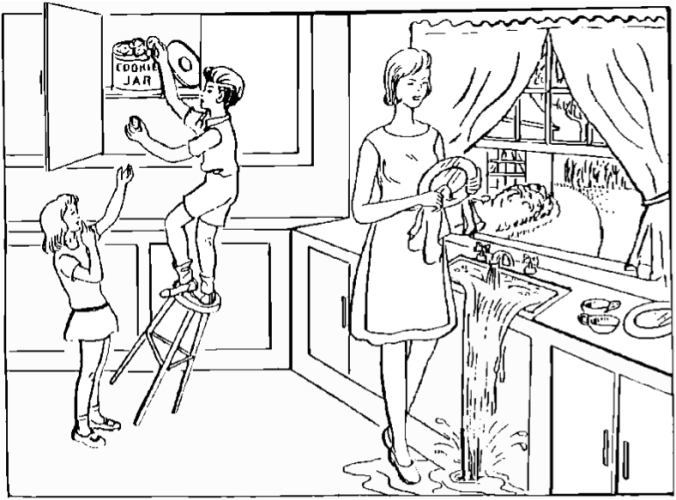
  • That picture above is part of the NIH stroke protocol, which I now know by heart having been subjected to it several times. When was it drawn, 1958?

Could it be more gender stereotyped?

  • About half the hospital personnel under 35 had unpronounceable foreign names, recalling this article which I read last week, Once upon a time, immigrants coming to the U.S. wanted to have American-sounding names. It signaled a desire to commit to the culture, just like learning the language and adopting American values. My mother’s bothers and sister had Greek first names, but outside the home the family used the Anglicized versions of them. My mother was Helena, and called herself Eleanor.

This was, culturally, a much healthier tradition than what we have now—unifying, respectful, responsible. I see ostentatiously foreign-sounding names as defiant, and signaling a determination to avoid assimilation, to enjoy the rights and privileges here, without fully committing to them. I definitely regard any problems and inconvenience resulting from keeping the names Ngongsa or Ijeoma entirely self-inflicted. Continue reading →

Comment Of The Day: The Betrayal And Ultimate Triumph Of Dorothy Seymour Wills”

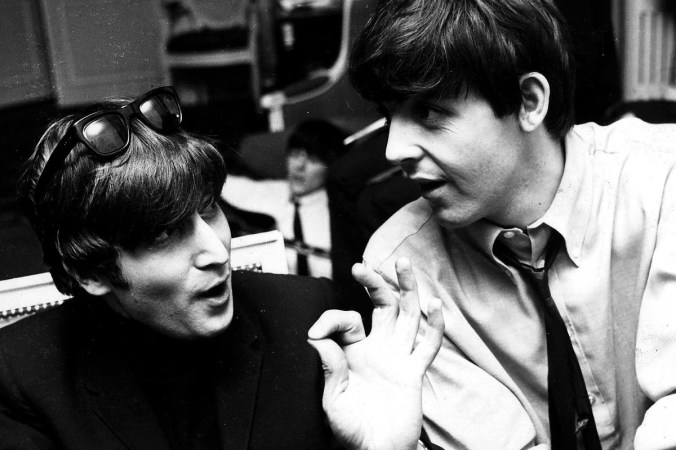
The smartest –and most ethical—thing John and Paul ever did: agreeing to share credit for every song, no matter who wrote it.

On the topic of authors being reluctant or resistant to sharing authorship credits,I wrote in a replay in a comment to the post,

I have shared the authorship credits of several stage shows where I was the initiator and the creator of 75-95% or more. There are two shows, a drama and a musical, that have made substantial money without my sharing in any of it—one because I added co-authors out of respect for their non-authorship contributions, the other for which I got no credit at all despite making the alterations that made the difference between the show being a hit and a flop. My wife thinks I’m a sap and a patsy. No, I think sharing credit liberally is the right thing to do, and that generosity should be the rule, not the exception. And I will continue to do unto others what they should have done unto me, even if the others usually don’t.

Here is a different personal perspective on the issue, in mermaidmary99’s Comment of the Day on the post, “The Betrayal And Ultimate Triumph Of Dorothy Seymour Wills”:

I was a record producer in the early 1980’s. (Still am.)

In ones early 20’s it was unheard of to be a producer unless one was in the group. To be a woman in their early 20’s was shocking to most every man who would arrive to the studio to see me in charge. They often assumed my boss was coming.

The men were always respectful and helpful as I cut my teeth in those early days.

How did I get a job like that?

The label owner, who was a studio musician and had played with The Righteous Brothers and other acts, had heard 3 songs I wrote on an album (my boss chose them and was the producer) and loved them. He asked my boss who wrote them, and he said I had. (And that I assisted on production on those too) so the owner said. “have her write and produced the next record, this stuff is amazing!”

So along with my then boyfriend, I did.

Yes, later I was a mom and asked to produce for another label. (Women producers were still unheard of) and I accepted. I asked my husband to help.

I’ll never forget his reply.

He kindly declined saying. If he did, I’d not get the credit, They’d think, “Oh, she helped her husband and probably nagged for credit.”

I was hurt because I wanted him to share in it. He explained nicely again how it wouldn’t support my Dream. And he LOVED producing too .

I’ve often felt lucky he was so supportive, and reading this I realize how very fortunate I am to have had him by my side.

I’m glad this story is being told. This woman deserves credit and I can see why men would both want her to, and not. Continue reading →

Comment Of The Day: “Comment Of The Day: “Pre-Thanksgiving Day Ethics Wrap-Up, 11/27/2019””


Alizia Tyler’s Comment of the Day predictably set off another round of debates relating to the Civil War. There are few episodes in our history that are so rich with ethics and leadership controversies, so it is not surprising that Lincoln, secession, slavery, the Confederacy, Lee and other objects of contention keep finding their way here, most recently in connection with the relentless Confederate Statutory Ethics Train Wreck.

Red Pill Ethics has made an impressive entry in this fascinating and ever-green category. Here is his Comment of the Day on the post,”Comment Of The Day: “Pre-Thanksgiving Day Ethics Wrap-Up, 11/27/2019””….I’ll be back at the end.

I sat and argued Lincoln a bit to my significant other. Or at least all the things history kind of brushes aside.

1) Laws determine what we can’t do, not what we can do. If there is no law saying that an act is illegal then it is by definition legal. This is the foundation of American law. The government just can’t make up rules and arrest you for things that aren’t illegal.

By this universally true standard, the South’s secession was legal. There is no law prohibiting it and, historically, none of the early states entered the union with the understanding that it was an unbreakable agreement. Indeed the federal government was deliberately made to be a weak structure to preserve the autonomy of the states. To this day there is no law saying that the states can’t leave the union – in any case such a law would be deeply hypocritically and ethically bankrupt given America’s rebellious origin. Some Supreme Court cases have touched the issue but their constitutional basis is literally non existent – “Texas had become part of ‘an indestructible Union, composed of indestructible states’ ” uhhhhh where does the constitution say that?

2) At the time of the Civil War, secession was widely if not universally viewed as a legal option. So a few Southern States peacefully succeeded and ordered all Northern troops out of their sovereign territory. The feds did not comply. They sat in Fort Sumter and did not leave. The Confederacy then blockaded the Fort to prevent it’s resupply that the unlawful occupiers of that land might be forced to leave. Again the Feds did not comply. Instead they ran the blockade and sent more men and material to the Fort. Sorry fam, but when one nation sends troops into another nation to occupy their land… that’s an invasion no matter how bloodless it may be. The modern equivalent of a bloodless invasion like this would the Russian annexation of Crimea. Bloodless but inarguably illegal and an act of war. If Ukraine had gotten its shit together and actually had a functioning military or military alliances it very likely would have been the start of a big ol’ war. As it stands though, Ukraine lacks the power to fight back and so it took the invasion on the chin.

The South did not. They opened fire on the Fort and eventually took it back – and they managed to do it without actually killing anyone. A bloodless invasion was met with a bloodless defeat and sovereign land was returned to its sovereign owner. In any case, the North’s soft invasion and the previously unheard of authority that it implied so alarmed the other states that four more states who had initially opposed secession then decided to secede. The North then blockaded the South’s ports and invaded Virginia. Even Maryland and Delaware, Northern states, considered withdrawing from the Union but were prevented from doing so by federal intervention…which brings us to the next evil that Lincoln’s administration perpetrated. Continue reading →

Sunday Ethics Review, 12/I/50: Birthday/Finding Dad Dead In His Chair Anniversary Edition

[Yesterday I was just about to post the following when I felt a recurrence of the dizziness that sent me to the floor on Thanksgiving,  This sent me to the emergency room, where I spent  the second worst birthday of my life. I just got home, now just about 24 hours later, after three blood tests, about ten stroke tests, lots of other tests and quizzes, four doctors and a miserable night, culminating in the conclusion that whatever this was, it wasn’t related to my heart or circulation. 54% of fainting incidents, I learned remain mysteries. Swell.]

_____________________________________________________________

Hi.

Ten years ago today, I went over to my parent’s condo to check on my dad, since my mother, then recovering from knee surgery, was concerned that she hadn’t heard from him. Jack A. Marshall Sr. was also going to take me out for dinner, since it was my birthday, but that pleasure was not to be. He had died, quietly during a nap, a few months short of his 90th year. I miss my father’s inspiration, guidance and unflagging support constantly, and December first has been a matter of serious dissonance for me ever since. I did take comfort, while everyone was telling me that I was a fool not to go to the emergency room after my fainting episode on Thanksgiving, that the odds of anyone dropping dead not only on the anniversary of his father’s death, but also on his own birthday, seems extremely remote. Kind of cool, though.

I took my birthday off of my Facebook page because those reflex happy birthday messages—I send them myself—are meaningless and  faintly obligatory. Two years ago I received almost 200 of them, then last year I got the message when the number fell by about two-thirds. I had made it clear by then that I was rebelling against the Facebook Borg aka “the resistance,” and so I had been told that I did NOT deserve a happy birthday. Fine. Bite me.

1 “The Crown” Ethics. A. The Pretend Sister-in-Law Of The King’s Pass! While waiting to see if I was going to pass out again, I began watching Season 3 of Netflix’s “The Crown.” Like the first two seasons, the series is uniformly excellent and largely accurate, but I am annoyed at Helena Bonham Carter’s turn as the middle-aged Princess Margaret. Carter is an excellent actress as well as one of the biggest stars the series has featured, but to be blunt, she’s too fat to play Margaret, who at that point in her life was  still vain winning the battle against middle-aged spread (at 5’1, it could not have been easy.) For a production that mostly aims for near perfect look-alike casting (young Charles, Princess Anne and Prince Phillip are especially uncanny), why would the producers allow Carter to appear on screen like this? Mostly, I’m annoyed at her: actors gain and lose weight all the time for roles, and a mere 10-15 pounds would have made Carter a credible and flattering Margaret. She could have hit the gym and laid off the kidney pie; obviously the actress didn’t care, and the producer and director let her get away with it, because she’s a star. Yet all the lines about how glamorous Margaret is make no sense as a result. Carter’s a beautiful woman, but she’s a mighty frumpy Princess Margaret.

B. A perfect future episode for Season 4, or maybe 5, is going on right now.  Prince Andrew, the younger brother of Prince Charles, has long been mentioned a party pal of billionaire sex-slaver Jeffrey Epstein, and thanks to a car crash  of a BBC interview in which he couldn’t have seemed more guilty and less remorseful, the Duke of York is reportedly being removed from all royal duties and may have his allowance cut off, meaning that his two princess daughters will no longer be supported by taxpayers, among other nasty consequences. Charleshas ordered a crisis meeting with his scandal-scarred brother before Monday night’s dreaded BBC special with key accuser Virginia Roberts Giuffre, who accuses Andrew of raping her while she was under Epstein’s control.

The news media has been ostentatiously uninterested in Prince Andrew’s travails, in marked contrast to its coverage of the various Charles-Diana scandals in days of yore. One reason, I think, is that Epstein’s OTHER celebrity playmate was Bill Clinton, and it will be hard to expose one without drawing attention to the other. After all, the objective now is to get Trump, not remind the public about Bill (or Harvey.) Media bias is exhibited as much by what isn’t reported as by what is. Continue reading →

The Betrayal And Ultimate Triumph Of Dorothy Seymour Wills

There was an upsetting ethics story in the obituaries last week. It told the tale of the rank injustice perpetrated by a famous and much-honored researcher, historian and author on his collaborator, from whom he withheld  credit and recognition—because she was his wife.

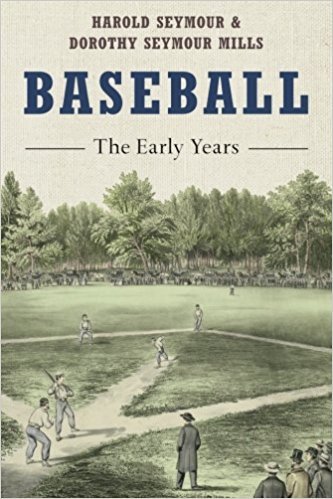
Dorothy Seymour Mills collaborated for more than 30 years on a landmark three-volume history of baseball with her first husband, Harold Seymour. Their work, originally attributed only to him,  is regarded as the first significant scholarly account of baseball’s past.  (“No one may call himself a student of baseball history without having read these indispensable works.” John Thorn in 2010, then Major League Baseball’s official historian.)

“Baseball: The Early Years” (1960), “Baseball: The Golden Age” (1971) and “Baseball: The People’s Game” (1990) all were completed with substantial and indispensable contributions by Dorothy, who, unlike her husband, was not a baseball fan. (“You write a lot more objectively about a subject you’re not in love with,” she once observed.) She was the primary researcher, organized the projects, typed the manuscripts, prepared the indexes (ugh) and edited each book before it went to the publisher. Because of her husband’s failing health, she wrote a substantial portion of “Baseball: The People’s Game.” Yet her husband adamantly refused to give her an author’s credit. Each book bore only Harold Seymour’s name, and hers was relegated to the acknowledgments.  The first book in the trilogy, “Baseball: The Early Years,” received rave reviews.  Sports Illustrated compared Seymour to Edward Gibbon, the iconic historian who wrote “The History of the Decline and Fall of the Roman Empire.” Dorothy was invisible, and her husband wanted it that way. Continue reading →

Mrs. Q’s Corner: Political Mascot


by Frances Quaempts-Miller

Towards the end of British author Douglas Murray’s latest book The Madness of Crowds is a call to find significance beyond politics:

 “One of the ways to distance ourselves from the madness of our times is to retain an interest in politics but not to rely on it as a source of meaning.  The call should be for people to simplify their lives and not mislead themselves by devoting their lives to a theory that answers no questions, makes no predictions and is easily falsifiable.  Meaning can be found in all sorts of places.  For most individuals it is found in the love of the people and places around them: in friends, family and loved ones, in culture, place and wonder.  A sense of purpose is found in working out what is meaningful in our lives and then orienting ourselves over time as closely as possible to those centres of meaning. Using ourselves up on identity politics, social justice and intersectionality is a waste of a life.”

 Murray ends his book arguing, “To assume that sex, sexuality, and skin colour mean nothing would be ridiculous.  But to assume that they mean everything will be fatal.”

 In the last year and a half my wife and I have lost six loved ones, including two grandmothers last month, only three weeks apart.  Between us we have lost three grandparents, a cousin, an aunt, and my father. Ours has been a house of grieving that has prompted both of us to re-examine what has brought us a sense of purpose and what we need to focus our energies on in the future.  After spending not just years but decades fighting for equality, it has become clear, with so much death, that such supposed noble efforts have only rendered a more broken heart in a more broken world. 

 At the age of fourteen I went to my first protest to express concern for the United States involvement in El Salvador.  At the time, I didn’t really know what our country was doing wrong but I did know that the exhilaration of marching in the middle of the street, after the police told us through their bullhorns not to, while yelling various slogans repeatedly, was intoxicating.  All my frustration with whatever complications life had thrown my way dissolved instantly.  Suddenly I was a part of something bigger than myself while believing my actions and those of the other protesters were on “the right side of history” (see 1B. The Psychic Historian on the list of Unethical Rationalizations and Misconceptions). For a somewhat shy teenager, I was instantly transformed by that march into a powerful person.  Continue reading →