Weekend Ethics Catch-Up

If you took an ethics break this last weekend of February, here’s your Ethics Alarms make-up assignment:


Matrix Chicken Ethics

Yum-yum!

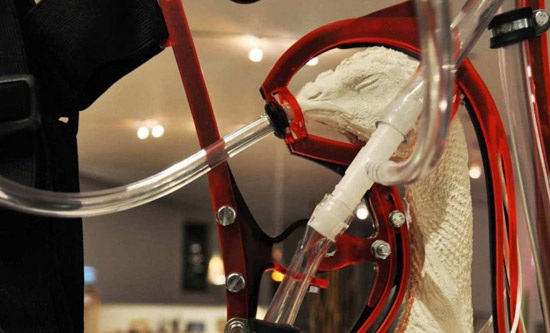
Architecture Student and artist André Ford has sparked an ethics debate after proposing that chickens be raised for meat in vertical racks after  their frontal cortexes have been severed, rendering them brain-dead and essentially growing meat. The question is, would this practice be more ethical than current factory farming, less ethical, or does it make no difference?

Ford’s system would have the chickens suspended and immobile, with their feet removed. Tubes would supply water and nutrients directly into them while other tubes would carry away their waste. The chickens, of course, wouldn’t feel a thing, which one could argue is a superior state to the well-documented stress and misery they would experience in traditional chicken farms. Meanwhile, the costs of raising chickens would be (theoretically) reduced, in part because far less space would be required, and the process would also be cleaner—again, theoretically. Continue reading

Ethics Quiz: The Case of the Human Cat

This is not only an ugly story, but also one that many people are incapable of analyzing dispassionately, or even rationally. I’m going to try.

Michael Puerling is a landlord…some would call him a slum lord…in Menomonee Falls, Wisconsin.  A tenant in the upper unit of his property had adopted a black and brown stray cat, which she named Sage. Puerling told the woman she couldn’t keep a cat, so she evicted the feline, which eventually took up residence in the vacant lower unit. Puerling discovered the cat had after it had been making itself at home for months, tearing up furniture and generally making the apartment a giant litter box. According to the landlord, he opened the doors and windows and tried to get Sage to leave, but the cat hid under the kitchen sink. Then Puerling tried to remove the cat by hand…not a good idea, as any cat owner could have told him. When he couldn’t grab the scruff of Sage’s neck, he yanked the cat out by his tail, with the predictable result–the cat went crazy, and attacked him.

So Puerling bashed the Sage’s head in by swinging him by his tail against a slab of concrete outside. Continue reading

5 Things PETA Doesn’t Understand About Ethics

Stay classy, PETA.

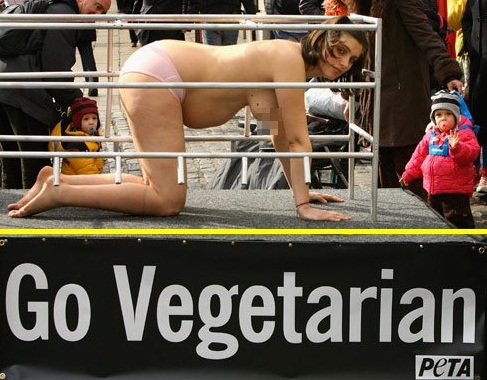
PETA—People for the Ethical Treatment of Animals— has announced that it is starting a porn website to attract attention to the plight of animals. Over on his Business Ethics Blog, Chris McDonald asks whether this means that PETA has “jumped the shark.” More so than offering Octomom money to put a billboard on her lawn advocating spaying pets so they won’t have litters like hers? More so than complaining that Punxsutawney Phil, the groundhog of Groundhog Day fame, should be replaced by a robot? I don’t think so. Besides, jumping a shark would be cruel to the shark.

The tunnel-visioned organization, well on its way to becoming a joke to the detriment of its abused animal constituency, has registered the domain name peta.xxx and plans to launch a pornography website in December that “draws attention to the plight of animals.” How will it do that, you ask? By using images of naked women performing  sex acts on men to attract viewers, and then making the audience observe graphic videos of animal abuse for the privilege of watching the graphic sex. “We try to use absolutely every outlet to stick up for animals,” says PETA spokesperson Lindsay Rajt, who adds that the organization wouldn’t use its “flashier tactics if we didn’t know they worked.”

Let’s put that right at the top of this list, entitled “5 Things PETA Doesn’t Understand About Ethics.” Continue reading

Hero, Villain or Hypocrite: The Dilemma of the Undercover Dog-Fighter

The limits of absolutism and the drawbacks of utilitarianism both come under scrutiny in assessing the strange saga of Terry Mills, whom the ASPCA recently appointed as its Animal Fighting Specialist.

Beyond question, this is a job he is uniquely qualified to hold. In 2008, Mills worked for the FBI’s domestic-terrorism task force, and went under-cover for more than a year to expose and break up a national dog-fighting ring. His efforts resulted in many arrests, and the rescue of more than 500 animals. Accomplishing all of this, however, required Mills to become part of the culture he was attacking. He trained and fought his own dogs, engaging in the very cruelty he was working to prevent. Continue reading

The Final Proof That Michael Vick Doesn’t Get It

In the finale of “Animal House,” after the expelled Delta House members have sabotaged Faber College’s parade causing wanton destruction, mayhem, panic and riots, the fraternity’s  president approaches the dean (who is lying in the ruins of the stands toppled by the Delta House “Deathmobile”) and hopefully asks for “one more chance.”

I thought of this classic moment when I read that Michael Vick, the serial dog-abuser now seeking redemption by winning football games for the Philadelphia Eagles, had told an interviewer that he really missed owning a dog and hoped to have one as a pet some day. Continue reading

When the “Everybody Does It” Excuse Works: Police Dog Cruelty in North Carolina

In January, Ethics Alarms named the North Carolina State Personnel Commission an Ethics Dunce for reinstating North Carolina State Trooper Sgt. Charles Jones, who had been fired for abusing one of his police dogs. He had been videoed as he hung the dog, Ricoh, and kicked him for not releasing a chew toy on command. The Commission heard testimony from officers regarding the brutal training methods routinely used by the police, and ruled that by practice and law, what Jones did was not what they call “abuse” in North Carolina, at least when it is done to police dogs.  “Though disturbing, the treatment of Jones’ animal does not rise to the level of ‘abuse,'” the ruling reads, and even if it did, the Commission noted that the Wake County, N.C., animal ordinance specifically exempts police dogs.” In other words, abusing police dogs is acceptable conduct for K-9 trainers.

The ruling came after the testimony of other dog handlers had prompted the Highway Patrol to suspend all use of dogs, anticipating public outrage. Governor Easley also pushed for Jones’s dismissal after the video surfaced, and he made certain that the Commission’s reinstatement of Jones was appealed.

You’re not going to like the result. Continue reading

False Redemption and the Michael Vick Fallacy

Michael Vick was once a star quarterback for NFL’s Atlanta Falcons. Then it was discovered that he was secretly in the illegal dog-fighting business, breaking the law and being brutally cruel to dogs in the process. This lost him his job, his contract, his freedom, and many millions of dollars. Now he’s a star quarterback again, leading the Philadelphia Eagles. Last Monday night, he had what some have called the best game any quarterback has had in the NFL in forty years. Many are celebrating his return to stardom as an inspiring example of rehabilitation and redemption. After all, he’s a hero again.

Not to me, he isn’t.

It well may be that Michael Vick is a changed man, but the jury is out on that; it’s just taking longer to get a verdict than it did for his dog-fighting charges. There is absolutely no nexus between Vick’s resurgence on the football field and his character. Continue reading

More Unethical Anti-Dog Slander by The Daily Beast

It is odd that a news website called “The Daily Beast” is engaging in an ongoing effort to misinform and frighten the public regarding dogs. Someone—publisher Tina Brown perhaps?—in The Daily Beast’s lair must have been badly frightened by a puppy at some point in his or her life, leading to an irrational fear of dogs and mind-blowing ignorance regarding them. Earlier this year, the site published two unhinged calls for the eradication of  anything resembling a pit bull by a writer whose pet was attacked by one. At the moment, The Daily Beast features a gallery with the ominous title “39 Most Dangerous Dog Breeds” that had to be assembled by some one who has seldom seen a real dog, much less owned one. On the home page, the feature is placed under the heading, “Beware of the Dog.”

The criteria for the ranking is completely mysterious—several of the breeds listed, for example, have exactly one attack attached to them. The gallery itself is riddled with errors and is actually quite funny, if one knows anything about dogs at all. In addition to being careless and incompetent, the feature is dishonest, and seems to be calculated to make people irrationally frightened of dogs, when in fact the relationship between human and canines is one of life’s great and fortunate pleasures. Continue reading

Ethics, Ethics, Everywhere…

Stories with ethical implications are popping up everywhere, in many fields. I’m running hard to keep up; if you want to join the race, here are some recent developments and notes:

  • A prominent Harvard professor and respected researcher just retracted a major paper and has been put on leave, as an investigation showed irregularities in his methods and results. “This retraction creates a quandary for those of us in the field about whether other results are to be trusted as well, especially since there are other papers currently being reconsidered by other journals as well,’’ wrote one scientist. “If scientists can’t trust published papers, the whole process breaks down.’’
  • A Wisconsin lawyer bought a farm from his own client in a bankruptcy matter, a classic conflict of interest. The lawyer’s defense was amusing: since his license had been suspended, he no longer had a fiduciary duty to his now former client. The court canceled the sale. The story is on the Legal Profession Blog.