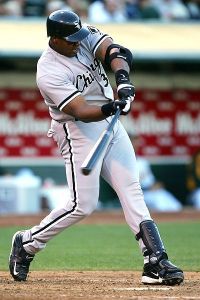
Well, THAT Question’s Answered: No Parting Gifts For A-Rod

No-GiftI wrote in an earlier Ethics Quiz that the retirement of Yankee Cheat and Head Creep Alex Rodriguez tomorrow would put the Boston Red Sox in a difficult position tonight. Should they honor him, as the Yankees will honor Red Sox star David Ortiz in his final appearance in Yankees Stadium? Or should they  eschew any recognition, since the Boston fans hate Alex’s guts?

Apparently, as often is the case, the problem was not as difficult as my ethical alarms were telling me. The Sox won’t even give A-Rod a cupcake. There will be no recognition of his career, other than the symphony of boos that will rain down on him from the Fenway Faithful every single time he comes to bat.

Good.

Ethics Quiz: Boston’s A-Rod Dilemma

newsday-AROD

This is a really, really hard one.

Over the weekend, as reported here, Yankee superstar/pariah/cheating jerk for the ages Alex Rodriguez announced that he would “retire” after next Friday night’s game. He’s not really retiring, of course. Like almost everything involving A-Rod, lies and cover-ups reign. Since the Yankees were going to have to pay the rest of his contract to the tune of 27 million bucks either way, they told Alex that they could release him, thus ending his career on a sour note, or allow him to pretend to make the decision to leave the game himself, which would be better PR for all concerned.

However, the announcement presents a problem for the Boston Red Sox. A-Rod’s next-to-last game is Thursday night in Fenway Park, and a player with Rodriguez’s astounding career on-field achievements would typically warrant an on-field salute, like the Sox gave Yankee icon Derek Jeter when he retired. The problem is that Red Sox fans don’t like or respect A-Rod, and they shouldn’t. No baseball fan should. He disgraced the game with his drug use and lies; was an unsportsmanlike presence for most of his career, and will not reach the Hall of Fame despite one of the best careers ever unless the Hall junks all of its character requirements.

Yet reciprocity raises its ethical head. David Ortiz, the beloved Red Sox slugger, is also retiring after this season, and the Yankees have planned to give him a big send-off when Big Papi plays his last game in Yankee stadium. How can the Red Sox snub A-Rod, and expect the Yankees to honor their hero? If the Red Sox do hold a ceremony for Rodriquez, will Sox fans use it as an opportunity to heap well-deserved abuse on Alex one last time? If Sox fans fill Fenway with boos, will Yankee fans reciprocate by ruining Ortiz’s moment in New York? (I would give my guess on this, but it might expose a long-held bias against Yankee fans.)

Your Ethics Alarms Ethics Quiz of the Day:

What is the most ethical way to handle this awful situation?

Continue reading

Alex Rodriguez Announced That He’s Retiring As A Baseball Player. He Could Have Been Fair And Ethical About It. Nah!

alex-rodriguez

New York Yankee Alex Rodriguez, a three time MVP, 14-time All-Star and one of the most talented and controversial players in baseball history—and the epic Ethics Corrupter  who has been criticized on Ethics Alarms more than any other sports figure!—  announced that he will play his final major league game next Friday. For his 20 million dollar  salary this year, “A-Rod” is hitting only .204 with nine home runs and 29 RBIs in 216 at-bats. He can’t play in the field anymore, and any normal player of his age (41) and diminished skills would have been released long ago. (Indeed, any normal player of  his age and diminished skills would have quit.) The team, however, is obligated to pay Rodriguez’s 20 million annual salary not only this year, but also the next. This makes him untradeable as well as too expensive to release.

Of course, if a player voluntarily ends his relationship with a team by retiring, he waives the rest of his contract. Many players have done that when they reached the point in their careers where they were no longer helping the team, taking the place of a better young player on the roster, and embarrassing themselves. None of those players, however, would be forfeiting 27 million dollars, the current tab the Yankees are contractually obligated to pay A-Rod as the final lap of a $275 million, 10-year contract that was baseball’s largest in 2007.

Nevertheless, forfeiting the money is what an ethical player should do. He’s not earning it. Rodriquez has made more than a half-billion dollars in his career, not counting various endorsement fees and bonuses. His two children are guaranteed to be tycoons many times over. He has lots of money, but very little accumulated good will or respect, as a confessed steroid cheat (he was suspended for the entire 2014 season for PED use and a cover-up) and is one of the most disliked players in any sport. Retiring as a straightforward admission that he is no longer able to play and has been hurting his team and team mates would have been the ethical course—a sacrifice, but not much of one.

Nah. Continue reading

Perhaps The Best Baseball Ethics Story Ever: The Chris Sale Uniform Freak-Out

White Sox uniforms

Last night, incomplete fragments of news came through the baseball media that Chicago White Sox pitching ace Chris Sale had been pulled from his scheduled start against the Tigers. Was he about to be traded? No, we learned that there had been a “non-physical” altercation with someone in the White Sox front office. Huh? What did that mean?

It turned out that the truth was stranger than any speculation. Sale, we learned, had refused to wear a retro White Sox uniform during a “Turn Back The Clock” promotion that nigh, and to ensure that he wouldn’t have to, he cut up all the vintage uniforms, using a scissors and a knife, while the rest of the team was taking batting practice.

As soon as I heard this, I told my wife,”I bet I know exactly which uniforms the team was supposed to wear.” I was right: the White Sox promotion involved giving out free facsimile 1976 uniform jerseys to the first 15,000 game attendees, with the team wearing the infamous fashion abortion perpetrated on baseball by puckish former White Sox owner Bill Veeck, the same iconoclast who sent a midget up to bat in a real game.

Here are those uniforms, almost unanimously agreed-upon by all critics as the silliest baseball garb ever to appear on a Major League player (that’s Veeck in the middle; the ones on the left are the uniforms in question):

1976-white-sox-uniforms_mtqjliw57ekb1e3fkjxj4grkj

It is recorded that the players and the fans hated the 1976 uniforms, which were quickly discarded, especially the version with the shorts, which only appeared in one game. No wonder Sale was upset.

Now to the ethics issues: Continue reading

Baseball Ethics: Revealed At Last! Extraordinary Cheating By The 1975 California Angels

Dick Williams, cheat...but a successful and creative cheat, you have to admit.

Dick Williams, cheat…but a successful and creative cheat, you have to admit.

Yesterday on the New England Sports Network broadcast of the Red Sox-Yankees game, Sox color man Jerry Remy was discussing how some teams doctor their home fields for tactical advantages. The Yankee Stadium infield grass, for example, is kept long, slowing down ground balls so the infielders have a better chance of getting to them before they scoot into the outfield for hits. The current Yankees team hitting, such as it is, tends to be fly ball oriented. Jerry expounded on how teams that bunted a lot would sometimes have groundskeepers slant the dirt around the foul lines toward fair territory. “In 1975, when I played for the Angels,” he said, “our home baselines were like gutters. A bunted ball almost couldn’t roll foul.” Such customization is considered fair gamesmanship, because the rules don’t specify ground conditions in sufficient detail.

Then Remy revealed an example of  baseball cheating in the extreme. Also n 1975, Remy said, during his rookie year with the California Angels, manager Dick Williams realized that speed on the bases was one of his few assets on a weak roster. (The ’75 Angels would finish  last in the AL West with a 72-89 record) Remy, Tommy Harper, Mickey Rivers and Dave Collins were all accomplished base-stealers, so Williams had groundskeepers move second base six inches closer to first base, thus shortening the distance a base-runner attempting to steal second would have to cover.

“It was that way all year,” Remy said. “Nobody ever noticed.” Continue reading

The Black Lives Matters Effect, Part I: The Tenor And The Blogger

Singing the right lyrics also matters, you boob...

Singing the right lyrics also matters, you boob…

One thing you have to say for Black Lives Matters: it is good at making people make asses of themselves. “Late Night” host Seth Myers was yesterday’s example, but there are oh-so-many-more, and much worse.

For example, in the pre-game ceremonies of the Major League Baseball 2016 All-Star Game in San Diego, a Canadian tenor, apparently driven to distraction by the reverential treatment given to a group that promotes race hatred and a color-based standard for law-enforcement, snapped while performing the Canadian national anthem. Remigio Pereira, a member of  the vocal group The Tenors tapped to sing the anthem, held up a handwritten sign that read “All Lives Matter” altered the lyrics in the line “With glowing hearts we see thee rise. The True North strong and free” to “We’re all brothers and sisters, all lives matter to the great.”

This doesn’t fit the music, and is even worse than the real lyrics, which is quite a feat. Of course, Remigio was unethical to do this, expropriating an event that had nothing to do with Black Lives Matter, nor race, nor politics to make his own grandstanding statement (come to think of it, baseball does have something to do with grandstands. The stunt was disrespectful of everyone—his hosts, Major League Baseball; San Diego; the captive audience in the stadium, the TV audience, Canada. It was also a breach of trust that directly and perhaps fatally wounded his group, which immediately suspended him (Can we say F-I-R-E-D, Tenors? Sure we can) and issued an abject apology.

The statement was not unduly disrespectful to Black Lives Matter, however, which has shown itself to be unworthy of respect, as all divisive hate groups are.

The Black Lives Matters effect is wide-ranging, however, as this episode shows. It not only makes Canadian tenors irresponsible, but sportswriters too. Over at NBC Sports online, baseball blogger Craig Calcaterra couldn’t perceive the unethical nature of a performer hijacking a paid gig for his own purposes, but lectured his readers on the sin of using the term “All Lives Matter,” writing,

This may not seem terribly controversial to some, but in the context of the Black Lives Matter movement that has risen over the past few years, “All Lives Matter” has come to be seen as a reactionary response which fundamentally misunderstands — often intentionally — the purpose of the Black Lives Matter movement. And is used to belittle and marginalize the Black Lives Matter Movement. The phrase “black lives matter” does not mean that “black lives matter more than any other lives.” If it did, sure, maybe “All Lives Matter” would be a reasonable response. But “Black Lives Matter” is a response to a society and, particularly, police, which treat blacks as lesser persons and who do not face repercussions for harming and in some cases killing black people through excessive force. It’s “black lives matter too” — a necessary statement, sadly — not “black lives matter more.”

Sigh. Continue reading

Calling Balls And Strikes

Robot Umpire

Calling balls and strikes in major league baseball has to be mechanized. This is obvious and beyond argument, and the only question is what will finally make the bitter-enders abandon their rationalizations and capitulate to reality.

I last wrote about this in 2012 in a post titled “Umpire Accountability, As the Day Of The Robot Approaches,” following a 1-0 game in which a batter in a position to tie the game was called out on strikes by an umpire named Larry Vanover, who rang him up with three balls out of the strike zone for the final 9th inning out. This particular contest was between two teams that had finished the previous season with one of them edging out the other for the play-offs by a single game, on the last day of the schedule. The pitches called strikes in this particular at bat weren’t even close to being over the plate. You could see that all three were wide with the naked eye as they arrived in the catcher’s mitt; you could see it in the computer graphic on the screen, and after the game, the pitches’ locations were charted to show that they were, in fact, balls. I wrote…

Baseball fans invest too much time and emotion into following the games and their teams to just shrug off results warped by obvious incompetence. The kind of atrocious umpiring demonstrated by Vanover…poses a direct challenge to baseball’s integrity. What will baseball’s leaders do about it?

They have only three choices:

1.They can, for the first time, take public and punitive action against umpires whose poor performance exceeds a missed call or a human mistake, and demonstrates inexcusable incompetence or a lack of professionalism. First time: a stiff fine. Second time: a suspension without pay. Third time: dismissal.I know that the umpires union in Major League Baseball protects its incompetents as zealously as the teachers unions, but baseball has its product to protect.

2. Baseball’s leaders can make a commitment to automated strike and out calling, and cut back on crews to one field umpire to keep order and one booth umpire to read the printouts, watch the TV screen, and study the replays.

3. Baseball can reject integrity and credibility, and continue to let the Vanovers on the field wreck the games and alienate fans.

So far, disgracefully, the sport has chosen #3, but the clock is ticking. Continue reading

Ethics Hero: World War II Vet Burke Waldron

It is a day late, but I finally have my Memorial Day post.

Thank-you, Burke Waldron, for your service, for making me feel young, and for having the integrity not to embarrass yourself, your contemporaries, and everyone else by making pathetic attempt at throwing a baseball.

I’m not sure which elements of Ethics Hero 92-year-old WW II veteran Burke Waldron displayed yesterday, as he threw out the ceremonial first pitch at the Seattle Mariners game on Memorial Day. Call him a holistic hero. He’s a hero, like all of the fallen soldiers—including my dad—of past wars, because he risked the horrors of combat to defend our nation and the values it stands for…well, at least until Donald Trump is President.

He’s a hero because he represented his generation yesterday with style, verve and energy, running to the pitcher’s mound—in his uniform!as thousands cheered. Most of all, to me, he’s a hero because he took his assignment seriously, and didn’t emulate the pathetic rockers, politicians and even retired athletes who defile their first pitch honors by throwing the ball like a 7-year-old T-ball player, because they couldn’t be bothered to practice. Petty Officer, 2nd Class Waldron threw a strike to his catcher…

…just like another war hero, Ted Williams, did in his last appearance on a baseball field, at the 1999 All-Star Game in Boston. Continue reading

Lasers, Ethics, And Baseball

"TOO MUCH! TOO MUCH!"

“TOO MUCH! TOO MUCH!”

Out of the ever-rich world of major league baseball comes another excellent example of how technology challenges, stretches and confounds traditional ethics.

Over the last decade or so,  it has become possible to track exactly where every ball put into play by every batter goes, and even how fast it gets there. As a result, computers can generate spray charts that will indicate the optimum defensive placements for the opposing team’s players, maximizing the chance that a batter will hit a ball within reach of a fielder. When Cleveland manager Lou Boudreau positioned four infielders on the right side of the field to foil Ted Williams, the “Williams shift” was considered radical and revolutionary. Today, there are shifts designed for a majority of players.

The problem is that with so many shifts, making sure each defensive player is in the right place becomes a challenge.  Now some teams are experimenting with using lasers to mark the grass, so a player will know exactly where to position himself. Continue reading

Boy, You’re Gonna Just Hate THIS Ethics Quiz…

Tigers manager Brad Ausmus, the quiet, Ivy League-educated manager of the struggling Detroit Tigers in the American League, snapped in frustration during last Monday’s game. He cursed, he raged, he threw dirt, he threw his cap,  he took off his hoodie and draped it over home plate. Some of his X-rated remarks were captured by microphones and broadcast to the nation. Naturally, such conduct is frowned upon by MLB umpires, so he was thrown out of the game, suspended and fined.

Now he is auctioning the hoodie and cap from his tirade on the web. Here’s part of the description:

” Neither item has been washed since the May 16 game and both items show dirt consistent with being placed or tossed on the field.”

Bidding is approaching  $5000. The auction website adds: “Neither item has been washed since the May 16 game and both items show dirt consistent with being placed or tossed on the field. Both items feature the #7, as seen in the photos.” Bidding will close on Wednesday.

Your annoying Ethics Alarms Ethics Quiz of the Day is….

Is auctioning the items used by Ausmus in his on-field tantrum as unethical, more unethical, or less unethical than George Zimmerman’s auctioning the gun that he used to defend himself against Trayvon Martin, resulting in the teen’s death?

Continue reading