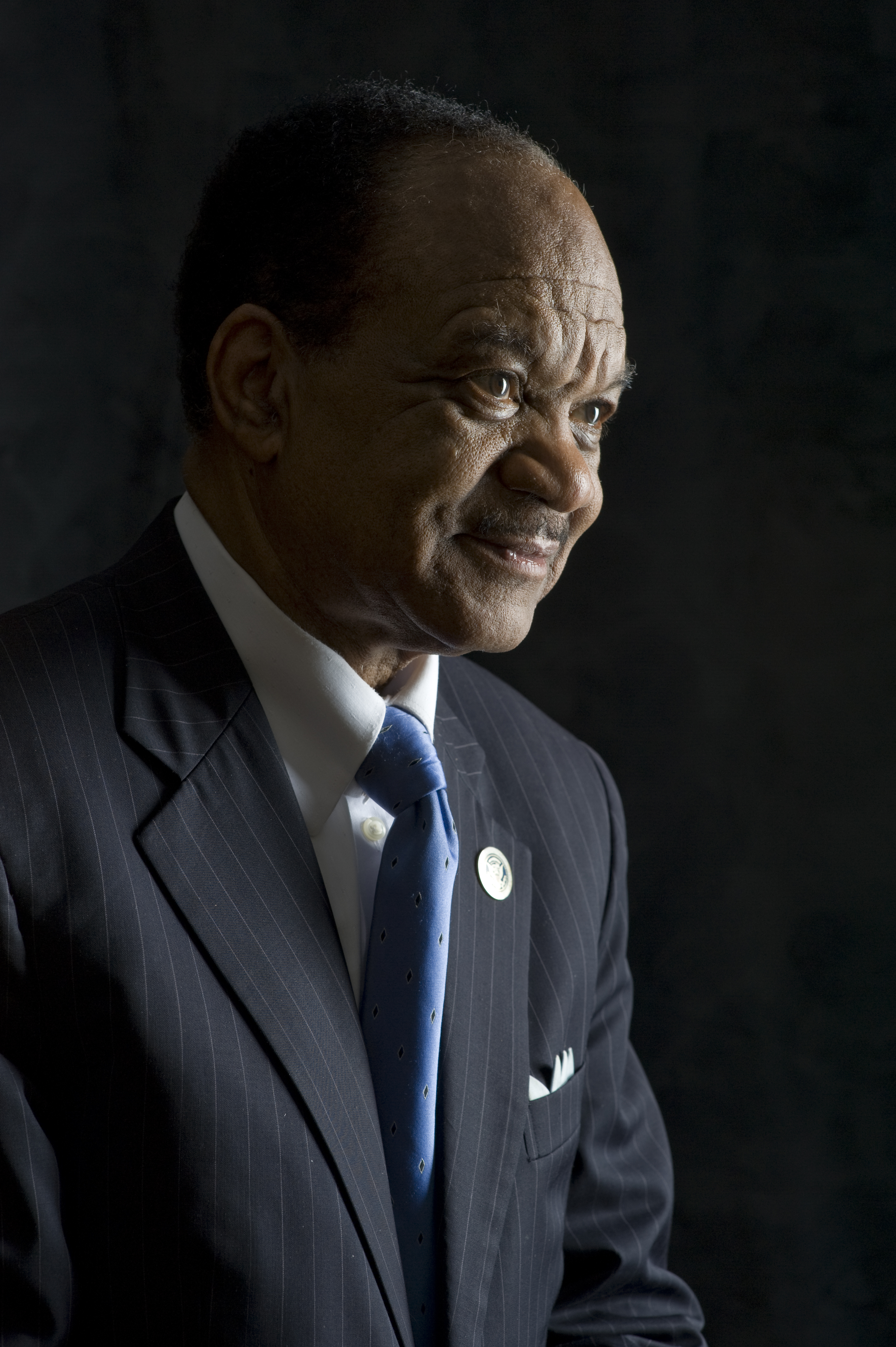
The AWOL Walter Fauntroy, Flawed Black Martyrs And The Duty Of Outrage

Walter Fauntroy, D.C. icon, civil rights hero, fugitive, coward, crook...but still a hero. Somehow.

Walter Fauntroy, D.C. icon, civil rights hero, fugitive, coward, crook…but still a hero. Somehow.

As I was composing this post in my head, I stumbled upon—and I mean that, because I normally avoid her columns like cheap Chinese food—Kathleen Parker’s latest column. Parker is the sort-of conservative, sort-of op-ed pundit who has mastered the art of compassionate equivocation, meaning that her opinions on public affairs usually consist of one long sigh. She was at it again here, except that the topic she was sighing about confounds me, he who does not shrink from assigning blame, almost as much as it does she who usually spreads blame so evenly that its ethical impact is nil.

Parker wrote…

At the same time that people avoid too-sensitive subjects, they seem to fear stating the obvious lest their thoughts be interpreted as an act of betrayal to “the group.” Politicians are the most risk-averse of all. Few are the Democratic women who will find (or express) fault with Clinton. It is the rare African American who finds fault with Obama. When Rawlings-Blake also said that she “gave those who wished to destroy space to do that,” her Democratic colleagues spoke only of her “poor choice of words.” Not poor thinking? Not lousy leadership? Republicans don’t get a pass. Heaven forbid they should call out someone who wants to inject biblical end-times into political debate.”

Ah, how it makes my chest fill with pride that I have flagged all three of the ethical breaches Parker mentions within the few daysHillary Clinton’s brazenly suspicious conduct and the disgraceful refusal of her cheering section to either acknowledge or question it…Rawlings-Blake’s “lousy leadership”… and Republicans who use religiosity as a prop. Parker being Parker, she had earlier used an example of missing outrage that sets my teeth on edge because, while correct, it calls to mind another area of missing outrage and societally-damaging martyrdom that I can’t quite figure out how to talk about.

Where is the outrage beyond the African American community about police brutality and the deaths of young black males? Where are members of Congress other than those belonging to the black caucus? My God, the list of those killed is staggering,” she writes, “yet this is not a new phenomenon. Baltimore’s Freddie Gray, the 25-year-old who suffered spinal injuries while in police custody and died, is but the most recent. Yet you see only the usual black activists speaking up.”

True. The missing paragraph, however,  is this: “Where are the African-American activists asking why so many young black men are constantly in positions that place them in conflict with the police? When protesters chant the names and carry photos of police victims like Freddie Gray, Walter Scott, yes, and Mike Brown, they are presenting in honored terms African-Americans who weren’t credits to their communities or examples for the next generation to emulate. Indeed this ritual sanctifies lives and backgrounds that are part of the same urban pathology as the police attitudes that killed them.”

Freddie Gray was only 25-years-old, and yet he already had a staggering 18 previous arrests since he turned 18-years-old. His mother was a heroin addict; he had no father in his life. Why was someone like this even out of jail, in a position to become yet another victim of police anger and contempt against the endless wave of young, irresponsible, law-defying young men who undermine the vitality of their own communities and the nation?

The fact that Gray’s death was undeniably the greater outrage shouldn’t allow the outrage of lives like his to be ignored. Black crime and police dysfunction are part of the same pathology. If only the Bill O’Reillys are going to ask the hard questions about black communities policing their young and changing their deadly culture—and are they really hard for O’Reilly, whose audience is inclined to look for ways to side with the police even when they commit murder?—then those questions and their equally hard answers, involving, among other things, avoidance of responsibility and accountability, can be and will be largely ignored.

This is part of the loyalty to “the group” phenomenon that cripples the African-American community and warps its values. It is especially powerful when prominent leaders, those African-Americans who should be leading the way away from self-destructive conduct and who have the power, visibility, and credibility to do so, demonstrate an atrocious lack of ethics themselves. Where are the black voices—those not belonging to black women he sexually assaulted, that is—condemning Bill Cosby? Or Al Sharpton? Charles Rangel?

Washington, D.C.’s overwhelmingly black population was conditioned to accept black leadership outrages by the late Marion Barry. I was not quite aware of the extent of this cultural purging of the ability to hold prominent African-Americans to ethical standards until I read a jaw-dropping Washington Post feature about the wife of local civil rights legend Walter E. Fauntroy, who helped Martin Luther King plan the 1963 March on Washington, and who served as the District’s congressional delegate for two decades. The tone of the article is enough to make a reader think he or she is going mad. The loving 80-year-old wife, Dorothy Fauntroy, speaks about her husband in glowing terms that nothing in the article suggests is inappropriate. Continue reading


Comment of the Day: “Comment of the Day: ‘Why The Sweet Briar College Fight Matters'”

Sweet BriarThe Sweet Briar closing, which was first raised as an ethics issue in the post, “The Sweet Briar Betrayal, has attracted many new readers and commenters to Ethics Alarms from the all-women Virginia college’s alumnae and supporters. Things are starting to move fast in the situation, with an investigation looming and questions being asked by the state legislature. Enlightening us further on this troubling story is faculty member Marcia Thom Kaley; here is her Comment of the Day on the post Comment of the Day: “Why The Sweet Briar College Fight Matters”: Continue reading

Comment of the Day: “Why The Sweet Briar College Fight Matters”

Sweet Briar2

Ethics Alarms has been graced with a wave of new commenters, prompted by this post and its predecessor, “The Sweet Briar Betrayal.” The issue is the ethics of a college board surrendering to adversity without a fight, with millions in the bank, a beautiful campus, and an important mission, and doing so before fully informing and involving the larger college community, especially alumnae. I opined that the board had an ethical duty to both  mission and the school itself not to euthanize Sweet Briar College prematurely, at very least, not before a last ditch capital fundraising campaign.

Thousands of readers seemed to agree, and my posts on the looming Sweet Brier closing have become part of the effort to promote and coordinating a growing movement by concerned alumnae and others to reverse the board’s decision. A few, in contrast, accused me of being unfair to the board, arguing that it has taken an unpopular but responsible course, and was courageous to do so. SBCFan2000, a new  commenter who arrived in the crowd of Sweet Briar supporters, reinforces my assumptions in this revealing Comment of the Day: Continue reading

Why The Sweet Briar College Fight Matters

sweet-briar-collegeEthics Alarms has been besieged by interest in the threatened Sweet Briar College closing, with the recent post on the topic already the third most viewed essay in the history of the blog. I was surprised; I shouldn’t have been. From an ethics and societal perspective, what the controversy stands for is as important as any covered here. It is also central to the nation itself.

When a business fails, the casualties include ambitions, opportunities, dreams, financial resources, community assets, and jobs. That is serious and tragic. Non profit organizations, however, exist to turn ideas into reality, to strengthen them, bolster them, and prove that they deserve to survive and flourish. The death of Sweet Briar will also mean the loss of ambitions, opportunities, dreams, financial resources, community assets, and jobs. Far more important, however, is that it will mean the death of an idea, or at very least the serious wounding of one.

This is why non profit boards should not be, as they so frequently are, merely comfortable curriculum vitae-stuffers  and networking forums for prominent dilettantes. Non profit boards are stewards of ideas, and they must also be willing and able to be warriors in defense of those ideas, if an idea is imperiled. It is not a job for the faint of heart, and the consequences of failure, or, as in the case of Sweet Briar, fearful and premature capitulation, are catastrophic, not just for the organization, institution and its constituents, but the entire U.S. culture.

Sweet Briar exists to nurture a particularly vital idea, the mission of training young womenContinue reading

The Sweet Briar Betrayal

white-flag-2

After 114 years, Sweet Briar College, the venerable women-only college in rural Virginia, announced Tuesday that this will be its final year despite strong alumnae support and more than $90 million left in its endowment, even after several years of running a deficit.

Paul G. Rice, board chair, said that he realized some would ask, “Why don’t you keep going until the lights go out?” but that doing so would be wrong. “We have moral and legal obligations to our students and faculties and to our staff and to our alumnae. If you take up this decision too late, you won’t be able to meet those obligations,” he said. “People will carve up what’s left — it will not be orderly, nor fair.”

Well, at least the board is taking this lying down.

Rice’s excuse is nonsense, and the board’s action  is an abdication of a difficult duty, not an acceptance of one. Non profits have missions, and their boards are obligated to keep pursuing that mission until it becomes hopeless, not until it becomes tough. Yes, small colleges face challenges, and single-sex education has been out of favor since the Sixties. On the other hand, feminists are making the case that co-ed universities are little better than hunting grounds where women are the helpless prey of serial rapists. Surely Sweet Briar’s niche might become an asset with some vision and leadership. Continue reading

Q: Why Is CNBC Posting Anti-Vaccination Propaganda?

A: Because its staff is lazy, inattentive and irresponsible.

Weston Price (1870-1948), Quack. His work goes on...

Weston Price (1870-1948), Quack. His work goes on…

The cable business news network posted this press release from the natural foods and nutrition huckster group, The Weston A. Price Foundation.

It isn’t news. It is poison.  The press release makes the false claim that vaccinations spread measles, as well as other diseases. This is standard anti-vaxx hysteria, and it gets children killed.  It is false. “Measles live vaccine doesn’t transmit easily at all,” said Dr. Jane Seward of the CDC’s Division of Viral Diseases told NBC, which apparently doesn’t communicate with its subsidiaries. “I don’t think there has ever been a secondary transmission,” she added. “There is no evidence of any transmission of measles virus from a child to household contacts.” As for the Foundation itself:

“The Weston A. Price Foundation is a nonprofit, tax-exempt charity founded in 1999 to disseminate the research of nutrition pioneer Dr. Weston Price, whose studies of isolated nonindustrialized peoples established the parameters of human health and determined the optimum characteristics of human diets. Dr. Price’s research demonstrated that humans achieve perfect physical form and perfect health generation after generation only when they consume nutrient-dense whole foods and the vital fat-soluble activators found exclusively in animal fats….

Yes, it is strange, like Dr. Price’s theories, and not in a benign way. Among the foundation’s other objectives is to show that vaccinations are unnecessary if you eat right, or something: when a  home page prominently displays a link that reads, COD LIVER OIL: Our Most Important Superfood, my eyes tend to gloss over, I file the group under “Nut Balls” and move on.

CNBC posted this promotional piece uncritically and without context, leaving the impression that it was actual news, thus allowing fake news to go to the top of Google searches for gullible readers.  At the bottom of the screen it says “More from CNBC” and not “More from health food hyping anti-science fanatics.Continue reading

Painter Nelson Shanks, Art Fick

Shanks. (The photographer hid a tiny image of an asshole in the photo, Nelson. He knew you'd approve.)

Shanks. (The photographer hid a tiny image of an asshole in the photo, Nelson. He knew you’d approve.)

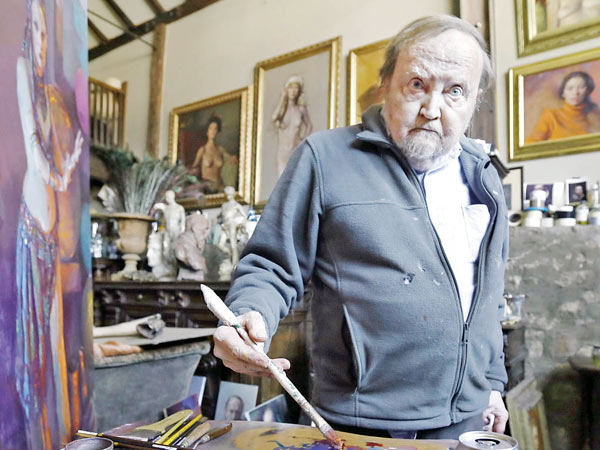
A “fick” is an individual isn’t just unethical, shamelessly unethical, or openly unethical. Fick is the Ethics Alarms term, created in honor of the horrible Leroy Fick, who is proudly and cheerfully unethical. Fick sightings are mercifully rare, but we have a true giant of the species: Philadelphia portrait artist Nelson Shanks. Shanks, who was the artist commissioned by the Clintons to paint the portrait of Bill that hangs in the National Portrait Gallery, just gave an interview to the Philadelphia Inquirer, and without a gun pointed to he head, told them this:

“Clinton was hard. I’ll tell you why. The reality is he’s probably the most famous liar of all time. He and his administration did some very good things, of course, but I could never get this Monica thing completely out of my mind and it is subtly incorporated in the painting.

If you look at the left-hand side of it there’s a mantle in the Oval Office and I put a shadow coming into the painting and it does two things. It actually literally represents a shadow from a blue dress that I had on a mannequin, that I had there while I was painting it, but not when he was there. It is also a bit of a metaphor in that it represents a shadow on the office he held, or on him.”

Fick.

Bill Clinton chose Shanks for this prestigious task, paid him, patronized him, posed for him, and trusted him. And Shanks not only does this trick with the dress shadow, which is bad (making a disguised uncomplimentary reference to a career scandal in an official portrait is a betrayal of the subject whether it is discovered or not —See Rationalization #10, The Unethical Tree in the Forest, or “What they don’t know won’t hurt them.” ), but then makes his conduct public, instantly transforming the portrait from an honor into an indictment. He was not hired to paint an indictment.

Fick

He is using this now to his own advantage, gaining fame and name recognition, possibly enhancing the value of his work, definitely increasing interest in the painting itself. He knows there will be TV interviews and controversy; he knows enemies and critics of the Clintons, Republicans, and many of those–like me— who find Bill Clinton’s continued currency among Democrats, women and feminists infuriating will applaud him, defend him, and even reward him in various ways.

Fick.

He knows what he did was wrong, and knows announcing it is wrong. He’s still pleased with himself.

Fick.

________________________

Pointer: Tim Maher

Downton Abbey Ethics: Evil Barrow’s Ethics Lesson

Downton-abbey-season-5

If some of your PBS watching friends are unclear on those essential ethics analysis tools, the concepts of moral luck and consequentialism, the season finale of “Downton Abbey”( which you can view here) provided a wonderful example of both in action.

Now, settle down, because this takes some table-setting: Continue reading

KABOOM! “Hey! Let’s Torture Our Son For His Own Good!”

This was a bad one...

This was a bad one.

I really need my brains right now. I have an intellectual property legal ethics seminar to write, and an aggravating commentary on the ridiculous stand-off over gay marriage in Alabama. And yet there are my brains, scattered all over the ceiling and walls after the first KABOOM! of 2015.

That’s one more reason to be furious at Elizabeth Hupp, Rose Brewer,  and Denise Kroutil, otherwise known (here) as the Cretin Family.  That, and the fact that they are brutal, child abusing idiots. You see, Auntie Denise was concerned that Hupp’s six-year-old son wasn’t sufficiently wary of strangers. Grandma Rose agreed, so with Mom’s approval, they arranged to have a stranger kidnap the child, imprison him, and terrorize him.

Followed by a stern lecture.

Let me know when your head blows up as I relate this ridiculous/horrible/unbelievable but true story. Continue reading

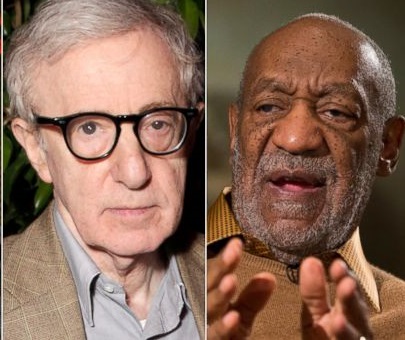
No, There’s No Comparison Between Bill Cosby And Woody Allen And No “Double Standard”

One of these things is not like the other....

One of these things is not like the other….

Newspapers should make us more informed and smarter, not less informed and dumber. Thus a Washington Post feature this morning qualifies as journalism malpractice, incompetence exemplified. Its theme: “Gee, why is Woody Allen signing a new deal to do a streaming comedy series for Amazon, while Bill Cosby lost his deal with NBC?” The print edition sub-heads: “Crisis responses may explain…”

No, they don’t. This is a false comparison based on superficial similarities: two comics who initially peaked in the same era, both in their seventies, shadowed now by sex scandals. The effort to use one to question the treatment of the other is either intellectually dishonest or so analytically unsound that it should forfeit the authors’ privileges of being assigned to write anything for mass consumption (the Post piece is by Stephanie Merry and Amy Argetsinger, and shame on them). The question of why Allen and Cosby are being treated differently in the court of public opinion isn’t worth asking, but since they asked, here are the obvious answers:

1. Woody Allen’s art, comedy, and persona have never had anything to do with virtue, stable families or being any kind of a role model. As a performer, he has presented himself as perpetually horny, neurotic, obsessed with sex and masturbation, prone to lying, and open to adultery, betrayal, stealing friends’ lovers; in “Manhattan,” he happily romanced a virtual child. In real life, he says things like “The heart wants what the heart wants,” which is a  rationalization for any act unethical or illegal, involving sexual or romantic desire. If you were ever a fan of Woody Allen after the age of 13, you were so because he was funny, accepting the fact that he is at best a sexually obsessed, maladjusted creep.

None of this is true of Cosby, who has always aimed his comedy at innocence, functional families and traditional virtues, and represented his own values as consistent with these when speaking for himself. Sex was not any part of Cosby’s art or image. He was an iconic good guy. Continue reading