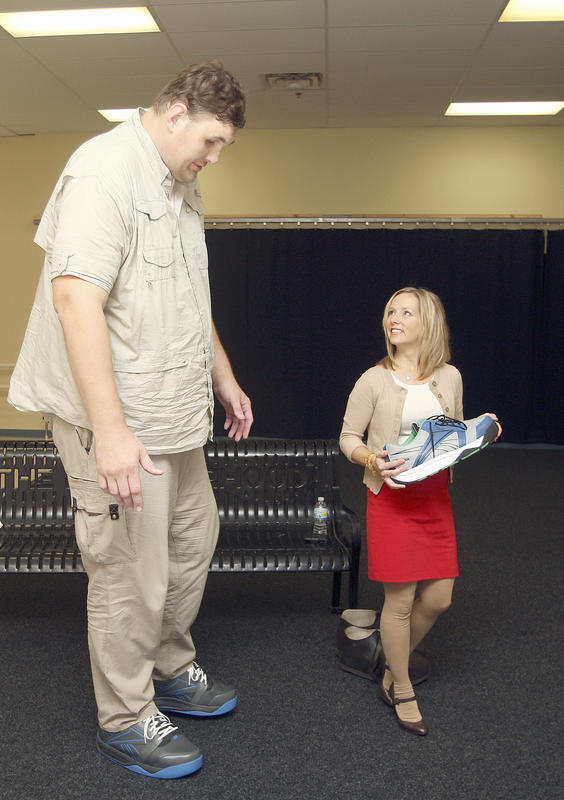
Ethics Hero: Reebok

Of course it’s for publicity.

The woman is 6’2″. OK, she’s only 5’1″, but still: that’s one big shoe..

Sure it’s marketing. Certainly it contributes to Reebok’s prestige and good will, and will help sell its shoes.

Never mind. There are many ways that the athletic sportswear company could have promoted itself without helping someone who desperately needed it. Instead, it made three free custom pairs of size 24, 10E sneakers for Igor Vovkovinskiy, the tallest man in the U.S. He was suffering, and now he can walk without pain.

The 7’8″ Rochester, Minnesota man had undergone 16 foot surgeries in six years because he could not find shoes that fit his giant feet.  Reebok heard about his plight and decided to help him. The special shoes took months to manufacture, and each pair would have cost about $15,000 if Igor had to pay for them. In fact, he was taking contributions to help him afford pain-free footwear. Now, he says, he can finally walk again

Capitalism doesn’t have to be ruthless and cold. It just needs to be creative, and pay attention. It is possible to maximize profit and still do good for people along the way, sometimes with the very same act.

Good for Reebok, and good for Igor Vovkovinskiy. Capitalism at its best.

_______________________________

Facts : New York Daily News

Graphic: Star Tribune

Unethical Feature: “Top 10 People Who Don’t Deserve To Be Millionaires”

And leave Bubbles alone.

I know: it’s a feature, it’s a gag, it’s not meant to be taken seriously. I don’t care: the underlying attitude behind The Daily Caller’s recent slideshow, “Top 10 People Who Don’t Deserve To Be Millionaires” is too common these days to be emulated, even in half or whole jest. The belief that citizens of the U.S. “don’t deserve” to have the money they do is at the root of toxic politics, bad economic policy, class resentment and self-excused jealousy, and it shouldn’t be encouraged. If there is a genuine and persuasive argument to be made that people don’t deserve the money they earn, then make it, and you have to do better than “you didn’t build that!”

Taylor Bigler, the Caller’s entertainment editor who compiled the list, doesn’t. She just appeals to jealousy, as if nobody really really does resent people who have made more money than they have so its fine to pretend they do. “Now, some people are millionaires because they are ambitious and kept their noses to the grindstone,” she says. “Those people certainly deserve their hard-earned success. But honestly, there are many other people who are millionaires that simply don’t deserve to be.” Like? Continue reading

Marketing the Glock and Corporate Social Responsibility

Dr. Chris MacDonald has a thoughtful post on this topic on the always excellent Business Ethics Blog. “The social benefits of selling handguns may be fundamentally contentious; in other words, reasonable people can agree to disagree,” he writes. “But I doubt that the same can really be said for marketing moves designed, for example, to foster the sale of high-capacity magazines (ones that hold 33 bullets instead of the usual 17).”

You can read the whole article here.

Gallup’s 2010 Ethics Poll: Little Trust Where We Need It Most

As it does periodically, Gallup has released the results of its surveys to determine what professions Americans regard as ethical, and which ones they don’t. Gallup notes that there has been very little change over the last two years; on its site, it compares the results to those of polls taken from 2004 to the present.

The professions that have positive ratings from the public are nurses, the military, pharmacists, grade school teachers, doctors, police, clergy, judges, and day care providers.

The rest are in the red, trust-wise, with TV and newspaper reporters coming in below auto mechanics and bankers, lawyers below them, business executives even below lawyers, and well below them, Congress, which comes in barely above car salesmen—and more people actually have a low opinion of Congress members than of car salesmen. Congress inches ahead because a larger number also think that members of Congress are ethical.

Probably federal workers… Continue reading

So Much For “Don’t Be Evil”: YouTube and Google Ethics on Display

The Business Insider has posted evidence gathered by Viacom in its lawsuit against Google, consisting primarily  of e-mails and instant messages. It is far from conclusive on the legal issues, which revolve around YouTube and Google’s unauthorized use of copyrighted material. It is very conclusive, however, regarding how often any ethics alarms went off with various Google and YouTube executives as they contemplated bottom line issues: rarely.

Here is a startling example.  In a 2005 e-mail exchange YouTube co-founder Steve Chen reasoned thusly: Continue reading

NPR Shows How Bad Opinions Get Made

Dan Ariely is a behavioral economist at Duke University who struck gold with his Malcolm Gladwell-esque airplane book, Predictably Irrational. The book discussed his work in human behavior and how apparently irrelevant or minor factors affect our behaviors in significant and surprising  ways. I like the book, and I like Professor Ariely, but I now suspect him of using the American public as his guinea pigs for Best Seller #2,  and of rigging the experiments in the process. Continue reading

Ethics Quote of the Week

“A lot of our folks have second and third homes and alimony payments and other obligations that require substantial current cash.”

—-A banker quoted anonymously by Stephen Brill in his essay, “What’s a Bailed-Out Banker Worth?” in the Jan.3  New York Times Magazine. The article discusses that financial industry’s rationale (or rationalizations) for its compensation culture.