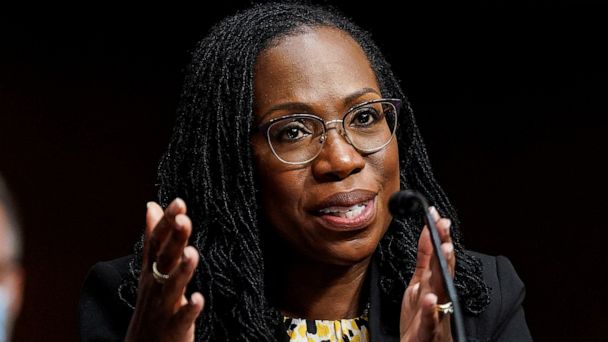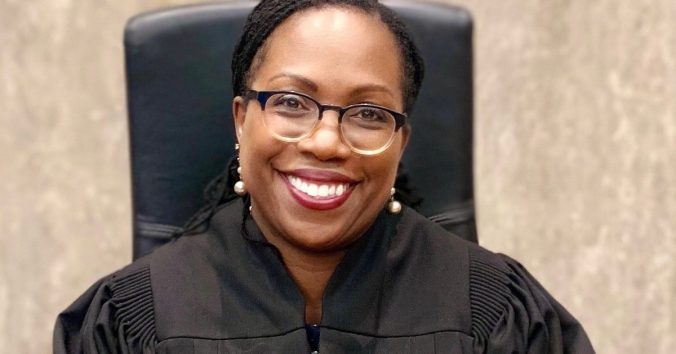
Judge Ketanji Brown Jackson Pledges To Recuse Herself From The Harvard University Affirmative Action Case

And that, as they say, is that.

I was wrong, Prof. Turley was right. He was certain that Jackson would recuse from the case because of the screaming conflict she faced by sitting on Harvard’s Board of Overseers. He wrote,

“It would be profoundly inappropriate for a jurist to sit on a case for a school in which she has held a governing position and a role in setting institutional policies. This would be akin to a justice sitting on a case on oil leases for Exxon while being a member of the oil company’s board of directors.”

I wrote, “That’s exactly right. But I bet Jackson doesn’t recuse.” Continue reading

Integrity Test: Judge Ketanji Brown Jackson Will Be Conflicted Out Of The Harvard Affirmative Action Case If She’s Confirmed. Which Progressives Will Have The Ethics To Say So? [Corrected]

And will she?

Stipulated: Judge Jackson is a fully qualified choice to succeed Justice Breyer on the U.S. Supreme Court. Also stipulated: she should be and will be confirmed and by a large majority, unless Republicans are as petty and foolish as I think they are.

However, the soon to be Justice Jackson has an unwaivable conflict of interest in the contentious Harvard admissions case, which I would term a “scandal.” Harvard unambiguously discriminates against Asian-American applicants to inflate the numbers of lesser qualified black and Hispanic students admitted to the college. In the era of The Great Stupid, when racial discrimination is treated as “antiracism,” this SCOTUS case is a high profile and significant one, and Future Justice Jackson has a dog in the hunt, as they say. Jackson serves on Harvard’s board of overseers, one of the University’s two governing boards. The board plays “an integral role in the governance of the university.” End of controversy. She’s integrally involved with a party in the case. It is a classic conflict, and cause for recusal. Continue reading

“Ethics? What’s Ethics?” Mayor Adams Takes The Reins…[Updated!]

Next time a New York Democrat complains about an elected government official’s ethics when he or she identifies as Republican, breaking out into uncontrollable laughter would be appropriate.

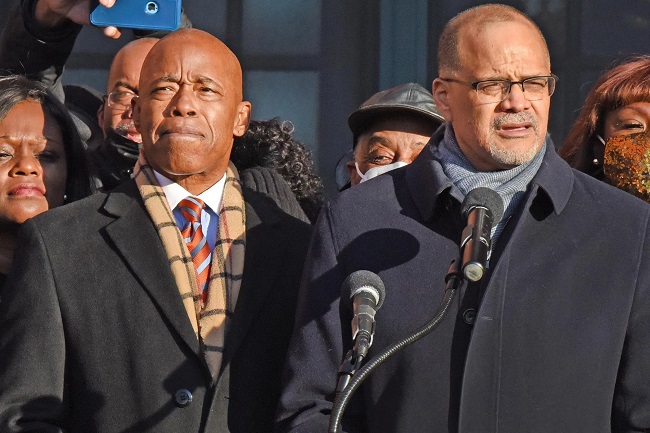
New New York City Eric Adams, elected as the “anti-de Blasio,” almost immediately proved that he has at least one thing in common with New York’s “Worst Mayor Ever.” Just a few days ago, Ethics Alarms noted that the former mayor had defiantly continued to ask corporate contractors for the city to contribute to a de Blasio slush fund, in a time honored unethical shakedown ploy known as “pay to play,” even though he had been formally warned to cut it out by the city’s ethics board. Now the new improved mayor is also signalling that he isn’t very concerned about ethics, the appearance of impropriety, or conflicts of interest.

Adams appointed as his sole male deputy mayor (the other five are female) Philip Banks III, who comes with some interesting baggage. (That’s Banks above on the right, the new mayor is on the left.)

Continue reading

Ethics And Those Wacky Cuomo Boys, 2: Andrew And His Book

Chris’s scandal may be more embarrassing, but Andrew’s latest problem may be more expensive.

In July 2020, then-New York Governor Cuomo, riding high in the public eye, asked the state ethics panel for permission to write a book about his leadership during the pandemic.

I must interject here that such books are virtually always unethical, often in multiple ways. I say “virtually” because there really may be some instance, buried deeply in the sands of time, when a book written while a popular elected official (or a First Lady) was in office and published with that official’s name as the author was really written by the official in his or her spare time, wasn’t just a government-funded campaign and propaganda tool, and also didn’t provide a way for supporters both individual and corporate to launder contributions. Maybe, but I doubt it.

For one thing, if an elected official spends any time at all writing a book during his or her work day, he or she is getting paid by taxpayers to do work that primarily benefits the official. Books are hard. Books take time. Trust me on this, I’ve co-written one, and would have five more (I have the titles and outlines!) out there if I could get out of my own way. But my time is my own: I don’t bill clients for writing this blog, and any time I spend writing a book is time I don’t get paid for. Governors, like Presidents, are paid to be on-duty every waking hour.

Continue reading

Ethics And Those Wacky Cuomo Boys, I: Chris And CNN [Updated!]

Really, how can anybody be surprised?

Transcripts released yesterday revealed that CNN host and beefcake star Chris Cuomo actively worked with his brother’s aides to defend then Gov. Andrew Cuomo from the many sexual harassment accusers whose accounts eventually forced the Governor to resign. Chris Cuomo. aka. “Fredo,” had looked in America’s face—you know, like Bill Clinton when he said he never has sex with “that woman”—in August and assured it that he ‘never made calls to the press” on behalf of his brother. But New York Attorney General Letitia James’ report revealed texts where Chris told aide Melissa DeRosa he would take up the allegations with his “sources,” and offered to help draft statements for his brother’s team. Cuomo used his CNN contacts dig up information about his brothers’ his accusers, presumably to discredit them. Another revelation in James’ documents was that Cuomo was working through a friend to approach actor Alec Baldwin about making a video defending Andrew.

In summary, Chris Cuomo used his contacts, sources and influence as a CNN journalist to actively assist an elected official, indeed to assist an official in avoiding the consequences of illegal acts. This is, duh, wildly unethical, unprofessional, and a breach of trust with both CNN and the public. Apparently it is even so unethical that other unethical journalists of the Left, who are usually hesitant to throw stones at fellow propagandists and fake news purveyors from inside their glass houses, have pointed their fingers at poor Chris like pod people identifying their next target for assimilation.

Continue reading

Ethics Pre-Daylight Losing Time Fallback, 11/6/202: So?…Go!…Oops! And More

Fall back

At this point in U.S. history, there is no justification whatsoever for not having daylight savings time year-round. The failure of Congress to kill Ben Franklin’s anachronistic brainstorm is pure cowardice and incompetence.

1. So? The NRA Foundation has twice paid attorney David Kopel, a Second Amendment activist, to write pro-gun rights amicus briefs in Supreme Court cases, according to a hacked document released last week. Since 2019, Kopel has submitted two briefs backing an NRA affiliate in cases before the court, including one involving New York’s ban on carrying licensed guns in public. The briefs did not disclose the source of funding, which is being condemned as unethical by the news media and the usual NRA bashers. “Attorneys who author these briefs must disclose whether they’ve taken money from either side to deliver a filing,” one source says.

Well, first of all, an amicus brief succeeds or fails based on its arguments, and who writes it or funds it should be irrelevant. This would be, at worst, a technical violation. However, the applicable rule in the SCOTUS amicus brief memo does not support the description above. “Rule 37.6 Disclosures” states,

“The first footnote on the first page of text of an amicus brief must include certain disclosures concerning contributions to the brief….It should indicate whether counsel for a party authored the brief in whole or in part and whether such counsel or a party made a monetary contribution intended to fund the preparation or submission of the brief. It should also identify every person other than the amicus, its members or counsel, who made such a monetary contribution; the Clerk’s Office views it as better practice to state explicitly that no such contributions were made if this is in fact true.”

This is astoundingly sloppy drafting, especially for the Supreme Court. “Must” and “should” are terms of art. “Must,” like “shall,” means some action is mandatory; “should” means that something is best practice, but not absolutely required. When two “shoulds” follow a “must,” it is impossible to determine what’s mandatory and what isn’t.

Continue reading

Ethics Dunce: U.S. Attorney General Merrick Garland

This video, from Garland’s testimony before the House Judiciary Committee, tells you everything you need to know, but I have a bit to add…

Observations:

Continue reading

Now THIS Is The Appearance Of Impropriety…

impropriety

The big legal ethics story of the day is a Wall Street Journal report showing that 131 federal judges, appointed by nearly every President from Lyndon Johnson to Donald Trump, have violated federal law by failing to recuse themselves in cases where either they or family members held a financial interest in one of the parties, meaning that the judge’s decision could have resulted in a direct or indirect benefit. This is, of course, a conflict of interest. Even if the judge was as trustworthy as a saint and would never dream of allowing such a conflict to interfere with his or her judgment, allowing these cases to appear before them violates the judicial ethics canon requiring judges to avoid even the appearance of impropriety.

The Wall Street Journal report found that the judges failed to recuse themselves from 685 court cases since 2010. About two-thirds of all federal district judges had holdings of individual stocks, about one of every five of these heard at least one case involving those stocks without withdrawing. When these judges participated in such cases, about two-thirds of their rulings on motions favored the party that their or their family’s financial interests would benefit from prevailing.

Continue reading

If This Post Seems Like Déjà Vu, There’s A Good Reason: The Texas Law Clerk-Prosecutor [Update]

Justice scales bad

UPDATE: “I don’t understand how this could happen. Since it obviously can, I wonder how many other outrageous conflicts of interest are rotting the justice system while nobody is paying attention.”

That’s how I started this post when I wrote it yesterday. Here’s how I ended this post, from May 17, just four months ago: “…the fact that something like this could happen at all, and for so many years, should have ethics alarms sounding throughout the justice system, and not only in Texas.”

This is because the two posts are about exactly the same episode. The similarities didn’t ring a bell with me at all yesterday. A new appellate court opinion related to the same outrageous Texas conflict of interest breach came down this month, so I treated the whole episode as new. It took commenter Rich in CT’s note to alert me. (Thanks Rich.) So here are my thoughts while banging my head on my desk:

  • I apologize. It’s not as if there aren’t really new and horrible ethics stories to consider, especially in the law and the justice system. It’s OK if I waste my time, but its inexcusable to waste yours.
  • I like the first post better.
  • Silver lining: at least the posts don’t contradict each other.
  • The association of legal ethicists I belong to scooped the ABA on this one, discussing the prosecutor’s conduct long before the legal press caught up to it. One more reason to renew my membership.
  • I could write that this scandal is so outrageous that it is worthy of two posts, and maybe more. It is, but that doesn’t excuse the fact that I’m an idiot.
  • I think this has happened to me once before. But what do I know?

Once again, I’m sorry.

***

The Texas Court of Criminal Appeals has overturned the 2003 conviction and death sentence of Clinton Lee Young in a Sept. 22 opinion. Why? Oh, just one of those technicalities: on of the prosecutors in the case was moonlighting as a a clerk for the judge in the trial the trial and who considered the the convicted man’s habeas application. That’s all.

WHAT?????

Continue reading

The Category Is “Jeopardy Ethics”! And The Question Is: “Who Is Mike Richards?”

Mike Richards

If you need another bit of evidence about how social media wastes our time—and why would you?—consider the uproar over the search for a replacement for Alex Trebek. The original “Jeopardy!” host, Art Fleming, was popular too, and he hung around for 11 years. That was sufficiently long to be briefly legendary; the “Jeopardy!” announcer, Don Pardo, was familiar enough that Saturday Night Live! used him and his unique voice as a running joke for decades. But when Fleming retired, there was no controversy over his replacement, because, seriously, who cares who reads the questions and answers in a quiz show, unless they have a speech impediment or sexually harass the contestants, like Richard Dawson on “Family Feud”? But in the Age of The Great Stupid, everything is a big deal.

After months of celebrity tryouts, kind of like Presidential primary debates, “Jeopardy!” has finally chosen two replacements for the late Alex Trebek. The actress formerly known as “Blossom” and later as Sheldon’s girlfriend on “Big Bang Theory,” Mayim Bialik, will host the prime time version and its spinoffs. Can’t wait for those spin-offs! Bialik is legitimately smart and knowledgeable, and not just compared to other performers: she has a PhD in neuroscience from UCLA. She also, like most successful TV actors, projects a likable personality. And, of course, she’s a woman. I assumed a black host would be found, but Steve Harvey’s already taken.

The kerfuffle is over Trebek’s replacement for the main, daily syndicated edition, which has been around since 1984. The show’s current executive producer, Mike Richards got the job. Richards was not one of the more popular auditioners, but he had one thing the rest didn’t have: the power to choose who got hired. He thought, and thought, and chose…himself! This suggests that the process was rigged.

Continue reading