
Afternoon Ethics Flotsam And Jetsam, 9/16/2019: Ethics Movies, Clowns And Harvard Professors

…As I prep for a CLE road trip…

1. I finally saw “Doubt,” the film adaptation of the John Patrick Shanley stage drama about a parish priest suspected of child abuse. It’s an ethics film, and unlike many ethics films, made a profit at the box office.

I had seen the play on stage, and found it didactic and contrived; the film did not, I’m sure because the cast was so excellent. Meryl Streep, Viola Davis and Phillip Seymour Hoffman as the priest were all wonderful, especially Davis, whose single scene in which she runs down a series of desperate arguments and rationalizations to justify allowing her son to be molested—maybe—is an ethics cornucopia. Unlike the stage production I saw, the movie benefits by having its protagonists appear less sympathetic than its apparent villain.

This goes on the ethics movie list, which is due for an update.

2.  Yet another ethics movie of more recent vintage is 2019’s “The Challenger Disaster,” a fictionalized recounting of how the decision was made to allow the doomed space shuttle to launch despite the warnings of Morton Thiokol engineers.  I wrote about this depressing ethics case study here , in a tribute to the primary Cassandra in the tragedy, Roger Boisjoly, and here,  about his troubled colleague, Bob Ebeling. The film’s hero appears to be an amalgam of the two. Here is an excerpt from a review on The Engineering Ethics Blog:

Even if you are pretty familiar with the basics of the story, as I was, the film is almost agonizing to watch as the launch time draws closer….The focus is always on Adam [the fictional hybrid of the engineers opposing the launch]: his belief going in that the truth is always a sufficient argument (it’s not, as it turns out), his doubts that he’s done enough to stop the launch, and his retrospective descriptions of what went on in the hours leading up to the launch…. the generally underlit atmosphere symbolizes Adam’s darkening mood as the critical conference call comes and goes, and the decision is made to launch. After Adam drives home that evening, he just sits out in the driveway in his car until his wife comes and gets into the seat beside him. …Later, during the  hearings that Adam and his fellow engineers attend, they come forward out of the audience and interrupt the proceedings after they hear a Morton-Thiokol manager lie about his knowledge of the seal problem. After the hearing, a sympathetic commission member finds Adam and reassures him that there are whistleblowing laws to protect him from repercussions of his testimony.

While it is never good to kick a man while he is down, I wish the film had taken time to show in more detail the intensity of the ostracism that forced the real-life Boisjoly to resign from Morton-Thiokol after his participation in the hearings made him persona non grata at work. … Boisjoly made a new career out of giving talks to engineering students about his experiences. …For a complex, historically accurate, and thought-provoking take on the Challenger disaster, I cannot think of a better medium than “The Challenger Disaster”  for conveying the seriousness of the emotion-laden decisions that have to be made at critical times. It is not a fun movie, but it’s a good one. And I hope it does well in video-on-demand release, because engineers need to see it.

Also lawyers, doctors, corporate executives, military officers, government officials, journalists, students… Continue reading

Morning Ethics Warm-Up: 7/23/17

Good Morning!

1. Not a single comment on yesterday’s sole warm-up topic, the propriety of complimenting someone’s physical appearance or features? That’s fascinating.

2. I had to wrestle my fingers to the ground yesterday to avoid writing a full post on this editorial by the New York Times editors. I know everyone is sick of Ethics Alarms pointing out the relentless, unprofessional anti-Trump bias in the news media, because I’m sick of  writing about it. This may have been a new low, however. In the wake of Sean Spicer’s resignation as White House press secretary, the Times unleashed the equivalent of a mean playground taunt.  To read it, one would never guess that the Times had ever experienced any other press secretaries, especially President Obama’s trio of Robert Gibbs, Jay Carney and Josh Earnest , who were uniformly dishonest with disgraceful regularity. Spicer was a “four Pinocchio” spokesman? The standrad term her for Obama’s press lackies was “paid liars,” and the description was fair. Yet the Times didn’t greet the news of any of their withdrawals for the post with “Nyah nyah nyah you suck!” editorials, because the New York Times accepted that President’s lies and deceptions as designed for the greater good.

Of course, it was exactly this unethical journalistic bias that caused Spicer to adopt the attitude that most prompted the Times to attack him personally on his way out the door. He believed that journalists who don’t behave like journalists need not he respected as journalists, and he was absolutely correct in this. Indeed, no newspaper that isn’t able to discern that an editorial like the one yesterday regrading Spicer makes it look like a partisan hackery shop should be respected at all. Spicer was a really bad spokesman—inarticulate, inept, dishonest and not very bright. Nonetheless, he was trying to do a difficult job, did his best, and was no more nor less awful at it than all but a few Presidential press secretaries over the last half century or so. Only Spicer, however, was deemed deserving of such insults at the end, not even Ron Ziegler, Nixon’s complicit press secretary who looked and sounded like a half-successful laboratory clone of his boss. That is because the Times’ editorial was personal, based on emotion and anger, and an ethics alarms void.

3. This story from Canada reads like it was designed to illustrate the folly of giving government more power over our lives rather than less. Continue reading

Ethics Hero: Richard Dawkins

The headlines shout out: “World’s Most Famous Atheist Admits: I Can’t Be Sure God Doesn’t Exist!”

Wow, what a confession. Stop the presses.

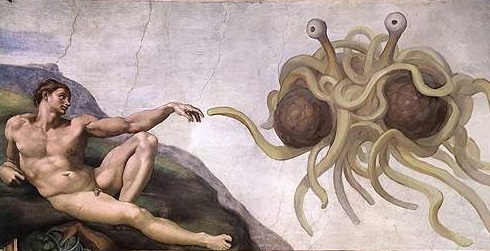
Can anyone be 100% sure this doesn't belong in the Sistine Chapel?

To his great credit, and knowing how the 50% (that is, those of below median intelligence, a sad number of whom reside in the profession of journalism) would react, Prof. Richard Dawkins, the British evolutionary biologist who is point man for the atheist assault on religion, told a student audience at Oxford during a “discussion” ( translation: informal debate) with the Archbishop of Canterbury that he thinks “the probability of a supernatural creator existing is very very low,” but he can’t be 100% certain.

Well, of course not. While this will be taken as a sign of weakness by the faithful who, of course, are 100% certain of the Supreme Being’s existence, no honest, intelligent, fair individual suffering from less than clinical levels of egomania and omniscience could possibly claim to know with certainly where the universe came from. Bravo to Dawkins for his honesty and integrity.