Ethics Poll: The Amityville Kidney

"Wait---you're going to put THAT  inside me???"

“Wait—you’re going to put THAT inside me???”

In the comments to the post The Kidneys of Orlac, Texagg04 raises a fascinating angle that I had not considered. I have previously written, regarding state regulations that do not require realtors or sellers to disclose that a grisly murder or six occurred on a property, that a purchaser has the right to know about such conditions that may bother him personally, and that regardless of the laws involved, there is an ethical duty inform  a potential purchaser know that he is buying the site of the Amityville Horror (for example). Texagg04 suggests..

“Much like real estate agents ought to reveal that a house had a grisly murder in it, I’d submit that recipients of organ donations of this kind should get to be informed of the donor’s convictions.”

Hmmm. I’m not so sure. One of the reasons for my views about the death houses is that they may be difficult for the uninformed buyer to sell later if the home’s history is known or becomes well known. Also, there are always alternatives to buying a particular house—given a choice between the site of a murder and a similar house with no such history, I might opt for the latter—I’ve seen too many of the “Paranormal Experiences”  and “The Grudge” movies, I guess. But with donated organs, the options are more limited. Maybe not telling the recipient that he has the heart of the Green River Killer is the fair and kind thing to do.

Let’s vote!

If You Are Surprised To Learn That “No Animals Were Harmed During The Making Of This Film” Doesn’t Mean That No Animals Were Harmed During The Making Of The Film, Then You Havn’t Been Paying Attention To The Ethical Culture In Hollywood

"OK, the tiger almost drowned. No harm, no foul, right?"

“OK, the tiger almost drowned. No harm, no foul, right?”

Hollywood abuses its child actors routinely, and you really believed it was kind to animals?

Today the Hollywood Insider carries a thorough exposé revealing that the American Humane Association, which supposedly monitors films for their treatment of  animals and grants the familiar“No Animals Were Harmed” trademark accreditation seen at the end of film and TV credits, participates in the covering-up of animal deaths and cruelty as much as it prevents them. The report suggests that the AHA  has been thoroughly co-opted by the industry, so that it is not an objective advocate for the creatures it supposedly represents, but a willing participant in audience deception.

The smoking gun quote may be this one, from Dr. S. Kwane Stewart, the veterinarian who took over as the national director of the AHA’s “No Animals Were Harmed” program in April:

“This whole idea that we’re cozy with the industry — it’s simply not the case. We first and foremost want to keep the animals safe…[but] we need to keep in mind that [the producers and directors of productions the AHA monitors] want to arrive at their vision as well.”

This means, of course, that the AHA representatives are not acting as an advocate for the animals, but as a participant in the film-making process that balances the lives and welfare of the animals against the concerns, needs and profit motives of the speaking, spending, threatening and otherwise powerful human beings with which they share a species and common values. Gee–I wonder who has the most weight in reaching that balance… Continue reading

“Would You Rather”: An Ethics-Horror-Health Care-Dinner Party In Hell Movie You May Have Missed

“Would You Rather” is an odd 2012 film that sets up a film-long set of unlikely ethical dilemmas for its characters to solve. Desperate to save her dying brother with expensive medical treatment she can’t afford, the heroine (played by Brittany Snow) finds herself at a dinner party with seven other desperate strangers, hosted by a wacko family of millionaires who will help one of them after the others have been “eliminated” during the course of the evening. As what is described as a game progresses, each contestant is put through escalating rounds of risk, pain and torture in which they must make various Sophie’s Choices, such as…

  • Would you rather administer a painful shock to yourself with high-voltage electricity, or the person next to you? What if that person has been weakened by a previous shock? What if she is in a wheelchair?

My JFK Ethics Tale

 Shredded Files

As regular readers here  know, I am not an admirer of the character of John Fitzgerald Kennedy, though he had some notable leadership skills that I respect. His reputation as a great man and President is vastly inflated and, in a strange way, I may share some of the responsibility for that.

Several years ago, I had just completed an ethics seminar for the DC Bar. One of the issues I discussed was the lawyer’s ethical duty to protect  attorney-client confidences in perpetuity, even after the death of the client. An elderly gentleman approached me, and said he had an important question to ask. He was retired, he said, and teased that I would want to hear his story. I don’t generally give out ethics advice on the fly like this, but I was intrigued.

“My late law partner, long before he began working with me, was Joseph P. Kennedy’s “‘fixer,'” he began, hooking me immediately. “Whenever Jack, Bobby or Teddy got in trouble, legal or otherwise, Joe would pay my partner to ‘take care of it,’ whatever that might entail. Well, my partner died last week, and when I saw him for the last time, he gave me the number of a storage facility, the contract, and the combination to the lock. He said that I should take possession of what was in there, and that I would know what to do. Continue reading

In Search Of Ethical Pop Songs

It was around this time last year that Ethics Alarms expanded its list of the top Hollywood movies with ethical lessons and themes to 25. (You can find the complete collection here, here, here and here.) I am researching a similar list for popular songs, and this task is far more difficult. Most pop songs, if they have a story at all, convey unethical lessons and cautionary tales: exemplary ethics are not, apparently, the stuff hits are made of.

I am soliciting nominations. To get you started, here are two on my list, both oldies. The first is “Ringo,” one of those talking songs like Jimmy Dean’s “Big John” (also a candidate for the list), performed by Pa Cartwright himself, Lorne Greene. The ethical values shown in this Western tale are kindness, reciprocity, loyalty, and gratitude:

My second nomination is one of several sound-alike hits from Gary Puckett and the Union Gap. In this song, Gary illustrates an understanding of Restraint Bias—none of us is as resistant to temptation as we would like to believe. The song is about responsibility. (I don’t think Roman Polanski was a fan of the Union Gap).

I await your playlists.

Ethics And “The Rifleman”

If you want to ground your child in basic values and ethics, buying the new DVDs (available next month) with all 168 half-hour episodes of “The Rifleman,” the classic Western TV series, is a good way to start. I’ve been watching episodes recently (they are currently showing on both AMC and Starz), and am struck by how virtually every one has a strong ethics lesson to teach, and teaches it well without interfering with the drama. Most of the TV westerns from the genre’s Golden Age (which had already ended before the demise of “Bonanza,” the last of the great ones) had strong ethical values embedded in their plots, but few made ethics as thematic as the show starring Chuck Connors as a single father, living on the prairie in the 1880s, who used his Winchester rifle the way other cowboys used a pistol, but faster and with more accuracy.  Because Lucas McCain was trying to survive while teaching his young son (played by original Mousekateer Johnny Crawford) how to be a good man and citizen, he was always striving to be a role model while solving the difficult and often dangerous problems that came his way. Unlike many Western heroes, McCain didn’t always get it right, sometimes letting his emotions get the better of him or being unfair or impetuous, and had to undergo an ethical course correction by the end of an episode.

A repeated theme in the show was redemption and trust, as McCain often became the champion of a fallen woman or reformed criminal, or had to rely on an ally with a less than sterling past.  Villains in “The Rifleman” sometimes saw the error of their ways at the last second, committing a noble act before dying or going to jail. And sometimes they didn’t, and got shot with the Winchester. I’m sure that “The Rifleman,” with its gun-happy opening sequence (it presents the rifle as the star of the show as much as Connors) will seem like an unlikely source of ethics to the gun-queasy parents out there, and that is a shame. There is much to learn from “The Rifleman.”

You can watch some episodes of the show herehere and here. The catchy theme music is here; I was surprised to discover that it had lyrics, which by the standards of the generally terrible lyrics of westerns that had songs that were actually sung on a show, aren’t too bad. The best of its endless verses:

                           
THERE IS A MORAL TO HIS EXPLOITS                         

AND HE’S TAUGHT IT TO HIS SON

SPEAK SOFTLY TO YOUR ENEMY

BUT LET HIM SEE YOUR GUN!

Chorus:             

THEY CALL HIM THE RIFLEMAN
THE STRONG, COURAGEOUS RIFLEMAN
A GREAT BIG MOUNTAIN OF A MAN!


___________________________________

Sources: Wikipedia, The Rifleman, Chuck Connors,

Workplace Ethics: 62 Things That Are Legal, But 22 Of Them Are Unethical

"Oh, sure, he's hell to work for, but he never breaks any laws, so you'll be fine."

“Oh, sure, he’s hell to work for, but he never breaks any laws, so you’ll be fine.”

I have been remiss in not adding the terrific blog Evil HR Lady to the Ethics Alarms links, and will finally do so as soon as I post this entry. No profession deal s with ethical nuances and dilemmas more frequently than human resources professionals, and they can be very difficult, even gut-wrenching. In a recent post, EHRL searched through the archives of questions she has answered over the past years, and compiled an eye-opening list, especially for non-lawyers, of the conduct employers could engage in legally, which is to say, get away with and not be successfully sued, to employees, together with some questionable kinds of conduct that are legal for employees to do to each other.

She listed 62 of them, many of which are reasonable ( it’s okay to fire an employee for “being a jerk”) and some are obvious, or should be;  it is legal to quote the Bible in the office, for example. What is legal is not always good, fair, or right, however, and I perused the list with an eye out for legal workplace conduct that was legal but still unethical. About a third of the types of conduct on the Evil HR Lady’s list made mine. What follows is the sub-list of the 62 things it is legal to do at work, the 22 things it may be legal to do at work, but which are still unethical. The reasons for my unethical verdict follow Evil HR Lady’s items.

Here’s the list of the unethical 22 workplace practices: Continue reading

Ethics Quote Of The Week: Sportswriter Joe Posnanski

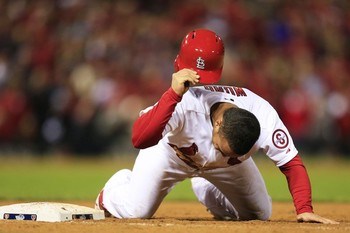
Picked off first, Kolton Wong curses the fates...

Picked off first, Kolten Wong curses the fates…

Just as baseball’s post season was starting, I wrote a post about how U.S. society’s flawed use of consequentialism to judge merit, wisdom and ethics is encouraged by our sporting events. The example I used was an old one, from the 1968 World Series, which I consider to be a classic and extreme example. This morning, the great sports essayist Joe Posnanski addressed the same issue, focusing on an event in last night’s weird World Series game, which ended like none other in post season history. With two outs and the potential tying run at the plate, Boston relief pitcher Koji Uehara picked off St.Louis pinch-runner Kolten Wong to end the game and stop the Cardinals’ most dangerous sluggers from batting with a chance to tie or win the game. Posnanski marvels at how what he considers a foolish decision to station the first baseman near the base for a pick-off throw had good results, and how hard it is for us to focus on process rather than results. He is, of course, talking about the appeal of consequentialism, and the way baseball encourages it. I beat him to it by almost a month, but Posnanski amplifies the point nicely. Here’s Joe: Continue reading

Case Study: The Botched DP, Baseball, Ethics Evolution, and “Getting It Right”

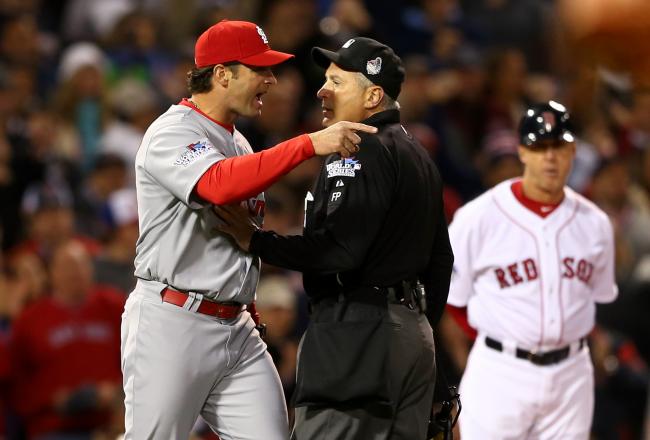
manager-mike-matheny-argues

I know this is a long essay.

Yes, it involves baseball.

Bear with me. I think it is worth your time.

Last night, in Game 1 of the 2013 World Series, embarrassingly kicked away by the St. Louis Cardinals and won handily by some team called the Boston Red Sox,  an intricate ethics drama appeared, allowing us to see the painful process whereby a culture’s ethical standards evolve and change in response to accumulated wisdom, altered attitudes and changing conditions. An obviously mistaken umpire’s call was reversed by the other umpires on the field as the Cardinals manager argued not that the original call had been correct, but that reversing it was a violation of tradition, established practice and precedent….in other words, doing so was wrong, unfair, unethical because “We’ve never  done it this way,” a variation of the Golden Rationalization, “Everybody does it.”   You should not have to appreciate baseball (but if you don’t, what’s the matter with you?) to find the process illuminating and thought-provoking. Continue reading

CBS’s “Blue Bloods”: Endorsing the Saint’s Excuse and Polk County Justice


Time for the department ethics training, Chief. You should sit in on it too...

Time for the department ethics training, Chief. You should sit in on it too…

“Blue Bloods,” Tom Selleck’s New York police family drama on CBS, began as a paean to the core values of public service, nobility, justice, courage and honesty as it chronicled the work and lives of three generations of the Reagan family. The Reagan men are all cops, the one female is a DA, and Selleck is the paternal Chief of Police. Based on last night’s episode, “The Truth About Lying,” series creators Mitchell Burgess and Robin Green have permitted the show’s writing staff to be infiltrated by the Dark Side in its fourth season, and now its calling cards will include the enthusiastic promotion of the abuse of power and the celebration of lying as long as it’s all for a good cause. That’s the Saint’s Excuse, one of the most deadly of the rationalizations, in which “good” people decide that they are empowered to do unethical things in the pursuit of what they believe are worthy goals. The Saint’s Excuse is something of a theme in the United States these days. Now “Blue Bloods” is making sure popular culture spreads the word.

The episode, which you can watch here, was ostensibly about Selleck’s Chief’s efforts to foil the city’s newly appointed “inspector general,” installed in the wake of a “ripped from the headlines” court rejection of an effective “stop and frisk” program by New York’s finest. Continue reading