Your Incompetent, Biased, Lazy, Untrustworthy News Media At Work: A Case Study

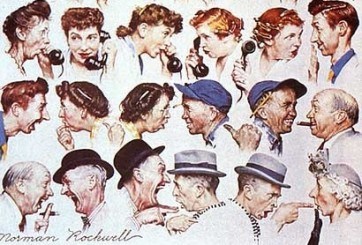
Remarkably, Norman Rockwell accurately predicted how news would be reported in 2013!

Remarkably, Norman Rockwell accurately predicted how news would be reported in 2013!

Last week, the Huffington Post breathlessly reported that McDonald’s could double its workers wages, thus giving them a “living wage,” by raising the price of a Big Mac by a mere 68 cents. This obviously had appeal to the HuffPo’s liberal sensibilities, more proof of how a big corporation was needlessly lining its pockets while exploiting the lowest rungs of the workforce. The “proof” was in a study that had been represented as a being run by a “University of Kansas researcher.” The study results looked so good that the fine progressives at the site just knew it had to be right—after all, it perfectly confirmed their own beliefs. This, I’m sure you have guessed by now, is confirmation bias in its purest form.

The Huffington post writer and editors didn’t check the source, and didn’t check the study. And as some non-biased, at least in the same direction, reviewers quickly found out when they did, neither held up. The “researcher” was an undergraduate (Arnobio Morelix, whose wonderful name alone would have made me want to check him out) , and the “study” might have been a term paper. The paper’s assumptions, conclusions and math didn’t hold up, as is fairly common for undergraduate papers. The Huffington Post had to retract its story, five days later.

Alas, too late! Continue reading →

The Unethical Ploy Of The Blameless, Powerless Agent

It happened again.

Do you ever feel like Jerry when they didn't have his rental car?

Do you ever feel like Jerry when they didn’t have his rental car?

I am always friendly, respectful, kind and generous to people behind desks, windows and counters, unless they engage in a particular kind of conduct that is guaranteed to cause me to be confrontational and critical, and that almost always leaves me feeling simultaneously guilty and infuriated. This is when an agent of a service provider announces, almost always with a smile, that the organization/company/government agency will not be able to do what it has assured me, often for a price, that it would do, or is not able to do it at an acceptable level of quality, or perhaps in the promised time frame. The agent helpfully tells me that I am stuck with the  inferior product or service I bargained for and relied upon, and that yes, it shouldn’t be this way, but it is, so there.

Then, when I express some dissatisfaction with that result, explanation, and most important of all, the absence of any guaranty that I will be compensated or that the organization, while acknowledging its failure, has given any thought to compensating those like me or executing some response in time for my problem to be, if not solved, mitigated, the agent pathetically points out that he or she is just a humble and powerless messenger and that it is cruel of me to persist in expressing my dissatisfaction to him or her, since the agent is neither responsible for the problem nor has any power to fix it.

This is where I lose it.

And it happened again.

My wife and I paid close to $1500 ( in fees only, transportation and lodging not included) for the privilege of attending a national conference of a professional association to which we belong. When we arrived at the site hotel to register and pick up our credentials, badges, tickets and materials, shortly before the opening reception, we were told by a cheery, smiling woman that our name and convention materials were not there. “But we paid for them, and pre-registered,” my wife said. “I got a confirmation. We were told in an e-mail response that the materials for events and programs we designated would be waiting for us here.”

“Ah, then you must have registered on-line after Wednesday,” she told, us smiling. “Unfortunately, we were already here by then, and there was no way for us to make out your package! And you don’t have one of our formal, printed, professional badges that make you look like the member you are, but I’m happy to give you a crappy sharpie so you can scratch out a couple and look like you snuck in instead of paying 1500 buck for the privilege. Isn’t that good enough?” (She didn’t quite say it that way, but that was the gist of it.)

“Well, no, actually, it’s not,” I said.  “Your confirmation said that everything would be ready for us here. It isn’t ready.”

“That was just an automatic response, sir.”

THERE it is! “Don’t blame the owners and programmers of the computer, sir—it’s Skynet’s fault!”  Do not tell me that. Ever. Continue reading →

Ethics Quote Of The Week: Prof. William Jacobson

“The incessant attempt to turn race-neutral phrases into racial testing grounds is part of a larger political war in which race agitators seek to turn everything into a discussion of race all the time in every sphere of life…Equating the race-neutral phrase “brown bag” used in the context of bringing lunch to work with some esoteric past-practice of inter-black skin tone testing is so ludicrous that it may have revealed a chink in the armor of the language police, which can be exploited by the vast majority of Americans of all races and colors who just want to get on with the conversation.”

—–Prof. William Jacobson, deriding yet another outbreak of mind-numbingly ridiculous political correctness word-censorship, an edict against using the term “brown bag” in Seattle, and the unwelcome return of one of the all-time silliest imaginary offenses, a CNBC reporter being criticized for using the phrase “chink in the armor.”

My family thanks you, Prof. Jacobson. This could have been me. And might yet...

My family thanks you, Prof. Jacobson. This could have been me. And might yet…

I (and my loving family, which really, really likes me) need to thank Professor Jacobson, the author of the blog Legal Insurrection, for writing his post about this topic—one I truly hate—-before I learned myself about the “brown bag” memo and especially the unwelcome sequel to the Jeremy Lin “chink in the armor” controversy. For one thing, after a long and infuriating day of traffic jams and car trouble, had I read the reports of these embarrassments to the human species in straight news accounts, some aneurism deep in my brain might well have popped, killing me on the spot. For another, he invested such obvious contempt and exasperation in his excellent post that I don’t have to risk death by working myself into a head-exploding rant-producing fury to do this continuing outrage justice. Jacobson pretty much knocks this hanging curveball right out of the park.

Among other things, he links to his discussions of previous examples of perfectly good, innocent and useful words, idioms and phrases that have been attacked by political correctness fanatics (which, unfortunately, includes a disturbingly large percentage of U.S. Democrats), including such “offensive” terms as black list, “Baa Baa Black Sheep,” rejigger, Providence Plantations, Black Friday, gobbledygook, illegal immigrant, undocumented immigrant, and master bedroom. Inexplicably, the professor left out the grandaddy  of them all and my personal favorite, “niggardly,”  the perfectly good word meaning “stingy” the use of which  once got a supervisor in the D.C. government fired, and which spawned Ethics Alarms’ indispensable Niggardly Principles, 1 and 2. He also chose to omit the long list of various words and phrases MSNBC’s Chris Matthews has declared as racist, including urban, “monkeying around,” welfare, food stamps, and even Chicago, but these are cynical “gotcha’s,” devised to show that every opponent of President Obama is secretly motivated by racial hate. Continue reading →

The Best Of The Ethical Ann Althouse

woman_falling_from_a_balcony

In a recent post, I criticized blogger Ann Althouse for an ethics commentary misfire, along with the error of not allowing readers to comment on it, and thus point out where her analysis went wrong. I would not want to leave the impression that this was typical of Althouse in any way, or discourage any reader here from sampling her generally fascinating and well-written observations. Luckily, today she delivered a post which I would put among her best, a measured and deft take-down of Slate’s often silly feminist blogger L.V. Anderson, for a classic diatribe dripping with manufactured accusations of gender bias in a news story where none exists.

This is the real Ann Althouse, and you should read the entry, here.

___________________

Sources: Althouse, Slate

Graphic: Oceansbridge

Helpful Civility Hint For Newspaper Editors: Don’t Tell The President of The U.S. To “Shove It”

Classic song, catch phrase, unethical headline.

Classic song, catch phrase, unethical headline.

In a classic example of the stark difference in world views between the so-called “conservative media” and the mainstream (a.k.a. Left-biased) news media, the firing of a Chattanooga newspaper editor for an editorial headline telling President Obama to  “shove it”is either being held up as proof that the President’s allies are censoring the news and trying to drive objective journalists out of their jobs, or being ignored as a local story with no larger implications.

The story has larger implications, and they are these: Continue reading →

Ethics Quiz: My “Disrespectful” Comment

alas_header3

There has been an epic thread, over a week long now, I think, on Ampersand’s blog about the Zimmerman trial. It has been very illuminating and valuable for me, because the vast majority of the discussion consists of articulate knee-jerk liberals desperately searching for some way to hold on to the myth that Trayvon Martin was the victim of racial profiling, and that George Zimmerman, a closet racist cold-blooded killer, got away with murder. It is fascinating, if depressing. So many seemingly smart people who just “know” that Zimmerman was really guilty, and that Martin was gunned down because he was wearing a hoodie and carrying Skittles.

One of the outnumbered rational commenters there, a chap calling himself Conrad, responded to a persistent Zimmerman-hater who kept saying that it was “50-50” who started the fatal fight, and that it should disturb anyone that there is, therefore, a 50-50 chance that Zimmerman got away with murder. Conrad pointed out that the evidence, in fact, strongly suggested that Zimmerman did not provoke the physical encounter, and, sure enough, none of the  factual arguments to the contrary were deemed persuasive. I had intervened several times in the discussion (since it was launched in the blog post by Ampersand saying that my assertion that there were no legitimate grounds on which to challenge the jury’s verdict as anything but compelled by the evidence was biased), and this was the final straw.

I wrote, to Conrad:

“Fascinating, isn’t it? So many compassionate, fair, intelligent people tying their brains into knots because they have staked everything on a badly cast George Zimmerman being the epitome of a murderous, conservative, vigilante racist. Oops! He’s not white! Oops! His prom date was black! Oops! He voted for Obama! Oops! He never used a racial slur! Oops! He was jumped by the victim! Oops! He really was injured! Oops! The evidence and all the witnesses support his account! Never mind…you just KNOW he did it.

“This is the real lesson of this endless mess–how confirmation bias makes good people into bigots and persecutors.

“There is another piece of evidence: when police, while interrogating Zimmerman, told him that the entire altercation was caught on a security camera—a lie, to check his reaction–his instant response, according to witnesses, was “Thank God!” Clever guy, that George. Quick thinking!

“But this has never been about evidence. It was about making Obama’s base fear for their lives just in time for the 2012 elections, and increasing racial divisiveness for cynical political gain. At least I hope that was what it was about, because if there wasn’t some tangible reason for it, it is the stupidest self-inflicted wound on society that I can remember.”

I was shortly thereafter shocked to receive Ampersand’s stern reprimand for this comment.

“Jack, please reread the moderation goals for this blog. In particular, this bit: “Debates are conducted in a manner that shows respect even for folks we disagree with.” If you don’t find it possible to disagree with people while treating them with respect, then I’ll ask you to stop leaving comments here. Where would make me unhappy, so I hope it doesn’t come to that. –Amp”

He generously left my entire post up with a strike-through, making it unreadable as well as  hanging a scarlet letter on the content. Nice. Apparently it was all too disrespectful. (In fact, I would judge many of the approved comments in the thread far more directly insulting to specific commenters than mine, which impugned the whole anti-Zimmerman chorus.)

Your Ethics Quiz as we head into the first August weekend:
Was it too disrespectful? Continue reading →

Mind Control? My Alarm Is Ringing. Should It Be?

Kirk Mind

Harvard researchers are on the way to perfecting brain-to-brain interfaces, permitting a human to control the behavior and eventually instincts and emotions of other creatures with thought alone. Continue reading →

“Lookism” And The Plight of the Borgata Babes

"Uh...Desiree? We need to talk..."

“Uh…Desiree? We need to talk…”

Atlantic City’s Borgata Hotel Casino & Spa calls its waitresses the “Borgata Babes,” and makes its hiring decisions accordingly. The cocktail waitresses’ job description requires part fashion model, part beverage server, part hostess, and entirely eye candy for the male of the species.  When the casino  hires a new BB, it weighs her. If her poundage increases by more than 7 percent, the casino reserves the right to suspend her until she’s back in flirting trim.

Anyone could see this lawsuit coming a mile away, and sure enough, twenty-two newly-portly babes lost a lawsuit against the casino in which they claimed sexual discrimination. (There are no male equivalents to the Borgata Babes, just the usual ugly, flabby male waiters and bartenders.) New Jersey judge Nelson Johnson ruled last week that the Babes are paid sex objects, and that the Borgata’s requirements were legal because the women were aware of them and accepted them as a condition of their employment. Johnson wrote, “Plaintiffs cannot shed the label ‘babe’; they embraced it when they went to work for the Borgata.”

Slate, in writing about the case, sees the ruling as an endorsement of weight discrimination that could spread like the flu, putting corpulent women and men on the breadlines. ” Says Slate:

[T]he ruling also raises questions about the role of babes in workplaces across the country. It’s conventional wisdom that male gamblers will keep pulling away at the slots as long as they’re lubricated by strong drinks served up by babely women. But wouldn’t some female patrons prefer to be served be hunky pieces of man candy? And couldn’t most workplaces argue that its jobs are better performed by babes, regardless of the venue? Is it OK to require that strippers be babes? Casino waitresses? How about investment bankers?”

Now there’s a slippery slope argument if I ever saw one. While it is true that physical attractiveness can be an employment asset in virtually any job—note #2 on fired TV reporter Shea Allen’s “confessions”— there are some jobs for which it is the primary, or at least a substantial and thus legitimate requirement. Strippers, of course. Fashion models. Cheerleaders. Actresses. Personal trainers. Fox newsreaders. Hooters girls, and pretty obviously, Borgata Babes. To say that a business can’t make a decision to have fantasy sex objects as part of its appeal is an excessive use of political correctness grafted to state power. Essentially, the suing Babes are arguing that they can pull a bait and switch—use their well-toned beauty to get hired, agree to maintain the high standard of visual perfection that they presented to their employer, then go to pot and sue if their employer objects. Beauty is an asset in the workplace and a tangible one: the pressure on the culture to behave as if that asset doesn’t exist (the pejorative labeling of a preference for the lovely over the hideous as “lookism” is the weapon of choice) and to prohibit employers from ever hiring on that basis in jobs where it is a substantial and relevant qualification is as unfair to the fit and comely as requiring an investment banker to look like Kate Upton.

Since the law will require, and should require, clear standards, there will need to be a legislative determination of what kind of jobs for men or women can justify termination when their occupants become unsightly. The law should also, however, permit a job applicant’s appearance to provide a legitimate and legal edge when all other qualifications are equal even when the job itself does not have any beauty or fitness requirements. I do not deny that this is an ethical and emotional minefield, implicating age and race bias, and that there are some contentious battles to be fought. I do deny that the Borgata Hotel Casino & Spa is the place to fight one.

One place where the appearance discrimination battle does need to be fought is Iowa, where the case I wrote about earlier, in which a hen-pecked dentist sought to fire his attractive and competent assistant because he found her “irresistible” and his wife was jealous, had the same ridiculous resolution last week. Yet another Iowa court ruled that her impeccable appearance was a legal justification to can her. That’s as outrageous as firing a dental assistant because she’s put on a few pounds, but being a “babe”—or not—should be irrelevant to one’s skill in flossing teeth.

It does give some hope to the ex-casino waitresses. I hear they are hiring unsexy dental assistants in Iowa.

_____________________________________

Facts: Time

Sources: Slate, UPI

Graphic: YouTube (Yikes!)

Lauren Green vs Reza Aslan Aftermath: Attack Of The Spinners

spinningThe interview Lauren Green of Fox news inflicted on her guest, Reza Aslan, was bad journalism, bad television, and just plain wrong–unfair, unreasonable, and biased. In a sane U.S., nobody would defend such a dull-edged hatchet job, which appeared to be crafted, by Green or her Dark Lords at Fox, to make the network’s conservative Christian viewers happy by accusing a scholar of religious bias for simply challenging the historical accuracy of the New Testament. But this is an insane, crazily partisan U.S., where every perceived defeat in the culture wars is cause for garment rending, so such niceties as being honest when one of your allies misbehaves is considered tantamount to surrender.

Thus along comes conservative religious scholar Matthew J. Franck, who on his blog First Thoughts hands the Christian Soldiers of the Right just the ammunition they need to rehabilitate Green. (Note: Green revealed herself as a shameless hack, and doesn’t deserve to be rehabilitated.) Naturally, the strategy is to discredit Aslan, and this he tries to do with gusto in not one, but two blog posts. His accusation: Aslan misrepresented his scholarly credentials, when he was trying repeatedly to challenge Green’s idiotic contention that a Muslim isn’t qualified to write about Jesus. This means, concludes Franck, that Aslan can’t be trusted, so Green was right all along. His book should be ignored.

Ironically enough, this calls to mind another one of Bickmore’s Laws (His First Law of Being Biased was featured in the original post about Green’s interview) , Bickmore’s Second Law of Being Biased:

Nitpicking others’ arguments is not the same thing as “critical thinking.”  That involves nitpicking your own arguments.

This applies nicely to Franck’s attack on Aslan.

Aslan said, off the cuff and while being badgered by Green, Continue reading →

Ethics Quiz: Critic Ethics

How I love critics...

How I love critics…

This is a delicate one for me; the names have been omitted and details disguised to protect…well, for a lot of reasons.

Last week I posted about the mixed-gender version of “I Do! I Do!” I directed for The American Century Theater, which I co-founded and where I am the artistic director. The show met all my objectives and expectations, even surpassed them, and until today, all of the reviews have been raves.

Today, though, a non-rave came out on a local theater website. It is the kind of review I detest, where the standard of the critic is “why didn’t you do it this way? That’s what I would have done.” The answer to that is, bluntly, “Direct your own damn show, then.” Snap judgments from one-time viewers, even extremely sophisticated ones, about what they would do if they were the author, actor, director, or designer of a stage production—when if truth they never have been or could be—are inherently unfair, incompetent and also obnoxious. After considering and experimenting and testing various artistic approaches to any problem over months of preparation, meetings and  intense rehearsal with a large production and artistic team, any production deserves the respect of being assumed to have considered and rejected for cause other solutions, which for various reasons didn’t work.

This is not, of course, a professional reviewer, though a reader could only know that from the quality of the review. Among other tells, the critic misidentifies which performers sing what, and the whole concept of non-realistic sets seems to be alien to him: yes, dear, we could have afforded a four-poster bed; the director felt the show would be better without one, and in fact, it is. Okay, the reviewer is a boob: that’s fine; most theater reviewers are.  I would not make an issue about one sloppy and badly reasoned amateur review, because if I did, I’d be in a padded room.

However, after the review was published, I learned that our company had a prior experience with this reviewer: he had been on the crew of a show last year, and we had to fire him. In 17 years and over 80 productions, he is the only person to be fired from that particular job.

Your Ethics Alarms Ethics Quiz with a theatrical bent:

Does a critic who has a past relationship with a theater company whose production he or she is reviewing have an ethical obligation to disclose it as part of the published review? Continue reading →